
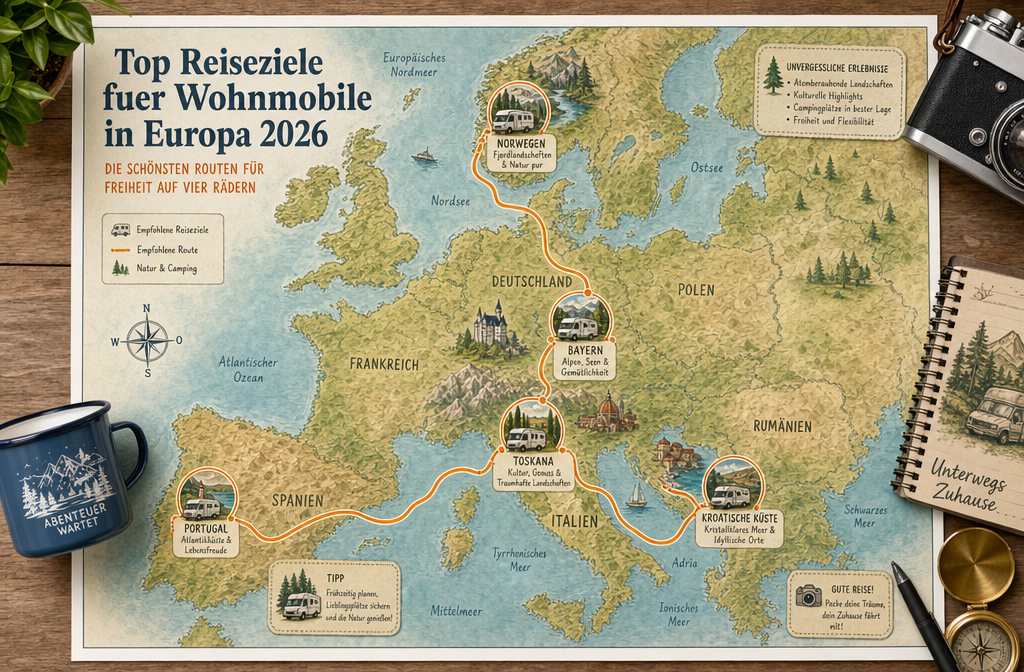
The most popular motorhome destinations in 2026 are Norway, Tuscany, the German Alps, Croatia and Portugal. These destinations offer a combination of well-developed infrastructure, breathtaking nature and a growing number of pitches. Those who want to travel flexibly and experience pure nature are spot on with these routes.
Auf einen Blick
- 🏕️ Norway, Croatia and Portugal are among the most visited motorhome destinations in Europe in 2026
- 💶 A road trip through the German Alps costs on average €80-130 per day (estimate including pitch, fuel, food)
- 👨👩👧 Family-friendly routes can be found particularly well in Bavaria, Tuscany and on the Croatian coast
- ❄️ In Norway, special rules apply to wild camping – the right to roam applies, but with restrictions
- 🚐 Partially integrated mid-range motorhomes are best suited for long distances
- ⚡ Electric motorhomes are not yet suitable for everyday use for tours over 400 km
- 💡 Renting is worthwhile up to approx. 30 days per year, after which it pays to buy
- 🌍 Countries such as Albania and North Macedonia are still difficult for motorhomes in terms of infrastructure
- 🔐 Solo travellers should rely on secure pitches, door locks and digital check-ins
- 📋 The most common mistake on the first motorhome trip: planning too many kilometres per day
What are the top 5 campsites in Europe for RVs?
The five best campsites for motorhomes in Europe in 2026 are in Norway, Tuscany, Croatia, Bavaria and Portugal. They score with good infrastructure, electricity and water connections and proximity to natural highlights.
| Platz | Land | Besonderheit | Ø Preis/Nacht |
|---|---|---|---|
| Camping Preikestolen | Norway | Fjord view, hiking trails directly from the site | 25–35 € |
| Camping Orbetello | Toskana, Italien | Beach, pine forests, peaceful atmosphere | 30–45 € |
| Camping Slatina | Croatia | Adriaküste, Schnorchelspot | 20–35 € |
| Camping Tegernsee | Bayern, Deutschland | Alps panorama, family-friendly | 28–40 € |
| Camping Sagres | Portugal | Atlantic coast, surfer vibe | 15–25 € |
Decision rule: If you're looking for nature and peace, choose Norway or Portugal. If you prioritise comfort and infrastructure, Bavaria or Tuscany are better choices.
How expensive is a road trip through the German Alpine regions in a campervan?
A one-week road trip through the German Alps realistically costs between €560 and €910 for two people. These are estimates based on typical pitch prices, diesel costs and moderate leisure expenses.
Cost items at a glance:
- Pitch: 20–40 € per night (depending on facilities and season)
- Fuel: Approx. 0.25–0.35 € per km with a consumption of 10–12 l/100 km (Diesel, as of 2026)
- Catering: 25–40 € per day for two people (self-catering)
- Leisure activities: 10–30 € per day (mountain railway, entrance fees, etc.)
Common mistake: Forgetting toll fees for Austria and Switzerland. A 10-day vignette for Austria costs around €9.90 (as of 2026, source: ASFINAG).
Which campervan routes are family-friendly?
Family-friendly campervan routes are characterised by short daily stages, safe campsites with playgrounds and sanitary facilities, and proximity to child-friendly attractions. The best options in Europe are:
- Bavarian Lake Loop (Germany): Chiemsee, Ammersee, Starnberger See – flat routes, many bathing opportunities
- Tuscany tour (Italy): Agriturismo pitches, vineyards, historic towns
- Istrian Coast (Croatia): Family-friendly camping resorts with water park offers
- Algarve Route (Portugal): Wide beaches, warm climate, cheap pitches
Tip for families: Plan a maximum of 150–200 km per day. Children need breaks, and spontaneous stops are the real joy of campervanning.
What do you need to consider when camping in Norway?
In Norway, the so-called Everyman's Right (Allemannsretten) applies, which basically allows wild camping on public land – but with clear rules. Campervans may stand in the same place for a maximum of two nights, must be at least 150 metres away from inhabited houses and must not leave any damage.
Important points for Norway travellers:
- Plan for ferries: Many fjord routes require ferry crossings (e.g. Sognefjord). Cost: 10–30 € per crossing
- Toll: Norway has an electronic toll system (AutoPASS). Foreign vehicles are automatically registered and billed by invoice
- Season: July and August are peak season. May/June and September offer less traffic and often cheaper prices
- Disposal: Greywater must not be disposed of in nature – use disposal stations
Differences between campervan trips in southern and northern Europe
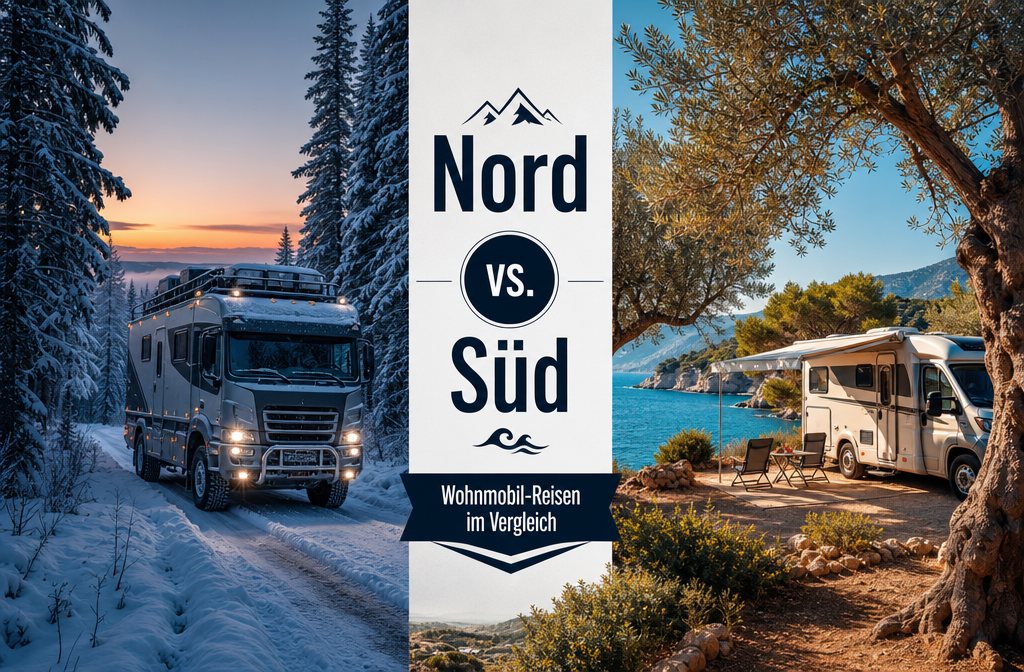
Northern Europe offers more wilderness and freedom when camping, while Southern Europe scores with warmth, culture and cheap prices. Both regions have clear strengths – the choice depends on the travel style.
| Criterion | Northern Europe (e.g. Norway, Sweden) | Southern Europe (e.g. Italy, Croatia) |
|---|---|---|
| Wild Camping | Largely allowed | Often restricted or prohibited |
| Pitch prices | 0–35 € | 15–50 € |
| Infrastructure | Good, but sparsely distributed | Dense, many camping resorts |
| Climate | Cool, unpredictable | Warm, dry (summer) |
| Road quality | Very good to moderate (gravel roads) | Variable (Portugal/Greece partly bad) |
| Best time to travel | June–September | April–June, September–October |
Decision rule: Those who want solitude and nature should travel north. Those who seek comfort, warmth and culture are better off in the south.
Which motorhome models are best suited for long distances?
For long distances, semi-integrated motorhomes in the 6–7 metre class are the best choice. They offer enough storage space, a comfortable bed and are still manoeuvrable enough for narrower campsites.
Top models 2026 (by driver type):
- Couples & Long-term travellers: Hymer B-Klasse, Dethleffs Globebus – good value for money, reliable technology
- Families: Knaus Sky Wave, Bürstner Lyseo – pull-down bed, large bathroom, plenty of storage space
- Overlander & Off-Road: Tischer Expedition, Unicat MD55 – for off paved roads
Important: Vehicles over 3.5 tonnes require a special driving licence (Class C1) in some countries. Check beforehand!
Most common mistakes on the first motorhome trip
The biggest mistake on the first motorhome trip is too much distance per day. Many first-timers plan as if they were in a car – and underestimate driving time, parking space search and familiarisation.
The five most common beginner mistakes:
- Too many kilometres per day: 200–250 km is the maximum for beginners
- Don't reserve a pitch: In high season (July/August), popular pitches are often booked weeks in advance
- Forget vehicle height: Many car parks, underpasses and barriers are closed to motorhomes
- Underestimate fresh water management: Tank often only lasts 2–3 days
- No offline maps: There is often no mobile network in Norway or Albania
Are electric motorhomes already practical for longer tours?
Electric motorhomes are not yet suitable for everyday use for tours over 300–400 km at a stretch in 2026. The charging infrastructure for heavy vehicles (over 3.5 t) is patchy in large parts of Europe, and the range is often not sufficient for typical motorhome stages.
What's currently available:
- Hymer Electric and Dethleffs e.home are the best-known concepts, but still available in limited numbers
- Range: approx. 200–300 km under real conditions (with air conditioning, luggage, headwind)
- Charging time: 1–3 hours at fast charging stations (CCS), but not all campsites offer sufficient charging power
Conclusion: Anyone travelling regionally and staying on a well-equipped campsite every evening can make good use of an e-motorhome. It is currently not a recommendable option for Scandinavia tours or wild camping.
Where can you rent motorhomes cheaply?
Cheap motorhome rentals are available on platforms such as CampcruisersPrices start from around €70 per day for basic models in the off-season.
Tips for saving money:
- Book in the off-season: April/May and September/October are 20–40% cheaper than July/August
- Peer-to-peer platforms: Yescapa or PaulCamper often offer private vehicles 30–50% cheaper than traditional rental companies
- Early bird discounts: Many providers offer 10–15% discount for bookings 3+ months in advance
- Check the mileage package: Unlimited mileage is worthwhile from around 1,500 km total distance
When is it worth buying vs. renting a motorhome?
For those planning more than 30–40 travel days per year, buying a motorhome pays off in the long run. Below that, renting is almost always cheaper – especially if you want to try out different vehicle types.
Quick calculation (estimates):
- Rent: €90 × 30 days = €2,700 per year
- Purchase (Used, €40,000): With 10 years of use, approx. €4,000 annual costs (incl. insurance, maintenance, depreciation)
Buying is worthwhile if: You travel regularly, also use the vehicle as accommodation (e.g. festivals, sporting events) and appreciate flexibility when setting off spontaneously.
Which countries are not suitable for motorhomes?
Some countries are less suitable for motorhome travel due to poor infrastructure, lack of parking spaces or restrictive laws. These currently include:
- Albania: Bad roads, hardly any official parking spaces, precarious supply situation
- North Macedonia: Similar problems, little camping infrastructure
- Turkey (certain regions): Legal uncertainties with wild camping, pay attention to the political situation
- Morocco: Basically possible, but requires a lot of preparation and experience
Don't get me wrong: These countries are not impossible – but definitely not recommended for beginners.
Costs for pitches and campsites in a country comparison
The pitch costs vary considerably in Europe. Portugal and Eastern Europe are the cheapest, Scandinavia and Switzerland are the most expensive.
| Land | Ø Pitch/Night | Wild camping allowed? |
|---|---|---|
| Portugal | 10–20 € | Restricted |
| Croatia | 18–35 € | No (officially) |
| Germany | 20–40 € | No |
| France | 15–35 € | Restricted |
| Norway | 0–35 € | Yes (Right to Roam) |
| Switzerland | 30–55 € | No |
| Sweden | 0–30 € | Yes (Allemansrätten) |
Safety tips for solo travellers with a motorhome
Solo travellers with a motorhome are statistically no more likely to be victims of theft than other tourists – but a few simple measures significantly increase the feeling of security.
Practical tips:
- Prefer official pitches: Especially in cities and Southern Europe
- Door security: Additional door bolts or a security bar for the driver's door
- Digital check-in: Apps such as Park4Night or Campercontact show reviews and safety information from other travellers
- Hide valuables: Leave nothing visible in the vehicle when you're out and about
- Store emergency contacts: Share your itinerary with a trusted person
Conclusion: How to plan your motorhome trip 2026
The most popular motorhome destinations in 2026 offer something for every travel style – whether it's a fjord adventure in Norway, a family holiday in Bavaria or a sunny road trip along the Algarve. The right preparation is crucial.
Actionable Next Steps:
- Determine destination and season – Northern Europe in summer, Southern Europe in spring/autumn
- Pre-book pitches – especially July/August in popular regions
- Choose or rent a vehicle – use peer-to-peer platforms for affordable entry-level options
- Download offline maps – Maps.me or OsmAnd for areas without network coverage
- Plan stages realistically – maximum 200 km/day as a rule of thumb for relaxed travel
If you keep these points in mind, you'll start the season in a relaxed mood – and are sure to get a taste for it.
FAQ
What is the most popular motorhome destination in Europe in 2026? Norway leads the list, followed by Croatia and Portugal. All three offer a combination of nature and good camping infrastructure.
Do I need a special driving licence for Norway? No, a normal car driving licence (Class B) is sufficient for vehicles up to 3.5 tonnes. Heavier vehicles require Class C1.
Can I travel through Albania in a motorhome? Basically yes, but it requires a lot of experience, a robust vehicle and good preparation. Not recommended for beginners.
How early should I book pitches in high season? At least 4–8 weeks in advance for popular pitches in July/August. Some campsites in Norway or Croatia are already fully booked in May.
Is it possible to travel by motorhome with a dog? Yes, many campsites are pet-friendly. For travel abroad, an EU pet passport with a current rabies vaccination is mandatory.
How much does motorhome insurance for foreign travel cost? Fully comprehensive insurance with foreign cover costs between €800 and €2,000 per year, depending on the value of the vehicle and the provider (estimated value).
Are there alternatives to expensive campsites? Yes: pitches on farms (e.g. via Landvergnügen), wineries in France/Italy or official wild camping zones in Scandinavia.
How long does it take to get used to a motorhome? Most drivers need 1–2 days to get used to the vehicle's width and height. Practice drives in an empty car park help.
Which app is best for motorhome travellers? Park4Night is the most used app for pitches in Europe. Campercontact offers more official campsites with detailed reviews.
Can you drive to Norway in an electric motorhome? Technically possible, but the charging infrastructure for heavy vehicles is still patchy. For 2026, only recommended with very careful route planning.
Quellen
- ADAC Camping Guide Europe 2024 – https://www.adac.de
- ASFINAG Vignette Austria – https://www.asfinag.at
- Norges Miljø- og Bioverk (The Right to Roam) – https://www.miljodirektoratet.no
- Park4Night Community Data 2024 – https://www.park4night.com
- Statista: Motorhome Travel in Germany 2023 – https://www.statista.com
Average pitch costs per night in a country comparison (2026)


 English
  German
  Spanish
  Italian
  Polish
  Dutch
Dutch  French
  Danish