
Quick Answer: With over a million registered motorhomes in Germany alone and a record 42.9 million camping overnight stays in 2024, the market for private pitches is more attractive than ever. Anyone who owns a free piece of land can rent it out as a motorhome pitch via Campcruisers and thus achieve a solid side income. From an empty field to a cash cow: Your own Campcruisers pitch in 5 simple steps shows how this works in concrete terms.
Key Takeaways
- Between 30 and 50 euros per night can be achieved per pitch, with an average of 100 to 120 occupied days per year
- Motorhome pitches are legally considered built structures and require a permit from around 4 pitches onwards
- Agricultural operations have simplified permit options for a few pitches in rural areas in many federal states
- The initial investment ranges from a few thousand to over 20,000 Euros depending on the equipment.
- Campcruisers charges a 12% commission on the brokered gross revenue, with no base fee for private pitches.
- Liability insurance and a written rental agreement are mandatory, not optional.
- Pitches in suburban and tourist regions achieve significantly higher occupancy rates.
- Year-round operation is possible, but a seasonal operation (April to October) is easier to manage for beginners.

What is Campcruisers and how does the platform work?
Campcruisers is a booking platform where private property owners, farmers, and campsite operators can rent out their pitches directly to campervan travelers. Providers list their pitch, set a price, and Campcruisers handles booking, payment, and customer communication.
For private pitches, the performance package applies: no base fee, but a 12% commission on the brokered gross revenue. Payment is processed via Stripe, and the provider receives their share in their account 7 days after booking. So, anyone listing their pitch on Campcruisers doesn't need their own booking system, website, or payment infrastructure.
The model is particularly attractive for beginners: you test the market without fixed costs and only scale when demand justifies it. More on the history and development of the platform can be found in the Campcruisers Start-up Report.
From an empty field to a cash cow: Your own Campcruisers pitch in 5 simple steps

Here is the concrete path that property owners must take to operate their first pitch legally, profitably, and stress-free.
Step 1: Check property and legal situation
Before even a single campervan rolls onto the property, the building law situation must be clarified. Campervan pitches are considered built structures and generally require a permit in Germany.
- Exterior area (§ 35 BauGB): In many federal states, agricultural businesses can have up to 3 pitches approved as "ancillary projects" without their own building permit if there is a spatial-functional connection to the business.
- Interior area (§ 34 BauGB): Here, local development plans apply; a preliminary building inquiry with the municipal administration is the first step.
- From 4 pitches: In almost all federal states, camping site regulations apply with detailed requirements for sanitary facilities, fire protection, and access roads.
First points of contact: Municipal administration, building supervisory authority, Chamber of Industry and Commerce (for commercial use), BVCD e.V. (Federal Association of the Camping Industry)
Step 2: Build infrastructure
The minimum equipment depends on the target group. A paved area is sufficient for transit travelers, but more is needed for overnight guests.
| Features | For transit travelers | For overnight guests |
|---|---|---|
| Paved pitch | Recommended | Duty |
| Power connection (CEE, 16A) | Optional | Duty |
| Water connection (3/4 inch) | Optional | Duty |
| Sanitary room | Optional | Highly recommended |
| WLAN | Optional | Recommended |
| Wastewater disposal | Duty | Duty |
Important dimensions: Pitches should be at least 5 x 10 meters. Access roads must be at least 5.50 meters wide and capable of supporting vehicles up to 3.5 tons. Motorhomes can be up to 12 meters long.
Step 3: Clarify legal matters and insurance
- Draw up a written rental agreement (regulates liability, notice periods, ancillary costs)
- Take out business liability insurance
- Register a business if the rental is operated commercially
- Check VAT liability (pitch rentals are generally exempt from VAT according to § 4 No. 12a UStG, but an option exists)
- Clarify tourist tax or local tax with the municipality
Step 4: List pitch on Campcruisers
Listing on Campcruisers is uncomplicated. Providers register, deposit a Stripe account for payout, upload photos and description, and set the price. Bookings can be set as instant booking or request.
Tip: Professional photos, an honest description of the amenities, and clear cancellation policies significantly increase the booking rate. Guests book trust, not just a spot.
Step 5: Optimize and scale operations
After the first bookings, it quickly becomes clear what guests really want. Reviews on Campcruisers are the most important marketing tool. Those who additionally sell farm products, offer a barbecue area, or enable breakfast noticeably increase revenue per guest.
What permits do I need for a motorhome pitch?
The permit requirement depends on location, number of pitches, and federal state. As a rule of thumb: from 4 pitches, the respective camping site ordinance of the federal state applies with specific requirements.
For agricultural businesses in rural areas, simplified permission for a few pitches is possible in some federal states, provided they are subordinate to the business. In Rhineland-Palatinate, for example, up to 3 pitches can be permitted as a complementary project of an agricultural business.
Permit Checklist:
- Submit building pre-inquiry to the municipal administration
- Read the camping site ordinance of your own federal state
- Check nature conservation requirements (especially in protected areas)
- For commercial use: Register business with Chamber of Industry and Commerce or municipality
- Implement fire safety regulations (fire extinguishers, fire water supply)
- Set up sanitary facilities according to the ordinance
- Clarify reporting obligations for accommodation statistics
How much does it cost to open a campsite?
Start-up costs vary greatly depending on the initial situation and level of equipment. Those who already own a suitable plot of land and plan only a few pitches will get off much cheaper than someone who builds from scratch.
Typical cost items:
- Installation of parking spaces: 800 to several thousand euros per space, depending on the ground
- Sanitary room (new construction): at least 20,000 euros, significantly less if existing buildings are used
- Electricity and water connections (service columns): 1,500 to 4,000 euros per unit
- Insurance: 500 to 1,500 euros annually
- Permit costs: 200 to 2,000 euros depending on the federal state and scope
- Marketing and Listing: no basic fee with Campcruisers, only commission
Overall framework for a small private parking space (3 to 5 spaces): Realistic start-up costs are between 5,000 and 30,000 euros, depending on how much infrastructure is already in place.
How much money do you earn with a campsite?
A private parking space generates between 30 and 50 euros per night. With an average occupancy of 100 to 120 occupied days per year and 5 parking spaces, this results in an annual revenue of 15,000 to 30,000 euros gross, before commission and costs.
Calculation example for 5 parking spaces:
- Price per night: 35 euros
- Occupied days per parking space: 110
- Gross revenue: 5 x 35 x 110 = 19,250 euros
- Campcruisers commission (12%): 2,310 euros
- Net revenue before operating costs: approx. 16,940 euros
Additional services such as farm products, breakfast service or experience offers can increase revenue per guest by 20 to 40%.
How long does it take for the campsite to become profitable?
With moderate start-up investments (under 15,000 euros) and good occupancy, the break-even point is often reached after 2 to 3 seasons. Those who invest more need correspondingly longer.
Factors that accelerate profitability:
- Location in a touristically attractive region
- Existing infrastructure (sanitary, electricity) from the agricultural operation
- Active advertising on Campcruisers with good photos and reviews
- Additional offers that increase the value of the stay
Factors that delay profitability:
- High new construction costs for sanitary facilities
- Poor accessibility or lack of tourist infrastructure in the surrounding area
- Seasonal restrictions due to location or weather conditions
How many pitches are needed to be profitable?
From 3 to 5 pitches, a private operation generally becomes economically interesting, provided that the infrastructure costs are not too high. With fewer than 3 pitches, the revenue barely covers the ongoing costs for insurance, maintenance, and administration.
Rule of thumb: Those who can manage without building new sanitary rooms (because existing buildings can be used) can achieve a positive contribution margin with just 3 pitches. Those who need to build new sanitary rooms need at least 6 to 8 pitches to recoup the investment in a reasonable time.
Infrastructure and equipment for a motorhome pitch
The basic equipment of a good pitch includes more than just a free space. Motorhome users have specific needs that differ from normal campers.
Mandatory equipment:
- Stable ground (at least 3.5 tons gross vehicle weight)
- Wastewater disposal (greywater and faeces from chemical toilets)
- Fresh water supply
- Waste disposal (separate from living areas)
- Sufficient lighting and signage
Recommended additional equipment:
- CEE sockets (16 Amperes) for power supply
- Service columns combine electricity and water in one unit
- WLAN (especially important for long-term guests)
- Privacy screens using hedges or trees for privacy
- Playground or barbecue area for families
For the disposal of wastewater, a discharge permit is required depending on the connection to the sewer system.
What insurances are necessary for a campsite?
At least two insurances are indispensable for every pitch operator: a business liability insurance and a property liability insurance.
Necessary insurances:
- Business liability: Covers damages incurred by guests on the premises
- Property liability: Protects in case of breach of duty of care for public safety (e.g., poor lighting, slippery paths)
- Building insurance: If sanitary facilities or other buildings are on the premises
Optional, but sensible:
- Business interruption insurance for longer operational interruptions
- Legal protection insurance for commercial landlords
Important: The duty of care for public safety lies with the landlord. Those who do not adequately illuminate paths or do not rectify defects are liable for resulting damages.
Operate campsite year-round or seasonally?
For beginners, seasonal operation (April to October) is significantly easier to manage. Demand is concentrated on these months anyway, and the effort for maintenance, cleaning, and guest support is manageable.
Year-round operation is worthwhile if:
- The location is in a region with winter tourism
- Pitches are well-insulated and can be heated
- Demand is secured by permanent campers or winter hikers
Seasonal operation is better if:
- Sanitary facilities are not frost-proof
- The operator wants to limit the effort
- The region mainly has summer tourism
Campsite near cities vs. rural areas
Pitches near cities (within 30 km of a major city) have structural advantages: higher occupancy due to transit and city tourists, longer season, and potentially higher prices.
Conversely, rural pitches in touristically attractive regions (coast, low mountain ranges, wine-growing regions) can achieve higher prices during peak season and benefit from travelers' longing for nature and peace. Those who position their farm as an experience destination have a clear advantage here over anonymous campsites.
Decision rule: Prefer a city-near location if occupancy is the main goal. Prefer a rural location if an experience concept (farm, viticulture, nature experience) justifies the price.
Common mistakes when setting up a campsite
Many beginners underestimate the bureaucratic effort and overestimate demand in the first year. These mistakes cost time and money.
The most common errors:
- Ignoring permits: Pitches operated without a building permit risk closure and fines
- Investing too much at once: Better to start small and expand after the first seasons
- Poor photos in the listing: On Campcruisers, pictures decide on the first booking
- No written rental agreements: Without a contract, there is no basis in case of damage or disputes
- Underestimating sanitary facilities: Campers who do not find proper wastewater disposal leave bad reviews
- Setting prices too low: Those who offer below market price signal poor quality and still have low margins
Campsite Business Plan: What needs to be included?
A solid business plan for a private pitch does not need to be 50 pages long. However, it needs the most important figures and assumptions.
Core elements of a pitch business plan:
- Location analysis (location, accessibility, competition)
- Target audience (transients, families, couples, long-term guests)
- Equipment planning and investment costs
- Pricing and occupancy assumptions
- Revenue forecast (scenarios: conservative, realistic, optimistic)
- Running costs (insurance, maintenance, commission, administration)
- Permit plan and timeframe
- Break-even analysis
The Bavarian State Institute for Agriculture provides a calculation aid as an Excel tool with which the most important key figures can be quickly calculated.
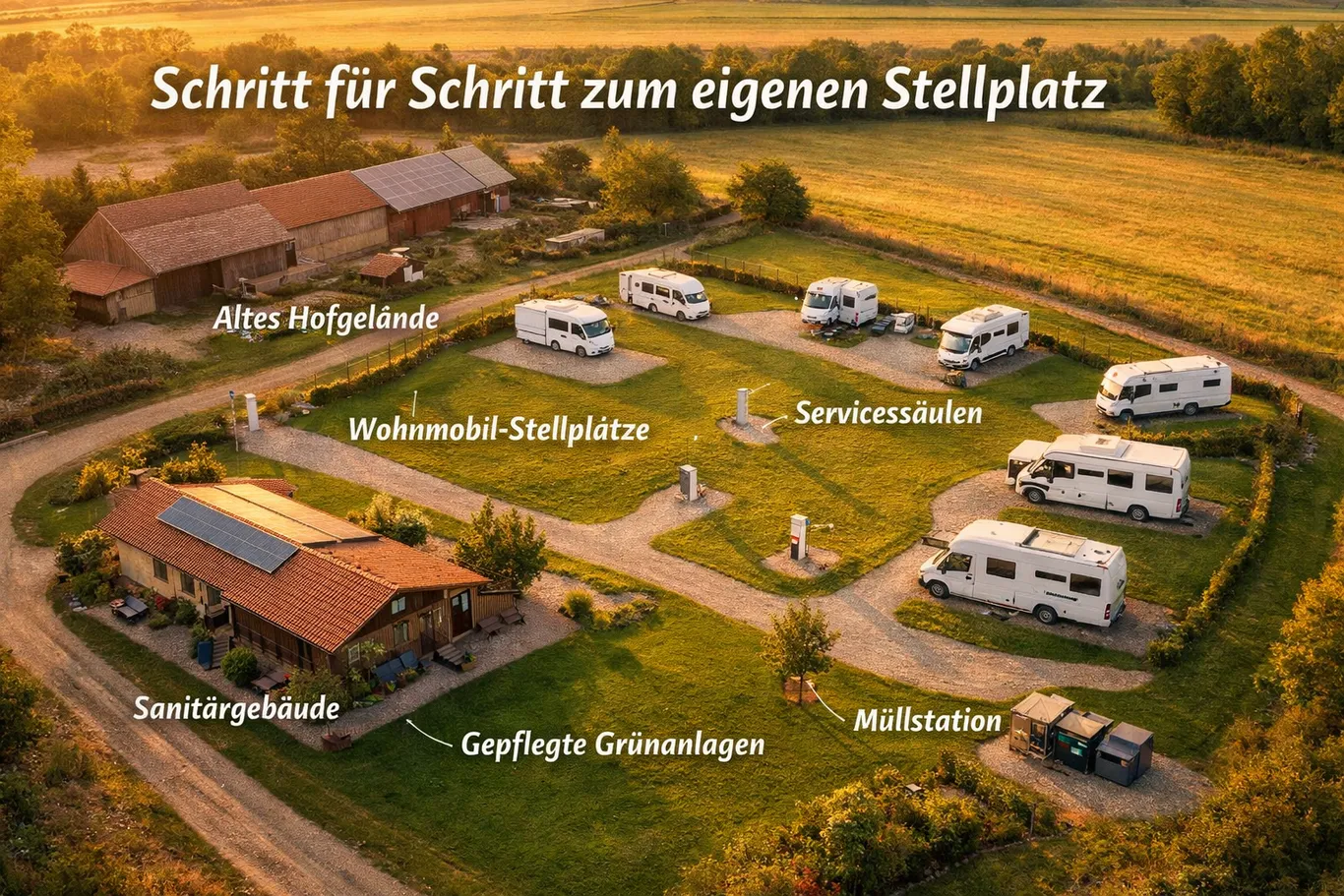
From an empty field to a cash cow: How to succeed with Campcruisers
The path from an unused plot of land to a functioning pitch is shorter than many think. Those who clarify permits early, build infrastructure step-by-step, and list their pitch professionally on Campcruisers can already generate revenue in the first season.
Campcruisers is the easiest way to gain visibility with motorhome travelers without incurring your own marketing costs. The platform handles booking, payment, and customer communication; the provider focuses on the essentials: offering a good pitch.
Those who want to understand more about traveling with motorhomes, which drives their future guests, will find in the Campcruisers blog about adventures in Tuscany and the Motorhome Guide for South Holland a good insight into the travelers' perspective. The Houseboat Guide for Beginners also shows how broadly Campcruisers is positioned.
Interactive Profitability Calculator
Pitch Profitability Calculator
FAQ
Do I need to register a business to rent out pitches? If renting is regular and profit-oriented, it is considered a commercial activity and must be registered with the responsible trade office or the Chamber of Industry and Commerce (IHK). Farmers who operate a few pitches as a side business may be exempt from business registration under certain conditions. When in doubt, always ask the municipality or a tax advisor.
How many pitches can I operate without a building permit? This depends on the federal state and the location of the property. In some federal states, up to 3 parking spaces on agricultural holdings in rural areas are possible without a separate building permit if they are subordinate to the operation. From 4 spaces, the campsite regulation usually applies.
What does the listing on Campcruisers cost for private parking spaces? Private parking spaces (e.g., on farms or private properties) do not pay a basic fee. Campcruisers charges a 12% commission on the successfully brokered gross revenue, plus VAT.
How quickly do I get my money after a booking? In the standard model, the provider receives the booking amount minus the Campcruisers commission 7 days after the booking to their linked Stripe account.
Do I have to collect tourist tax? This depends on the municipality. Many tourist municipalities charge a tourist tax or bed tax, which the provider collects from their guests and pays to the municipality. The municipality will inform you about this when you register the business.
Is parking space rental subject to VAT? In principle, the rental of parking spaces is VAT-exempt according to § 4 No. 12a UStG. However, providers can waive the exemption and opt for VAT liability, which can bring tax advantages in the case of high investments. Consult a tax advisor.
What is the minimum size a parking space should have? According to the DTV planning guide, parking areas should be at least 5 x 10 meters in size to comfortably accommodate even longer motorhomes (up to 12 meters). Driveways must be at least 5.50 meters wide.
Can I offer my parking space without sanitary facilities? Yes, this is possible, especially for travelers and self-sufficient people with fully equipped motorhomes. However, a lack of sanitary infrastructure limits the target group and reduces the achievable nightly rate. An wastewater disposal station (cassette toilet emptying) is also useful without a complete sanitary building.
How do I find the right price for my parking space? Research comparable offers in your region on Campcruisers. Factors such as location, amenities, and season influence the price. Transit spots without infrastructure tend to be around 20 to 30 euros, well-equipped spots in tourist locations around 40 to 60 euros per night.
What happens if a guest causes damage to my property? This requires a written rental agreement with an liability clause and operating liability insurance. Without both, the provider is poorly protected in the event of damage. Campcruisers stipulates in its terms of use that providers are responsible for the legally compliant design of their offerings themselves.
Is it worthwhile to get started even without an agricultural business? Yes. Private individuals with suitable property can also rent out parking spaces, but they must meet the building law requirements. Without agricultural privileges, obtaining permission in rural areas is more difficult, but often possible in urban areas.
Conclusion: Get started now, don't wait
The market for private motorhome pitches continues to grow, and demand significantly exceeds supply in many regions. Anyone who owns a suitable plot of land has a real opportunity in 2026 to turn it into a reliable source of income.
The most important next steps:
- Clarify building law situation: Contact municipal administration and submit a preliminary building application
- Plan infrastructure realistically: Start with the existing budget, not the wish scenario
- Draw up insurance and rental agreement before the first guest arrives
- List pitch on Campcruisers with professional photos and honest description
- Evaluate after the first season: What do guests really want? Then scale
Anyone curious about how motorhome travelers think and what they expect from a pitch will find in the Campcruisers blog about motorhomes up to 3.5 tons and the Campcruisers PitchingDay report valuable insights into the platform and its community.
Quellen
- Campcruisers Blog: Renting out a motorhome pitch and benefiting from others' wanderlust (2025), blog.campcruisers.com
- Bavarian State Institute for Agriculture (LfL): Motorhome pitches on the farm (2025), lfl.bayern.de
- Chamber of Agriculture Rhineland-Palatinate: Motorhome pitches on agricultural and viticultural farms (2022), lwk-rlp.de
- Law firm Herfurtner: Renting out a pitch, Legal notes and tips, kanzlei-herfurtner.de
- Campcruisers GmbH: Special terms of use for providers (as of April 2026), campcruisers.com
Tags: Renting out a motorhome pitch, opening a campsite, Campcruisers provider, pitch permit, camping side income, farm pitch, private campsite, campsite costs, motorhome pitch earnings, campsite business plan, pitch infrastructure, Campcruisers platform

 English
  German
  Spanish
  Italian
  Polish
  Dutch
Dutch  French
  Danish