
Only around 1.5 million foreign tourists visit Kyrgyzstan each year — a country that is larger in area than Austria and Switzerland combined and 90 percent mountainous. Anyone wanting to discover Kyrgyzstan on their own will find one of the last true adventure travel destinations in Central Asia: barely crowded trekking routes, nomadic hospitality and landscapes that cannot be compared to any other country in the world.
The most important things at a glance:
- Kyrgyzstan is visa-free for citizens of the EU, Switzerland and Austria for up to 60 days.
- The best time to travel for trekking and camping is June to September.
- A daily budget of €25–40 is realistic for backpackers.
- Russian and Kyrgyz are the main languages; English is rarely spoken.
- Public Marshrutkas (minivans) are the cheapest and most commonly used means of transport.
- Camping is allowed and culturally accepted almost everywhere.
- Bishkek is the logical base for entry and further planning.
- Cash in Som (KGS) is essential — card payment is the exception.
- Cultural sensitivity towards nomadic traditions is not a nice-to-have, but a must.
- Typical mistakes: not planning enough time, not having cash, underestimating altitude sickness.
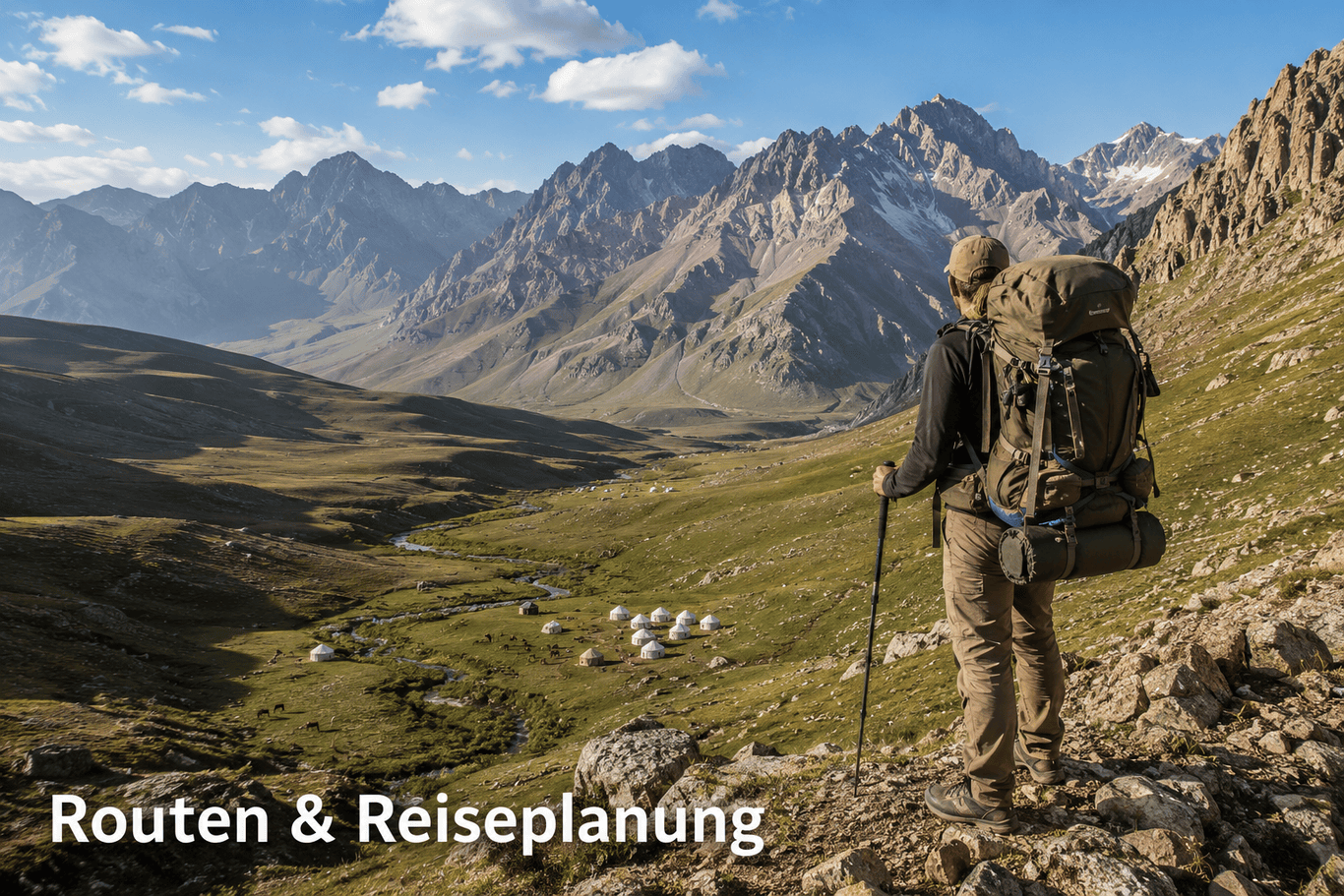
What are the entry and visa requirements for Kyrgyzstan?
Entry to Kyrgyzstan is straightforward for German, Austrian and Swiss citizens: visa-free travel for up to 60 days has been in place since 2012 and has been confirmed several times since then. Registration with the State Registration Service (GRS) is required if you stay in the country for longer than five days — hotels do this automatically, you have to take action yourself for private accommodation or yurt camps.
Entry checklist:
- Passport valid for at least 6 months
- Return ticket or proof of onward travel recommended
- Registration after arrival (for stays longer than 5 days)
- Travel insurance with mountain rescue cover — absolutely necessary
Important: The registration requirement is sometimes checked at border crossings when leaving the country. Ignoring it risks fines.
What is the best time to travel for a tour?
The best time to travel for a self-planned tour through Kyrgyzstan is June to September. During this period, the high mountain passes are open, the yurt camps are in operation and the weather is stable enough for multi-day trekking tours.
| Month | Conditions | Recommendation |
|---|---|---|
| April–May | Passes partly still closed, spring storms | Only Bishkek & valleys |
| June–August | Ideal: warm, dry, all routes open | ✅ Best time |
| September | Autumn colours, fewer tourists, cooler | ✅ Very good |
| October–March | Many passes closed, snow in high altitudes | For experienced users only. |
For those who want to travel specifically for the Nomad Festival (World Nomad Games): The event usually takes place in September and attracts visitors from all over the world.
What are the best routes for a customized trip through Kyrgyzstan?
The classic backpacker route leads from Bishkek via Lake Issyk-Kul to Karakol, then through the interior of the country to Lake Son-Kul and back via Kochkor. This circular route can be easily completed in 2–3 weeks and covers the most important types of landscape.
The most popular routes at a glance:
- Bishkek → Issyk-Kul → Karakol: Entry route, well developed, lots of accommodation
- Karakol → Altyn Arashan: 3-day trek to hot springs, also suitable for beginners
- Son-Kul-See: High plateau at 3,016 m, yurt camps, authentic nomadic life
- Osh → Sary-Chelek: Southern route through the Fergana Valley, less touristy
- Bishkek → Suusamyr Valley → Toktogul Reservoir: Off the beaten track, spectacular gorges
Anyone wanting to discover Kyrgyzstan on their own should plan at least one night at Lake Son-Kul — the experience of waking up in a yurt camp at 3,000 metres in the morning is irreplaceable.
How safe is it to travel alone through Kyrgyzstan?
Kyrgyzstan is considered one of the safest countries in Central Asia for independent travellers. Petty crime in Bishkek (pickpocketing in markets) is the most common problem — serious violent crime against tourists is rare. The greatest risks are natural: altitude sickness, sudden changes in weather and poor mountain trails.
Safety tips for solo travellers:
- Take altitude acclimatisation seriously (at least 1–2 days in Bishkek before climbing)
- Never start trekking routes without a map or GPS device
- Book local guides for difficult high mountain tours
- Travel registration with the Foreign Office before departure
- Divide cash and keep it in several places
For women travelling alone: Harassment is rare, but traditional values in rural areas mean that more conservative clothing (covered shoulders and knees) is respected and makes the trip more pleasant.
What does a self-planned trip through Kyrgyzstan cost?
Kyrgyzstan is one of the cheapest travel destinations worldwide. A realistic daily budget for backpackers is 25–40 Euroif you rely on yurt camps, guesthouses and local cuisine.
Typical costs (estimated values, 2026):
| Category | Price per day/unit |
|---|---|
| Guesthouse / Jurtencamp | 8–20 € |
| Lokales Essen (Lagman, Manti) | 2–5 € per meal |
| Marshrutka (Überlandstrecke) | 3–8 € |
| Geführter Tagesausflug | 20–40 € |
| SIM-Karte mit Daten (30 Tage) | ca. 5–8 € |
Anyone wanting to travel with a campervan or rental vehicle can book off-road campers from Campcruisers Book off-road campers.
Which means of transport are best for backpackers in Kyrgyzstan?
Marshrutkas (minivans) are the backbone of public transport and the cheapest option for backpackers. They connect all major cities and many villages, but operate on the principle of „when full, then go“ — plan for waiting times.
Transport options in comparison:
- Marshrutka: Cheap, authentic, slow — ideal for short to medium distances
- Shared taxi: Faster than a Marshrutka, a bit more expensive, good for routes like Bishkek–Karakol
- Private taxi: Expensive, but flexible for day trips or remote destinations
- Bicycle: For adventurers on well-maintained routes (e.g. Issyk-Kul loop)
- Rental car/Campervan: Maximum freedom, but bad roads require four-wheel drive
Tip: The app Yandex Go works reliably in Bishkek for taxis within the city.
Where should you definitely travel to in Kyrgyzstan?
Five places that should not be missing on any Kyrgyzstan trip:
- Issyk-Kul Lake — One of the largest mountain lakes in the world, mild climate, beaches and trekking
- Karakol — Starting point for trekking tours into the Tian Shan Mountains, lively animal market on Sundays
- Son-Kul Lake — High plateau with real nomadic life, unforgettable yurt nights
- Ala-Archa National Park — Only 40 km from Bishkek, perfect for a day trip or short trek
- Osh — Second largest city, historical Silk Road bazaar, gateway to the south
What languages do I need for a trip through Kyrgyzstan?
Russian is the most important language of communication and is understood by most adults in cities and villages. Kyrgyz is the mother tongue of the majority, but Russian is sufficient for most everyday situations. English is hardly spoken outside of tourist centres.
Practical language preparation:
- Learning basic Russian phrases (numbers, directions, orders) — is hugely worthwhile
- Download Google Translate with offline package for Russian and Kyrgyz
- Kyrgyz greetings („Salamatsyzby“) are always received with pleasure
- In guest houses and tourist centres, there are often English speaking staff
What should you consider when camping and tenting in Kyrgyzstan?
If you want to discover Kyrgyzstan on your own, you can hardly avoid camping — and that's good news. Wild camping is largely permitted and culturally accepted in Kyrgyzstan, as long as you are respectful of nature and the property of the nomads.
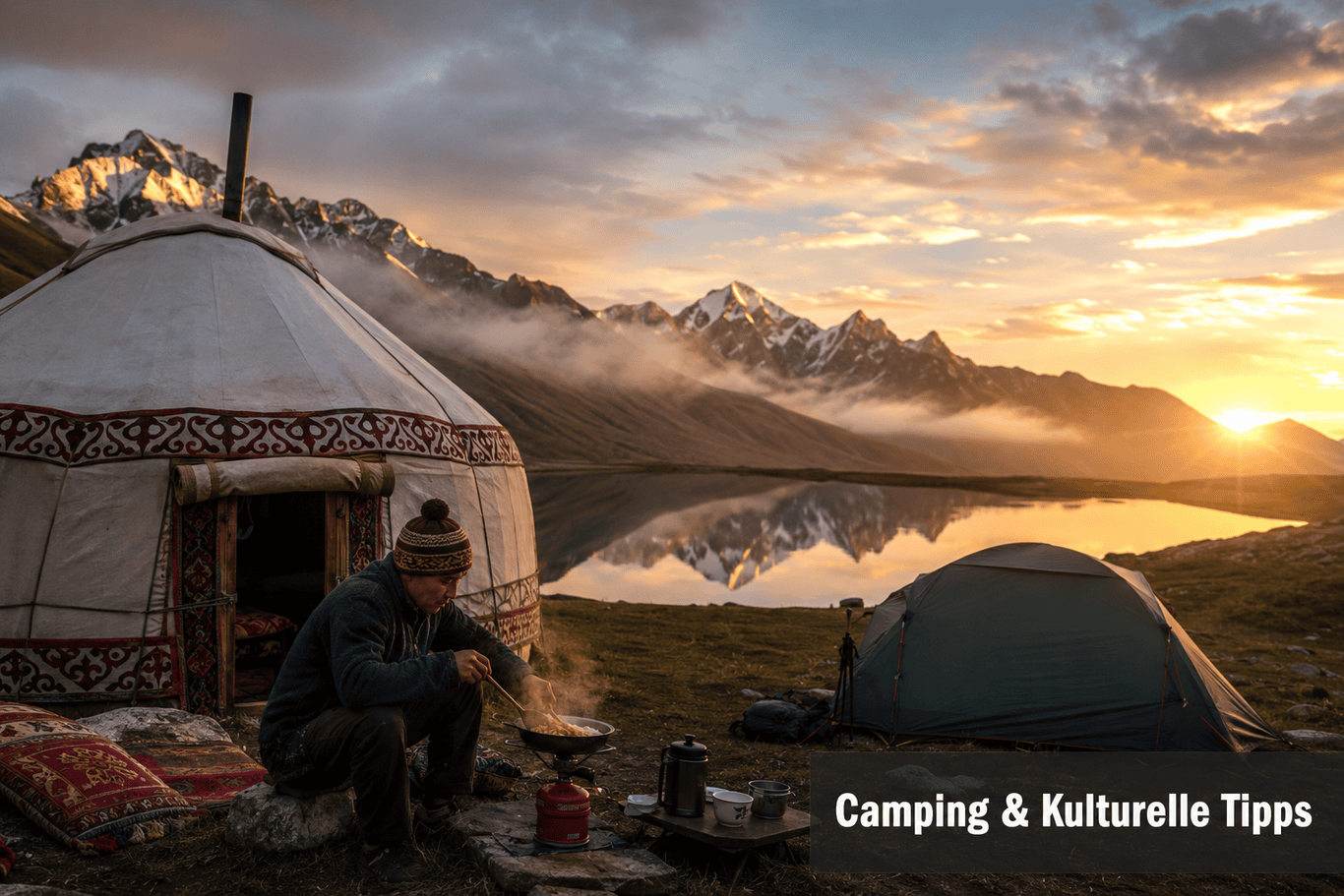
Important camping rules:
- Never camp on private pastureland without asking (nomads are often happy to have guests)
- Campfires only where permitted — observe the risk of fire during dry periods
- Consistently take rubbish with you — Kyrgyzstan has hardly any disposal infrastructure
- Always filter or boil water from mountain springs
- At 3,000 m+ altitude, night temperatures can drop to -5°C even in summer — choose sleeping bag accordingly
- Bear encounters are rare, but storing food safely is still advisable
Yurt camps are a cheap alternative to your own tent: For 10–20 euros per night, there is often dinner included and an introduction to nomadic life.
What cultural peculiarities should you know?
Kyrgyz hospitality is legendary — and it comes with expectations. Anyone who is invited into a house or yurt should take the invitation seriously and not decline.
Cultural ground rules:
- Take off your shoes before entering a yurt or house
- Tea (Kymyz or green tea) is always offered — refusing is considered impolite
- Older people are greeted first
- Always ask before taking photos of people
- Observe Ramadan times: In rural areas, consideration for fasting locals is appropriate
- Clothing: Cover shoulders and knees in mosques and religious sites
What are typical mistakes made by travellers in Kyrgyzstan?
The most common mistakes cost time, money or nerves — sometimes all three at the same time.
- Allowing too little time: Kyrgyzstan is large, and the roads are slow. Travel between two places that look close on the map can take 5–8 hours.
- No cash on you: ATMs often don't exist in small towns. Always take enough Som in cash with you.
- Ignoring altitude sickness: Many travellers drive straight from the airport to 3,000 m — that ends badly. Plan at least one night in Bishkek (760 m).
- Bad shoes: Even 'easy' trekking tours in Kyrgyzstan require sturdy footwear.
- No offline maps: Mobile reception in the mountains is unreliable. Download Maps.me or OsmAnd with the Kyrgyzstan map offline.
- Forgetting registration requirements: Can lead to problems when leaving the country.
FAQ: Discover Kyrgyzstan on your own
Do I need a visa for Kyrgyzstan as a German citizen?
No. Germans, Austrians and Swiss citizens can enter visa-free for up to 60 days. However, registration after 5 days is mandatory.
How much cash should I take with me?
For 2–3 weeks, approx. 400–600 euros in Som is sufficient (exchange at the airport or in Bishkek). Cards are hardly accepted outside the capital.
Is Kyrgyzstan suitable for solo travellers?
Yes, especially for experienced backpackers. The biggest risks are natural, not social. A local guide is recommended for difficult trekking routes.
Is it possible to camp in Kyrgyzstan?
Wild camping is largely permitted and common. Respectful treatment of nature and nomadic property is a prerequisite.
Which vaccinations are recommended?
Hepatitis A and B, typhoid and up-to-date tetanus protection are recommended. Rabies vaccination is recommended for trekkers in remote areas.
Is there internet and SIM cards?
Yes. SIM cards from Beeline or O! are inexpensive (approx. €5–8) and available at the airport. There is good 4G in cities, but hardly any signal in the mountains.
What is the currency and where is the best place to exchange money?
Kyrgyzstani Som (KGS). The best rates are available in Bishkek at licensed exchange offices — not at the airport.
How long should a trip to Kyrgyzstan last at least?
At least 2 weeks, better 3–4 weeks, to see more than just the standard route.
Is Kyrgyzstan also suitable for families with children?
Yes, for older children from about 10 years who are keen on hiking. The infrastructure (bad roads, altitude, little medical care) is challenging for small children.
Which app is essential for the trip?
Maps.me with offline map of Kyrgyzstan, Google Translate (offline package Russian), Yandex Go for taxis in Bishkek.
Is it possible to travel to Kyrgyzstan in autumn?
September is still excellent. It gets cooler in October and many passes close — only recommended for well-equipped experienced travellers.
Is there medical care in remote areas?
Hardly any. There is basic care in small villages, but helicopter evacuation is necessary for serious injuries or altitude sickness — therefore mountain rescue insurance is mandatory.
Conclusion: How to make your solo trip a success
Discovering Kyrgyzstan on your own means embracing a country that has not yet been optimised for mass tourism — and that is precisely its greatest appeal. The combination of spectacular mountain scenery, nomadic culture and low travel costs makes it one of the most attractive destinations for backpackers and outdoor enthusiasts worldwide.
Concrete next steps:
- Check passport validity (at least 6 months beyond the end of the trip)
- Take out travel insurance with mountain rescue cover
- Learn basic Russian phrases (2–3 weeks are enough for the basics)
- Download Maps.me and OsmAnd with offline map of Kyrgyzstan
- Book Bishkek as a starting point and plan at least 1–2 acclimatisation days
- Exchange cash into Som only in Bishkek (better rates than at the airport)
- Register your trip with the Foreign Office before departure
Those who prepare well, remain flexible and travel with a genuine interest in Kyrgyz culture will discover a country that deeply impresses most travellers — and that they will not soon forget.


 English
  German
  Spanish
  Italian
  Polish
  Dutch
Dutch  French
  Danish