
Last updated: May 24, 2026
Quick Answer: Not every motorhome has Isofix mountings — this depends on the year of manufacture, manufacturer and model. The easiest way to find out if your vehicle has Isofix is to feel between the back and seat of the front passenger or rear seat for the metal bracket mountings. If these are missing, you can often have Isofix retrofitted or switch to approved belt seats.
Key Takeaways
- 🔍 You can recognize Isofix mounts by two metal brackets between the seat and backrest—often marked with a small Isofix symbol.
- 🚐 Many newer motorhomes (from around 2004) have Isofix as standard, older models often do not.
- 🔧 Retrofitting is possible, but only by certified specialists — costs are usually between 150 and 400 euros per seat.
- ✅ Isofix is considered safer than securing with a seatbelt alone because the seat is rigidly connected to the vehicle structure.
- 👶 Isofix is not only suitable for babies — there are compatible systems up to Group 3 (approx. 36 kg).
- ⚖️ In Germany, the StVO (Road Traffic Regulations) applies: Children under 12 years of age or under 150 cm in height must be secured in a suitable child seat.
- 🏕️ When renting a campervan, it's worth specifically asking about Isofix fittings — not all rental vehicles have them.
- 🚫 Most common mistake: Installing an Isofix seat without checking if the vehicle is approved for that specific seat.
What exactly is Isofix and how does it work in child seats?
Isofix is an internationally standardized system for rigidly attaching child seats directly to the vehicle structure — independently of the seat belt. The child seat is engaged via two metal bars (the so-called Isofix anchors) into the vehicle-side brackets, resulting in a form-fitting, wobble-free connection.
The decisive advantage over pure belt fastening: In the event of an impact, the force is transferred directly to the body, not to the seatbelt. This significantly reduces the risk of incorrect installation because the seat can only click into place in a single correct position.
How the system works technically:
- The vehicle has two reinforced metal brackets (ISO/IEC 13216) installed between the seat and backrest.
- The child seat has matching metal connectors that click into these bars.
- Many systems also have a Top-Tether (upper tether) or a Support leg, which pushes forward onto the vehicle floor — both further increase stability.
- The Isofix symbol (stylized child in a seat) is often printed on the seat or on the vehicle mount.
Important: Isofix is not a free pass. The chosen child seat must be approved for the specific vehicle model – this is stated in the vehicle list of the seat manufacturer.
Do all RVs have Isofix or only certain models?
No, not all motorhomes have Isofix. The equipment depends heavily on the year of manufacture, manufacturer, and base vehicle.
Camper vans based on modern transporters (e.g. Fiat Ducato, Mercedes Sprinter, Volkswagen Crafter) have often had Isofix points on the front seats since the mid-2000s. Whether the rear seats in the living area are also equipped with them varies greatly – many manufacturers install their own seating there that does not have Isofix mountings.
Rule of thumb by year of construction:
| Year of manufacture | Isofix probability |
|---|---|
| Before 2000 | Very rare |
| 2000–2006 | Rare to occasional |
| 2007–2014 | Frequently found on front seats |
| From 2015 | Standard on front seats, rear seats vary |
Brands with known good Isofix equipment (front seats):
- Hymer, Dethleffs, Knaus on Fiat Ducato base: Isofix on the passenger seat often standard from approx. 2008
- Carthago, Bürstner: similar equipment
- Older vehicles based on the Ford Transit: rarer
At the Rent a campervan Is it worth explicitly asking the landlord about Isofix fittings – the information is often missing from standard vehicle descriptions.
How do I know if my campervan has Isofix mountings without reading the owner's manual?
You can quickly identify Isofix in a motorhome by a simple visual inspection and touch test—the instruction manual is not even necessary.
Here's how it works step by step:
- Move seat forward (with adjustable seats) or slightly raise the seat surface.
- Feel between the seat and backrest. — Isofix brackets are located there as two metal U-shaped hooks, usually 27–28 cm apart.
- Look for the Isofix symbol — a small pictogram (stylized child) is often embossed into the seat surface or backrest or attached as a sticker.
- Check vehicle documents: Isofix may be noted in the vehicle registration document (field “Special equipment” or supplementary sheet).
- VIN inquiry with the manufacturer: The vehicle identification number allows the base vehicle manufacturer (e.g. Fiat) to confirm whether the base vehicle had Isofix.
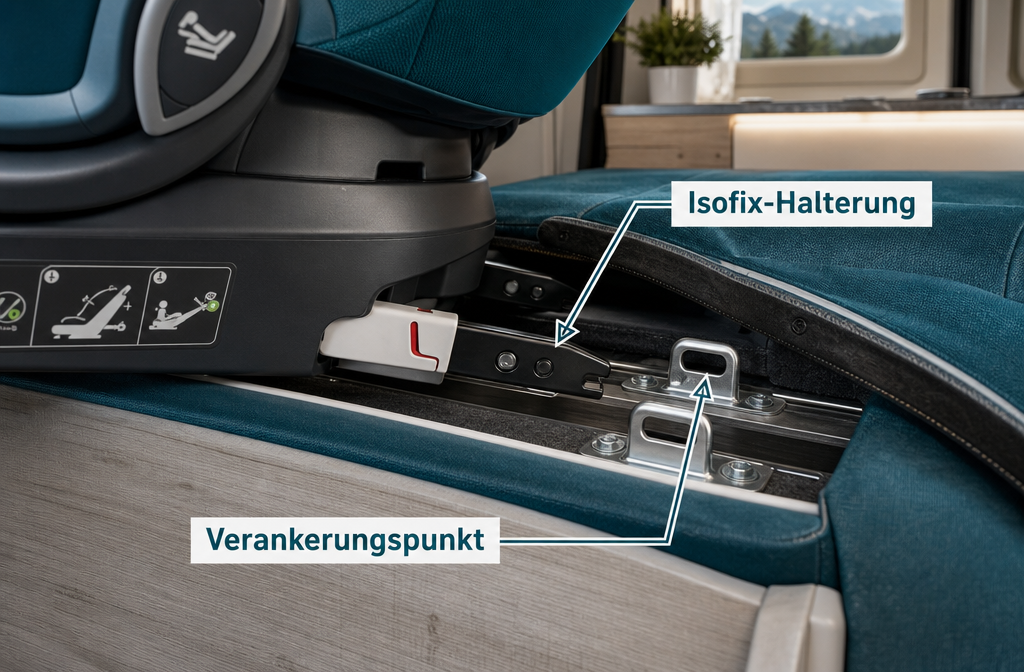
Common misconception: Many motorhomes only have Isofix on the passenger seat, but not on the seats in the living area. If you want to secure children on the back seat, you have to check there separately.
Isofix in Motorhomes: How to Identify Vehicles Suitable for Child Seats — Differences Between Various Brands
Isofix equipment varies not only depending on the year of manufacture, but also on the base vehicle on which the motorhome is built. This is the crucial factor that many travelers overlook.
Base Vehicles in Comparison:
- Fiat Ducato (most common base): From model year 2006 onwards, Isofix on the front passenger seat as standard or as an option. Standard in many trim levels from 2014.
- Mercedes Sprinter: Isofix on front seats available from approx. 2006, depending on the equipment variant.
- VW Crafter/MAN TGE: Isofix on driver and front passenger seat standard from model year 2017 (new generation).
- Ford Transit: Isofix on front seats from approx. 2014 (from the current generation).
What this means for RV buyers: The body manufacturer (Hymer, Knaus, Dethleffs etc.) builds upon this base vehicle. Isofix points in the driver's cabin are usually retained. However, in the living area, they are often replaced by new seating furniture that does not have Isofix anchorage.
Can I have Isofix retrofitted in my older campervan?
Yes, retrofitting is generally possible—but only under certain conditions and by a specialist company with the appropriate certification.
What to consider when retrofitting:
- Retrofitting must be in the load-bearing vehicle structure integrated because Isofix mounts have to absorb high forces in the event of a crash.
- There is/are Retrofit kits from specialized providers (e.g. for certain Fiat Ducato variants) that allow for TÜV approval.
- Without official approval and registration in the vehicle documents, the retrofitting is not approved for road use — the child seat would then not be properly secured in accordance with the law.
- Retrofitting Isofix in motorhomes with seats in the living area is more complex because the seat structure is often not designed for Isofix forces.
Recommendation: First, inquire with the vehicle manufacturer or a specialized RV dealer to see if an approved retrofit solution exists for the specific model.
How much does it cost to retrofit Isofix in a motorhome?
The costs for retrofitting Isofix depend on the vehicle and effort involved and range between 150 and 400 euros per seat — Material costs and installation included. Additional costs may apply for the TÜV (Technical Inspection Association) approval and entry in the vehicle documents (approx. 50–100 euros).
Cost factors at a glance:
- Retrofit Kit: 80–200 Euro (depending on vehicle model and provider)
- Installation by a qualified technician: 60–150 Euro Labor cost
- TÜV approval and registration: 50–100 Euro
- Total costs: Approximately 190–450 Euro per seat
Note: These figures are estimates based on standard market prices in Germany (2026). Specific offers may vary depending on the region and company.
Which child seats are compatible with Isofix and what should I look out for when buying one?
Not every Isofix child seat fits in every vehicle — compatibility must always be checked for the specific vehicle. The seat must be approved in the manufacturer's official vehicle list for the specific motorhome base vehicle.
Isofix child seats by age group:
| Group | Weight | Typical use |
|---|---|---|
| 0+ | up to 13 kg | Infant car seat, rear-facing |
| 1 | 9-18 kg | Toddler, forward or backward |
| 2/3 | 15–36 kg | Older children, forward facing |
What to consider when buying:
- ECE R44 or R129 (i-Size): Only seats with one of these approvals are legal in the EU. R129 (i-Size) is the newer standard and offers better side impact protection.
- Check vehicle list: Each seat manufacturer publishes a list of compatible vehicles—always enter the base vehicle of the motorhome.
- Top tether or support leg: Check if the vehicle has the appropriate anchor point.
- Weight Class: Don't switch to the next car seat group too early.
Is Isofix safer than securing with the vehicle seatbelt?
Yes, Isofix is generally considered safer than securing with a seatbelt alone — and for a specific reason: Incorrect installation is more common with seatbelt-secured seats and has more serious consequences.
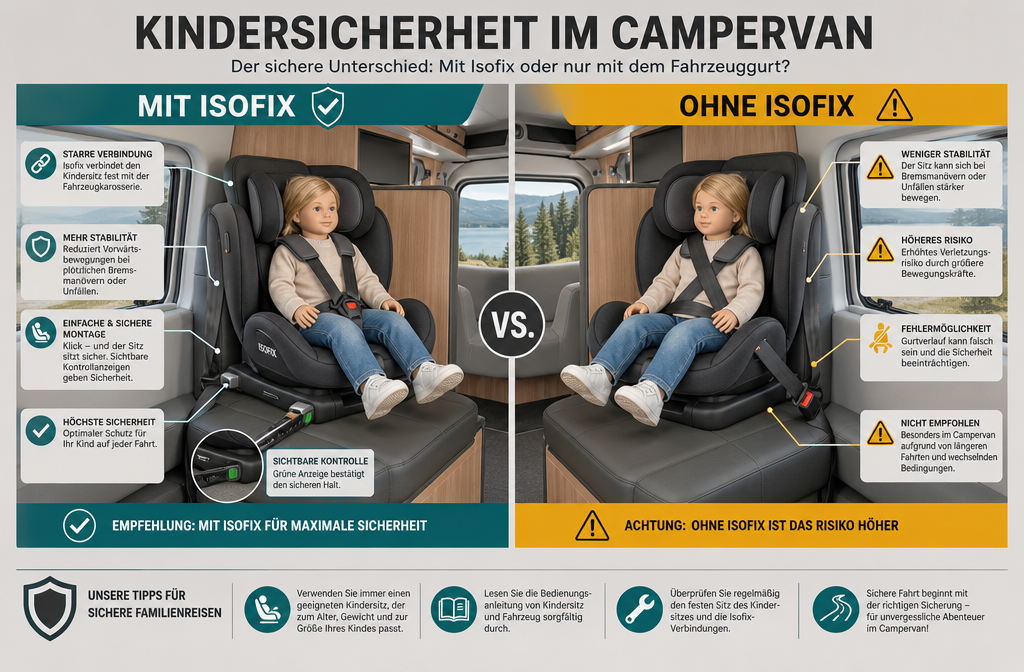
Studies by ADAC and Euro NCAP consistently show that Isofix seats perform better in crash tests because the rigid connection to the vehicle structure enables a defined transfer of force. Belted seats can show significantly more movement in the event of a crash if they are incorrectly installed (belt too loose, incorrect belt path).
Advantages of Isofix compared to seat belt installation:
- Positive locking connection – no room for installation errors
- Faster installation and removal (relevant for families with multiple vehicles)
- Reduced forward displacement of the seat in a frontal impact
Disadvantages / Limitations:
- Only usable on seats with Isofix points.
- Not every Isofix seat fits in every vehicle.
- Some RV rear seats are missing the mounts completely.
What alternatives are there if my RV does not have Isofix?
If Isofix is missing in the camper van, there's no need to panic - there are safe, approved alternatives.
Option 1: Belt seat with ECE approval
Group 1-3 child seats can be secured with the vehicle's seat belt, provided they have valid ECE-R44 or R129 approval. Important: Follow the belt routing exactly according to the instructions.
Option 2: Belted-Base Systems
Some manufacturers offer infant car seats with a base that is secured with a seatbelt and still provides a very stable connection (e.g., Maxi-Cosi Pebble with FamilyFix-Base without Isofix).
Option 3: Rent a vehicle with Isofix
Those who are flexible can when Camper mieten specifically filter for vehicles with Isofix equipment. This is often the most straightforward solution for family trips.
Option 4: Retrofitting (see above)
Decision rule: Choose a seat belt-secured seat if the vehicle does not have Isofix and retrofitting is not possible—but invest in a high-quality seat with current R129 approval and have the installation checked once by a professional.
Are there legal regulations or recommendations for child seats in motorhomes?
Yes, and they apply just as they do in passenger cars. In Germany, §21 of the StVO (Road Traffic Act) stipulates that children under 12 years of age or under 150 cm in height must be secured in a suitable child seat — regardless of whether the vehicle is a passenger car or a motorhome.
What that means in concrete terms:
- The child seat must have a valid ECE approval (R44 or R129).
- It must be suitable for the child's weight and size.
- It must be installed correctly in the vehicle—this includes Isofix or correct seatbelt fastening.
- Children are not allowed to travel on seats without a seatbelt while the vehicle is in motion. does not sitting.
Important for RVs: Many seating options in the living area (dinette, side bench) do have seat belts, but no Isofix points and are often not approved for child seat use. When in doubt, only use the front seats or rear seats that are explicitly approved.
Anyone travelling abroad with a motorhome should check the respective national regulations — similar rules apply in most EU countries. You can also find out more about the legal aspects of motorhomes in our article about Weight Limits and Fines for Motorhomes up to 3.5 Tons.
What mistakes should I avoid when installing an Isofix child seat in a motorhome?
Installing Isofix correctly in a motorhome is easier than using the seatbelt — but there are still typical errors that compromise safety.
The most common installation errors:
- Use seat without vehicle approval: Just because Isofix points are present does not mean that every Isofix seat will fit. Always check the seat manufacturer's compatibility list.
- Forgot top tether: Many parents click the seat into place but forget the upper tether strap — this significantly increases the forward displacement of the child's head in a collision.
- Support leg on incorrect surface: The support leg must stand on the vehicle floor, not on a carpet or floor mat that gives way.
- Mount on unapproved RV seat: Seats in the living area are often not approved for Isofix child seats — even if you retrofit brackets.
- Do not consider clothing: Thick winter jackets make the seat seem loose, even though it actually fits correctly. Always buckle your child in without a thick jacket.
Is Isofix also suitable for older children or only for babies?
Isofix is not limited to babies. There are Isofix-compatible child seats for all age groups up to approx. 36 kg (Group 2/3), which corresponds to children up to about 10–12 years old.
However: From Group 2/3 onwards, many seats are offered as Booster seat with backrest executed, which use Isofix points for stabilization, but are additionally secured with the vehicle's seat belt. The Isofix connection alone is not sufficient there.
Overview by child size/weight:
- Up to 13 kg (approx. 12 months): Infant car seat, rear-facing, Isofix base
- 9–18 kg (approx. 9 months to 4 years): Group 1 seat, Isofix + Top-Tether
- 15–36 kg (approx. 3–12 years): Group 2/3 seat, Isofix for stabilization + vehicle seatbelt
Which motorhomes are particularly family-friendly and have Isofix as standard?
Modern motorhomes based on the Fiat Ducato (from model year 2014+), VW Crafter (from 2017+) and Mercedes Sprinter (from 2018+) usually have Isofix on the front seats as standard. For families, alcoves and semi-integrated models with separate children's sleeping areas and at least two secured seats with Isofix are particularly recommended.
Family-friendly RV types:
- Alcove models: Plenty of space, often with a child's bed above the driver's cab
- Semi-integrated with queen bed + bunk beds: Good for families with two children
- Campervans (e.g., VW California): Compact, but Isofix often standard on front seats
Those looking for a family-friendly vehicle will find it at Campcruisers a large selection of motorhomes — when booking, simply filter by features and ask the rental company about Isofix. For inspiration on family travel routes, it's also worth taking a look at our South Holland tour with the campervan or the Tuscany with a motorhome.
Pros and cons of Isofix in a camper van compared to a car
Isofix works in principle in a motorhome just like in a car - but there are a few practical differences that families should know.
Isofix in a campervan vs. car:
| Criterion | Motorhome | Car |
|---|---|---|
| Isofix Availability | Often only front seats | Often front and rear seats |
| Seating position for child | Passenger seat (note airbag!) | Back seat preferred |
| Seat reservations | Fewer models listed | Wide vehicle lists |
| Installation complexity | Comparable | Comparable |
| Living Area Seating | Usually no Isofix. | Omitted |
Important information regarding the passenger seat: If the child seat is installed rear-facing on the passenger seat, the passenger airbag must be deactivated. This applies in motorhomes as well as in cars and is required by law.
FAQ: Isofix in Motorhomes
Can I use an Isofix child seat on the front passenger seat of a motorhome?
Yes, provided the passenger seat has Isofix attachments and the seat is approved for this vehicle. With rear-facing seats, the airbag must be deactivated.
How do I identify Isofix points without an instruction manual?
Feel between the seat surface and the backrest for two metal U-shaped brackets—they are located approximately 27–28 cm apart. Often an Isofix symbol is also printed on them.
Is Isofix regulated the same way in all EU countries?
The technical standards (ISO 13216) are uniform throughout the EU. The child seat requirement applies in all EU countries, but the specific age limits vary slightly.
Can I use an Isofix seat in the living area of the motorhome?
Only if the seats there are explicitly approved for Isofix child seats—which is rare. When in doubt, use front seats only.
What happens if I use a non-approved Isofix seat?
In the event of damage, this can have consequences under insurance law. Furthermore, safety is not guaranteed because the release requires vehicle-specific crash tests.
How long does it take to install an Isofix child seat?
An experienced parent needs about 1–2 minutes with a known vehicle. The first time, you should take 15–20 minutes and read the instructions carefully.
Does Isofix have to be registered in the vehicle registration document?
Not for factory-installed Isofix points. Retrofitted brackets require registration to be legally recognized for use.
Are there Isofix seats that fit in almost all vehicles?
Seats marked "Universal Isofix" (according to R129) have broader compatibility, but must still be checked against the manufacturer's vehicle list.
How much does a good Isofix child seat cost?
Quality Isofix seats start at around 150 euros (Group 1) and go up to over 500 euros for premium models with enhanced side impact protection.
Can I bring my own child seat when renting a motorhome?
Yes, that is easily possible. Check with the landlord beforehand to see if Isofix points are available so that your own seat can also be used.
Conclusion: Travel safely with the whole family 🏕️
Isofix in a motorhome is not a luxury — it is the safest way to protect children when traveling. You can check whether your vehicle has Isofix in just a few minutes: simply feel between the seat and backrest. If the brackets are missing, there are good alternatives with approved belt seats, retrofit solutions, or renting a vehicle with Isofix.
Actionable Next Steps:
- Check now: Feel around on the seats of your RV for Isofix brackets - that takes 2 minutes.
- Check compatibility: Visit the child seat manufacturer's website and enter the base vehicle into the vehicle list.
- When renting, ask: Explicitly request Isofix equipment from the rental company — or directly on Campcruisers book a family-friendly RV and clarify the features in advance.
- Have the installation checked. When installing a new seat for the first time, consult a specialist workshop or an ADAC support point.
Family trips with a motorhome are among the most beautiful adventures of all — with the right child seat solution, the whole family can set off relaxed and safely. 🚐
Quellen
- ADAC: Child car seat test and guide adac.de (various years)
- Federal Ministry for Digital and Transport: Section 21 of the German Road Traffic Act (StVO) — Securing Children in Motor Vehicles
- ECE Regulation R129 (i-Size), UN Economic Commission for Europe
- ISO 13216: Child restraint systems – Anchorages, International Organization for Standardization
Meta Title: Isofix in the Motorhome: Safely Identify & Use Child Seats
Meta Description: Finding, checking, and properly using Isofix in your motorhome: This is how you recognize mounts, avoid mistakes, and secure your child while traveling. Get informed now!
Tags: Isofix Motorhome, Child Seat Motorhome, Retrofitting Isofix, Child Safety Camping, Motorhome Family, Recognizing Isofix, Child Seat Attachment, Rent a Motorhome Family, ECE R129, Camping Vacation with Children, Isofix Base Vehicle, Motorhome Safety


 English
  German
  Spanish
  Italian
  Polish
  Dutch
Dutch  French
  Danish