
Last updated: May 24, 2026
Quick Answer: The panel van is the best-selling and most rented camping vehicle in Europe because it combines everyday usability with genuine freedom to travel. It fits in normal parking garages, can be driven with a normal car driver's license, and still offers everything you need for a self-determined adventure. For couples, solo travelers, and increasingly also small families, it is simply the smartest choice.
Key Takeaways
- 🚐 The panel van is based on a standard delivery van (e.g. VW Crafter, Mercedes Sprinter, Fiat Ducato) and is converted into a camper van.
- 🅿️ Thanks to its compact dimensions (usually 5.5–7 m), it fits into parking garages and normal parking spaces.
- 💶 New panel vans cost between approximately €40,000 and €100,000; well-converted used ones are available from around €15,000.
- 🛏️ It's ideal for singles and couples; families with children should realistically assess the space.
- 🔧 Conversion options range from basic conversion with a sleeping system to a full-fledged camper with a kitchen, shower, and solar system.
- ❄️ With proper insulation and heating, the van can be used all year round, even in winter.
- 📋 Anyone who stays under 3.5 t can drive with a Class B driving license; above that, Class C1 is required.
- 🌍 Those who want to test first can easily rent a panel van before buying one.
What is a panel van and how does it differ from other recreational vehicles?
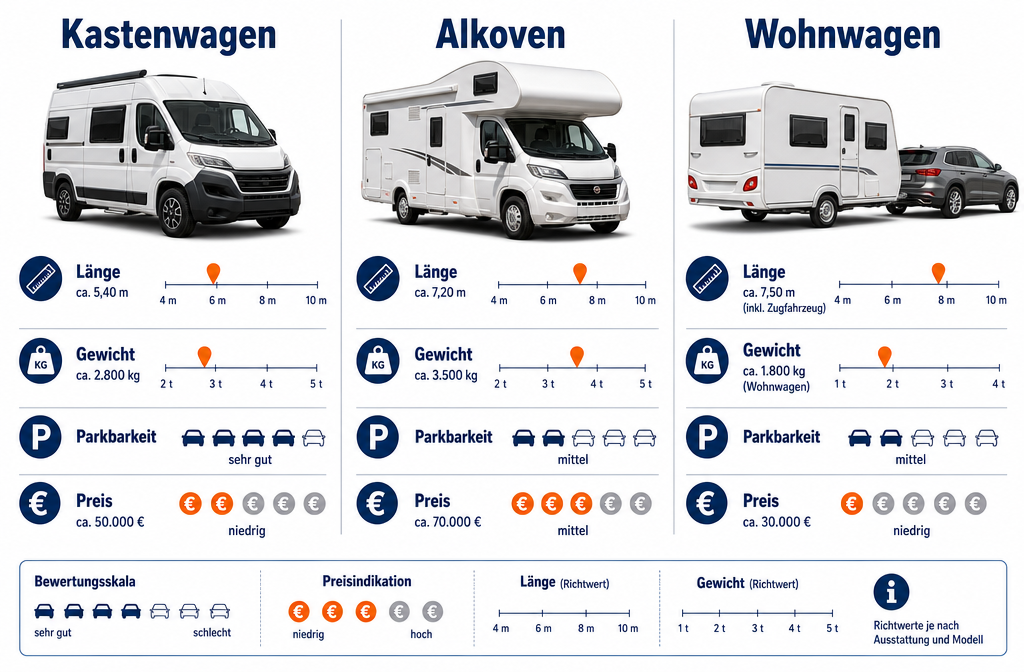
A panel van (also called a campervan) is a production van whose cargo area is converted into a living area. In contrast to an alcove motorhome or a semi-integrated motorhome, the panel van does not have an attached body, but uses the original vehicle shape.
That's what makes it unique compared to other camping vehicles:
| Vehicle type | Length (typical) | Driving licence | Parkability | Price (new) |
|---|---|---|---|---|
| Panel van | 5.5–7.0 m | Class B (up to 3.5 t) | Very good | €40,000–€100,000 |
| Semi-integrated | 6.5–8.0 m | Class B / C1 | Medium | 60,000–130,000 € |
| Alcove | 7.0–9.0 m | Class B / C1 | Difficult | €55,000–€120,000 |
| Caravan | variable | Class B + towing vehicle | Medium | €15,000–€60,000 |
Decision rule: Anyone who values everyday usability, easy parking and a single vehicle key is clearly better off with a panel van than with an alcove or caravan.
Which brands and models of panel vans are most popular?
The most popular base vehicles for panel van conversions are the Fiat Ducato, the Mercedes-Benz Sprinter and the Volkswagen CrafterMost manufacturers build on these platforms.
Well-known complete vehicles off the rack:
- Hymer Camper Van (on Fiat Ducato / Mercedes Sprinter) - a classic premium provider; Hymer recently launched the new Redwood in the 6-meter class drawn attention to itself.
- Westfalia Columbus - compact panel van with clever use of space.
- Dethleffs Globevan – known for good value for money.
- Carado CV - Entry-level models with solid features.
- DIY conversion on VW T6/T7, Ford Transit or Renault Master – for all who want to customize.
Tip: Anyone who isn't sure which model suits them should first rent and test various panel vans before buying. This saves expensive bad purchases.
How much does a good panel van cost and is the investment worth it?
A new, fully converted panel van costs, depending on the manufacturer and features, between 40,000 and 100,000 eurosUsed vehicles with solid conversions are available from approx. 15,000 to 25,000 euros available, where the state of expansion is decisive here.
Is it worth buying? That depends on the frequency of use.
- Who more than 30–40 nights per year spends in a panel van, amortizes the purchase much faster compared to hotel or vacation home costs.
- Who less than 20 nights per year Planting is often more economical than renting.
Ongoing costs that should be factored in:
- Vehicle tax and insurance (depending on the vehicle, approx. €800–1,800/year)
- Maintenance and MOT (camper vans frequently show defects from the 6th year onwards, as this TÜV overview shows)
- Pitch fees and camping passes
Decision rule: Buying is worthwhile if you want to use the vehicle regularly and flexibly. For occasional travelers, renting is the smarter solution.
How much space and equipment do I really need for camping?
For most travelers, a well-planned panel van is perfectly sufficient. A 6-meter panel van offers everything essential on a footprint of approx. 8–10 m²: sleeping area, kitchenette, seating area and storage space.
Minimal equipment for comfortable camping:
- Fixed or fold-out bed (at least 190 × 70 cm)
- Two-burner stoves are sufficient for most travelers.
- Cool box or compressor refrigerator
- Fresh and waste water tank (20–40 liters each, sufficient for short trips)
- 12V power supply with auxiliary battery
Optional extras that significantly increase comfort:
- Permanently installed shower or outdoor shower
- Solar system (100–200 Wp is sufficient for self-sufficient travel)
- Parking heater (diesel or gasoline)
- Roof window / pop-up roof for better ventilation
For inspiration on what's possible with the right equipment, it's worth taking a look at The best campsites in Europe - Campcruisers Blog - many of them are perfectly designed for panel vans.
What conversions and expansion options are there for a panel van?
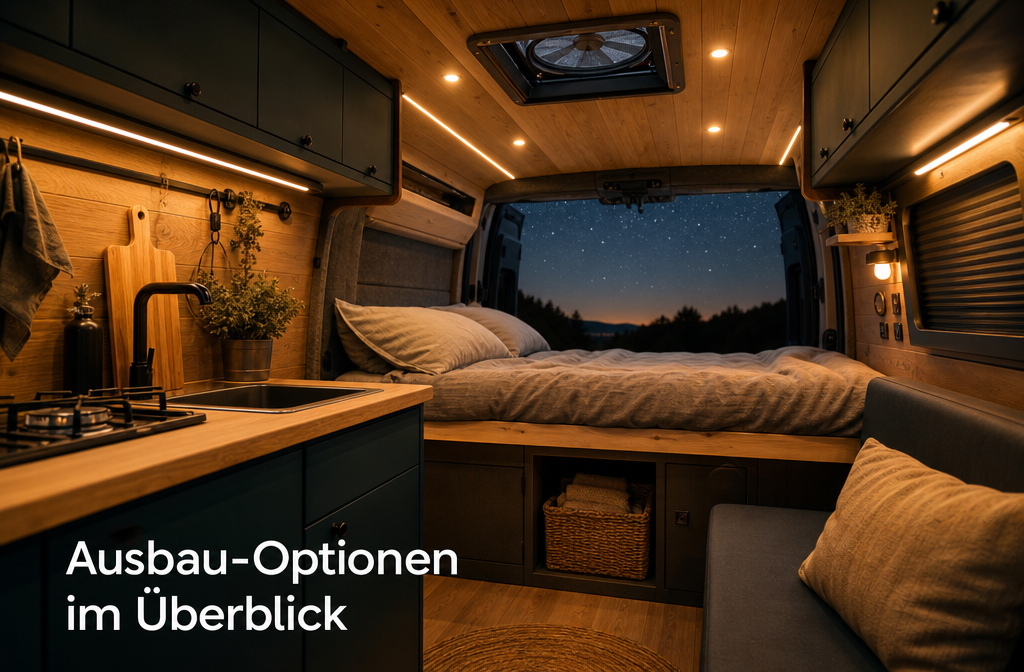
The conversion is the heart of the panel van. There are three basic approaches:
1. Ready-made conversion by the manufacturer
Fully converted vehicles directly from the manufacturer. Advantage: warranty, TÜV-compliant, ready for immediate use. Disadvantage: less individual, higher price.
2. Professional Partial Conversion / Modification
Specialist workshops carry out conversions according to customer wishes. Costs: approx. €5,000–25,000 depending on the scope. Advantage: tailor-made, yet professional.
3. DIY installation (DIY)
Increasingly popular, especially in the van-life community. Material and tool costs: approx. €3,000–10,000. Advantage: maximum individuality and cost control. Disadvantage: time expenditure, craftsmanship required.
Typical expansion elements and estimated costs:
| Extension element | Costs (estimated) |
|---|---|
| Insulation + Cladding | €500–€2,000 |
| Bed/Sleeping system | €300–1,500 |
| Kitchen module | €500–3,000 |
| Solar system + battery | €800–€3,000 |
| Parking heater | 500–1,500 € |
| Shower / WC | €300–€2,000 |
Anyone interested in electric drives: The eVentje - the electric camper van shows where the journey is headed for the panel van of the future.
Is a panel van suitable for families or more for singles and couples?
The panel van is primarily for singles and couples designed. Two adults can live comfortably in a 6-meter panel van; with a toddler it is still doable, but cramped.
For families with children:
- A pop-up roof (e.g., VW California style) creates additional sleeping space for a child.
- Panel vans from 7 m in length offer more leeway for small families.
- For families with two or more children, a semi-integrated motorhome or a larger vehicle is more realistic.
Decision rule: Panel vans = ideal for 1-2 people. Still possible with one child if the vehicle is well planned. For larger families, it is better to opt for a larger vehicle type or plan several trips in a smaller group.
What are typical mistakes when buying and converting a panel van?
The same mistakes happen again and again when buying and renovating, and they can be expensive:
- Choosing a base vehicle that is too small: Anyone who wants to build a fully-fledged motorhome on a length of 5 m will be disappointed.
- Underestimating weight: Many conversions exceed the permissible total weight of 3.5 t. Then class C1 becomes due - and fines are threatened. What exceeding the 3.5-ton limit costs, you should know in advance.
- Save on insulation: Poor insulation turns the vehicle into a sauna in the summer and a freezer in the winter.
- No test drive / no test overnight stay Anyone who has never spent the night in a camper van should definitely rent one first.
- Incorrect power planning. A battery that is too small or a missing solar system makes self-sufficient travel impossible.
- When buying used: Water damage overlooked during construction. Always pay attention to moisture stains and musty smells.
What legal aspects and insurance do I need to consider when owning a campervan?
Panel van up to 3.5 t permissible total weight can be driven with a normal Class B driving license. More heavily converted vehicles require Class C1.
Important legal points:
- Approval: Panel vans are registered as motor caravans (Class M1 SA) or as passenger cars, depending on the conversion. Registration as a motor caravan can bring tax advantages.
- Insurance: A motorhome insurance often covers more than a normal car insurance (e.g. camping equipment, built-in cabinets). Comparing offers is worthwhile.
- Parking Rules: You can't just set up camp anywhere. Wild camping is generally prohibited in Germany; other countries have different rules. Local regulations such as in Doetlingen, where the rules for mobile homes have been tightened, show that you should inform yourself in advance.
- EU driving licence changes: The EU is planning adjustments to the driving license categories for vehicles up to 4.25 t.
How economical are panel vans compared to motorhomes?
Panel vans are often more economical than large motorhomes in a direct comparison because the purchase price, insurance, fuel consumption and parking space costs are usually lower.
Cost-effectiveness Comparison (Estimates):
| Cost factor | Panel van | Large motorhome |
|---|---|---|
| Purchase price (new) | €40,000–€100,000 | €70,000–€200,000 |
| Consumption (Diesel) | approx. 9–12 l/100 km | approx. 12–18 l/100 km |
| Parking space costs | often cheaper | often more expensive (length surcharge) |
| Parking fees | Passenger car tariff possible | Special rate / Prohibitions |
| Insurance | lower | higher |
The panel van is also winning when it comes to flexibility: it can go into city centers, onto ferries, and into parking garages where an 8-meter alcove simply won't fit.
Can I also use a panel van in winter and for longer trips?
Yes, absolutely. A well-equipped panel van with Parking heater and proper insulation is suitable for travel all year round. Many van lifers use their vehicles all year round, even in Scandinavia or the Alps.
Requirements for Winter Camping:
- Parking heater (Diesel parking heater such as Webasto or Eberspächer recommended)
- At least 60 mm floor insulation, 40 mm wall insulation
- Double glazing or thermal curtains
- Winter tires (mandatory in Germany in icy and snowy conditions)
- Sufficient battery capacity (cold reduces battery performance)
For longer journeys, the panel van is also well suited, provided the fresh water and waste water tanks are appropriately sized. Those who are traveling for months should opt for a solar system and a lithium battery.
What alternatives to panel vans are there for camping enthusiasts?
The panel van isn't the best solution for everyone. Here are the most sensible alternatives:
- Camper van (e.g. VW California): Even more compact, ideal for city drivers and weekend getaways. Less living space, but maximum everyday usability.
- Partially integrated motorhome: More space, better features, but bigger and more expensive.
- Alcove motorhome: Maximum living space for families, but poor parking.
- Caravan: Affordable to buy, but requires a towing vehicle; no spontaneous departures.
- Glamping / Rental Accommodation: For anyone who wants the camping feeling without owning their own vehicle. The Glamping boom shows why the independence of the camper is more important than ever.
- Electric Campervan: Forward-looking, but currently limited range and charging infrastructure.
What technical aspects do I need to consider when camping with a panel van?
Technically, the panel van is not rocket science, but every driver should know a few basics:
Check before every trip:
- Tire pressure (panel vans are often more heavily loaded than you think)
- Fill or empty the fresh water and waste water tank
- Check gas bottle level
- Charge auxiliary battery
- Turn on the cooler in advance.
On the go:
- Use parking space apps (Park4Night, Campercontact)
- Empty wastewater only at designated disposal stations
- Turn off the gas system when driving (tunnels, ferries)
- Keep an eye on the weight limit
Common mistake: Many beginners forget to disconnect the auxiliary battery from the vehicle electrical system when the vehicle is parked for a long time. This discharges the starter battery.
Conclusion: The panel van (campervan) as a bestseller earns its reputation
The panel van is no accident at the top of sales and rental statistics. It strikes a chord because it combines true freedom with everyday life: no special driving license, no fear of parking garages, no compromise on spontaneity. Whether it's a weekend trip to the mountains, a road trip through Europe, or a multi-month van life excursion – the panel van makes it possible.
Actionable Next Steps:
- Rent first, then buy. Test different panel van models on real trips before making a purchase decision.
- Set expansion priorities. Consider which features you really need – heating and a bed are mandatory, a shower is optional.
- Calculate weight. Weigh the equipment before approval to avoid surprises.
- Book a trip now. On Campcruisers.com you can easily rent a campervan and get started right away – with professional vehicle providers at locations worldwide.
Adventure awaits. 🚐
FAQ: The Campervan – Frequently Asked Questions
Do I need a special driving license for a van?
No, as long as the vehicle remains under 3.5 t permissible total weight, the normal Class B driving license is sufficient.
How long does a well-converted van last?
The base vehicle, if well maintained, will last 300,000–500,000 km. The conversion requires less maintenance, but should be checked for moisture and wear every few years.
Can I wild camp with a van?
Wild camping is generally prohibited in Germany. In countries such as Sweden, Norway, or Scotland, the "Everyman's Right" applies and allows for more freedom.
What is the difference between a panel van and a campervan?
Practically the same thing. "Campervan" is the English term, "Kastenwagen" the German. In German-speaking areas, "Kastenwagen" is often used for the base vehicle and "Campervan" for the fully converted travel vehicle.
How much electricity do I need in a camper van?
For simple camping (lighting, cooler, smartphone), a 100 Ah lithium battery with 100 Wp solar is sufficient. If you use a laptop, coffee machine, and more, you should upgrade to 200 Ah and 200 Wp.
Is it worth converting a panel van yourself?
Yes, if you have craftsmanship and can invest time. Material costs are around €3,000–8,000, which is significantly cheaper than a finished conversion.
What is the best base vehicle for a campervan conversion?
Fiat Ducato, Mercedes Sprinter and VW Crafter are the most commonly used platforms because spare parts are inexpensive and workshops are well-connected. Which one is best depends on the budget and personal preferences.
Can I rent a van without buying it?
Yes. Via booking platforms such as Campcruisers Panel vans can be flexibly rented for individual trips – without a purchase obligation and with professional vehicles.
How hot does it get in a van in the summer?
It can get very hot without ventilation. A roof fan, a pop-up roof, or a location in the shade are essential in the summer.
Am I allowed to cook in the panel van while it is stationary?
Yes, that's easily possible with a gas cooker or electric stove. When cooking on gas, ensure adequate ventilation.
Quellen
- Caravanning Industry Association (CIVD) – Market Reports Motorhomes and Campervans
- Federal Motor Transport Authority (KBA) – Registration Statistics Motor Caravans Germany
- ADAC – Guide to Motorhomes and Campervans
- Hymer AG – Product Information Camper Van Series
Tags: Panel van, campervan, RV rental, camper rental, panel van conversion, van life, camping vehicle, camping vehicle comparison, buy a panel van, campervan travel, RV tips, camping equipment


 English
  German
  Spanish
  Italian
  Polish
  Dutch
Dutch  French
  Danish