
Last updated: May 24, 2026
Quick Answer: Partially integrated motorhomes and alcove vehicles are particularly well-suited for traveling with a dog because they offer sufficient floor space, stable attachment options, and a clear separation between sleeping and living areas. Panel vans are a good choice for smaller dogs or couples with a compact four-legged friend. Camper vans only work for very small dogs or very experienced travelers.
Key Takeaways 🐾
- Partially integrated motorhomes (6–7.5 m) offer the best balance of space, maneuverability, and dog comfort.
- Alcove motorhomes have the most floor space – ideal for large dog breeds like Labradors or German Shepherds.
- Panel van are suitable for small to medium-sized dogs and travelers who want flexible parking.
- Most landlords require a Dog surcharge from approximately €5–15 per day or a one-time fee.
- Dogs must be secured in a moving RV. secured Being - unsecured transport is subject to a fine in Germany.
- Many European campsites allow dogs, but there are restrictions (leash laws, breed bans).
- Eine Travel insurance for dogs is strongly recommended and costs on average €20–60 per trip.
- Dogs should before the first RV trip be gradually accustomed to the vehicle.
- The weight of the dog, its equipment, and its food counts towards the permissible maximum weight of the vehicle.
- At the Rent a campervan Dog-friendly vehicles can be specifically filtered via Campcruisers.
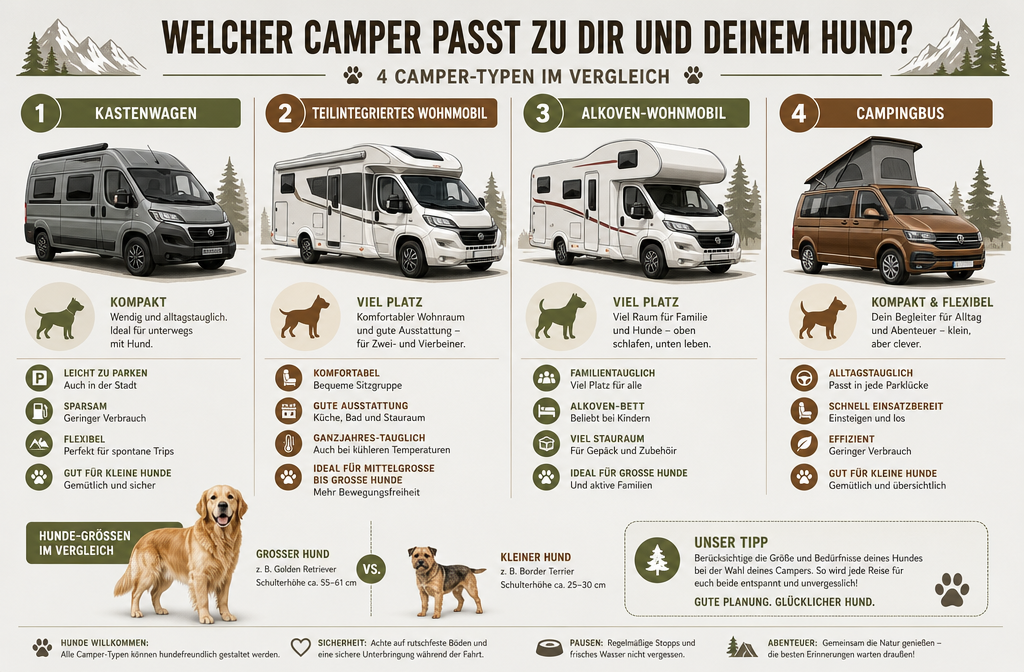
Which RV types are dog-friendly – and which one is right for you?
Not every RV is automatically a good temporary home for a dog. Decisive factors are floor space, ventilation, anchor points, and the possibility of providing the animal with a fixed space.
The four most important vehicle types at a glance
| Vehicle type | Length (typical) | Floor area | Suitable for | Dog Suitability |
|---|---|---|---|---|
| Campervan / Van | 4.5–5.5 m | low | 1-2 people, small dog | ⭐⭐ |
| Panel van | 5.5–6.5 m | medium | 2 people, small to medium-sized dog | ⭐⭐⭐ |
| Semi-integrated motorhome | 6–7.5 m | good | 2-4 people, medium to large dog | ⭐⭐⭐⭐⭐ |
| Alcove motorhome | 6.5–8 m | very good | Families, large dogs | ⭐⭐⭐⭐⭐ |
Partially integrated motorhomes are the sweet spot for most dog owners: enough space for a dog bed, a water bowl, and a transport box, without the vehicle becoming a challenge to park.
Alcove motorhomes offer even more space, but are longer and heavier – which is noticeable on tight campsites or mountain roads. Anyone traveling with a German Shepherd or Golden Retriever will appreciate the space, though.
Rule of thumb: For dogs up to 15 kg, a panel van is sufficient. For dogs from 25 kg, it should be at least a partially integrated motorhome.
How much space does a dog really need in a motorhome?
In a motorhome, a dog needs at least as much floor space as its own body size plus room to move around – so for a medium-sized dog (approx. 70 cm body length), at least 1 m² of solid lying surface plus free passage.
Specifically, that means:
- Dog bed or transport box: Fixed position, not in the aisle area
- Water bowl: Securely fastened with a non-slip grip, ideally near the door.
- Ventilation: Roof window or side window with fly screen - especially important in summer
- Cooling zone: Dogs overheat quickly in parked vehicles; a vehicle with stationary air conditioning or a roof fan is not a luxury when traveling in the summer.
For large dog breeds (Labrador, Bernese Mountain Dog, Husky) applies: panel vans are too narrow. A semi-integrated motorhome with a queen-size bed layout in the rear often offers enough space next to the bed for a large dog bed.
Are large or small dogs better suited for RV travel?
Small dogs up to approx. 10 kg are logistically simpler – they fit in any vehicle, need less food, and their transport box can be easily stowed in the van. Large dogs need more space and more exercise, but are often more relaxed on trips than nervous small dogs.
Small dogs: More flexible in vehicle choice, but often more sensitive to temperature fluctuations and noise.
Large dogs: Need a larger vehicle but are often quieter on long journeys and easier to secure.
Edge case: Certain breeds (e.g. Bulldogs, Pugs) have breathing problems in the heat – for these dogs, an RV air conditioner is not an option, but a necessity.
How much does a campervan with a dog cost per day?
Renting a motorhome with a dog typically costs this much in Germany and Europe during peak season (July/August): 80–180 € per day for the vehicle itself, depending on type and equipment. In addition, there is a Dog surcharge, which varies depending on the landlord:
- One-time fee: 30–100 € per booking (most common option)
- Daily surcharge: 5–15 € per day
- Deposit: Some landlords charge an additional cleaning deposit of €100–300.
These figures are indicative values based on standard market offers in 2026. Actual prices vary depending on the provider, season, and vehicle category.
Wer ein Rent a campervan Anyone wanting to bring their dog should always inquire about the dog fees directly with the respective landlord before booking – on Campcruisers, the conditions of the individual landlords can be viewed in the vehicle details.
How much does extra dog insurance for the RV cost?
Travel insurance for dogs for a two- to three-week trip to Europe costs an estimated 20–60 €, depending on the provider, age and breed of the dog. This insurance covers veterinary costs abroad – and these can quickly reach four-figure sums.
What many don't know: The Dog owner liability insurance usually also applies abroad if the dog causes damage to the motorhome or to third parties. Nevertheless, it is worth taking a look at the insurance conditions before the trip.
Insurance Checklist:
- Travel insurance for dogs (veterinarian abroad)
- Check personal liability insurance with dog ownership
- Clarify vehicle comprehensive insurance with the rental company (damage caused by dog?).
- Keep your EU pet passport and vaccination card up to date
What do I need to consider when renting a motorhome with a dog?
When renting a motorhome with a dog, there are a few points that determine whether the trip will be relaxed or unnecessarily stressful.
Before booking:
- Explicitly ask the landlord whether dogs are allowed - not all vehicles are approved.
- Get the surcharge, deposit, and cleaning conditions confirmed in writing.
- Match vehicle size to dog size (see table above)
- Check if the vehicle has attachment points for seat belts or transport boxes.
On the go:
- Dog in a moving vehicle. Always secure. - either by safety harness with belt or in a secured transport box. In Germany, this is mandatory according to § 22 StVO; an unsecured dog is considered improperly secured cargo.
- Schedule regular breaks – every 2 hours is a good rule of thumb
- Keep fresh water always within reach.
During setup:
- Place the dog bed in a quiet corner, not directly next to the stove
- Do not store poisonous plants or cleaning products within the dog's reach.
Anyone concerned about weight should be aware that dog, food, transport box and accessories can quickly add up to 50–80 kg. This is relevant for vehicles close to the 3.5-ton limit – more on this in the Campcruisers' Guide to Motorhomes up to 3.5 Tons.
Are there special RVs for dogs and owners?
Dedicated "dog campers" are not yet available as standard products. However, some rental companies offer vehicles that have been specially equipped for pet owners - for example with:
- Outdoor wash station (practical after hikes)
- Anti-slip mats on the floor
- Separable sleeping area (so the dog doesn't end up on the bed at night)
- Roof ventilator or portable air conditioner for hot days
When searching and filtering on Campcruisers.com vehicles can be filtered according to equipment features and you can directly ask the rental company about dog-friendly equipment.
Which RV brands are recommended for dog owners?
No brand is universally "the best" for dog owners – the specific model and layout are crucial. Nevertheless, there are characteristics to look out for:
- Hedge entry with low threshold: Good for older or short-legged dogs (e.g. many Fiat Ducato-based vehicles)
- Open-plan concept: Models with a queen-size bed across the rear free up more floor space.
- Good ventilation: Vehicles with multiple roof windows (e.g., Dometic roof vents) are significantly more comfortable in the summer.
- Robust flooring: Vinyl flooring instead of carpet – easier to clean after muddy paws
Brands such as Bürstner, Knaus, Carado and Adria offer models in all relevant size classes. Which vehicle is specifically available depends on the respective rental company.
What mistakes should I avoid when RV camping with a dog?
The most common mistakes either cost money or nerves – sometimes both.
- Dog not accustomed to the vehicle: Putting the dog in the RV for the first time when the trip is already underway risks stress for both animal and human. At least two to three test drives beforehand are advisable.
- Vehicle chosen too small. A 65 kg Rottweiler in a van is uncomfortable for everyone involved.
- No fuse in the vehicle: Not just a risk of fines, but life-threatening for the dog and occupants in an accident.
- Dog left in parked vehicle in the heat. Even at an outside temperature of 20°C, the temperature inside the vehicle can quickly rise to 40°C. Never leave the dog unattended in the RV if there is no active cooling running.
- Campsite booked without a dog check: Not all places allow dogs, some have breed restrictions.
- No travel health insurance: Veterinary costs abroad can be enormous.
How do I prepare my dog for an RV trip?
Good preparation makes the difference between a relaxing vacation and a stressful experience.
Step-by-step preparation:
- Explore vehicle: Let the dog sniff the parked RV in peace before the first trip starts.
- Short test drives: First 10 minutes, then 30 minutes, then an hour - gradually increase.
- Set up a permanent spot: Dog bed or crate always in the same place, so the dog has his "anchor".
- Check for travel sickness: Some dogs suffer from nausea in the car. The veterinarian can help preventatively.
- Compile documents: EU pet passport, vaccination records (rabies!), health insurance card, photo of the dog for emergencies.
- First aid kit for dogs: Bandage material, tick tweezers, cooling pad.
It's worth taking a look at the itinerary for The best campsites in Europe - Campcruisers Blog – many of the listed places are explicitly dog-friendly.
What to do if my dog gets sick on the go?
If your dog gets sick while traveling, quick action is important. The first point of contact is always a local veterinarian.
Immediate actions:
- Have the dog's travel insurance readily available (emergency number)
- In the EU: Veterinarians can be found in every larger city; Google Maps + "veterinarian" + location works reliably.
- If poisoning is suspected: Keep the animal calm, do not give it anything to eat, go to the vet immediately.
- For heatstroke: get the dog into the shade, cool it with lukewarm water (not ice cold!), seek veterinary attention immediately.
Important: Always carry the EU pet passport in the vehicle - veterinarians abroad require the vaccination documentation.
Anyone who wants to keep their internet connection under control while on the go in order to quickly find a vet will find helpful tips in the article. Rent a motorhome without internet? That doesn't have to be the case..
Which campsites allow dogs in RVs?
Most European campsites allow dogs, but there are important restrictions.
What generally applies:
- Dogs must leashed Be (on the court and in common areas)
- Some places have Breed bans for dogs classified as dangerous (Pitbull, Rottweiler, Dobermann – depending on the country and federal state)
- In some places, dogs are in sanitary facilities, restaurants, and pools. Not allowed.
- During peak season, some campsites require a Dog surcharge from €1–5 per night
How to find dog-friendly places:
- Enquire directly at the campsite (specify breed, size, and number of dogs).
- ADAC camping guide and Camping.info list dog-friendly campsites with a filter function
- In Scandinavia and the Netherlands, dogs are welcome in most places.
- In France and Italy, restrictions are more frequent, especially during peak season.
For specific recommendations: The Campcruisers guide to Dog-friendly campsites in Europe gives a good overview of places that explicitly welcome four-legged friends.
How safe is a motorhome for my dog?
A motorhome is safe for dogs – provided the dog is secured during the journey and the vehicle is appropriately equipped.
Security risks and how to avoid them:
- Unsecured transport: The greatest risk. In an impact at 50 km/h, a 30 kg dog becomes a danger to all occupants. Solution: Safety harness with approved belt (TÜV-tested) or secured transport box.
- Heat in parked vehicles: Always ensure active ventilation or air conditioning when the dog is left alone in the vehicle.
- Slippery floors: Anti-slip mats or a dog bed with non-slip properties prevent injuries when cornering.
- Toxic substances: Cleaning products, antifreeze and some camping accessories are poisonous to dogs – store safely.
FAQ: Renting a Motorhome with a Dog
Am I allowed to bring my dog in every rented RV?
No. Not all landlords allow dogs. Permission and any additional costs must be clarified before booking.
Do I have to secure my dog in a moving RV?
Yes. In Germany, § 22 StVO stipulates that animals must be secured in such a way that they do not obstruct the driver and do not pose a danger in the event of an accident. An unsecured dog can incur a fine of €35–75.
Which RV is suitable for a large dog?
For dogs from 25 kg, a semi-integrated motorhome or an alcove vehicle with a length of at least 6.5 m is recommended.
Can I travel to Scandinavia with my dog?
Yes, but there are entry requirements: current rabies vaccination, EU pet passport and in some countries (e.g. Finland) additional requirements such as a tapeworm treatment before entry.
What is the cost of the dog surcharge when renting a motorhome?
Typically €30–100 as a one-time fee or €5–15 per day, depending on the landlord. A cleaning deposit may also apply.
How long can I drive with the dog at a stretch?
It is recommended to take breaks every 2 hours - for both the dog and the driver. Dogs should be given water and allowed to walk briefly during each break.
Are campsites in Germany generally dog-friendly?
Most German campsites allow dogs, but leashes are required almost everywhere. Some campsites have breed restrictions for certain dog breeds.
Do I need a special insurance for my dog in the RV?
Travel insurance for dogs is highly recommended, but not legally required. Before traveling, you should check whether your personal liability insurance (with dog ownership) includes coverage abroad.
Can my dog sleep in the RV while I sleep in the tent?
Yes, provided the landlord agrees and the vehicle is sufficiently ventilated. In the summer, a stationary air conditioner or a roof fan is absolutely necessary.
How do I find dog-friendly RVs on Campcruisers?
On Campcruisers.com Vehicles can be filtered according to equipment and the rental conditions can be viewed directly. For specific requirements, it is recommended to contact the renter directly via the platform.
Conclusion: With the right vehicle, a vacation with your dog becomes an experience
Renting a motorhome with a dog – which vehicle types are best suited is not a matter of taste, but of specific requirements: dog size, trip duration, destination and budget determine which vehicle is really suitable. For most dog owners, a Semi-integrated motorhome the ideal compromise. If you're traveling with a large dog or a family, you're better off choosing a Alcove motorhome.
Your next steps:
- Realistically assess dog size and space requirements (table above as a guide)
- Check insurance coverage and take out travel health insurance for the dog
- Update EU pet passport and vaccination record.
- Gradually Acclimatize Your Dog to Car Rides
- Dog-friendly motorhome for sale Campcruisers.com search and ask landlords directly about dog conditions
Vacationing with your dog in a camper van is one of the best ways to travel – no stress factor of a „dog kennel“, no guilty conscience, but shared adventures on four wheels and four paws. 🐕
Quellen
- ADAC: Traveling with Pets – Tips and Information, adac.de (2023)
- Federal Ministry for Digital and Transport: Road Traffic Regulations (StVO) § 22, bmvi.de (2023)
- European Commission: Travelling with pets in the EU – Pet Passport, ec.europa.eu (2024)
Tags: Rent a motorhome with a dog, dog-friendly motorhomes, rent a camper with a dog, motorhome vacation with dog, motorhome vehicle types, camping with a dog, securing a dog in a motorhome, semi-integrated motorhome, alcove vehicle, traveling with pets, campsites for dogs, rent a motorhome


 English
  German
  Spanish
  Italian
  Polish
  Dutch
Dutch  French
  Danish