
Last updated: May 24, 2026
Quick Answer
Pleated blinds for the cab are folded textile roller blinds that can be extended and retracted in guide rails to effectively block light, heat and prying eyes. For darkening the cab, pleated blinds should be operated correctly by guiding them evenly and without tilting in the rails, never pulling them with force and retracting them completely after use. Good pleated blinds keep the cabin significantly cooler, improve sleep and greatly increase concentration while driving.
Key Takeaways
- Pleated blinds consist of folded fabric in guide rails and can be opened and closed continuously.
- There are retrofittable clamp-on pleated blinds and factory-installed versions, which differ in quality and accuracy of fit.
- The cost of cab blinds generally ranges from roughly €30 to €250 per set, depending on the vehicle type and quality.
- Common operating errors include jerky movements, dirt in the rails, and incorrect insertion during retrofitting.
- Pleated blinds with a thermal layer noticeably reduce the heating of the driver's cab and protect against UV radiation.
- Alternatives like curtains, suction cup blinds, or blackout mats have clear advantages and disadvantages compared to pleated blinds.
- Cleaning is easy: wipe with lukewarm water, never soak, regularly dust the rails.
- For camping trips, a motorhome with pre-installed pleated blinds is worthwhile, so you can get started right away.
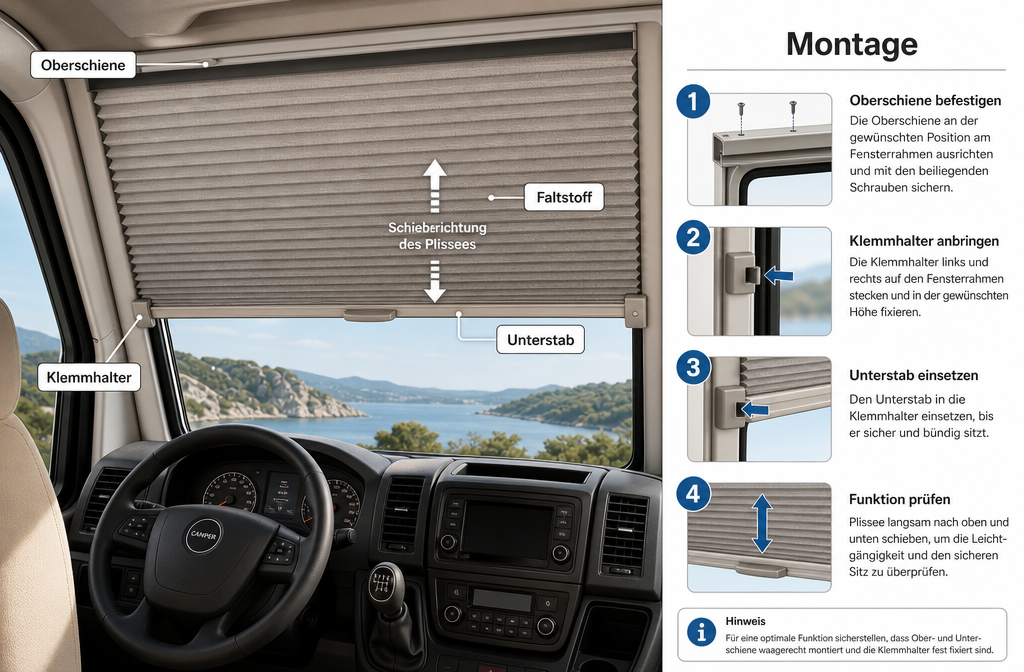
What are pleated blinds and how do they work in the driver's cab?
Pleated blinds are window coverings made of folded fabric, arranged in a zigzag pattern (the namesake "pleat") and moving in two parallel guide rails. In the cab of a truck, van or campervan, they are either pulled up, down or from both sides to regulate light steplessly.
The functional principle is remarkably simple: the folded fabric is pulled out of the track with a slight pull on the bottom rod or a handle and locks into the desired position. High-quality models use a cord or locking mechanism, while cheaper versions simply hold in place by friction. In the driver's cab, the rails are usually attached to the window frame or the roof edge.
Why pleated blinds and not just curtains? Because pleated blinds lie flat against the window, don't require storage space, and don't flutter while driving. That makes them the most practical solution for darkening the cab.
What types of pleated blinds are available for different vehicle types?
There are three main categories, suitable for different vehicles and needs:
| Type | Suitable for | Besonderheit |
|---|---|---|
| Simple Pleated Blind | Cars, vans, small camper vans | Single-ply, inexpensive, easy installation |
| Double pleated blind (Duette) | Motorhomes, truck cabs | Two layers: one opaque, one translucent |
| Thermal Pleated Blind | All vehicles with overheating issues | Additional aluminum layer for heat protection |
- Clamp pleated blinds are mounted without drilling and are ideal for rental RVs or those who don't want to leave any traces.
- Rail Pleated Blinds are firmly screwed together and offer more stability, especially with large windshields.
- Custom-made pleated blinds are tailored to the specific vehicle model, for example for Mercedes Sprinter or VW Crafter, and fit significantly better than universal models.
Those who rent a motorhome will often find factory-installed pleated blinds in modern vehicles, making getting started particularly easy.
How much do pleated blinds for trucks and vans cost?
Driver's cab blinds are not a luxury product, but the price range is wide. Simple retrofit kits for vans like the Ford Transit or VW T6 cost roughly between €30 and €80 per window in specialist shops. Custom-made sets for a complete driver's cab (windshield + side windows) often range between €100 and €250.
What the price covers:
- Quality of guide rails (plastic vs. aluminum)
- Fabric quality and UV protection factor
- Thermal layer (aluminum lamination)
- Dimensional accuracy (Universal vs. vehicle-specific)
Tip: Cheap universal pleated blinds often don't fit snugly on the window frame, leading to light gaps and rattling noises. For frequent travelers, investing in vehicle-specific models is worthwhile.
Why do my pleated blinds sometimes stick or get caught?
This is the most common problem with blackout shades in the driver's cab. Pleated blinds almost always jam for one of three reasons: the tracks are dirty, the fabric is warped, or the mounting is no longer straight.
Causes and quick solutions:
- Dirt in the guide rail - Dust, sand and insect remains slow down the fabric. Clean the rail with a dry cloth or soft brush.
- Tilted fabric - Never pull with force. Fully retract the pleated blind, reattach it, and pull evenly with both hands.
- Warped rail - Occurs in intense heat or after accidents. Carefully straighten or replace the rail by hand.
- Incorrect assembly – If the rails are not parallel, the fabric will inevitably jam. Check the installation and realign if necessary.
Common mistake: Many users pull the pleated blind on one side, which twists the fabric in the rail. Always operate it from the center or with both hands simultaneously.
Can pleated blinds also help against heat and sunlight?
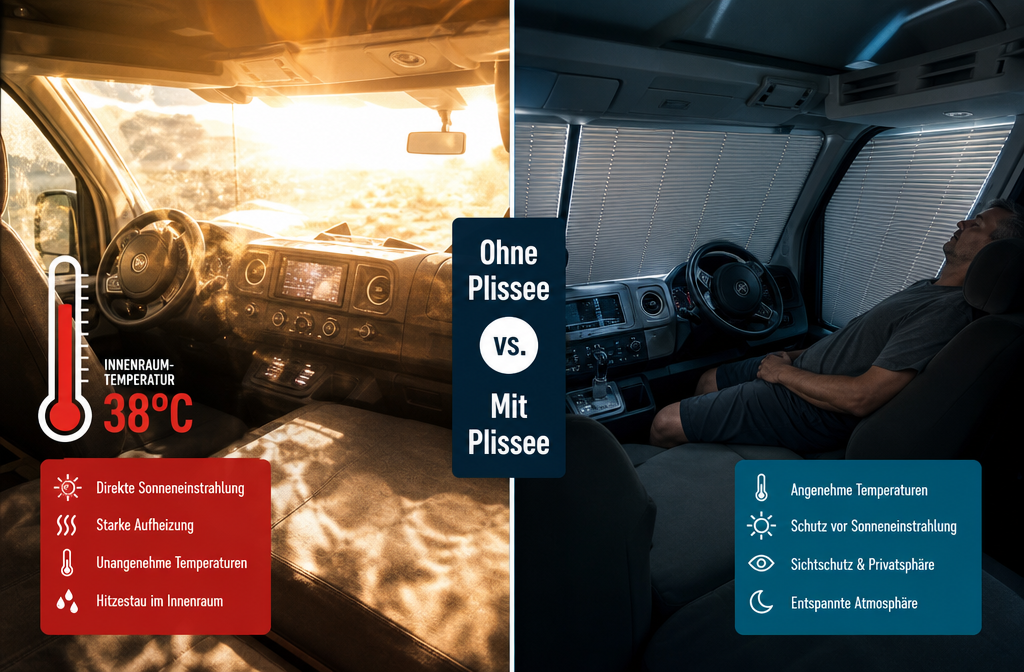
Yes, and that is one of the most important advantages, in addition to the darkening effect. Thermal pleated blinds with aluminum coating reflect a large portion of the solar radiation before it can enter the cab. This noticeably reduces the heating of the interior, especially at the windshield, which represents the largest area.
What Thermo-Pleated Blinds Can Do:
- Reflects solar radiation through the aluminum inner layer
- Reduce UV exposure that fades dashboards and seats
- Also act as an insulating layer against the cold in winter
For camping trips in the summer, a thermal pleated blind on the windshield is not a gimmick, but a real gain in comfort. Anyone traveling in southern Europe in summer temperatures knows the problem: A parked camper van quickly turns into a sauna without blackout. In addition, it is worth taking a look at our article on Thunderstorm camping: safety and comfort during storms, which gives more tips for changeable conditions.
Differences between aftermarket and factory-installed pleated blinds
Factory-installed pleated blinds are integrated directly by the vehicle manufacturer or converter and are tailored to the vehicle model. Retrofittable pleated blinds are installed subsequently and are available universally or vehicle-specifically.
Direct comparison:
| Criterion | Ex factory | Retrofit |
|---|---|---|
| Accuracy of fit | Very high | Medium to high (depending on the model) |
| Assembly effort | None (already installed) | 30–120 minutes |
| Cost | Included in the vehicle price | 30–250 € extra |
| Interchangeability | Elaborate | Easy |
| Optics | Integrated, high-quality | Varies greatly |
Anyone who rents a motorhome through a platform like Campcruisers often benefits from factory-installed pleated blinds in modern vehicles, without having to worry about assembly or compatibility. This is especially practical for first-time campers.
How do I install pleated blinds myself in the driver's cab?
Assembling clamp pleated blinds yourself is possible for most vehicles without tools. Rail pleated blinds require a cordless screwdriver and some patience.
Step-by-step guide for clamp pleated blinds:
- Taking window measurements - Measure the width and height of the glass surface, not the frame.
- Selecting suitable terminals - The clamps must fit the frame thickness (usually 3–8 mm).
- Position rails - Clamp the upper rail into the frame, check the alignment with a spirit level.
- Insert lower rail. - Insert fabric, attach bottom rail.
- Test function – Raise and lower the pleated blind several times, paying attention to even movement.
Additionally, the following applies to pleated blinds for rails:
- Mark drill holes using a template (often included in the delivery).
- Use anchors only with plastic frames.
- Do not overtighten the screws to avoid damaging the frame.
Whoever is insecure: Many camping accessory retailers offer installation services, often for €20–50 per window.
What mistakes are made when installing and operating pleated blinds?
The most common mistakes when darkening the driver's cab happen either during installation or in daily use.
Installation error:
- Rails not mounted parallel (leads to jamming)
- Incorrect measurements taken (pleated blind too wide or too narrow)
- Clamps too loose (pleated blind falls out while driving)
Operating error:
- Pull with a jerk instead of evenly and slowly.
- Let the pleated blind flutter in the wind with the window open.
- Break in fabric wet or damp (risk of mold)
- Leave the pleated blind open in the sun overnight (fabric will fade)
Motto: Pleated blinds like it gentle, dry, and straight. If you take that to heart, you'll enjoy them for years to come.
How do I properly care for and clean pleated blinds in a truck?
Pleated blinds in the driver's cabin are low-maintenance, but not maintenance-free. Regular care significantly extends their lifespan.
Cleaning instructions:
- Fabric: Dab with a slightly damp, lint-free cloth. Never rub, as this will damage the pleats. No soaking, no washing machine.
- Rails: Dust with a dry brush or compressed air. For stubborn dirt, wipe with a slightly damp cloth and allow to dry completely.
- Mechanics: Once per season, lightly treat the guide rails with a touch of silicone spray (no oil!) to help the fabric glide more easily.
Cleaning interval: With regular use, a thorough cleaning is sufficient every 2–3 months. More often after dusty tours or rides on gravel roads.
What alternatives are there for darkening the driver's cab?
Pleated blinds are not the only option. Depending on the vehicle, budget and frequency of use, there are sensible alternatives.
| Alternative | Advantages | Disadvantages |
|---|---|---|
| Curtains | Affordable, easy to change | Fluttering while driving, doesn't fit snugly against the window |
| Suction cup blinds | No assembly required | Don't hold up well in the heat, often fall off |
| Blackout mats (Isolite or similar) | Very good insulation | Bulky, slow installation/removal |
| Film (tinted film) | Permanent, no effort | No complete blackout, legal restrictions |
| Magnetic curtains | Quickly assembled | Suitable for metal frames only |
Choose pleated blinds if you want daily use, a clean look and stepless light regulation. Choose blackout mats when maximum thermal insulation in winter is a priority and you accept the installation effort.
Are pleated blinds suitable for all vehicles and drivers?
Pleated blinds fit most vehicle types, but not every usage profile. They are the most practical solution for campers, long-distance drivers and anyone who regularly sleeps or takes breaks in the cab. For occasional short trips, a simple suction cup blind is often sufficient.
Pleated blinds are particularly suitable for:
- Camping trips with overnight stay in the vehicle
- Truck drivers with legally required rest periods in the cab
- Vanlife enthusiasts who live permanently in vans
- RV travelers who want privacy even during the day
Less suitable for:
- Vehicles with very irregular window shapes (difficult to customize)
- Drivers who only use the vehicle for short day trips
Anyone looking for the perfect travel companion will find it on the Campcruisers Blog exciting information about modern campervans. For travel destination inspiration, we also recommend our article about North Sea dreams on four wheels.
How do pleated blinds contribute to driver relaxation and concentration?
Good sleep in the cab is not a luxury, but a safety factor. Pleated blinds contribute directly to this by completely darkening the cab and thus supporting a natural sleep rhythm, even when there is still daylight outside.
Concrete benefits for driver rest:
- Complete darkness promotes melatonin production and thus restful sleep.
- Privacy screens facing outwards provide a feeling of privacy and security.
- Reduced heating due to thermal pleated blinds ensures pleasant sleeping temperatures.
- No waking up from the headlights of passing vehicles
For long-haul drivers who need to observe rest periods, effective blackout is not a question of comfort, but directly relevant to road safety. Well-rested drivers react faster and make better decisions. Those who want to learn more about safety and comfort when camping can find it in the article Thunderstorm camping: safety and comfort during storms further useful information.
FAQ: Blackout in the Driver's Cab
Which pleated blind fits a VW Crafter or Mercedes Sprinter?
Vehicle-specific sets from manufacturers like Hindermann, Carbest, or Reimo are tailored to these models and offer the best fit. Universal models are cheaper but often don't seal completely.
Am I allowed to have the pleated blinds closed while driving?
Pleated blinds on side windows may be closed while driving if visibility is not impaired. The windshield must always be clear while driving. Pleated blinds on the windshield are only permitted when stationary.
How do I attach a pleated blind without drilling?
Clip-on pleated blinds use clips that are clamped into the window frame without drilling or gluing. They are suitable for most vehicles and leave no traces behind.
How long do cab blinds last?
With careful maintenance, high-quality pleated blinds last 5–10 years. Cheaper fabric can fade or tear more quickly, especially with strong UV exposure.
Can I repair pleated blinds myself if the fabric tears?
Small tears can be provisionally repaired with fabric glue. For a permanent fix, it is recommended to replace the fabric, which many manufacturers offer as a spare part.
Are pleated blinds for the windshield a good idea?
Yes, especially as a thermal pleated blind or blackout blind. They prevent heating and protect the dashboard from UV damage. They must be fully retracted when driving.
How much does a custom-made pleated blind set for a motorhome cost?
Vehicle-specific complete sets (windshield + all side windows) cost roughly between €150 and €400, depending on the vehicle and manufacturer. Individual windows from approx. €40.
Can I also retrofit pleated blinds in a rented RV?
That depends on the rental agreement. Pleated blinds that leave no traces are usually not a problem. Always ask the landlord before installation.
Conclusion: Blackout curtains in the driver's cab are really worth it
Good pleated blinds in the driver's cab are one of the most effective and affordable investments for anyone who regularly sleeps or takes breaks in their vehicle. They improve sleep, protect against heat and UV radiation, provide privacy, and still look neat.
Your next steps:
- Measure the window dimensions of your vehicle and search for vehicle-specific pleated blinds.
- If you have heat problems, specifically look for thermal pleated blinds with aluminum coating.
- Choose clamp options if you want to remain flexible or leave no traces.
- Clean the rails regularly and run in the fabric dry, then they will last for years.
And for those who don't have their own vehicle yet, but the adventurous spirit is already burning: Get ready to Campcruisers.com you'll find a large selection of campervans and motorhomes for rent, many of them already with comfortable interiors including blackout. Easy Rent a campervan or Camper mieten and drive off right away! 🚐✨
Quellen
- Hindermann GmbH: Product Information on Vehicle-Specific Pleated Blinds (hindermann.net)
- Carbest: Product Range Overview Driver's Cabin Blackout (carbest.de)
- Reimo Motorhome Center: Installation Instructions and Product Descriptions (reimo.com)
Tags: Pleated Blinds for Driver's Cabin, Camper Blackout, Motorhome Blackout, Driver's Cabin Privacy Screen, Thermal Pleated Blind, Camper Sleep, Motorhome Accessories, Pleated Blind Installation, Driver's Cabin Heat, Campervan Equipment, Blackout Solution, Camping Comfort


 English
  German
  Spanish
  Italian
  Polish
  Dutch
Dutch  French
  Danish