
Last updated: May 24, 2026
Quick Answer: The Truma Combi is the most common built-in heating system in European motorhomes and combines space heating with hot water preparation in one compact unit. For beginners, the Truma Combi 4 and Combi 6 models are the easiest entry point, as they are reliable, widespread, and well-documented. Those who want to delve into the subject Heating in the motorhome: Truma Combi and Co. explained for beginners Anyone who wants to understand will find everything that really matters here.
Key Takeaways 🔑
- The Truma Combi 4 is suitable for motorhomes up to approx. 6 meters that Combi 6 for larger vehicles from 7 meters.
- Built-in heaters primarily run on Liquefied petroleum gas (LPG) and require only a small amount of power for the fan and control system (approx. 10–40 W).
- A new Truma Combi costs in stores between approx. €800 and €1,500 (Unit without installation), installation by a specialist company will incur further costs of €300–700.
- The Self-installation is technically possible., but in most countries only permitted by certified specialist companies for safety reasons.
- Alternatives to the Truma Combi are Webasto, Eberspächer, diesel heaters and electric fan heaters (only with shore power).
- Gas heaters in RVs are safe., if they are regularly maintained and correctly installed.
- For real. Winter Camping Below -10 °C, a diesel parking heater or a Truma Combi with frost protection function is recommended.
- From about +5 °C outside temperature An auxiliary heater is worthwhile as soon as you want to sleep in the vehicle at night.
How does a built-in heater work in a motorhome?
An integrated heater in a motorhome burns gas or diesel, heats air or water with it, and distributes the heat via air ducts or radiators in the vehicle interior. The Truma Combi is a so-called Combination deviceIt simultaneously heats the living space and prepares hot water for the shower and sink.
This is how the process works:
- Gas supply: Liquefied petroleum gas flows from the on-board gas cylinder to the burner.
- Combustion: The burner ignites the gas, and the resulting heat is transferred to a heat exchanger.
- Heat distribution: An electric blower pushes warm air through ducts into the living space. Optionally, a water boiler is heated in parallel.
- Exhaust gas discharge: Combustion gases are safely discharged to the outside, and the living space remains free of exhaust gases.
- Control: Modern devices like the Truma Combi can be controlled via the control panel or via an app (Truma iNet Box).
Important for beginners: The blower runs on power from the vehicle battery. Without sufficient on-board power, a gas heater will also not function.
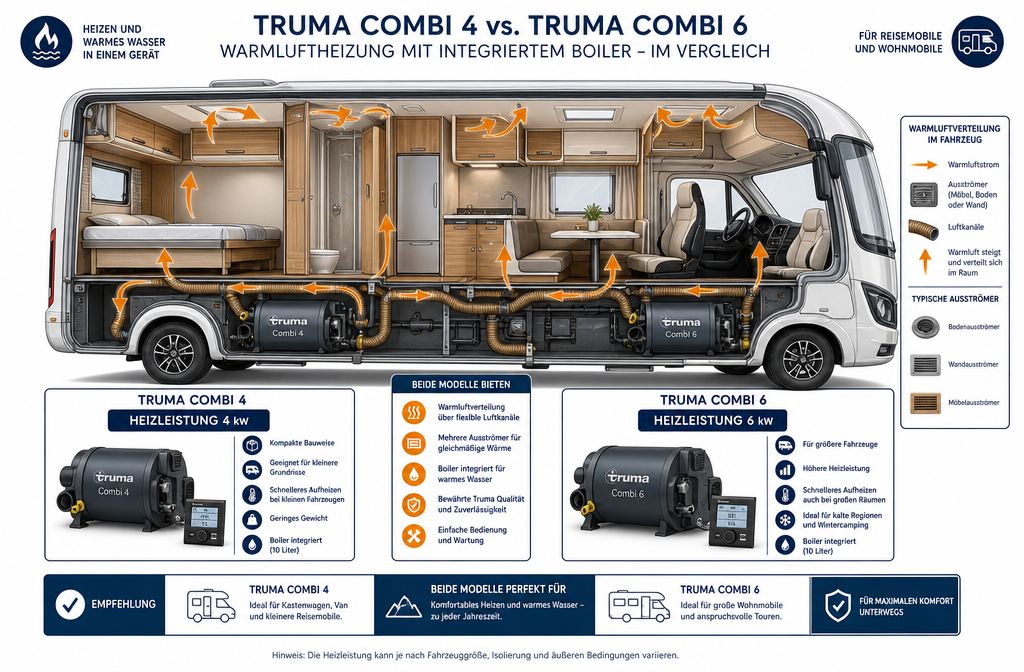
How much does a Truma Combi heater for motorhomes cost?
The acquisition costs for a Truma Combi range, depending on the model and features, between approx. €800 and €1,500 for the device alone. Professional installation by a specialist company typically costs an additional 300 to 700 €, depending on vehicle type and installation effort.
| Model | Heating output | Approximate device price |
|---|---|---|
| Truma Combi 4 | 4 kW | approx. €800–1,050 |
| Truma Combi 6 | 6 kW | approx. €1,050–1,300 |
| Truma Combi 6 E | 6 kW + 900 W Electric | approx. €1,200–1,500 |
Prices are guide prices for German specialist retailers, as of 2026. Prices may vary depending on the dealer and equipment package.
Buy used: Used Truma Combi heaters can be found for around €300–500, but you should pay attention to the maintenance history and age of the unit. Devices older than 10 years should be inspected by a specialist company before installation.
Difference between Truma Combi 4 and Combi 6
The essential difference lies in the Heating outputThe Combi 4 delivers 4 kilowatts, the Combi 6 delivers 6 kilowatts. For most buyers, this is the decisive question when making a purchase.
Choose Combi 4 if:
- The camper van is up to about 6 meters long
- Camping is mainly done from spring to autumn.
- If there is little space available for the heater (the Combi 4 is slightly more compact)
Choose Combi 6 if:
- The vehicle is 7 meters or longer
- Regularly sleeps at temperatures below 0 °C
- Fast heating desired after a long absence.
Both models are also available as "E“" variant (e.g. Combi 6 E), which can also heat with shore power (230 V). This is practical on campsites with a power connection, because you then don't use any gas.
What is the best heater for small RVs?
For small motorhomes up to 5.5 meters (e.g. compact panel vans or van conversions) is the Truma Combi 4 or a pure air heater like the Truma Vario Heat the right choice. If you don't need hot water from the heating system, a pure air heater saves space and costs.
Alternatives for small vehicles:
- Truma Vario Heat Comfort: Pure air heating without a boiler, very compact, approx. €400–600
- Webasto Air Top 2000 STC: Diesel air heater, ideal if there is no gas on board
- Electric Fan Heater: Only useful with a permanent shore power connection, no gas consumption
For campervans and small panel vans, it is also worth taking a look at the weight distribution - more on this in the guide to Motorhomes up to 3.5 tons and overloading.
Can you install a Truma heater yourself?
Technically, self-installation is feasible for people with good manual skills, but legally and in terms of safety, it is not in Germany and most EU countries. Only permitted by certified specialist companies.Gas installations in vehicles are subject to the DVGW standard (Germany) and must be approved.
What can go wrong with self-installation:
- Leaking gas connections (risk of explosion and poisoning)
- Improperly sized exhaust duct (CO poisoning)
- Lapse of vehicle insurance due to improper installation
- Problems with TÜV/HU
Recommendation: Always have the installation carried out by an authorized specialist company (motorhome dealer, gas installer) and demand acceptance with a test report. This not only protects safety but also insurance coverage.
How much electricity does an RV heater use?
A gas heater like the Truma Combi only consumes 10 to 40 watts electrical power for blower, ignition and control. That is very little and hardly puts a strain on the on-board battery. In comparison, an electric fan heater draws 1,000 to 2,000 watts and cannot be used permanently in a motorhome without shore power or a large solar system.
| Heating type | Power consumption (electrical) | Primary energy |
|---|---|---|
| Truma Combi (Gas) | 10–40 W | Liquefied petroleum gas |
| Webasto/Eberspächer (Diesel) | 10–30 W | Diesel |
| Electric fan heater | 1,000–2,000 W | Electricity (Shore Power) |
| Infrared heater | 300–800 W | Electricity (Shore Power) |
Those who travel self-sufficiently in a motorhome are much more relaxed about the power supply when using a gas heater.
Alternative heating systems to the Truma Combi
The Truma Combi is widespread, but not the only option. There are several good alternatives, depending on the vehicle type, budget, and how it is used.
Webasto Thermo Top / Air Top: Diesel parking heaters that use the vehicle's fuel tank. No separate gas tank needed, very robust, good for winter camping.
Eberspächer Airtronic / Hydronic: Similar to Webasto, also diesel-powered, with good market penetration in Europe.
Propex Heatsource: Cheaper gas heater from Great Britain, popular in the van conversion sector.
Electric infrared heater: Only makes sense with permanent shore power, no gas consumption, very quiet.
Wood-fired oven (Tiny-Wood-Stove): For off-grid adventures and DIYers, but complex to install and not suitable for every vehicle type.
Anyone interested in an adventure off the beaten track, such as Wild camping in Oman, Uganda or Georgia, should especially rely on a reliable, self-sufficient heating solution.
Typical errors with motorhome heating
Even experienced campers make the same mistakes when it comes to heating. Here are the most common, so that beginners can avoid them from the start:
- Running gas cylinders empty. Always carry a full spare bottle, especially in winter.
- Operate heating without maintenance: Annual inspection by a specialist company is mandatory, not just a recommendation.
- Block exhaust vent. Snow, dirt, or incorrectly parked objects can block the exhaust vent. Always check before operating.
- Ignore condensation: Poor ventilation combined with heating leads to moisture and mold. Ventilate regularly!
- Adjusting incorrect gas pressure: European gas systems operate at 30 mbar. Anyone buying abroad must pay attention to the correct pressure regulator.
- Operating the heater in a closed vehicle without ventilation: Always ensure sufficient fresh air supply.
Are gas heaters in RVs safe?
Yes, gas heaters in motorhomes are safe if they are installed correctly, regularly maintained, and operated as intended. Modern appliances like the Truma Combi have multiple safety systems: flame monitoring, automatic shutdown in case of gas shortage, and pressure-secured connections.
Safety rules for everyday life:
- Install CO detectors in living spaces (mandatory in many countries, sensible anyway)
- Have the gas system checked by a specialist company every 2 years.
- Only transport gas cylinders in the vehicle in designated, ventilated compartments.
- Switch off the heating when driving in tunnels or on ferries (regulation)
At the Gas grill in the RV Incidentally, similar safety rules apply to handling gas.
How warm does it get with a Truma Combi heater?
A Truma Combi 4 can easily heat a well-insulated living space of 6 meters in length to 20–22 °C to heat up, even when it's −10 °C outside. The Combi 6 reaches these temperatures faster and keeps them stable even in larger vehicles.
The actual room temperature depends on several factors:
- Insulation quality of the vehicle (older motorhomes heat less well)
- Outside temperature and wind
- Vehicle size and number of people
- Condition of the heating system (cleaned nozzles, freshly serviced)
For temperatures below −15 °C, manufacturers and experienced winter campers recommend additional measures such as thermal mats for windows and door seals.
Which heater is suitable for winter camping and from what temperature is an auxiliary heater worthwhile?
For genuine winter camping below −5 °C, a Diesel parking heater (e.g. Webasto or Eberspächer) or a Truma Combi 6 with good vehicle insulation is the most reliable choice. Diesel heaters have the advantage that they start reliably even at very low temperatures and do not require a separate gas tank.
From what temperature is an auxiliary heater worthwhile?
As soon as the night temperatures consistently fall below +5 °C becomes relevant. If you only occasionally stay overnight at 5–10 °C, a good sleeping bag and a small fan heater powered by shore power will suffice for the short term. For regular autumn and winter tours, such as through the Tuscany in Autumn or through Scandinavia, a permanently installed heater is indispensable.
Rule of thumb:
- Occasionally below 10°C: Space heater + shore power is sufficient
- Regularly below 5 °C: Truma Combi 4 or 6
- Winter camping below −5 °C: Truma Combi 6 or diesel heater
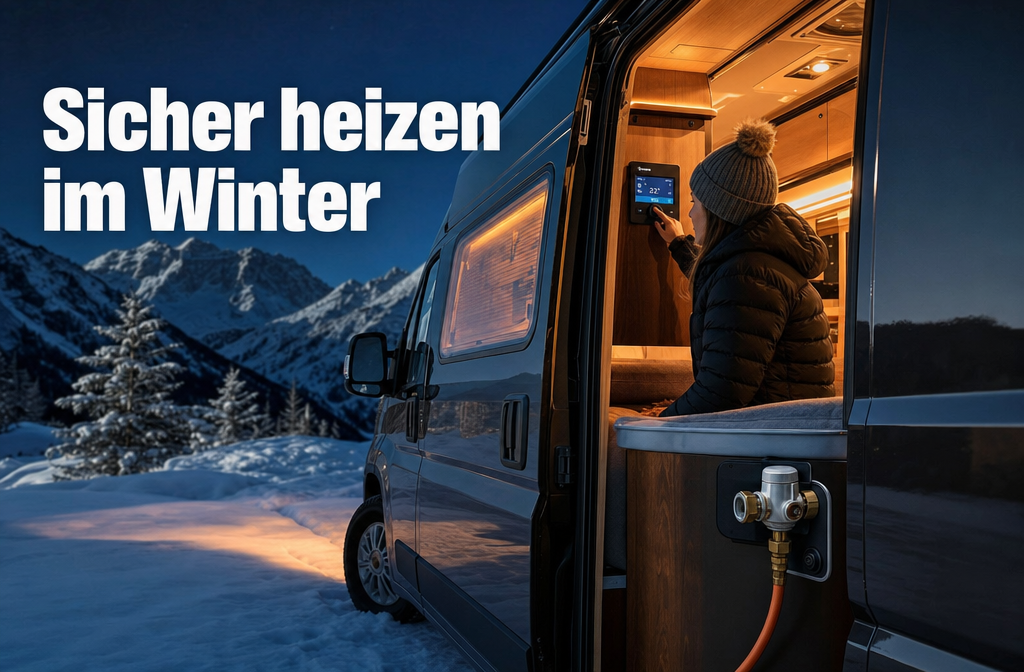
Campervan Heating: Truma Combi and Co. Explained for Beginners – FAQ
Can I also operate the Truma Combi with electricity?
Yes, but only the "E" variants (e.g. Combi 6 E). These can heat electrically up to 900 watts using 230-V shore power. Without shore power, the device runs exclusively on gas.
How often does a Truma Combi need to be serviced?
Truma recommends an annual inspection by an authorized specialist. At least every two years, a complete gas test of the entire system should be carried out.
Can I sleep in the RV while the heater is running?
Yes, that's safe with correctly installed and maintained built-in heaters. Nevertheless, a CO detector should always be installed.
What happens when the gas bottle runs out?
The heating switches off automatically. Modern systems with gas pressure regulators and two-cylinder operation automatically switch to the second cylinder.
How long does an 11 kg gas bottle last for heating?
With moderate heating operation (approx. 4–6 hours daily), an 11 kg bottle lasts about 5–10 days, depending on the outside temperature and heating power.
Is the Truma Combi also suitable for panel vans?
Yes, but for very compact panel vans (under 5 meters) the Combi 4 can be oversized. Here, the Truma Vario Heat or a small diesel air heater is often the better choice.
Am I allowed to travel on a ferry with a gas heater running?
No. The gas system must be shut off and the heating switched off on ferries and in tunnels. This is mandatory in most European countries.
What is the difference between air and water heating in a motorhome?
Air heaters (e.g., Truma Vario Heat) distribute warm air directly via ducts. Water heaters (e.g., Truma Combi as a combination unit) additionally heat water for sanitary facilities. Water heaters are more comfortable, but more expensive and complex to install.
Conclusion: Warm and carefree on the go
Whoever deals with the topic Heating in the motorhome: Truma Combi and Co. explained for beginners Once you understand it, you quickly realize: it's not rocket science. The Truma Combi 4 or 6 is suitable for most motorhomes, is reliable and readily available in specialist shops. If you have a small vehicle, take a look at the more compact alternatives. If you seriously want to camp in winter, consider a diesel parking heater.
The most important thing: Always have installation and maintenance carried out by a specialist, install a CO detector, and have the gas system checked regularly. Then nothing stands in the way of cozy autumn or winter camping.
Ready for your next adventure? Whether autumn in South Holland, winter in the Alps, or spring in Tuscany — on Campcruisers.com you can find RVs and campervans from professional rental partners worldwide. Simple Rent a campervan, drive off and enjoy the warmth. 🚐🔥
Quellen
- Truma Gerätetechnik GmbH & Co. KG – Product documentation Truma Combi 4/6, truma.com
- DVGW German Technical and Scientific Association for Gas and Water e.V. – Technical Rule G 607 (Gas Installations in Vehicles)
- Caravanning Industry Association (CIVD) – Market Data Motorhomes 2024
Tags: RV Heater, Truma Combi, Truma Combi 4, Truma Combi 6, RV Heater Installation, RV Gas Heater, Winter Camping, Webasto RV, Camper Van Heater, RV Rental, Camping Heater Comparison, Truma iNet


 English
  German
  Spanish
  Italian
  Polish
  Dutch
Dutch  French
  Danish