
Last updated: May 24, 2026
Quick Answer
On the subject of Bike rack on the rental motorhome: Weight and load limits a simple rule of thumb applies: The nose weight of the tow bar (usually 50–75 kg for rental campervans) limits how many and which bikes you can transport. E-bikes weigh 20–30 kg each and quickly use up this reserve. Always ask the rental company before booking or bringing your own carrier.
Key Takeaways
- 🚐 The nose weight of the tow bar (typically 50–75 kg) is the decisive weight limit for rear carriers on rental campervans.
- 🚲 Standard bicycles weigh 10–15 kg, e-bikes 20–30 kg – that quickly adds up to 60 kg for two e-bikes, before the carrier and accessories are added.
- ⚠️ Overloading can lead to termination of insurance, fines and liability risks.
- 💶 Bike racks usually cost an extra €5–15 per day from rental companies – check the rental agreement.
- 🔧 Rear carriers are much more suitable for campervans than roof racks, because the vehicle height otherwise becomes critical.
- 📋 Different regulations for bike racks sometimes apply abroad – check before travelling.
- 🔒 Bicycles must be secured with tension straps and anti-slip mats; wobbling while driving is not allowed.
- 📞 Always clarify with the rental company before travelling whether your own carrier is allowed or whether the hired carrier is suitable for the vehicle class.
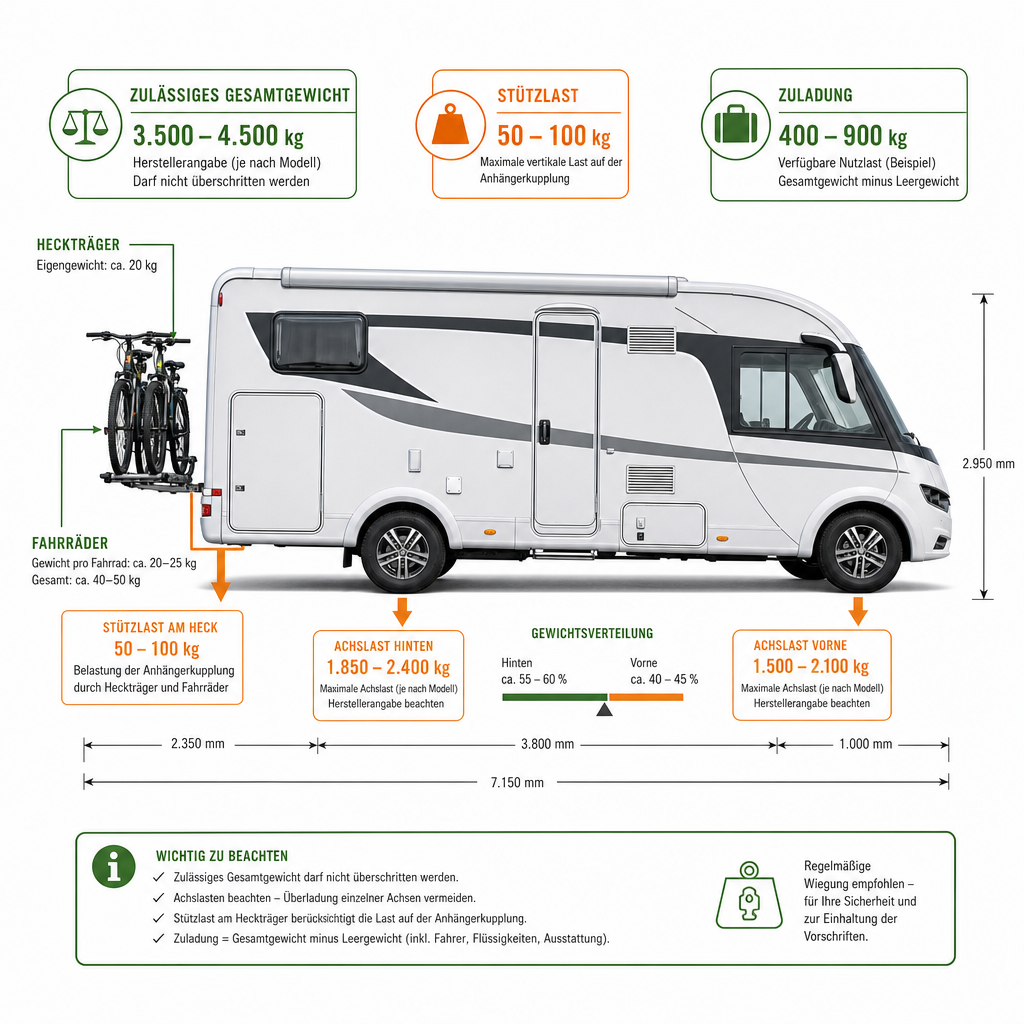
What are the most important weight limits for bike racks on campervans?
The central limit is the nose weight of the tow bar, i.e. the maximum weight that may press on the tow ball. For most rental campervans, this value is between 50 and 75 kg – and that already includes the unladen weight of the carrier.
There is also the permissible gross weight (zGG) of the vehicle. If the campervan is already fully loaded (water, food, luggage, passengers), the payload reserve for bicycles on the carrier can quickly drop to zero. This is particularly relevant for vehicles up to 3.5 tonnes, where the limits are tight – more on this in the Campcruisers-Guide to campervans up to 3.5 tonnes and overloading fines.
Important weight values at a glance:
| Term | Typical value (rental campervan) | What it means |
|---|---|---|
| Nose weight AHK | 50–75 kg | Max. pressure on the tow ball |
| Unladen weight of carrier | 8–20 kg | Goes from the nose weight |
| Payload carrier | 30–60 kg | Max. bicycle weight according to manufacturer |
| Permissible total weight | 3,000–3,500 kg | Must never be exceeded |
Rule of thumb: Nose weight minus carrier weight = available capacity for bicycles. With a nose weight of 60 kg and a carrier with a dead weight of 12 kg, there are still 48 kg available for bicycles.
How many bicycles can I safely transport on the rental motorhome?
In most cases, two to three standard bicycles realistic. For e-bikes, this is often reduced to two – sometimes even one, if the vehicle is already heavily loaded.
The calculation is simple: a normal trekking bike weighs 12–15 kg, an e-bike 22–28 kg. So, a carrier with 48 kg remaining capacity can fit three trekking bikes (3 × 14 kg = 42 kg ✅) or two e-bikes (2 × 24 kg = 48 kg, just about ✅) – but not three e-bikes.
Decision-making aid:
- Up to 2 standard bicycles: Almost always problem-free if nose weight ≥ 50 kg.
- 3 standard bicycles: Only if nose weight ≥ 70 kg and the carrier is designed for 3 bicycles.
- 2 e-bikes: Nose weight at least 60 kg, carrier specifically for e-bikes required.
- 3+ e-bikes: Generally not possible with rental campervans up to 3.5 t.
Which types of bicycle carriers are best suited for campervans?
Rear carriers (towbar carriers) are the first choice for campervans. They are easier to load, distribute the load evenly on the vehicle and avoid the problem of excessive height that arises with roof carriers.
Rear carrier vs. roof carrier: A direct comparison
| Criterion | Rear carrier (towbar) | Roof carrier |
|---|---|---|
| Installation | Easy, no tools required | Elaborate, ladders required |
| Vehicle height | No change | +0.8–1.2 m – note entrance heights! |
| Weight distribution | Rear (nose weight) | Roof (roof load, usually 100–150 kg) |
| Aerodynamics | Slightly higher consumption | Significantly higher consumption |
| For e-bikes | Special carrier required | Hardly suitable (too heavy) |
| Typical for rental campervans | Frequently available | Rarely offered |
Choose a towbar carrier if you're transporting e-bikes, don't want to mess about with complicated assembly, or are heading for campsites with height restrictions (barriers, underpasses).
Only choose a roof carrier if the rental company doesn't offer a towbar carrier and you're only transporting lightweight bicycles.
What happens if I exceed the maximum load limit?
Overloading is not a trivial offence. The following consequences may arise with a rental campervan:
- Insurance cover lapses – many rental agreements explicitly exclude damage caused by overloading.
- Fines – in Germany, fines are threatened for overloading exceeding 5%; from 20% it gets really expensive (up to several hundred euros plus points on your driving licence).
- Driving ban – in the event of massive overloading, the vehicle may be taken off the road.
- Liability for damages – if the carrier breaks or a bicycle comes loose, you are personally liable.
- Return problems – Landlords can charge tenants for damage to the rear or coupling.
Additional costs for bike racks for motorhome rentals
Bike racks are available from most landlords chargeable extras. Prices vary depending on the provider and type of rack, but are typically €5–15 per day or €30–80 per week. Some landlords also require a deposit for the rack.
What to check when booking:
- Is the rack included in the rental price or is it an extra?
- How many bicycles is the rack designed for?
- Is the rack approved for e-bikes (higher load capacity)?
- Is it permitted to bring your own rack, and if so, which coupling types are compatible?
At the Rent a motorhome via Campcruisers it's worth checking the vehicle details and available extras directly in the booking process – the platform works with professional rental companies worldwide that offer different equipment packages.
What mistakes do I make when transporting bicycles on a motorhome?
The most common mistakes happen not while driving, but beforehand. Here are the typical pitfalls:
- Nose weight not checked: Many travellers only look at the rack payload, but forget the nose weight of the coupling – the actual limit.
- Rack dead weight forgotten: A stable aluminium rack can weigh 15–18 kg. That is deducted directly from the available capacity.
- Bicycles not secured: Tensioning straps must secure bicycles in all directions. Just leaning them against something isn't enough.
- Rear lights obscured: In Germany (and most EU countries), number plates and rear lights must remain visible. Many carriers have an integrated lighting system – check whether this works.
- Vehicle height not recalculated: The overall height changes with a roof rack – multi-storey car parks, ferries and campsite gates can become a problem.
Are e-bikes heavier and do they need special carriers?
Yes, definitely. E-bikes are significantly heavier than normal bicycles – averaging 22–28 kg, cargo bikes even over 30 kg. This places special demands on carriers and couplings.
Special e-bike carriers differ in these points:
- Higher load capacity: At least 30 kg per bicycle, often 60 kg total load for two bicycles.
- Wider rails: E-bike tyres are often wider than those of normal bicycles.
- Lower loading height: Due to the high weight, carriers with a tilting function or ramp are practical.
- Stable frame clamps: E-bike frames often have unusual geometries (step-through, cargo frames).
Important: Not every rental company offers carriers suitable for e-bikes. Enquire about this early – ideally when booking.
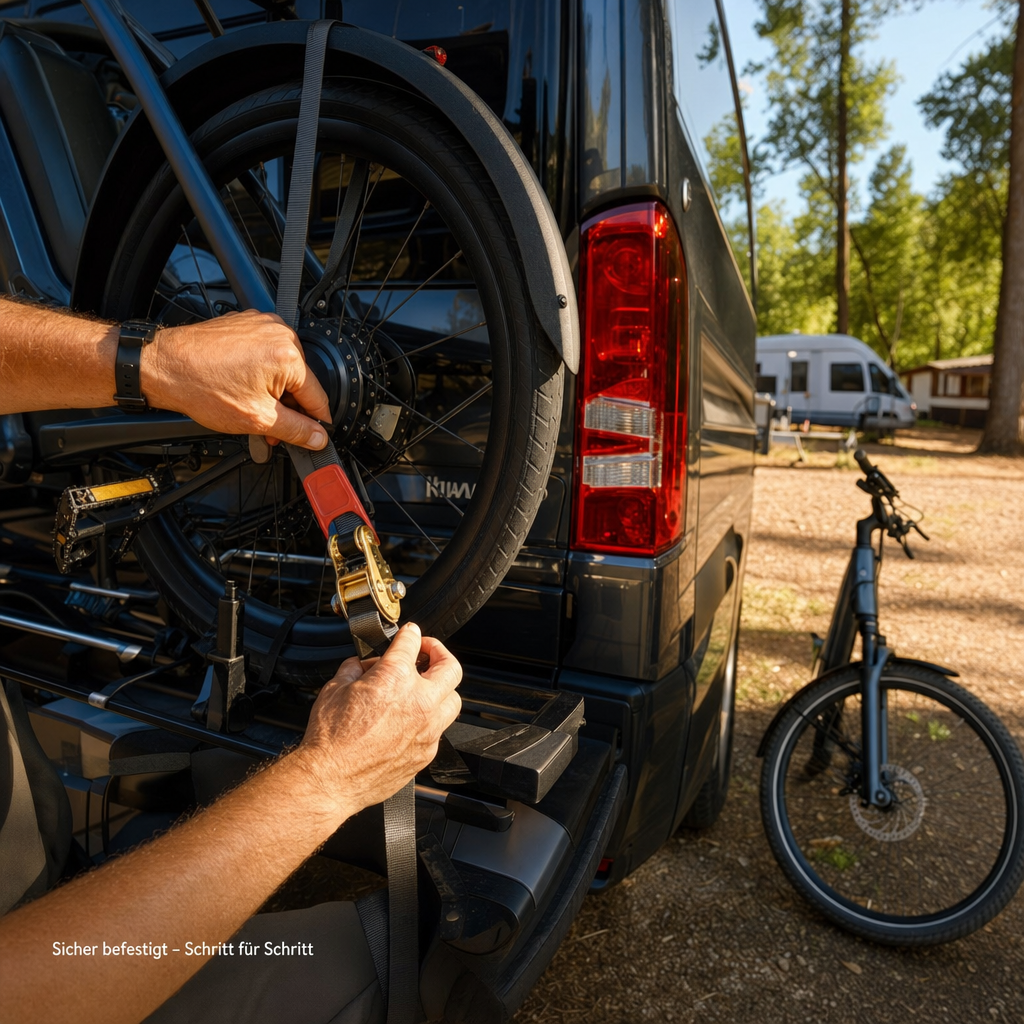
How do I safely attach bicycles to a motorhome carrier?
Bicycles must be attached so that they do not move while driving – neither sideways, upwards nor backwards. This is done in four steps:
- Insert bicycle into the rail: Use tyre holder or frame clamp, depending on the carrier type.
- Secure the frame with a tensioning strap: At least one strap across the frame, ideally two.
- Fix the wheels: Attach the front and rear wheels to the carrier with a tensioning strap or hooks.
- Test for wobbling: Shake the bicycle vigorously – if it moves, tighten it again.
Anti-slip pads protect the paint between the frame and clamp. Rubberised tension straps are better than metal hooks directly on the frame.
What insurance policies apply to bicycle carriers on hired motorhomes?
As a rule, insurance cover for hired motorhomes does not automatically cover the bicycle carrier and the bicycles. not automatically The following should be checked:
- Hire vehicle liability: Covers damage to the carrier caused by driving (e.g. rear-end collision), often only if the carrier was provided by the rental company.
- Own travel insurance: Some travel cancellation or baggage insurance policies exclude bicycles on carriers.
- Bicycle insurance: Anyone with separate bicycle insurance should check if transport on a carrier is covered.
- Credit card insurance: Some premium credit cards offer car rental insurance, but this rarely includes trailers or carriers.
Recommendation: Before travelling, get written confirmation from the rental company what the rental agreement's insurance covers.
What do I need to consider when transporting bicycles abroad?
The rules for bicycle carriers differ within Europe, even if the basic EU rules are similar. Anyone travelling, for example, with a motorhome through Tuscany or through South Holland should be aware of these points:
- Number plate obligation: In most EU countries, the number plate must remain visible - fines are imposed if the number plate is obscured. An additional number plate holder on the carrier is mandatory.
- Lighting: Rear lights and brake lights must function. Many countries require a separate lighting system on the carrier.
- Excess width: If bicycles protrude laterally beyond the vehicle, special rules apply (often a maximum overhang of 40 cm per side).
- France: High-visibility jackets are compulsory in the vehicle, even in the event of breakdowns with a loaded carrier.
- Spain: Reflectors on the bicycles on the carrier are recommended.
Anyone planning longer tours - such as from Buenos Aires to Ushuaia - should research the local regulations even more thoroughly, as completely different rules may apply outside the EU.
Which bicycle carriers are suitable for which motorhome models?
Not every carrier fits every coupling. Compatibility depends on the type of coupling and the vehicle's nose weight.
Coupling types for rental motorhomes:
- Ball head coupling (K80): Standard in Europe, most rear carriers are designed for this.
- Westfalia coupling: Special version, not compatible with all carriers.
- No coupling: Some smaller campervans do not have a tow bar at all - then a rear carrier with a support frame (without a coupling) is necessary, but this is rare with rental vehicles.
Motorhome classes and typical carrier compatibility:
| Vehicle type | Typical nose weight | Recommended carrier |
|---|---|---|
| Compact campervan (up to 3.5 t) | 50–60 kg | 2-bike rear carrier, lightweight |
| Alcove/Integrated motorhome | 60–75 kg | 2–3-bike rear carrier |
| Large motorhome (>3.5 t) | 75–100 kg | 3-wheel carrier, suitable for e-bikes |
If you would like to find out about the new driving licence regulations for motorhomes over 3.5 tonnes, you can find the latest information here: New driving licence regulation in the EU.
FAQ: Bicycle carriers on rental motorhomes
Do I have to inform the rental company if I bring my own bicycle carrier?
Yes, absolutely. Many rental agreements stipulate that only accessories provided by the rental company may be used. Your own carrier may jeopardise the insurance.
Can I add a bicycle carrier to my booking at a later date?
With most rental companies, yes, as long as the vehicle has a suitable tow bar. It is best to enquire directly after booking.
How heavy is a typical rear carrier for motorhomes?
Simple steel carriers weigh 12–18 kg, lighter aluminium models 8–12 kg. The dead weight is always deducted from the available nose weight.
Are bicycles allowed to remain on the carrier while driving?
Yes, provided they are properly secured and do not obscure the lights or number plate.
What happens if a bicycle falls off the carrier?
That is an accident that endangers others. Liability lies with the driver. Therefore: always double-check the security.
Are bicycles on the carrier insured against theft?
As a rule, not by the rental agreement. Separate bicycle insurance or travel baggage insurance is recommended.
How much does a bicycle carrier typically cost as a rental extra?
Between €5 and €15 per day, depending on the rental company and carrier type. It can be more expensive for e-bike carriers.
Can I drive into multi-storey car parks with a bicycle carrier?
With the rear carrier, the height does not change, but the length of the vehicle increases. Check the entrances to car parks. With a roof rack, the height is critical.
Do I need an additional number plate on the carrier?
Yes, in Germany and most EU countries this is compulsory if the carrier obscures the original number plate.
Can I use a bicycle carrier with a motorhome without a tow bar?
There are carriers that are attached to the rear without a tow bar (e.g. via screws or belt systems), but these are rarely available with rental vehicles and are often less stable.
Conclusion: This is how bicycle transport works on a rental motorhome
The topic Bike rack on the rental motorhome: Weight and load limits sounds technical, but is easy to master with the right information. The most important steps before the trip:
- Enquire about the nose weight of the tow bar from the rental company – this is the decisive limit.
- Calculate the total weight of the bicycles – including the carrier's dead weight.
- Clarify the carrier type and suitability for e-bikes – not every carrier is suitable for every bicycle.
- Check insurance cover – get written confirmation.
- Research foreign regulations – Number plates, lighting, excessive width.
If you take this to heart, you can relax and enjoy the freedom of getting on your bike spontaneously at your destination. No rental car, no bus journeys – just get on your bike and go. Campcruisers, Wheeloffice, eVentje, NAWALO
Ready for your next adventure on four wheels (plus two)? On Campcruisers you can find RVs and campervans from professional renters worldwide – many of them with a bicycle rack option. Now Rent a campervan and plan your next tour! 🚐🚲
Quellen
- Federal Motor Transport Authority (KBA): Technical requirements for trailer couplings and drawbar loads, valid version
- Road Traffic Licensing Regulations (StVZO) §22 (Load Securing), §49a (Lighting), currently valid version
- ADAC: Bicycle Carrier and Transport Guide, 2023
- European Commission: Road traffic regulations in the EU, 2022
Tags: RV Bike Rack, Rental RV, RV Weight Limits, Towbar Nose Weight, E-Bike Transport RV, RV Rear Carrier, Rent an RV, Rent a Camper, Bike Transport Camping, RV Load Limit, Camping Equipment, RV Accessories


 English
  German
  Spanish
  Italian
  Polish
  Dutch
Dutch  French
  Danish