
Last updated: May 24, 2026
Quick Answer: A rear garage in a motorhome typically offers between 1.5 and 4 cubic meters of storage space, depending on the vehicle class. How much space you really need depends on what you want to transport — bicycles, scooters, camping equipment, or a combination of these. If you want to use the rear garage properly, you must first know your own needs before choosing a vehicle.
Key Takeaways
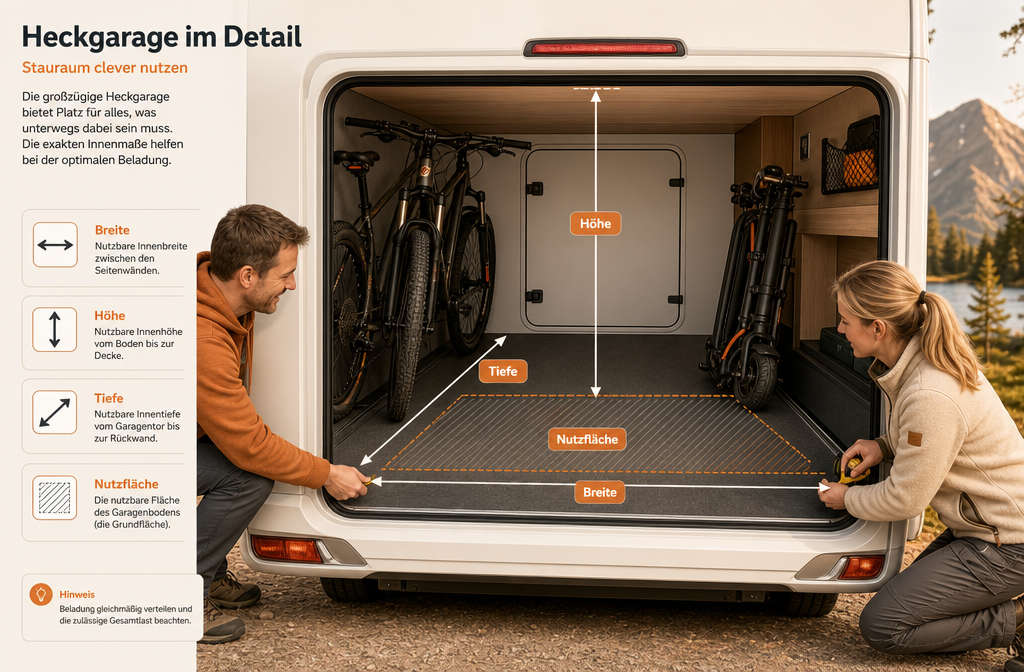
- Typische Heckgaragenmaße: Width 2.0–2.3 m, height 0.9–1.2 m, depth 0.8–1.5 m — that results in 1.5 to 4 m³ of usable volume.
- For two bicycles (without e-bike batteries), you need at least approx. 1.2 m width and 1.0 m height per parking space.
- A motor scooter or e-scooter requires a length of 1.6–2.0 m and a height of at least 1.1 m, depending on the model.
- The most common mistakes: not measuring dimensions beforehand, ignoring weight distribution, forgetting to secure the load.
- Rear garages are particularly suitable for active campers with a lot of sports equipment.
- Those who only transport suitcases and camping chairs don't need a large rear garage—a normal trunk is often sufficient.
- Overloading is subject to fines in Germany: The permissible total weight also applies to the contents of the garage.
- Alternatives to the rear garage: roof rack, rear bicycle rack, trailer.
What is a rear garage and how does it work?
A rear garage is an enclosed storage space underneath the living area of a motorhome, accessible via a hatch at the rear. It functions like a large, walk-in trunk: you open the rear hatch, slide in bicycles, scooters, or camping equipment, and then securely close everything again.
Technically, the rear garage utilizes the space between the vehicle frame and the vehicle floor, which is particularly large in semi-integrated and integrated motorhomes. Many models also have a through-loading option from the inside, so you can access the garage from the living area as well.
Typische Ausstattungsmerkmale:
- Galvanized or coated floors (easy to clean)
- Locking rails or eyelets for load securing
- Beleuchtung (LED)
- Partially heated (important for winter camping)
- Optional bike rails or roller systems
How much floor space do you really need for a rear garage?
That depends entirely on your luggage — but there are clear guidelines. As a rule of thumb: If you want to carry two bicycles, camping equipment for two people, and some tools, you need at least 2.5 m³ of usable volume.
| Nutzungstyp | Empfohlenes Mindestvolumen |
|---|---|
| Koffer + Campingstühle | 1,0–1,5 m³ |
| 2 Fahrräder (ohne Zubehör) | 1,8–2,2 m³ |
| 2 bicycles + camping equipment | 2,5–3,5 m³ |
| Motorroller oder E-Scooter | 2,0–3,0 m³ |
| Kajak oder Surfbrett | Spezialfahrzeug nötig |
Important: The volume alone doesn't say much. What's crucial are the exact interior dimensions—especially the interior height. Many rear garages are only 90–100 cm high, which isn't enough for upright bicycles. If you're transporting e-bikes with wide handlebar ends, you also need to check the width carefully.
How do I correctly measure the space needed for my rear garage?
First measure the luggage, then the vehicle — not the other way around. Many campers make the mistake of booking a motorhome and then finding that the bicycle doesn't fit.
So gehst du vor:
- Gepäck auflisten: Write down everything that should go in the rear garage.
- Take measurements: Measure the length, width, and height of each item—with handlebars, pedals unfolded, and kickstand taken into account.
- Gesamtvolumen schätzen: Add up the individual dimensions and add approx. 20% buffer for manoeuvrability.
- Check vehicle data sheet: Compare your dimensions with the internal dimensions of the rear garage (width × depth × headroom).
- Calculate weight: Add up the weight of all items and check whether the vehicle allows the payload.
Practical tip: Before booking, put your bicycle on the floor and measure it with a tape measure—including inflated tyres and folded handlebars. Many bicycles are 60–70 cm wide with handlebars, which is tight in narrower garages.
Which vehicles are best suited for a rear garage?
Bicycles (standard and e-bike), motor scooters up to 125 cc and compact e-scooters are the most common and best suited vehicles for a motorhome rear garage. They can usually be stowed without disassembly if the garage dimensions are correct.
Well suited:
- Trekking bikes and city bikes (height approx. 95–105 cm with saddle)
- E-bikes (same dimensions, but heavier – note the weight!)
- Compact scooters (up to approx. 1.6 m length)
- Folding bicycles (ideal for small garages)
- Compact camping equipment in boxes
Conditionally suitable:
- Mountain bikes with wide tyres (check width)
- Prams (length often problematic)
- Surfboards (only with special mount)
Anyone who regularly cycles should Rent a campervan specifically ask about vehicles with bicycle rails in the rear garage – this saves a lot of hassle when loading.
Which vehicle types are unsuitable for a rear garage?
Large motorcycles, quads and watercraft such as kayaks or SUP boards usually do not fit into a standard rear garage. Bicycles with a very high saddle or wide handlebars can also be problematic.
- Motorcycles over 125 cc (too long, too heavy, ground clearance)
- Quads and mini-buggies (width exceeds garage opening)
- Kayaks and canoes (length 3–5 m, not compatible)
- Cargo bikes and freight bicycles (too wide, too long)
- Wheelchairs with electric drive (weight often exceeds payload limit)
What are typical mistakes when using a rear garage?
The most common mistake is stowing items without securing them – this is not only impractical, but also legally problematic in Germany. Unsecured cargo can lead to dangerous situations during emergency braking.
The five most common mistakes:
- No load securing: Bicycles and boxes must be fixed with straps or rails.
- Ignoring weight: The rear garage is behind the rear axle – too much weight there significantly affects handling.
- Not checking dimensions in advance: Bicycle doesn't fit because handlebars are too wide.
- Storing damp equipment: Wet tents or clothes quickly become mouldy in the garage.
- Exceeding payload limit: Anyone who loads too much risks a fine for overloading.
Motto: The rear garage is not a dustbin on wheels. What goes in must also stay in safely.
Advantages and disadvantages of a rear garage compared to a traditional garage
A motorhome rear garage is no substitute for a home garage — but as mobile storage space, it beats many alternatives. Here is an honest comparison:
| Criterion | Rear garage (motorhome) | Heimgarage / Carport |
|---|---|---|
| Mobility | ✅ Always with you | ❌ Stationary |
| Volume | ⚠️ 1.5–4 m³ | ✅ 15–40 m³ |
| Security | ⚠️ Lockable, but limited | ✅ Solid |
| Cost | Included in the vehicle price | 5,000–30,000 € construction |
| Weather protection | ✅ Complete | ✅ Complete |
| Flexibility | ✅ Can be used daily | ❌ Only at home |
Conclusion: The rear garage isn't a competing product to a home garage, but rather a clever extension of the campervan for active campers.
Costs for a rear garage compared to a normal garage
A rear garage isn't a separate product that you buy – it's part of the campervan. Campervans with a rear garage typically cost more to buy than comparable models without, because they are larger and heavier (often over 3.5 tonnes total weight).
If you don't want to buy your own vehicle, you can also rent a campervan with a rear garage. On platforms like Campcruisers professional renters from all over Europe work together, so you can specifically filter for vehicles with a rear garage – without the high purchase costs.
Cost comparison (estimated values, 2026):
- Campervan with rear garage (purchase): from approx. €60,000–120,000 (new vehicle)
- Campervan with rear garage (rental): approx. €100–200 per day, depending on season and model
- Home garage (new build): approx. €15,000–40,000 depending on size and features
Note: The rental prices mentioned are estimates based on standard market prices in Germany 2026 and can vary greatly depending on the provider and vehicle class.
Anyone who knows the new EU driving licence regulations knows: Since 2026, campervans up to 4.25 tonnes can be driven with a Class B driving licence – this opens the door to larger vehicles with a comfortable rear garage.
Who benefits from a rear garage and who doesn't?
A rear garage is worthwhile for active campers who regularly transport bicycles, scooters or extensive sports equipment. On the other hand, those who mainly travel with suitcases or only occasionally camp don't need one.
Rear garage is worthwhile for:
- Families with several bicycles
- Mountain bikers and cycling tourists
- Campers with e-bikes (heavy, need a safe place)
- Long-term travellers with lots of equipment
- Motor scooter riders who want to take their second vehicle with them
Rear garage is not worthwhile for:
- Short-break holidaymakers with little luggage
- Couples who only travel with rucksacks
- Campers who mainly go to campsites with rental bikes
- City travellers who use the campervan as a hotel
If you are unsure whether a rear garage is really necessary, you should first rent and test a vehicle with a rear garage – before deciding on your own vehicle.
What do I need to consider when parking in a rear garage?
When parking bicycles or scooters in the rear garage, always load the heaviest object first, then the rest around it. This ensures even weight distribution and makes unloading easier.
Step-by-step loading:
- Open the tailgate and check the floor for cleanliness.
- Drive in the heaviest objects first (e.g. e-bike).
- Lock the bicycle into the rail or secure it with a strap.
- Stow lighter items (boxes, bags) in gaps.
- Check all straps and fastenings.
- Close the tailgate and check for proper closure.
When parking out: Always remove lighter items first, then wheel the bike out — never pull, always push or roll.
Alternative parking options if the rear garage is too small
If the rear garage isn't big enough, there are good alternatives: bike carriers on the rear, roof racks, or a small trailer. Each option has its own advantages and disadvantages.
Alternatives at a glance:
- Bike carrier (rear): Cheap, easy to fit, but bikes are exposed to the elements and rear visibility is restricted.
- Roof rack: Plenty of space for surfboards, kayaks or roof boxes — but pay attention to height restrictions in car parks and tunnels.
- Trailer: Maximum storage space, but check driving licence and vehicle registration; manoeuvring becomes more complex.
- Folding bike: Compromise solution—fits in almost any rear garage, but is not a full replacement for a normal bicycle.
Those camping on a well-equipped pitch may sometimes have access to rental bikes — saving space and weight. More on this in the article about Rent out and use RV parking spaces.
Common Problems and Solutions When Using Rear Garages
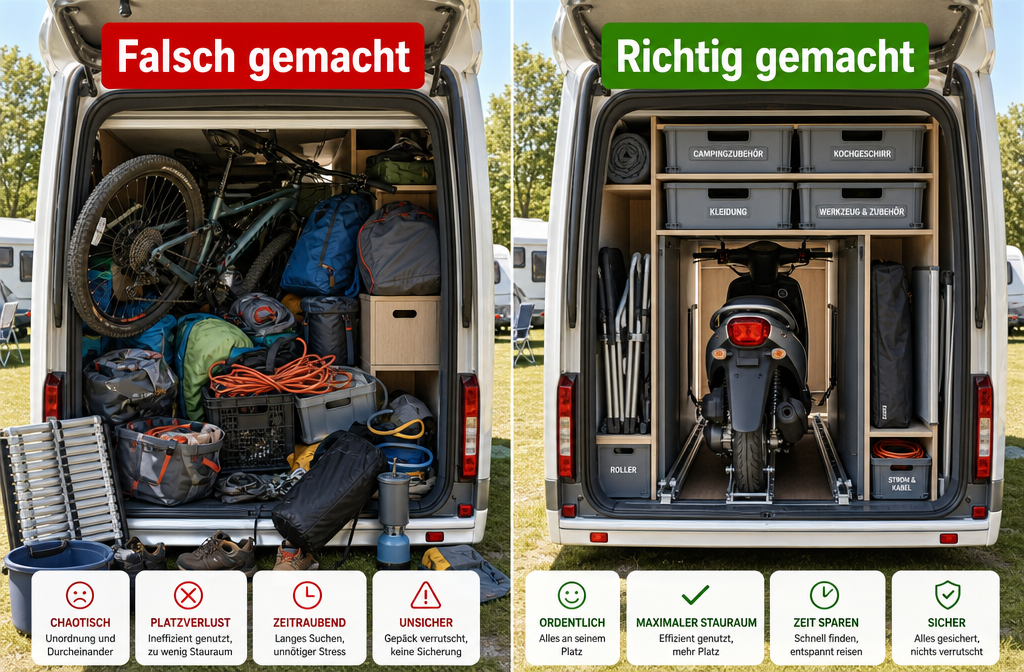
Most problems with the rear garage arise from poor planning or incorrect expectations. Here are the most common situations and what you can do about them:
Problem: Bicycle doesn't fit inside
→ Solution: Remove or fold down the handlebars, unscrew the pedals, lower the saddle. Alternatively: buy a folding bike.
Problem: Load slips during driving
→ Solution: Anti-slip mats on the garage floor, ratchet straps, retrofit a rail system.
Problem: Mold or odor
→ Solution: Only store dry equipment, ventilate the garage after camping, use moisture-absorbing bags.
Problem: Tailgate does not close properly
→ Solution: Regularly check and oil hinges and seals; for rental vehicles, report it to the landlord immediately.
Problem: Overcharge
→ Solution: Weigh luggage before the trip, check the load limit in the vehicle registration document, distribute weight on the front and rear axles. More on this in the guide to Motorhomes up to 3.5 tons and fines for overloading.
FAQ: How to properly use the rear garage
How big is an average rear garage in a motorhome?
Typical RV rear garages measure 2.0–2.3 m wide, 0.9–1.2 m high, and 0.8–1.5 m deep. This results in a usable volume of approximately 1.5 to 4 m³, depending on the vehicle class.
Can I put two bicycles in a rear garage?
Yes, with sufficient width (at least 1.8–2.0 m inside) and height (at least 1.0 m), two normal bicycles will fit next to each other. For e-bikes, a rail system for fixation is recommended.
Is the rear garage lockable?
For most modern RVs, yes — the tailgate has a lock. However, security is limited; for valuable bicycles, an additional bicycle lock is recommended.
Am I allowed to pack the rear garage full to the ceiling?
No. There should always be some space between the load and the garage ceiling so that the tailgate closes without pressure and the load doesn't press against the ceiling while driving.
What weight am I allowed to load into the rear garage?
That depends on the vehicle's payload capacity. Since the rear garage is behind the rear axle, you should keep the weight there as low as possible — a guideline is: a maximum of 150–200 kg in the garage, but always check the vehicle data sheet.
Can I use the rear garage in winter?
Yes, but only with heated garages or if the equipment is cold-resistant. Wet or frozen objects can cause damage to the garage. Some RVs offer optional heating for the rear garage.
Do I need a special driving licence for a motorhome with a rear garage?
That depends on the total weight. Vehicles up to 3.5 tonnes can be driven with a Class B licence; since 2026, a new regulation in the EU allows motorhomes up to 4.25 tonnes to be driven with a Class B licence under certain conditions. Details can be found in our article on the new EU driving licence regulations.
How do I secure bicycles safely in the rear garage?
The best way is with a built-in rail system and tension straps. Alternatively, anti-slip mats and additional tie-down straps will help. Bicycles should never just be left loose in the garage.
Is a rear garage standard on a rental motorhome?
No, not all rental motorhomes have a rear garage. When booking on platforms like Campcruisers you can specifically filter for vehicles with a rear garage.
What happens if the tailgate opens while driving?
This is a serious safety problem. Before each departure, the tailgate must be checked to ensure it is properly closed. In the case of rental vehicles, inform the rental company immediately if the lock is not working properly.
Conclusion: Using the rear garage correctly — here's how
If you want to use the rear garage correctly, don't start with the vehicle, but with your own luggage. Measure first, then book — that's the most important rule. With the right dimensions, a well-thought-out load and the appropriate securing, the rear garage becomes a real travel game-changer for active campers.
Your next steps:
- Measuring luggage: Measure bicycles, scooters and boxes with a tape measure — including handlebars and pedals.
- Select the vehicle specifically: On Campcruisers Filter for motorhomes with a rear garage and check the interior dimensions in the data sheet.
- Calculate weight: Don't forget the payload — overloading costs money and is dangerous.
- Plan the securing: Get straps, rails and anti-slip mats before the trip.
- Do a test run: Load everything carefully and check that it all fits the first time — before the big tour starts.
Camping is at its best when the logistics are right. With a well-used rear garage, you have everything you need for adventure — and nothing that's annoying. 🚴♂️🏕️
Quellen
- ADAC e.V. (2023): Motorhomes and Campervans — Equipment and Technology Guide. adac.de
- Caravaning Industrie Verband e.V. (CIVD) (2024): Market Data Motorhomes Germany. civd.de
- Bundesministerium für Digitales und Verkehr (2023): Straßenverkehrs-Zulassungs-Ordnung (StVZO) — Load Securing. bmvi.de
Tags: Rear garage, RV rear garage, rear garage dimensions, camper storage space, rent an RV, bicycle in RV, transporting camping equipment, rear garage tips, RV storage space, rent a camper, load securing in RV, active camping


 English
  German
  Spanish
  Italian
  Polish
  Dutch
Dutch  French
  Danish