
Around 80 percent of all houseboat renters ask themselves the same question before their first trip: What actually happens to what is flushed down the toilet? No sewage system, no connection to the municipal network, and yet everything works smoothly. The topic of wastewater and toilet on a houseboat sounds complicated at first glance, but with the right knowledge it can be quickly understood, and it won't stop you from enjoying the houseboat holiday adventure to the fullest.
What happens to wastewater on a houseboat?
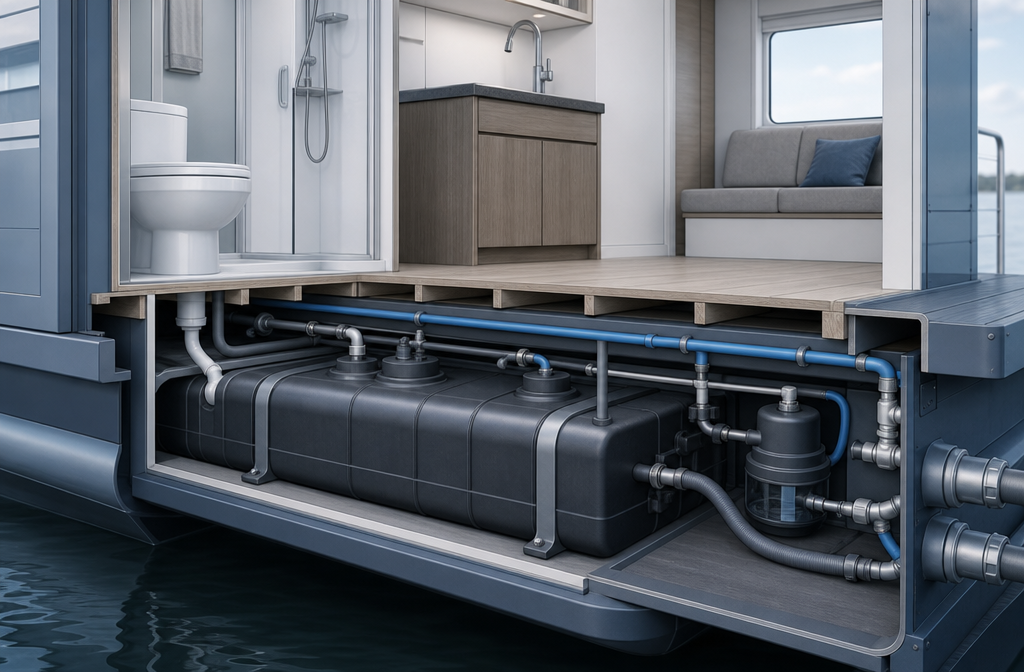
On a houseboat, wastewater does not simply end up in the river or lake. Greywater from the shower and sink, as well as blackwater from the toilet, are collected in separate or shared tanks on board until they can be emptied at an approved disposal station.
Most modern houseboats work with a closed holding system:
- Blackwater (toilet wastewater) ends up in the sewage tank, also called a holding tank.
- Greywater (shower, sink, kitchen) is either collected separately or discharged directly in certain waters, provided local regulations allow it.
- Marinas and boat stations have pump-out stations where the tank is professionally emptied.
Important: Direct discharge of blackwater into waterways is prohibited in almost all European countries and can be punished with hefty fines.
What types of toilet systems are there for houseboats?
For houseboats, there are four common toilet systems that differ in their functionality, comfort, and environmental compatibility. The choice depends on the boat size, destination, and personal preferences.
| System | Functionality | Comfort | Environment |
|---|---|---|---|
| Chemical toilet | Chemicals break down waste in the tank | Medium | Restricted |
| Cassette toilet | Removable tank, manually emptied | Medium | Neutral |
| Vacuum toilet | Sucks waste into holding tank | High | Good |
| Dry separation toilet | Separates solid and liquid waste | High | Very good |
Vacuum toilets are most commonly found on larger, more comfortable houseboats. They work similarly to aircraft toilets, use little water, and transport the contents safely to the holding tank. Cassette toilets are the most affordable solution and are widely used on smaller boats.
How do I dispose of the toilet on a houseboat?
Disposal varies depending on the type of toilet, but always follows the same basic principle: collect waste, go to the station, empty.
For cassette toilets:
- Remove cassette from the toilet base (usually accessible through an external flap).
- Go to the nearest disposal station or marina sanitary facility.
- Empty contents into the designated inlet opening.
- Rinse cassette with water and add fresh flush fluid if necessary.
For holding tanks (vacuum systems):
- Go to the pump-out station at the marina.
- Connect hose to the boat's pump-out connection.
- Pump activates the suction process, the tank is emptied in minutes.
- Rinse tank with fresh water.
Most marinas in Germany, the Netherlands, and France offer pump-out stations. When booking through Campcruisers, you always receive information about available stations along your route.
How often do I need to empty the toilet on a houseboat?
This depends on the tank size and the number of people on board. As a rule of thumb: A holding tank for four people typically holds between 60 and 120 liters and needs to be emptied every two to four days with normal use.
- Traveling alone or as a couple: every 4 to 5 days
- Families with children (4 people): every 2 to 3 days
- Groups (6+ people): daily to every two days
Plan your route so that you regularly pass marinas with disposal facilities. Most houseboat routes in Europe are designed so that pump-out stations are accessible every 20 to 30 kilometers.
Difference between dry toilet and chemical toilet on houseboats
Dry toilets and chemical toilets solve the same problem in fundamentally different ways. The chemical toilet uses liquid chemicals to break down waste and neutralize odors. The dry separation toilet works without water and without chemicals.
Chemical toilet:
- Requires special chemicals (blue or green, depending on type)
- Odor neutral with correct dosage
- Cassette must be emptied every 2 to 3 days
- Cheaper to purchase.
Dry separation toilet:
- Separates urine and solids mechanically
- Solids are composted, urine disposed of separately
- No water consumption, no chemicals
- Higher initial cost, but cheaper in the long run
For families with children, the chemical toilet is usually the more practical choice because it is more intuitive to use. Environmentally conscious travelers are increasingly opting for the dry separation toilet.
Are chemical toilets on houseboats environmentally friendly?
Chemical toilets are not the most environmentally friendly option, but they are acceptable with correct use. The actual problem lies not in the toilet itself, but in the disposal: anyone who simply dumps the contents into the water acts illegally and severely damages the ecosystem.
With proper use, the following applies:
- Biodegradable chemicals (recognizable by the blue environmental label) are significantly less harmful than older formaldehyde-based products.
- The contents must always be emptied at approved disposal stations.
- Modern alternatives such as dry separation toilets or vacuum systems with holding tanks are ecologically preferable.
What are the regulations for wastewater on houseboats?
The regulations vary by country and waterway, but follow a common European framework. In Germany, the Binnenschifffahrtsstraßen-Ordnung (BinSchStrO) governs the handling of wastewater on inland waterways. Similar national regulations apply in the Netherlands and France.
Basic rules for Europe:
- Blackwater must never be discharged directly into waterways.
- Graywater may be discharged directly into some inland waters, but not in protected areas.
- Violations can be punished with fines ranging from several hundred to several thousand euros.
- Houseboats must have approved disposal systems.
When booking a houseboat through Campcruisers, you will always receive a country-specific overview of the applicable regulations for your route.
Can a normal toilet be installed on a houseboat?
A conventional household toilet with a direct water connection cannot be easily installed on a houseboat because there is no sewage connection to the sewer system. What is possible: a ceramic toilet in combination with a macerator (grinding pump) and a holding tank.
This solution offers the comfort of a normal toilet but requires:
- A sufficiently large holding tank (at least 100 liters for 4 people)
- Regular pump-out appointments
- Professional installation by a boat builder
For occasional vacationers this solution is oversized. However, those who live permanently on a houseboat greatly appreciate the comfort.
What problems can I have with the toilet on a houseboat?
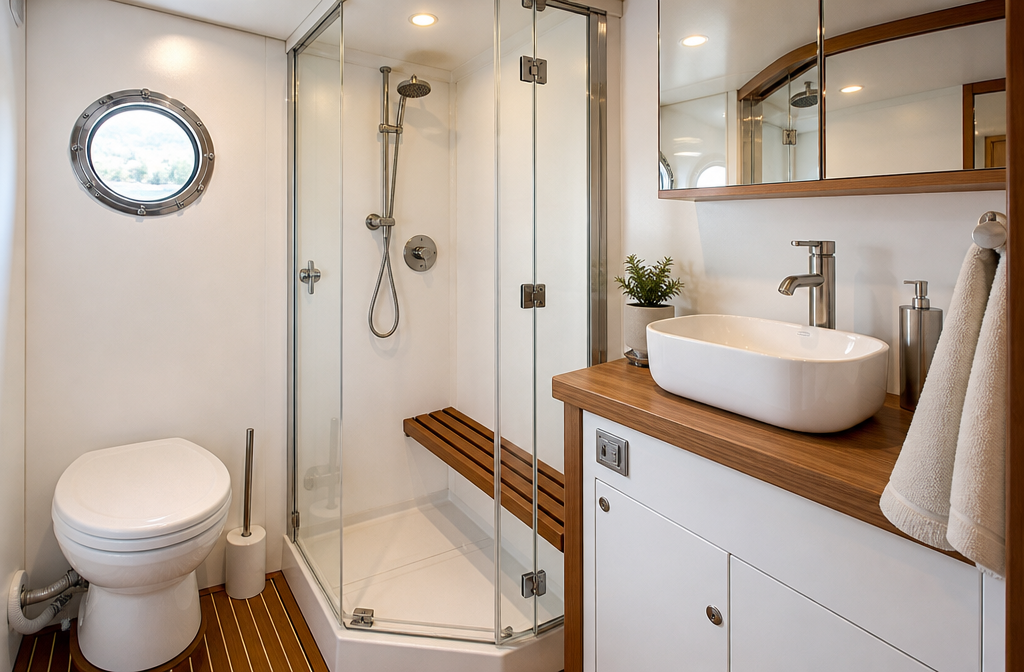
The most common problems are blockages, odors, and a full tank at the wrong time. All three can be avoided with a little foresight.
Common problems and solutions:
- Blockage: Mostly caused by wrong materials (wet wipes, thick toilet paper). Use only special boat paper or thin tissue paper.
- Odors: Occur with too few chemicals or a full tank. Empty tank in time, check ventilation valves.
- Pump not running: Often an electrical problem or a blocked macerator. Check fuse, clean macerator manually if necessary.
- Full tank on the go: Happens when there is no station nearby. Always check the fill level before leaving a marina.
What to do in case of a blockage of the onboard toilet?
In case of a blockage of the onboard toilet, the rule is: stay calm and do not use force. Chemical drain cleaners are taboo on boats because they attack seals and hoses.
Step-by-step for a blockage:
- Repeat the pumping process several times (for cassette toilets).
- Slowly pour in warm water and let it sit for 10 minutes.
- Use special boat toilet descaler (available in marinas).
- For vacuum toilets: Open the macerator cover and remove foreign objects.
- If nothing helps: Contact a boat mechanic at the nearest marina.
Prevention is the best protection: Use only boat-appropriate toilet paper, no wet wipes, no sanitary pads, no cotton swabs.
Are houseboats with toilets suitable for families?
Yes, absolutely. Modern houseboats are designed to allow families with children to live comfortably on board, and this explicitly includes the sanitary facilities. Many houseboats have two separate bathrooms, generous holding tanks, and user-friendly cassette toilets.
What families should pay attention to:
- Tank size: at least 80 to 100 liters for four people
- Number of bathrooms: Two bathrooms are highly recommended for families with children
- Route planning: Plan regular stops at marinas
- Briefing: Explain to children early on what is allowed in the toilet and what is not
Houseboats with a family setup can be specifically filtered on Campcruisers, so you can find the right boat for your crew directly.
Frequently asked questions
Can I shower on a houseboat like at home? Yes, most houseboats have full showers. Greywater goes into the greywater tank or is discharged directly, depending on the waterway and local regulations.
How do I know if my holding tank is full? Most modern houseboats have a level indicator in the cockpit or bathroom. Without an indicator: empty every two days at the latest for four people.
What does a pump-out station cost? In Germany and the Netherlands, emptying at a pump-out station costs between 5 and 15 Euros, depending on the marina. Many houseboat rental companies, including Campcruisers, include disposal fees in the rental price.
Am I allowed to empty the cassette tank in a normal toilet? Yes, this is allowed and even recommended in most countries if no pump-out station is available. Simply empty the cassette into a normal toilet bowl and flush.
How long does one filling of chemicals last in a cassette toilet? For two people and normal use, one filling (about 2 liters) lasts three to four days. For four people, correspondingly shorter.
Are there houseboats without a toilet on board? Very cheap or very old models may not have a fixed toilet, but this is an absolute exception with modern rental boats. All houseboats listed at Campcruisers have a full sanitary system.
What happens if I accidentally discharge black water into the water? This is a regulatory offense and can be punished with fines ranging from several hundred to several thousand euros, depending on the country and waterway. In addition, you are liable for environmental damage.
Can I use wet wipes in the onboard toilet? No. Wet wipes, even those marked as "flushable," reliably clog macerators and hoses. Only use toilet paper suitable for boats.
Ready for your houseboat vacation?
The issue of wastewater and toilets on a houseboat is much simpler than it appears at first glance. With the right system, thoughtful route planning, and a few simple rules, everything on board runs as smoothly as at home, only with the difference that a canal glitters outside instead of a front garden.
Ready for your houseboat vacation? Book your houseboat now with Campcruisers and start your next water adventure with a boat equipped for comfort and clean waters.


 English
  German
  Spanish
  Italian
  Polish
  Dutch
Dutch  French
  Danish