
Those who go on vacation for the first time with a houseboat or sailboat almost always make the same mistake: they pack as if for a hotel room. The result is stuffed cabins, frustrated fellow travelers, and luggage that gets in the way. Using storage space on the boat correctly is an art that can be learned quickly. This guide shows how to pack smartly for a small cabin, what really belongs on board, and what tricks experienced skippers use.
Short and to the point: Efficient packing for the small cabin means: soft bags instead of hard-shell suitcases, consistent decluttering before loading, and a clear system for clothing, equipment, and food. Those who adhere to these three basic rules will immediately gain noticeable space.
The most important things at a glance
- Soft duffel bags and dry bags adapt to the storage space, rigid suitcases do not
- Clothes are rolled, not folded, which saves up to 30% volume (estimate based on common packing techniques)
- Everything that is not packed waterproof on board will get wet sooner or later
- Every item needs a fixed place, otherwise it will slide around when tacking
- Store food in rigid containers, never in paper bags or cardboard boxes
- For a weekend trip, one medium-sized travel bag per person is sufficient
- Double duty is a must: clothing items that serve multiple functions have priority
- Moisture is the biggest enemy on board, silica gel packets and dry bags are a must
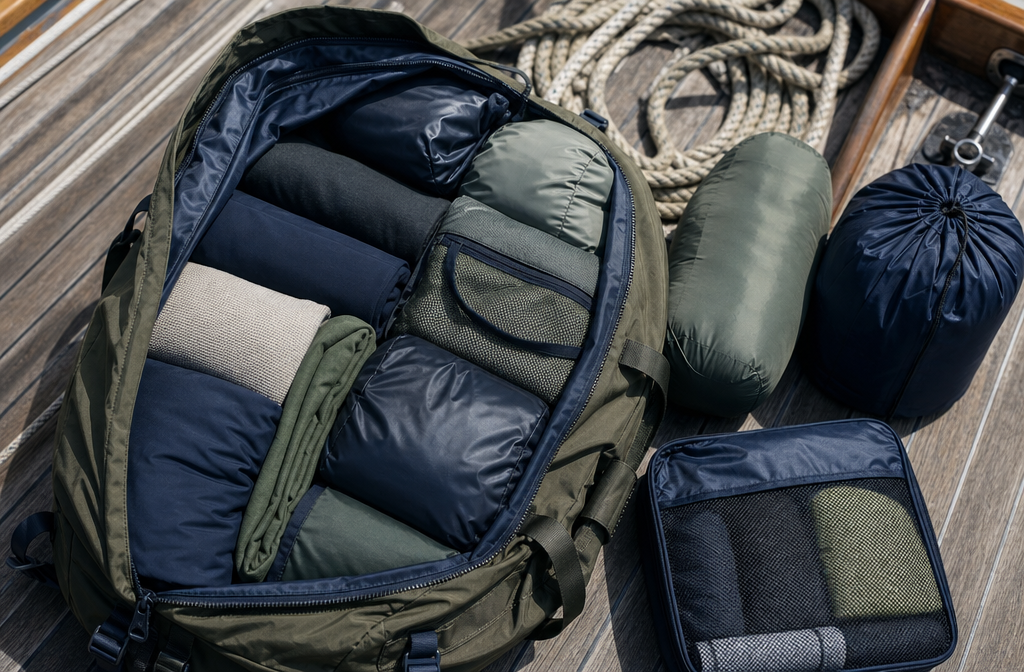
How do I pack most efficiently in a small cabin?
The most efficient approach for a small cabin is the so-called "Tetris principle": heavy items low and amidships, light things upwards and in the bow areas. Soft bags fill irregular voids where a suitcase would leave only empty space.
Concrete steps:
- Spread all items on the floor before packing and sort them into three categories: must take, maybe, stay at home
- Consistently roll clothes (so-called Ranger Roll technique)
- Store heavy equipment (tools, spare parts, water canisters) under the berths or in the bilge area
- Store light, rarely needed items in the forward berth or in high compartments
- Keep daily necessities readily accessible in a small deck bag or cockpit bag
Decision rule: If an item is needed less than twice on a 7-day trip, leave it at home.
What packing tips are there for sailboats with little storage space?
On sailboats, the available storage space is even scarcer than on houseboats because sails, lines, and safety equipment already take up a lot of space. The golden rule is: one person, one bag.
Practical tips specifically for sailboats:
- No hard-shell suitcases. They don't fit into the narrow storage spaces under the berths and roll around in rough seas
- Pre-sort clothes by daypack into individual zip-lock bags so you don't have to rummage through everything in the morning
- Reduce shoes to a minimum: one pair of deck shoes, one pair of sandals, that's it
- Microfiber towels instead of terry cloth, because they can be packed three times smaller
- Food in stackable plastic boxes with snap closure that do not open when the boat rolls
What really belongs on board and what can I leave behind?
What belongs on board is safe, functional, and compact. What can be left behind are comfort items that one is used to at home but have no place on a boat.
Must take:
| Category | Specific items |
|---|---|
| Clothing | 2-3 changes, rain jacket, fleece, swimwear |
| Security | Life jacket, signal whistle, waterproof flashlight |
| Navigation | Nautical charts, compass, cell phone in dry bag |
| Hygiene | Compact toiletries, sunscreen, insect repellent |
| Food | Dry goods in boxes, water in canisters |
Stays at home:
- Large hair dryers or electrical appliances (power is limited on small boats)
- More than two pairs of shoes
- Hardcover books (take an e-reader)
- Full cosmetic bottles (pour into small travel containers)
Space-saving suitcases and bags for boats
For storage space on the boat, soft, waterproof bags are the best choice. Dry bags made of PVC or TPU-coated nylon are the standard among experienced sailors and houseboat owners.
The best bag types in comparison:
- Dry Bag (10-30 liters): waterproof, compressible, ideal for clothing and electronics
- Duffel Bag: adapts to storage space shapes, no dead weight
- Mesh net organizer: for cockpit and cabin walls, keeps small items handy
- Compression sack: reduces sleeping bags and fleece jackets to a third of their volume
Hands off: Hard-shell rolling suitcases, backpacks with external frames, and large sports bags with rigid bottoms.
How do I organize clothing and gear in a confined space?
Clothing on a boat is never hung up or folded flat, but always rolled. This technique saves space and prevents deep creases. Gear is given a fixed, assigned place that is known to all fellow travelers.
Organization system for the cabin:
- Zone 1 (Berth): personal clothing in a dry bag under the mattress
- Zone 2 (Wardrobe/Compartment): shared equipment such as tools, medicine, spare parts
- Zone 3 (Cockpit Bag): Things needed during the day: sunscreen, snacks, map
- Zone 4 (Bilge): heavy reserves like water canisters and food supplies
Every person on board should know where things are located. This saves time and nerves, especially in bad weather.
How do I protect my belongings from moisture on the boat?
On a boat, everything gets damp at some point, either from spray, rain, or condensation in the cabin. Protection from moisture is not an option, but a necessity.
Proven methods:
- All clothing and electronics into waterproof dry bags pack, even if it's not raining
- silica gel packets place in storage compartments to combat condensation
- Electronics additionally in Zip-Lock bags pack
- Never put wet clothes in the bunk, but let them dry in the cockpit or on the mast
- Leave leather goods and sensitive materials at home if possible
Typical mistake: Many beginners pack their belongings in normal backpacks and wonder why everything is soaking wet after a rain shower. Waterproof bags are not a luxury, but essential equipment.
Avoid typical mistakes when packing a boat
The most common mistakes with storage space on a boat arise from habits of land life. Those who know them can avoid them deliberately.
The five most common mistakes:
- Packing too much: Storage space on a boat is limited. More luggage means more chaos, not more comfort.
- Rigid suitcases: Do not fit into the irregular storage spaces under bunks or in the forepeak.
- No system: If everyone stores their things somewhere, nobody finds anything.
- Ignoring moisture: Without dry bags, clothing and electronics are damaged.
- Storing food incorrectly: Cardboard boxes and paper bags get wet and moldy.
Which materials are best suited for boat luggage?
Materials that are light, robust, and water-repellent are suitable for boat luggage. PVC-coated nylon and TPU laminate are the industry standards for marine dry bags.
- PVC nylon: very waterproof, durable, slightly heavier
- TPU laminate: lighter, more environmentally friendly, also waterproof
- Polyester with DWR coating: water-repellent (not waterproof), good for deck bags
- Avoid: Cotton, leather, untreated canvas, as these materials absorb moisture and mold
What packing techniques do professional sailors use in small cabins?
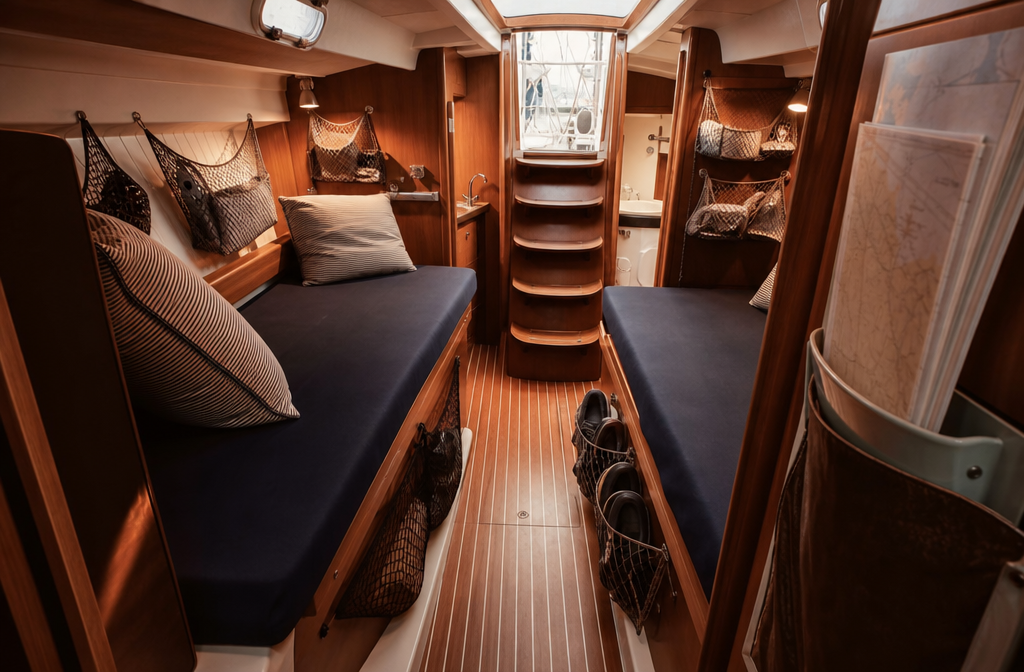
Professional sailors think in terms of weight and volume, not suitcase size. They pack according to the principle of "less is more" and rely on multifunctional equipment.
Pro tricks:
- Layering principle for dressing: Instead of thick jackets, several thin layers that can be combined
- Vacuum bags for sleeping bags and fleece jackets that halve the volume
- Cable ties and carabiners for attaching bags to railings or net holders
- Label everything: Tape and marker on every bag so you know what is where in the dark
- Distribute weight evenly: Too much weight on one side impairs sailing characteristics
Checklist for packing a boat with limited storage space
For a weekend trip (2-3 nights), the following packing list for one person is sufficient:
Clothing:
- 2 T-shirts
- 1 long pants
- 1 shorts
- 1 fleece jacket
- 1 waterproof rain jacket
- 3 underwear and socks
- 1 pair of boat shoes, 1 pair of flip-flops
- Swimwear
Gear:
- Life jacket
- Sunscreen (at least SPF 30)
- Microfiber towel
- Headlamp with spare batteries
- Mobile phone in drybag
- Nautical chart or GPS device
- First-aid kit (compact)
Food:
- Dry goods in stackable boxes
- Drinking water (at least 2 liters per person per day)
- Snacks in resealable bags
Frequently asked questions
How big should my bag be for a weekend trip on the boat? A 30-40 liter dry bag or a medium-sized duffel bag is perfectly sufficient for 2-3 nights. More volume only tempts you to pack more than necessary.
Can I use a normal backpack on the boat? Only if it has a waterproof outer shell or fits completely inside a dry bag. Standard backpacks get soaked in rain or spray.
How much clothing do I need for a week on the boat? As a rule of thumb, 3-4 changes are recommended for one week. Clothes can be washed on board or in the harbor. Taking more is hardly worthwhile.
Where can I safely store electronics? Always in a waterproof dry bag or a waterproof case. A zip-lock bag is also recommended as a second layer of protection for smartphones.
Can I take hard-shell suitcases on a boat? Technically yes, practically no. Hard-shell suitcases do not fit in the narrow storage spaces under berths and slide around in rough seas.
How do I distribute weight correctly on a sailboat? Heavy items belong deep in the hull (bilge) and as far midships as possible. Weight in the bow or stern noticeably deteriorates sailing characteristics.
What do I do if my belongings get damp despite a dry bag? Only consider dry bags truly waterproof if the roll closure is rolled at least three times and secured with the buckle. Simple knotting is not enough.
Can I store food in plastic bags? No. Plastic bags tear, become damp, and do not retain odors. Stackable plastic boxes with snap closures are the right choice.
Interactive Packing Helper Tool
Boat Packing List Checker
Check off what you've packed. The progress bar shows how ready you are.
Here's how it continues: Your houseboat vacation awaits
Organizing storage space on the boat correctly is not rocket science, but it requires a change in mentality: away from "I'd rather take too much" to "What do I really need?". Those who arrive with a dry bag instead of a rolling suitcase, roll clothes instead of folding them, and give every item a fixed place will quickly realize how relaxed life in a small cabin can be.
The reward for good packing is tangible: more freedom of movement on board, less stress when searching, and more energy for what really counts, namely the water, the wind, and freedom.
Ready for your houseboat vacation? Book your houseboat now with Campcruisers and experience how much adventure fits into a small cabin.


 English
  German
  Spanish
  Italian
  Polish
  Dutch
Dutch  French
  Danish