
Stagnant water, reeds, and warm summer evenings are a paradise for mosquitoes. Anyone planning a houseboat holiday or regularly out on the water knows: Without thoughtful Mosquito protection on the water a dream holiday quickly turns into an itching marathon. The good news is that mosquitoes can be reliably kept away with the right combination of repellents, clothing, and clever onboard solutions.
The most important things at a glance
- DEET and Icaridin-containing repellents offer the strongest protection on the water and last two to eight hours, depending on the concentration.
- Light-colored, long-sleeved clothing made of lightweight fabric significantly reduces mosquito bites without sacrificing comfort.
- Natural remedies like citronella or eucalyptus oil work, but offer shorter protection times and need to be applied more frequently.
- Children under two years old should not use DEET-containing products; Icaridin is considered safe from the age of two.
- Common mistakes: applying too little repellent, wrong order of sunscreen and repellent, leaving ventilation openings on the boat unprotected.
- Mosquito nets over sleeping areas and hatches are the most effective passive protection measure on houseboats.
- Allergy sufferers should opt for fragrance-free, hypoallergenic formulated products with Icaridin or PMD.
- Always apply sunscreen before repellent, maintaining a minimum 20-minute interval.
What are the best methods against mosquitoes during water sports?
The most effective strategy against mosquitoes on the water is a combination of chemical repellent, physical barriers, and behavioral measures. No single product offers complete protection; the interplay makes the difference.
The three pillars of mosquito protection on the water:
- Repellents on the skin: Products with active ingredients like DEET (10–50%), Icaridin (20%), or PMD (Lemon Eucalyptus extract) are the first line of defense. They interfere with mosquitoes' olfactory receptors, making humans invisible to them.
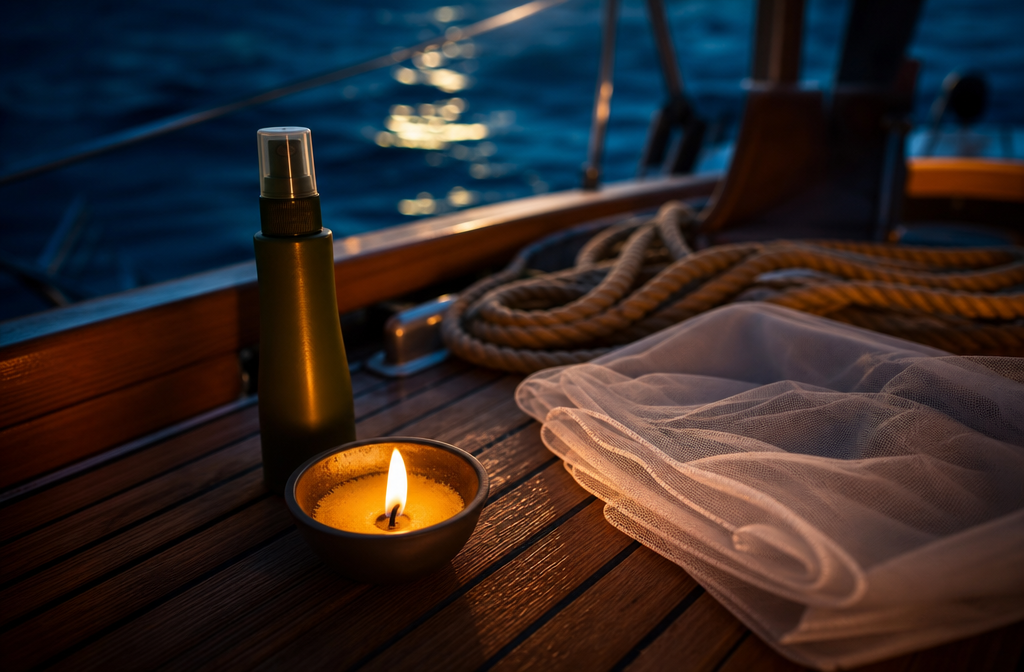
- Physical barriers: Mosquito nets over berths, hatches, and door openings keep insects out at night. On kayaks and SUP boards, close-fitting clothing and gaiters help.
- Environmental measures: Regularly empty standing water on board (buckets, flower pots), as it serves as a breeding ground. Citronella candles or electric vaporizers on deck create an additional protective zone.
Those who combine all three pillars reduce the risk of bites to a minimum, according to tropical medicine experts, even in mosquito-rich water regions like Mecklenburg Lake District or Spreewald.
How effective are mosquito repellents on boats and kayaks?
Mosquito repellents are generally as effective on water as they are on land, but they lose their effectiveness faster due to sweating, splashing water, and UV radiation. This means: more frequent reapplication is mandatory.
Active ingredient comparison on the water:
| Active ingredient | Protection time (dry) | Protection time (wet/water) | Suitable for children |
|---|---|---|---|
| DEET 30% | 4–6 hrs. | 2–3 hrs. | From 2 years old (max. 1x/day) |
| Icaridin 20% | 6–8 hrs. | 3–4 hrs. | From 2 years old |
| PMD (Citriodiol) | 3–4 hrs. | 1–2 hrs. | From 3 years old |
| Citronella (natural) | 30–60 min. | under 30 min. | Ja |
For kayaks and SUP boards, where spray water is unavoidable, Icaridin 20% is recommended as the best ratio of efficacy, skin compatibility, and water resistance. DEET also attacks plastics, which is relevant for boats with plastic parts or kayaks.
Which mosquito repellent products work best on the water
For use on the water, products that are formulated to be water-resistant and have an active ingredient content of at least 20% Icaridin or 30% DEET are suitable. Lotion formulations adhere better than sprays when spray water is a factor.
Recommended product categories:
- Lotion/Cream: Adheres longer to the skin, even with moisture. Ideal for houseboat holidays and calmer waters.
- Pump spray: Practical for quick reapplication, but difficult to apply on windy decks.
- Bracelet with repellent: Usable as a supplement, but not complete protection for the entire body.
- Electric vaporizer (12V/USB): Perfect for the cabin or cockpit of a houseboat. Works with mats or liquid cartridges.
Those traveling on a houseboat especially benefit from an electric vaporizer in the cabin, combined with a pump spray for time on the deck.
Are natural mosquito repellents safe and effective on the boat
Natural remedies are safe, but significantly less effective than chemical alternatives, especially on the water. They are suitable as a supplement, not as sole protection in mosquito-heavy areas.
Citronella, lavender oil, eucalyptus oil, and neem extracts are proven to repel mosquitoes, but their protection time rarely exceeds 30 to 60 minutes, and water further reduces it. For a relaxing evening on the boat deck at Schilfsee, a citronella candle is sufficient as atmospheric protection. For active watersports or regions with tiger mosquitoes, this is not enough.
When natural remedies make sense:
- As a supplement to chemical repellents
- For short outdoor stays (under an hour)
- For people with contact allergies to synthetic active ingredients (after consulting a doctor)
What are common mistakes in mosquito protection on the boat?
The most common mistake is applying too little repellent over too small an area. Mosquitoes find every unprotected spot, especially ankles, wrists, and the neck.
The most common mistakes at a glance:
- Too little product: Repellent must be applied evenly and generously to all exposed skin areas.
- Wrong order: Sunscreen always comes first, repellent afterwards. The other way around reduces the protective effect of both products.
- Forgotten hatches and vents: Mosquitoes don't just come through the door. All openings on the boat need nets.
- No reapplication: On the water, sunscreen needs to be reapplied every two to three hours, not just when it starts to itch.
- Standing water on board: Buckets, flower pots, or water collecting in tarpaulins are breeding grounds and should be emptied daily.
How do I protect children and babies from mosquitoes during water sports?
Children and babies require special attention when it comes to mosquito protection on the water, as many active ingredients have age-dependent restrictions. Physical barriers are the safest first choice for infants.
- Babies under 2 years old: No DEET, no Icaridin, no PMD. Mosquito nets over strollers and sleeping areas are the recommended method. Long-sleeved and long-legged clothing provides additional protection.
- Children from 2 years old: According to current pediatric knowledge, Icaridin 20% is considered safe to use, apply at most once a day. DEET is permitted from 2 years of age in low concentrations (max. 10%), but Icaridin is the gentler choice.
- Faces of children: Never spray repellent directly onto the face. Apply to your hands and then carefully distribute, avoiding eyes and mouth.

What clothing is most effective against mosquitoes on the water?
Light, tightly woven clothing with long sleeves and legs is the most effective passive protection measure against mosquitoes on the water. Dark colors and loose weaves attract mosquitoes and offer less protection.
Clothing recommendations for water sports:
- Light linen pants and long-sleeved shirts made of bamboo or functional fibers are breathable and still offer protection.
- Socks and closed shoes in the evening, as ankles are among the most frequently bitten body parts.
- Impregnated clothing (e.g., treated with permethrin) offers additional protection but is not suitable for direct skin contact and must be reapplied after several washes.
- On the houseboat: Light long-sleeved pajamas for the night, even if a mosquito net is available.
Are there mosquito protection solutions for allergy sufferers on boats?
Allergy sufferers have good alternatives to DEET: Icaridin is considered particularly kind to the skin and causes significantly fewer contact allergies than DEET or essential oils. Fragrance-free formulations are key.
If you react to fragrances or specific active ingredients, you should get an allergy test from a dermatologist before your vacation. For highly sensitized individuals, physical barriers (nets, clothing) are the safest strategy, supplemented by electric vaporizers in enclosed spaces that do not release skin contact allergens.
How long do mosquito repellents last on the water
On the water, the protective time of all repellents is reduced by 30 to 50 percent compared to the manufacturer's recommendation because sweat, spray water, and UV radiation break down the active ingredient. As a rule of thumb: reapply every two hours, immediately after swimming.
What to do if mosquito repellents don't work on the boat
If a repellent doesn't work, it's usually due to too low a concentration, incorrect application, or a mosquito species that reacts less to the active ingredient used. The first step is to switch to a higher concentration product or a different active ingredient.
Troubleshooting checklist:
- Was the product generously applied to all exposed areas?
- Has it been more than two hours since the last application?
- Are these tiger mosquitoes? They are active during the day and react less strongly to DEET than to Icaridin.
- Are all hatches and openings on the boat secured with nets?
- Is there standing water on board that serves as a breeding ground?
If all these points are checked off and bites still occur, an electric vaporizer in the cabin is the most reliable supplement.
Which mosquito species are particularly dangerous on the water
In Central Europe, native mosquitoes (Culex pipiens) and the increasingly widespread Asian tiger mosquito (Aedes albopictus) are the most common species on inland waters. The tiger mosquito is active during the day, smaller and more aggressive than the common mosquito, and transmits Dengue fever and Zika viruses in tropical regions.
In Germany and Austria, the risk of tropical diseases being transmitted by native mosquitoes is currently low, but the tiger mosquito is continuing to spread northward due to climate change. Anyone traveling on houseboats in Southern Europe or outside of Europe should inform themselves about current risks at a tropical institute.
Can I combine mosquito repellent with sunscreen
Yes, mosquito repellent and sunscreen can be combined, but the order is crucial: always apply sunscreen first and let it absorb for at least 20 minutes, then apply the repellent. Combination products of sunscreen and repellent sound practical, but they are problematic for two reasons: sunscreen needs to be reapplied more often than repellent, and the combination can reduce the effectiveness of both products.
On the water, where UV reflection intensifies sun exposure, a high sun protection factor (at least SPF 30) is essential anyway. If you need both, it's better to use two separate products and consistently adhere to the order.
Conclusion: Well protected on the water
Mosquito protection on the water is not rocket science, but it requires more consistency than on land. The combination of a highly effective repellent (Icaridin 20% is the most versatile choice), tightly woven clothing, mosquito nets on board, and regular emptying of standing water sources makes the difference between a relaxing evening on deck and a sleepless night full of itching.
Anyone who internalizes these basic rules can concentrate fully on what matters: the water, the silence, and the feeling of being able to completely switch off on a houseboat.
Ready for your houseboat holiday? Book your houseboat now with Campcruisers and enjoy the summer on the water without pests.
Frequently Asked Questions
Which repellent is most effective on the water? Icaridin 20% is the best choice on the water: skin-friendly, effective against mosquitoes and tiger mosquitoes, does not attack plastic parts, and lasts for three to four hours even in humidity.
How often do I need to apply mosquito repellent on the boat? Every two hours on the water, immediately after swimming or heavy sweating. Manufacturer instructions apply to dry conditions on land.
Can I use mosquito repellent on the boat for children under two years old? No. For babies and toddlers under two years old, mosquito nets and protective clothing are the recommended method. No chemical repellents.
Are mosquito nets really necessary on houseboats? Yes, especially for sleeping areas and hatches. Mosquitoes are nocturnal and find any unsecured opening. A net is the most effective and cheapest passive protective measure.
Can mosquito repellent damage plastic parts on the boat? DEET can dissolve plastics, varnishes, and synthetic fabrics. For kayaks and boats with plastic parts, Icaridin is the safe alternative.
Do ultrasonic mosquito repellents work on the boat? No. Ultrasonic devices against mosquitoes have shown no demonstrable effectiveness in independent tests. Rely on chemical or physical methods.
Which mosquito species bite during the day on the water? The Asian tiger mosquito (Aedes albopictus) is diurnal and increasingly widespread in warmer regions of Europe. Icaridin is more effective against it than DEET.
How do I protect the boat itself from mosquitoes? Secure all hatches and ventilation openings with fine-mesh nets, empty standing water on board daily, and operate an electric vaporizer in the cabin.


 English
  German
  Spanish
  Italian
  Polish
  Dutch
Dutch  French
  Danish