
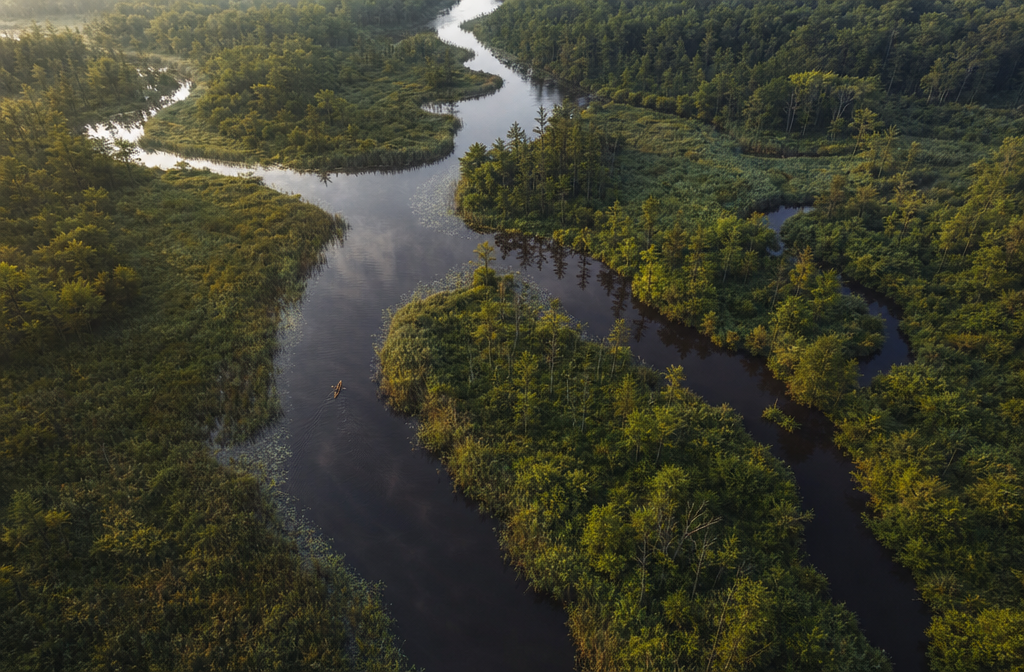
Few rivers in Central Europe are as untouched and wild as the Peene in Mecklenburg-Western Pomerania. For about 180 kilometers, it meanders through one of Western Europe's last large lowland moors, and conservationists rightly call it the "Amazon of the North." Those who explore the Peene region by boat immerse themselves in a world that has hardly changed in centuries, and experience a wilderness that one would not expect in Germany.
What makes the Peene region so special?
The Peene is one of the slowest and most natural rivers in Germany, with a gradient of almost zero and a water level that depends heavily on wind direction and Baltic Sea tides. This is precisely what makes it unique: the water sometimes even flows backward. This peculiarity, combined with extensive alder carr forests, vast reed belts, and countless oxbow lakes, creates an ecosystem that is unparalleled in Europe.
Compared to other German river landscapes like the Rhine, Elbe, or Müritz Lake District, the Peene region offers significantly less boat traffic, hardly any development on the banks, and a silence that allows for true deceleration. Those traveling here by houseboat or canoe have long stretches to themselves.
What distinguishes the Peene from other river landscapes:
- Almost no gradient, resulting in extremely calm, low-current waters
- Peaty, dark-colored water surface due to moor water (similar to Amazon blackwater)
- Little industrial use or development along the banks
- One of the most important wetlands in Central Europe, protected area according to the EU Fauna-Flora-Habitat Directive
- Home to over 100 breeding bird species, including white-tailed eagle, kingfisher, and crane
What wildlife will you encounter on the water?
The Peene region is one of the most species-rich wildlife areas in Germany north of the low mountain ranges. Those who travel slowly and quietly by boat have very good chances of observing rare animals up close.
The white-tailed eagle population is particularly impressive: the Peene valley is considered one of the densest white-tailed eagle breeding regions in Europe. In addition, there are ospreys, black storks, beavers, otters, and in autumn, tens of thousands of cranes resting in the region.
Common animal sightings on the water:
| Animal species | Best observation time | Probability |
|---|---|---|
| Sea eagle | All year round, esp. in the morning | Very high |
| Kingfisher | April to October | High |
| Beaver | Twilight, morning | Medium to high |
| Crane | September to November | Very high (autumn) |
| Otter | Early morning | Medium |
Important: Noise and fast movements scare the animals away. Houseboats and canoes have a clear advantage here over high-speed motorboats.
When is the best time to travel for a boat trip?
The best time for boat trips on the Peene is between May and October, with each season having its own charm.
- May to June: Fresh greenery, few tourists, many breeding birds active, pleasant temperatures
- July to August: Warmest weather, longest days, but also the most fellow travelers on the water
- September to October: Crane stopover, golden autumn light, significantly quieter, ideal for photographers
Anyone who wants to avoid the midsummer hustle and bustle is better off traveling in May or September. The Peene is not a mass tourist destination, but it is noticeably busier during school holidays than usual.
What does a boat trip in the Peene region cost?
The costs vary greatly depending on the type of tour and duration. As a rough guide:
- Guided canoe tour (day trip): approx. 30 to 60 euros per person, depending on the provider and group size
- Kayak/canoe rental (paddling yourself): approx. 20 to 40 euros per day for a single kayak
- Houseboat rental (week-long trip): depending on the boat type and season, between 800 and 2,500 euros per week for the entire boat
Houseboats offer the best value for money experience for families or groups, as accommodation and transport are included in one. At Campcruisers you will find houseboats specifically for the Peene region in various sizes and price ranges.
Ready for a houseboat holiday? Book your houseboat now at Campcruisers.
Guided tours or paddling yourself, which is a better fit?
Guided tours and independent canoe or houseboat tours appeal to different travelers. Both have clear strengths.
Guided boat tours:
- Ideal for first-time visitors without local knowledge
- Nature guides explain the ecosystem, animal species, and history
- No prior paddling experience needed
- Fixed route, fixed times, less spontaneity
Paddling yourself or taking a houseboat:
- Maximum freedom in terms of pace and route
- Overnight stays directly on the water are possible
- Requires some instruction, but no license for houseboats below a certain engine power
- Better for animal observation because you set the pace yourself
Decision rule: Those visiting the region for the first time and primarily wishing to observe animals will benefit from a guided half-day canoe tour as an introduction. For a holiday of several days, a houseboat is the superior choice.
How difficult are the boat routes for beginners?
The Peene is very suitable for beginners. The current is minimal, there are no rapids or technically challenging passages, and the water depth on the main routes is sufficient for houseboats.
For canoeists: Those who have received a brief introduction and master basic paddling techniques can manage without problems. Children from about eight years old can paddle safely with adults.
The only challenge: wind. Since the Peene flows through open reed landscapes, crosswinds on wider sections can drift canoes away. In strong winds, it's better to choose a sheltered side arm.
Is the Peene region suitable for children and seniors?
Yes, explicitly. The calm waters, the slow pace, and the possibility to dock at any time make the Peene region one of the most family-friendly boating regions in Germany.
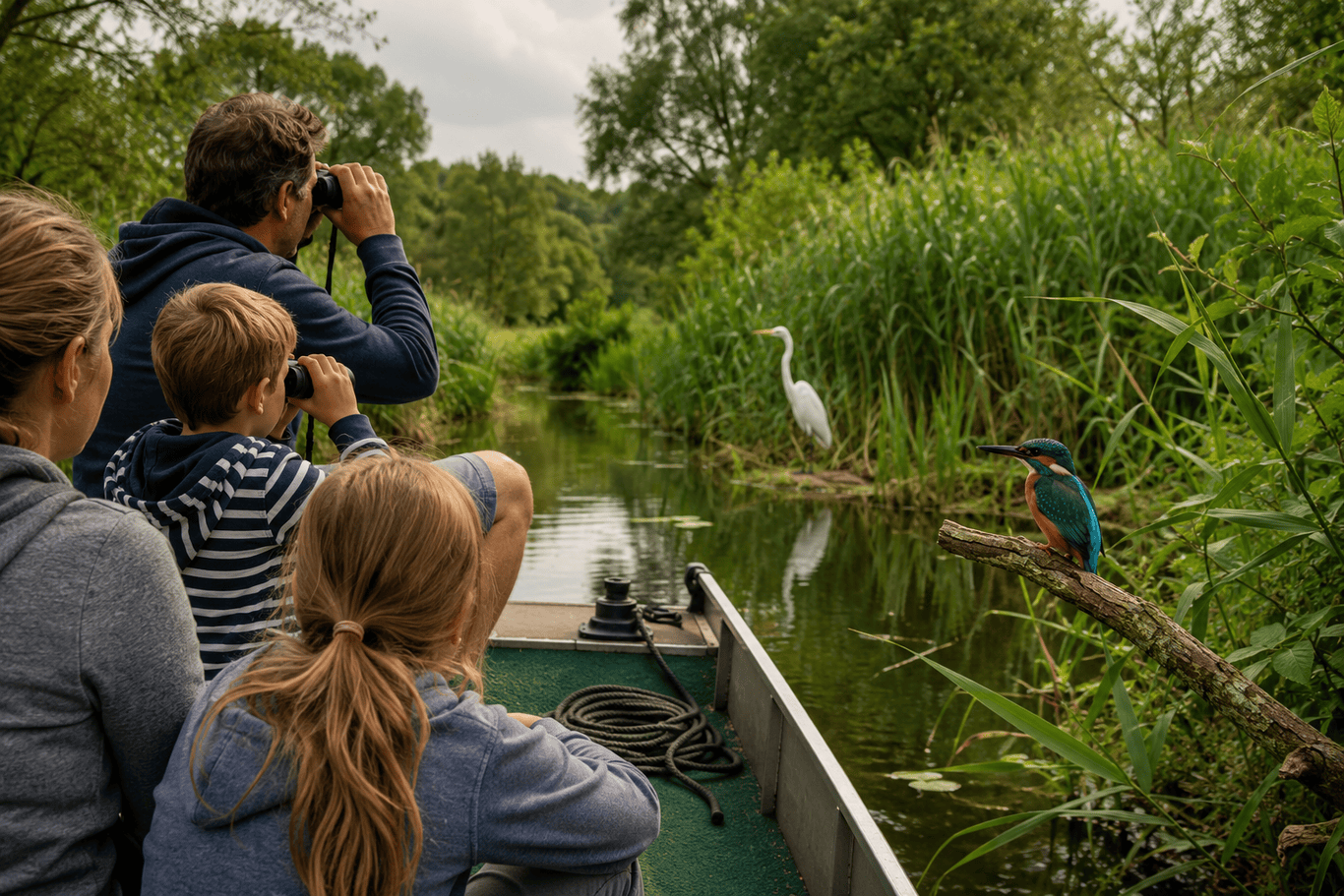
For seniors, a houseboat offers the advantage of not having to constantly get in and out. The deck serves as an observation platform, and the pace can be adjusted at any time. Children love the animal observations and the freedom on the water.
Recommendation for families: Houseboat with a flat deck and railing, pack binoculars, set off early in the morning for the best animal observations.
What equipment and clothing do you need?
A boat trip on the Peene requires no special equipment, but proper preparation makes the difference.
Absolutely take with you:
- Waterproof jacket (weather in Northern Germany changes quickly)
- Sturdy footwear with good grip for wet decks
- Insect repellent (essential in the reed areas, especially in the evening)
- Binoculars for animal observation
- Sun protection (the sun is strongly reflected on the water)
- Waterproof bag for camera and mobile phone
For houseboat renters, the landlord usually provides life jackets, boat hooks, and basic equipment. Inquire about your own bed linen and towels depending on the provider.
Safety on the water: What do you need to know?
The Peene is considered a safe area, but a few basic rules always apply.
- Always wear life jackets for all passengers, especially for children.
- Check the weather report daily, avoid thunderstorms on the water.
- Observe speed limits (nature reserves have strict rules).
- Do not enter reed or swamp areas, avoid grounding and environmental damage.
- Always have the emergency number and boat rental contact readily available.
Special note: Parts of the Peene and its tributaries are nature reserves. Mooring at undesignated spots is forbidden and is monitored.
Photography on the Peene: What awaits you?
The Peene region is a paradise for nature photographers. The combination of soft northern light, reflections on the calm water, and the proximity to shy wild animals creates shooting conditions that are rare in Central Europe.
Best photo opportunities:
- Sea eagles in a landing approach to tree stumps on the bank
- Morning fog over the reed belts shortly after sunrise
- Crane migration in autumn (October is the peak)
- Reflections of alder carr forests in the black moor water
- Houseboat at dusk, surrounded by reeds
Practical tip: Telephoto lens from 300mm for birds, wide-angle for landscape shots. Turn off the engine and let it drift for the calmest shots without vibration.
What alternative river landscapes are there in Germany?
Those who love the Peene region will find some similar, but not identical, alternatives in Germany.
- Müritz National Park (Mecklenburg): More lakes than rivers, good for houseboats, slightly more boat traffic
- Spreewald (Brandenburg): Denser canal network, culturally richer, less wilderness, more tourism
- Elbe Floodplain (Lower Saxony/Saxony-Anhalt): Wider river, impressive floodplains, but stronger current
- Lewitz (Mecklenburg): Smaller, quieter area, ideal for those seeking absolute tranquility
However, none of these regions combine the character of wilderness, biodiversity, and accessibility by houseboat as the Peene does.
Common mistakes by tourists in the Peene region
Even well-prepared travelers sometimes make avoidable mistakes.
- Planning too much distance: The Peene rewards slowness. Those who want to cover 50 kilometers daily will miss the best.
- Underestimating mosquitoes: Sitting on deck in the evening without protection ends painfully.
- Docking without permission: Many banks are protected areas. Only stop at designated landing stages.
- Traveling without binoculars: Most animal sightings happen from a distance.
- Book peak season without reservation: Good houseboats in the region are quickly booked up in July and August.
Frequently asked questions about the Peene region by boat
Do I need a boat license for a houseboat on the Peene? For houseboats with an engine power up to certain limits (in Germany often up to 15 HP on inland waters), no license is required. The rental company will provide precise information during the briefing.
How long should a houseboat holiday on the Peene last at a minimum? At least five to seven days to truly experience the region. Shorter stays leave little time for spontaneous discoveries.
Are there supply options along the way? Yes, in towns like Demmin, Anklam, and Loitz, there are supermarkets and gas stations. However, the distances between supply points on the water itself are large, so plan well in advance.
Is the Peene also recommended in autumn? Absolutely. The crane migration in October is one of Germany's most spectacular natural phenomena. Fewer tourists, golden light, and clear air make autumn the insider tip season.
Can you barbecue on the houseboat? That depends on the rental company. Many allow barbecuing on deck, some even provide grills. Inquire with the rental company beforehand.
How far in advance should one book? For the peak season (July/August), at least three to six months in advance. For May, June, and September, four to eight weeks are often sufficient.
Is there WiFi or mobile reception on the Peene? Mobile reception is weak to non-existent in remote sections. This is part of the experience and a plus for many guests.
Which places along the Peene are particularly worth seeing? Demmin with its historic old town, the Peenetal nature reserve near Gützkow, and the estuary region near Anklam close to the Baltic Sea are special highlights.
Conclusion: Why the Peene region is unforgettable by boat
The Peene region is not an ordinary travel destination. Anyone traveling here by houseboat experiences a nature that has almost disappeared in Western Europe and a silence that cannot be bought in any hotel. The combination of accessible waters, exceptional wildlife, and true seclusion makes the Peene region by boat one of the most valuable natural experiences in Germany.
Concrete next steps:
- Set travel dates (May or September for calmer conditions)
- Choose houseboat size according to group number
- Book early, especially for the summer months
- Pack binoculars, insect repellent, and waterproof clothing
- Slow down and enjoy the slowness of the Peene
Ready for your houseboat holiday? Book your houseboat now with Campcruisers and experience the Peene region as it should be: slow, wild, and unforgettable.


 English
  German
  Spanish
  Italian
  Polish
  Dutch
Dutch  French
  Danish