
Less than 10 liters of fresh water per person per day – that's how little experienced boaters actually manage with on long tours, while an average household in Germany consumes around 125 liters daily according to the Federal Environment Agency. Electricity and water on the houseboat: How you live resource-efficiently is therefore not an abstract eco-issue, but hard everyday practice. Anyone who lives or travels on the water must actively manage resources – and those who do it well save money, protect the environment, and enjoy more freedom on the water.
What you should know at a glance:
- A typical houseboat consumes between 2 and 8 kWh of electricity per day, depending on size, season, and equipment.
- Solar systems with 400 to 800 watts peak are the most practical and economical energy source for most houseboats.
- The installation of a self-sufficient energy system costs between 3,000 and 15,000 Euros, depending on the scope.
- Water consumption can be reduced to under 30 liters per person per day through low-pressure faucets, greywater recycling, and conscious behavior.
- Beginners regularly underestimate the energy requirements of air conditioners, water heaters, and older refrigerators.
- Legally, different regulations apply to electricity and water supply on houseboats depending on the mooring – the harbor operator is the first point of contact.
- With good planning, houseboats can have a significantly smaller carbon footprint than comparable land households.
What are the basic costs for electricity and water on a houseboat?
The ongoing costs for electricity and water on a houseboat range between 50 and 300 Euros per month, depending on the mooring and degree of self-sufficiency. Those moored at a pier with shore power and water connection pay harbor fees plus consumption – those living off-grid have higher investment costs but lower running expenses.
Typical cost items at a glance:
| Item | Costs per month (estimate) |
|---|---|
| Shore power at the pier | 30 – 120 Euros |
| Fresh water at the pier | 10 – 40 Euros |
| Harbor fee (incl. electricity/water) | 80 – 250 Euros |
| Diesel generator (fuel) | 50 – 200 Euros |
| Maintenance solar system/battery | 10 – 30 Euros |
A common mistake: Beginners only calculate the electricity price, but forget about harbor fees, generator maintenance costs, and battery replacement every five to eight years.
How much energy does a typical houseboat consume per day?
An average houseboat with two to four people consumes between 2 and 8 kWh of electricity daily. In summer, when air conditioners are running, this value can increase to 10 to 15 kWh.
Which devices consume the most electricity on a houseboat?
The biggest energy guzzlers are air conditioners (1,500 – 3,500 watts), electric water heaters (1,500 – 2,000 watts), tumble dryers, and induction stoves. Refrigerators, lighting, and consumer electronics, on the other hand, are negligible if they are modern and efficient.
Top consumers and savings potential:
- Air conditioning: Up to 60% savings possible through good insulation and shading
- Water heater: Solar thermal or instantaneous water heaters with a timer save 40 – 70%
- Refrigerator: 12-volt compressor refrigerators consume up to 80% less than household appliances
- Pumps: Pressure water pumps often run unnecessarily long – pressure tanks significantly reduce running times
Which solar and battery systems are best suited for houseboats?
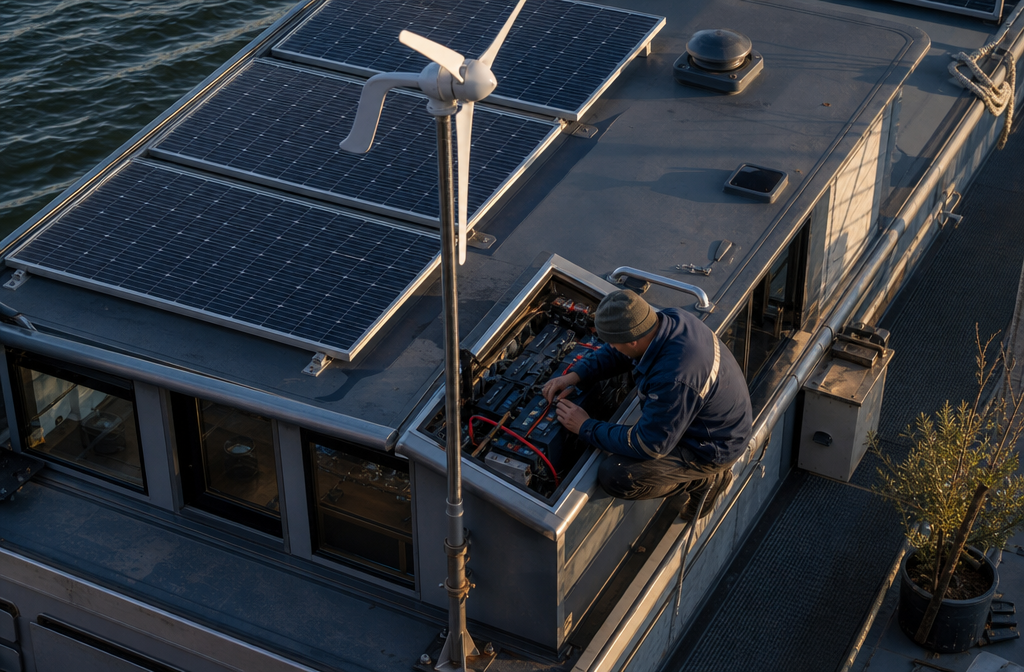
For most houseboats, monocrystalline solar modules with 400 to 800 watts peak combined with a lithium iron phosphate battery (LiFePO4) are the best solution. This combination offers high energy density, long service life (over 3,000 charging cycles), and good deep discharge capability.
Recommended system configuration by boat size:
- Small houseboat (up to 8 m): 400 Wp solar + 100 Ah LiFePO4 battery
- Medium houseboat (8 – 12 m): 600 – 800 Wp solar + 200 Ah LiFePO4 battery
- Large houseboat (over 12 m): 1,000+ Wp solar + 400 Ah battery bank
An MPPT charge controller (Maximum Power Point Tracking) is essential – it extracts up to 30% more energy from the panels than older PWM controllers. Those who spend a lot of time in the shade or travel in northern latitudes should dimension the battery capacity more generously.
Alternative energy sources for houseboats besides solar
Solar is not always enough, especially in autumn and winter or in cloudy weather. Small wind turbines (300 – 600 watts), hydrogen-based fuel cells, and diesel or gasoline generators are useful additions.
- Wind turbines: Sensible on exposed waters, less suitable in narrow canals or marinas
- Fuel cells: Still expensive (from 5,000 Euros), but silent and efficient – technology is maturing rapidly
- Diesel generator: Inexpensive to purchase, but noisy, maintenance-intensive, and polluting
- Shore power: Practical in the harbor, but limits independence
Anyone who wants to manage electricity and water on a houseboat in a truly resource-conserving way is best advised to combine solar as the main source with a small wind turbine or a generator as backup.
How can I reduce water consumption on a houseboat?
Water consumption on a houseboat can be reduced to 20 to 40 liters per person per day through technical measures and conscious behavior. Low-pressure taps, short showers, and a functioning greywater system are crucial.
Practical measures:
- Install aerators on all faucets (reduces flow by 40 – 60 %)
- Install flow restrictors in the shower (max. 6 liters per minute)
- Reuse greywater from shower and sink for toilet flushing
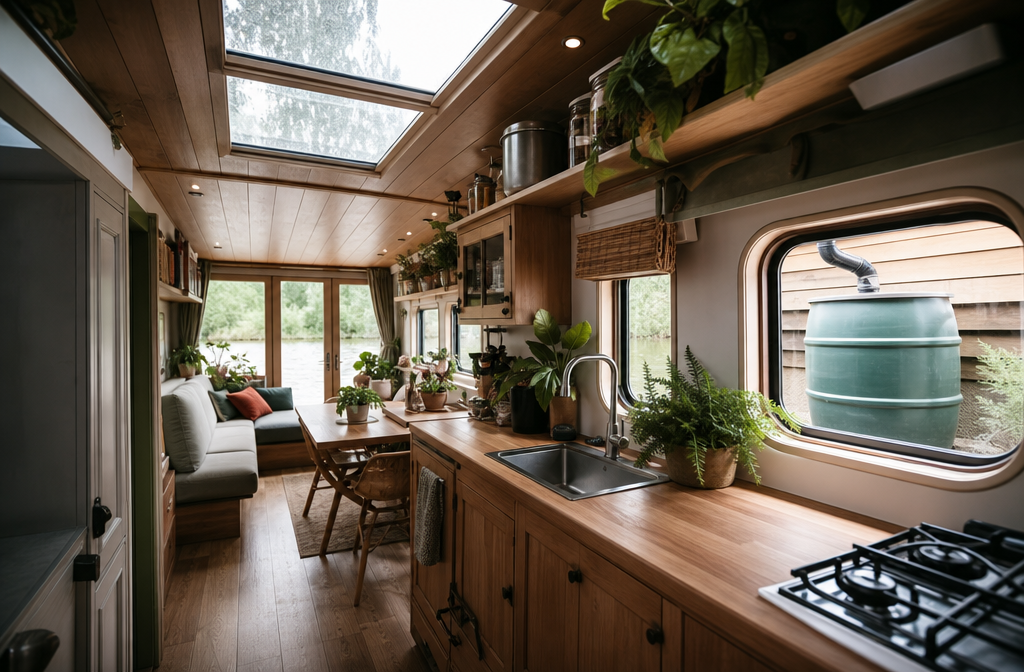
- Collect rainwater and use it for deck washing or the toilet
- Dishwasher instead of hand washing – modern appliances use only 6 – 9 liters per cycle
How does water management work on longer trips?
On trips without shore power, well-thought-out water management is vital for survival. The fresh water tank should be completely filled before departure, and daily consumption must be consistently monitored.
A good guideline: 30 liters per person per day as a planning basis, with a buffer of 20 %. For a five-day tour for two, you therefore need at least 300 + 60 = 360 liters of tank capacity. Many houseboats have tanks between 200 and 500 liters – knowing this allows for planning stops at marinas accordingly.
A water filter system (activated carbon + UV sterilization) makes it possible to safely use water from locks or harbors and significantly extends the range.
What does it cost to install an autonomous energy system on a houseboat?
A complete self-sufficient energy system for a medium-sized houseboat costs between 5,000 and 15,000 Euros including installation. Those who do the work themselves can save on labor costs, but should have electrical installations checked by a professional.
Cost estimate for a 10-meter houseboat:
- Solar modules (600 Wp): 600 – 900 Euros
- MPPT charge controller: 150 – 300 Euros
- LiFePO4 battery (200 Ah): 1,200 – 2,000 Euros
- Inverter (2,000 Watts): 300 – 600 Euros
- Wiring, fuses, mounting: 800 – 2,500 Euros
- Total: approx. 3,050 – 6,300 Euros (Material costs, without installation by a professional company)
The payback period is three to six years with average mooring fees of 100 Euros per month.
What mistakes do beginners make with power supply on houseboats?
The most common mistake is undersized battery capacity. Those who only look at solar power and neglect storage will be sitting in the dark after two cloudy days.
The five classic beginner mistakes:
- Battery capacity too low – rule of thumb: plan for at least two days' consumption as a buffer
- Using household appliances instead of marine appliances – higher consumption, no saltwater resistance
- Not keeping an energy balance – without monitoring, you don't know where the electricity goes
- Shore power as a permanent solution – limits flexibility and creates dependency
- Heating water electrically instead of solar – the biggest avoidable energy consumer on board
Is a houseboat practical for families with children?
Yes, houseboats are very suitable for families if the resource planning is right. Children quickly learn conscious handling of water and electricity – a real educational gain.
Important: child safety locks on tanks and electrical installations, non-slip floors and clear rules for handling water on board. Many families report that managing resources together strengthens their sense of togetherness and raises children's awareness of environmental issues.
Environmental impact of houseboats compared to permanent housing
With good equipment, houseboats have a significantly smaller carbon footprint than comparable land-based households. A fully solar-powered unit with efficient water usage can reduce CO2 emissions for energy and water by 60 to 80% compared to an average German household (estimate based on Federal Environment Agency consumption data 2023).
Critical are propulsion engines (diesel), wastewater disposal and paints/antifouling agents. Those who opt for electric propulsion, use biodegradable cleaning agents and dispose of greywater correctly actually live more environmentally friendly than in many city apartments.
Legal framework for electricity and water supply on houseboats
The legal requirements for electricity and water on houseboats vary considerably depending on the federal state, waterway, and mooring. In principle: wastewater must not be discharged untreated into the water (Water Management Act § 48), and electrical systems must comply with VDE standards for ships.
What you specifically need to clarify:
- Port regulations of the respective mooring – governs electricity and water connections
- Registration of the houseboat by the responsible Waterways and Shipping Authority
- Wastewater disposal: Black water tank with proof of disposal often mandatory in many ports
- Electrical installations: Inspection by a certified electrician recommended
If you are unsure, the German Motor Yacht Association (DMYV) or a specialized marine lawyer is the right point of contact.
Frequently asked questions
How long does a 200-liter fresh water tank last on a houseboat? With a consumption of 30 liters per person per day, a 200-liter tank is sufficient for two people for a good three days. With consistent saving and greywater recycling, four to five days are realistic.
Can I operate a normal washing machine on a houseboat? Yes, but only with sufficient battery capacity or shore power. A washing machine draws up to 2,000 watts at the heating element – that overwhelms small solar systems. Cold wash programs and front-loaders with low water consumption are the better choice.
Do I need special insurance for an autonomous energy system? The solar system and battery bank should be registered in the boat insurance as special equipment. Many standard policies do not automatically cover retrofitted systems.
How often do I need to replace lithium batteries on a houseboat? LiFePO4 batteries last 8 to 15 years or over 3,000 charging cycles with correct use. Overcharging and deep discharge below 10% remaining capacity significantly shorten the lifespan.
Is rainwater harvesting legal on houseboats? In Germany, collecting rainwater is generally permitted. However, the requirements of the Trinkwasserverordnung (Drinking Water Ordinance) apply to its use as drinking water – a multi-stage filter system is mandatory.
What is the difference between an inverter and a charge controller? The charge controller manages the charging of the battery from the solar system. The inverter converts the DC current from the battery into 230-volt AC current for household appliances. Both devices are necessary for an autonomous system.
How warm does it get on a houseboat in winter without shore power? With a well-insulated boat hull and a diesel heater (e.g., Webasto or Eberspächer), indoor temperatures of 20 degrees can be easily achieved even with outdoor temperatures of minus 10 degrees. Diesel consumption is between 0.5 and 1.5 liters per hour.
Ready for your houseboat vacation?
Managing electricity and water on a houseboat in a resource-efficient way is not a sacrifice – it is the opposite. Once you understand how a well-designed energy system works, you will enjoy a freedom on the water that no hotel room can offer. The combination of a solar system, efficient water use, and conscious consumption makes houseboat living not only cheaper but also more sustainable and independent.
The first step doesn't have to be a purchase. A test drive on a well-equipped houseboat quickly shows what is really needed – and what is not.
Ready for your houseboat vacation? Book your houseboat now with Campcruisers and start your adventure on the water.
Houseboat Daily Consumption Calculator
Estimated Electricity Consumption: – kWh/day
Water Consumption: – Liters/day
Recommended Solar Power: – Wp
Recommended battery capacity: – Ah (12V LiFePO4)


 English
  German
  Spanish
  Italian
  Polish
  Dutch
Dutch  French
  Danish