
Quick Answer: Farmers and landowners can convert their farm into an attractive motorhome pitch with comparatively little effort. With the right permits, solid basic equipment and clever marketing via platforms like Campcruisers, between 30 and 50 euros per pitch per night can be earned. The key is to leverage the uniqueness of farm life as a unique selling proposition, rather than competing with large campsites.
Key Takeaways
- In Germany, motorhome pitches require a permit. For agricultural businesses in rural areas, up to three pitches can be approved as a "related project" in many federal states.
- 30 to 50 euros per pitch and night are realistic. With 100 to 120 occupancy days per year, this results in a noticeable additional income.
- Commercial liability insurance is mandatory, not an option.
- Campers on a farm want nature, peace and authenticity. Less infrastructure is often more, if the atmosphere is right.
- For stays of several days, electricity (CEE socket, 16 amps), water and a disposal option are required at a minimum.
- Marketing via Campcruisers specifically reaches travelling motorhome users, without any marketing effort of their own.
- Common mistakes: creating too many pitches without a permit, lack of insurance, unclear house rules.
- Farm Camping and Glamping are two different concepts. Those who start with tents and simple meadows need less start-up capital.
What is agritourism and how does it work on a farm?
Agritourism means that agricultural businesses offer tourist accommodation without giving up their core business. The farm remains a farm, but part of the land is opened up to campers.
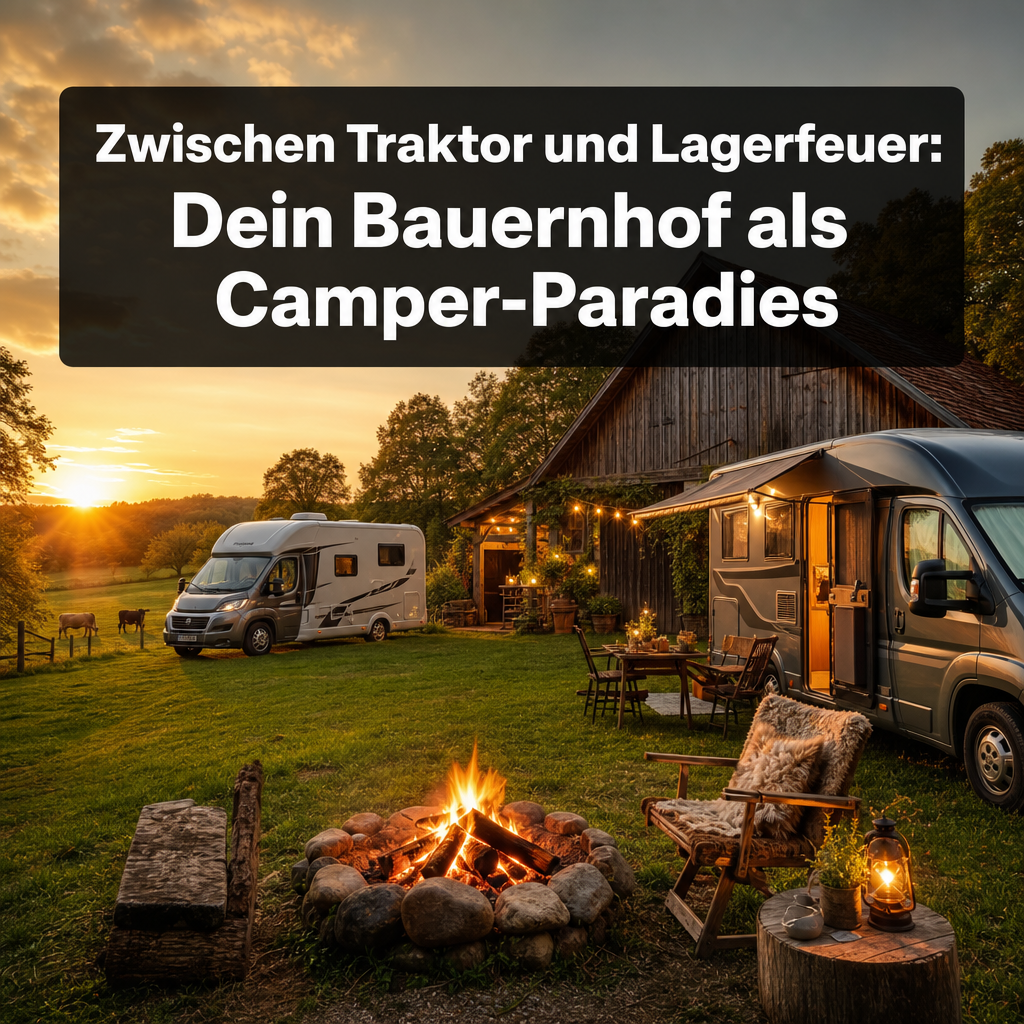
Specifically, it works like this: Farmers provide a meadow, an orchard or an area next to the farmstead for motorhomes, caravans or tents. Guests pay a nightly or weekly flat rate and in return get a spot in real country air, far away from crowded campsites. The model "Between tractor and campfire: How to effortlessly turn your farm into a camper paradise" thrives precisely on this contrast: authenticity instead of entertainment programs.
According to the Caravaning Industry Association (CIVD), over 1.6 million camping vehicles are now registered in Germany. The demand for alternative, nature-oriented pitches is growing faster than the supply. For farms with available land, this is a real opportunity.
Who benefits from this?
- Agricultural businesses with unused marginal land
- Private properties in rural or touristically interesting locations
- Businesses that already operate direct sales or farm shops
How much money can you earn with farm camping?
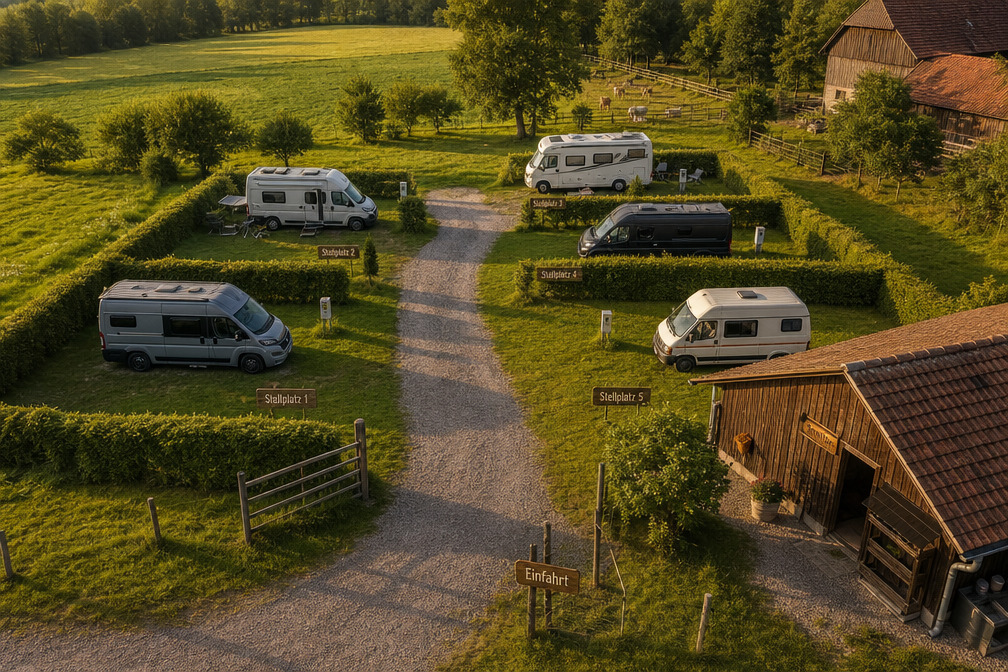
Realistic income is between 30 and 50 Euros per pitch per night. With an average occupancy of 100 to 120 occupied days per year and three pitches, this results in between 9,000 and 18,000 Euros in annual revenue before costs.
Additional income is generated by:
- Sale of farm products (eggs, vegetables, honey, jam)
- Breakfast service or campfire wood
- Guided farm tours for families with children
Cost calculation (example for 3 pitches):
| Item | One-time (approx.) | Annually (approx.) |
|---|---|---|
| Sanitary renovation (existing) | from 20,000 euros | – |
| Paving pitch | 800 – 3,000 Euros | – |
| Insurance | – | 300 – 600 Euros |
| Marketing / Platform | – | 0 – 200 Euros |
| Electricity / Water | – | 200 – 500 Euros |
The figures come from the calculation tool of the Bavarian State Institute for Agriculture (LfL, as of 2025). Those who already have sanitary facilities save the largest single item.
Decision rule: If you can invest less than 20,000 Euros, start with simple natural pitches without fixed sanitary facilities. Younger campers, especially van lifers and overlanders, are looking for exactly that.
What permits and licenses are needed for farm camping?
Motorhome pitches are building structures in Germany and therefore generally require a permit. This applies regardless of whether you charge money or not.
This is how it works in practice:
- Submit a preliminary building application to the responsible building authority of your municipality. Clarify whether your property is located in an interior or exterior area.
- Exterior area (§ 35 BauGB): For agricultural businesses, up to three pitches can be approved as a "consequential project" if there is a spatial-functional connection to the business. According to the RLP Chamber of Agriculture, this expressly applies to Rhineland-Palatinate, and similar regulations exist in Bavaria and other federal states.
- Camping ordinance of your federal state read. As a rule, ordinances apply from four pitches upwards. Below that, there are often simplified regulations.
- Register a business with the municipality or Chamber of Commerce and Industry (IHK) as soon as the rental becomes commercial.
- Tourism tax / visitor's tax clarify with the municipality.
- Reporting obligations observe for overnight statistics.
Important: Each federal state has its own camping ordinance. What applies in Bavaria is regulated differently in NRW. Always get binding information from the responsible building authority before you start building.
How can you legally set up campsites on your farm?
Between the tractor and the campfire: How to effortlessly turn your farm into a camper's paradise begins with the right planning, not with the spade. Here is the step-by-step procedure:
Checklist for setting up:
- Submit a preliminary building application to the building authority
- Check the camping ordinance of the federal state
- Register a business (for commercial use)
- Apply for building permit for sanitary facilities and fixed installations
- Take out business liability insurance
- Inform professional association
- Implement fire protection regulations (fire extinguishers, extinguishing water)
- Set up disposal station for wastewater and chemical toilets
- Provide drinking water connection
- Create signage and site plan
Minimum technical requirements according to LfL Bavaria:
- Access roads at least 5.50 meters wide, drivable by fire department
- Parking space size: maximum 5 x 10 meters per vehicle
- Ground load capacity: at least for 3.5 tons total weight
- Motorhomes can be up to 12 meters long and 2.5 meters wide
What insurance is needed for a farm campsite?
Liability insurance is the absolute minimum. Without it, you are personally liable if a guest falls on the premises, a vehicle is damaged, or an accident occurs.
Recommended Insurance:
- Business liability: Covers third-party personal injury and property damage on your premises
- Property liability: Specifically for traffic safety obligations (paths, lighting)
- Building insurance: If you build sanitary facilities or shelters
- Legal protection insurance: Optional, but advisable in case of disputes with guests
Common mistake: Many farm owners believe their existing agricultural liability covers camping guests as well. This is generally not the case. Speak explicitly with your insurer about tourist use.
What is the best equipment for campers on the farm?
The amenities depend on who you want to attract and how long guests are expected to stay. Little is sufficient for overnight guests, more is needed for multi-day guests.
For overnight guests (1 night):
- Level, paved or firm ground
- Power connection (CEE socket, 16 Ampere) desirable
- Access to a simple toilet
For multi-day guests:
- Electricity and water connection (3/4-inch thread)
- Disposal station for grey water and chemical toilets
- Showers and toilets in sufficient numbers
- WLAN (Campers expect this as standard today)
- Waste separation
- Privacy screening with hedges or trees
Extras that pay off:
- Campfire site with seating
- Children's play area
- Farm shop or self-service vending machine with farm products
- Barbecue facilities
Decision rule: Start with the minimum for overnight guests. If occupancy is good, gradually invest in comfort.
How does Farm Camping differ from Glamping?
Farm Camping and Glamping are two different concepts with different effort and different target groups.
Farm Camping means: Campers bring their own vehicle or tent. The farm provides space and basic infrastructure. The charm lies in authenticity, not luxury.
Glamping means: The provider supplies fully furnished accommodations, such as safari tents, treehouses, or tiny houses. The guest brings nothing but their suitcase. Investment costs are significantly higher, but so are the achievable prices.
| Characteristic | Farm Camping | Glamping |
|---|---|---|
| Start-up investment | Low (from approx. 5,000 Euros) | High (from approx. 30,000 Euros) |
| Target audience | Motorhome users, Vanlifers | Couples, Families, Luxury travelers |
| Price per night | 30 – 50 Euros | 80 – 200+ Euros |
| Operating expenses | Low | High (Cleaning, Service) |
| Permitting effort | Moderat | High |
For most farmers, Farm Camping is the better entry point. Glamping can follow later as an expansion.
How to market a farm campsite to tourists?
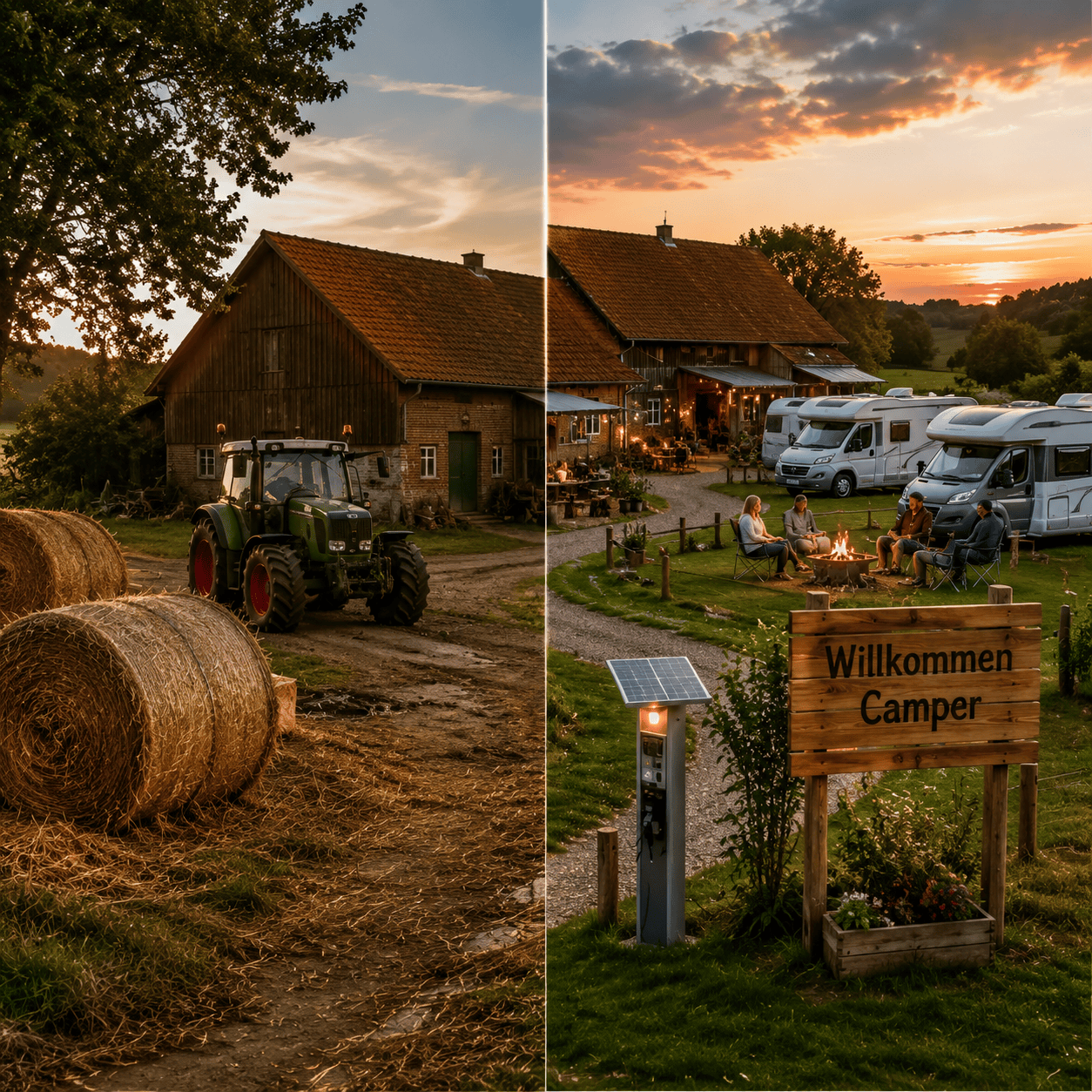
The simplest and most effective way is listing on Campcruisers. The platform specifically targets motorhome travelers and campers and generates bookings without your own marketing effort. For private pitches, the Performance Package applies with a 12 percent commission on the brokered gross revenue, with no basic fee.
Other marketing channels:
- Campcruisers: Direct bookings from motorhome users, automatic payment processing via Stripe, instant booking option
- Google My Business: Free profile for local visibility
- Instagram: Particularly effective for visually appealing farm photos and campfire pictures
- Regional tourism associations: Often free listings are possible
What convinces campers when searching:
- Honest photos of the pitch and sanitary facilities
- Clear information on electricity, water, and disposal
- Reviews from satisfied guests
- Flexible booking without lengthy communication effort
Those who already operate a holiday apartment or a farm shop can use marketing costs and infrastructure proportionally. This significantly reduces the effective costs for the camping sector. For inspiration on what campers are looking for on their travels, it is also worth taking a look at The best campsites in Europe - Campcruisers Blog.
Safety requirements and regulations for farm camping
Safety on the campsite is not an optional extra, but a legal obligation. Ignoring these points risks liability and the withdrawal of permission.
Fire protection:
- Sufficient fire extinguishers in accessible locations
- Ensure fire water supply
- Keep fire department access routes clear (at least 5.50 meters wide)
- Campfire sites with sufficient distance from vehicles and buildings
Hygiene and disposal:
- Chemical toilets must not be emptied into normal toilets. A special disposal station is mandatory.
- Greywater disposal: Depending on the connection to the sewage system, a discharge permit is required.
- Waste separation must be guaranteed and separated from living areas.
Accessibility:
- Facilities should be barrier-free accessible.
Duty of care for traffic safety:
- Paths and access roads must be illuminated and in proper condition.
- A site plan with all facilities, emergency exits, and fire extinguishers must be visibly displayed.
What equipment do you need to start a Farm Camping?
For a simple start with up to three pitches, the basic equipment is manageable. Many investments can be spread out.
Minimum equipment:
- Service column with CEE socket (16 amperes) per pitch
- Water connection with 3/4-inch thread
- Disposal station for grey water and chemical toilets
- Simple sanitary building (prefer using existing buildings)
- Paved access road and pitches (gravel, grass grid, or compacted ground)
- Signage and site plan
Costs for service columns: Professional columns cost between 500 and 2,000 Euros each, depending on the equipment. Simple solutions with extension cords and water connections are cheaper, but less comfortable.
Tip: Those who want to start a camping business without immediately setting up their own kitchen or outdoor infrastructure will find in our article about the Outdoor kitchen for campers practical tips on what guests wish for.
Can Farm Camping also be offered on a small plot of land?
Yes, Farm Camping also works on small plots. The decisive factor is not the area, but the location and the atmosphere.
Minimum size per parking space: According to the DTV planning aid for motorhome parking spaces, a parking space should be at least 5 x 10 meters. So, 50 square meters are sufficient for a motorhome with an awning.
For small plots of land, the following applies:
- A maximum of 2 to 3 parking spaces are often easier to handle from a legal approval perspective.
- Fewer parking spaces mean fewer guests and less effort.
- A single, beautifully designed parking space with a unique selling proposition (e.g., direct view of an orchard, campfire site, animal enclosure within sight) often achieves higher prices than three standard parking spaces.
Decision rule: If your property is smaller than 2,000 square meters, focus on one or two premium parking spaces instead of quantity.
Common mistakes when starting farm camping
Between tractor and campfire: How to effortlessly turn your farm into a camper's paradise sounds simple, but there are typical pitfalls.
The most common errors:
- Starting without a permit. Many farm owners simply take in campers without informing the building authority or municipality. This can lead to fines and demolition orders.
- Not taking out insurance. The existing agricultural liability insurance usually does not cover camping guests.
- Too many parking spaces at once. In many federal states, more than three parking spaces in the outer area require the municipality to have its own development plan.
- Unclear house rules. Without written rules, conflicts arise over noise, campfires, and animal freedom.
- No booking system. Those who only book by phone or WhatsApp lose guests who want to book spontaneously.
- Forgetting waste disposal. Campers need a legal way to empty greywater and chemical toilets. Without this option, many RVers won't even come.
How do you deal with difficult guests on the farm?
Difficult guests are rare, but it helps to be prepared. Clear rules and friendly, direct communication solve most problems.
Prevention is better than reaction:
- Send written house rules when booking (noise, campfires, animals, waste)
- Communicate arrival and check-out times clearly
- Provide an emergency contact number
If problems arise:
- Address calmly and directly, no email escalation
- For repeated violations: terminate the stay, referring to the house rules
- For serious incidents (property damage, theft): involve the police
Important: The rental agreement or booking conditions should include a clause that gives you the right to evict guests for violating the campsite's house rules.
Farm Camping vs. traditional campsite: What's better?
Farm Camping and traditional campsites appeal to different target groups and are not direct competitors.
Farm Camping wins with:
- Guests seeking peace, nature, and authenticity
- Families with children who want to experience animals and rural life
- Vanlifers and Overlanders who prefer simple, nature-oriented pitches
- Travelers who avoid large campsites with entertainment and noise
Traditional campsites win with:
- Guests who want a lot of infrastructure (pool, restaurant, playground)
- Long-term campers who stay for weeks
- Groups looking for social activities
Conclusion: Anyone running a farm should not try to copy a campsite. The unique selling point is the farm itself. Fresh eggs in the morning, cows in the pasture, a real campfire site – that beats any entertainment evening.
Anyone who wants to be inspired by further travel ideas with a motorhome will find exciting routes on the Campcruisers blog, for example Explore South Holland with a motorhome.
Farm Camping Revenue Calculator
13.200 €
FAQ: Farm as a campsite
Do I need a permit for a single parking space on my farm?
Yes, even a single parking space may require a permit as it is considered a structural facility. Clarify this in advance with your building authority. In many federal states, there are simplified procedures for a few parking spaces on agricultural holdings.
How many parking spaces can I create without development planning?
In Rhineland-Palatinate, up to three parking spaces in the outer area can be approved as associated with an agricultural operation. Bavaria has similar regulations. From four parking spaces, it generally becomes more complex.
Do I have to register a business?
As soon as you generate regular income, a business registration is usually required. Speak with your municipality or Chamber of Industry and Commerce, as there are exceptions for agricultural side businesses.
Can I accommodate campers without building sanitary facilities?
This is possible for short stays and simple nature pitches. Motorhomers have their own toilets and showers in their vehicles. However, you should still plan for a disposal station for grey water and chemical toilets.
How do I list my pitch on Campcruisers?
Register as a provider on Campcruisers, upload photos and description, and select the Performance package for private pitches. The commission is 12 percent of the brokered gross revenue, with no basic fee. Payment processing is automatic via Stripe.
What are the start-up costs for Farm Camping?
With existing buildings and simple equipment, a start is possible from approximately 5,000 to 10,000 Euros. If a new sanitary building needs to be constructed, expect at least 20,000 Euros.
May I allow campfires on my campsite?
That depends on local fire safety regulations and the season. Campfire sites must be a sufficient distance from vehicles and buildings. Fire bans may apply during dry periods. Clarify this with your municipality and inform guests in writing.
What happens if a guest is injured on my property?
Without operating liability insurance, you are personally liable. With valid insurance, it will handle the settlement of claims. Also, adhere to your duty of care: illuminated paths, orderly driveways, no loose trip hazards.
Can I offer my farm pitch seasonally?
Yes. Many providers only open from April to October. This reduces effort and is often legally easier than year-round operation.
How do I deal with taxes?
Income from pitch rentals is generally subject to VAT. However, there are possibilities for tax exemption or the small business regulation. Consult a tax advisor before you start.
Conclusion: How to start your farm as a camper paradise
Between tractor and campfire: How to easily turn your farm into a camper paradise is not a contradiction, but a real business model with a growing market. Over 1.6 million registered camping vehicles in Germany and increasing demand for natural, authentic pitches speak a clear language.
The most important next steps:
- Contact building authority and clarify how many pitches are approvable on your property.
- Check insurance and take out operating liability insurance that explicitly covers camping guests.
- Start small: Two to three simple pitches with electricity and waste disposal are a good start.
- List on Campcruisers: No marketing budget needed, direct bookings from RVers, automatic payment processing.
- Highlight the farm's unique features: Fresh farm products, campfire area, animal experiences. This is the unique selling proposition that no campsite can copy.
Anyone starting now benefits from a market that is not yet saturated. Campers are actively looking for alternatives to overcrowded campsites, and a farm with real character is exactly what they want. Further inspiration for travelers looking for such places can be found in the Campcruisers travel magazine, for example with routes such as Exploring Australia by campervan or a first houseboat adventure as an introduction to water tourism.
Tags: Farm Camping, Renting Motorhome Pitches, Farm Campsite, Agritourism, Farm Pitches, Renting Camper Pitches, Motorhome Pitch Permit, Farm Camping Germany, Renting Private Pitches, Campcruisers Provider, Campsite Costs, Holiday on the Farm


 English
  German
  Spanish
  Italian
  Polish
  Dutch
Dutch  French
  Danish