
Docking is the moment when it shows who really has experience on the water. Whether in a busy harbor or on a quiet shore in the middle of nature: those who know the basic rules save themselves hull scratches, torn lines, and embarrassing looks from the neighboring slip. This guide shows how to dock like a pro: practical tips for harbor and open nature really work, for everyone who wants to steer a houseboat or motorboat themselves.
The most important things at a glance
- Docking means bringing a boat to a standstill and securing it in a controlled and safe manner at a jetty, pier, or natural shore.
- In the harbor, fixed rules and infrastructure apply; in nature, more improvisation and the right equipment are needed.
- The most common mistakes are too high an approach speed, incorrectly placed fenders, and too few lines.
- Wind and current determine the direction of approach, not the other way around.
- Beginners benefit from an introductory course, which costs between 150 and 400 euros in Germany.
- Fenders, boat hooks, mooring lines, and a calm mind are the most important aids.
- Houseboats and wide canal boats are particularly easy to dock due to their stability.
- With wind speeds from Beaufort 6 upwards, one should avoid docking in the open nature.
- Damage can be almost completely avoided through correct fender positioning and a slow approach.
- Campcruisers offers houseboats with complete instruction so that the first docking attempt is successful right away.
What exactly does docking mean in sailing and motorboating?
Docking refers to the controlled approach of a boat to a fixed structure, such as a jetty, a pier, a buoy, or a natural shore, and then securing the boat with lines or anchors. It is not a single action, but a maneuver with several phases: approach, braking, docking, securing.
If you rent a houseboat, you don't have to be a sailing pro. But the basic principle remains the same: the boat approaches the docking spot slowly, controlled, and at the right angle. Too fast, too steep, or too shallow, and it will be expensive or at least uncomfortable.
The three phases of docking:
- Approach: adjust course and speed, assess wind and current
- Final approach: approach the docking spot slowly, fenders deployed, lines ready
- Securing: fasten bow spring, stern spring, bow line, and stern line
Differences between docking in the harbor and in nature
In the harbor, there is infrastructure: bollards, rings, jetties with edges and often harbor masters who help. In the wild, there is none of that, but there are trees, roots, stones and unknown ground.
Harbor:
- Clear berths, often numbered
- Solid bollards and rings for mooring
- Neighboring boats as orientation
- Harbor rules and mooring fees
Wild nature:
- No firm ground guaranteed
- Mooring to trees, poles or with anchors
- Water depth unknown, therefore sound beforehand
- More personal responsibility, more freedom
A tip for natural moorings: Always test the bottom with the boat hook before approaching the bank with the bow. Shallow shores can be deceptive.
What mistakes do people make when docking for the first time?
Most beginners make the same three mistakes when docking for the first time: too fast, too few fenders, too few lines. The result is scratches, shifted fenders or a boat that comes loose at night.
The most common beginner mistakes:
- Too high speed: A boat has no brakes like a car. Anyone approaching too fast cannot correct anymore.
- Incorrect fender position: Fenders must hang at the level of the jetty edge, not higher or lower.
- Only two lines: At least four lines (spring lines fore and aft, bow line, stern line) ensure that the boat does not rock in the swell.
- Forget to tack against the wind: He who ignores the wind will be surprised by the boat.
- No communication on board: Anyone sailing alone and steering and mooring at the same time needs a clear order.
Rule of thumb: The approach speed should be so low that a slight bump against the dock causes no damage.
What do I need for a perfect docking and what equipment helps?
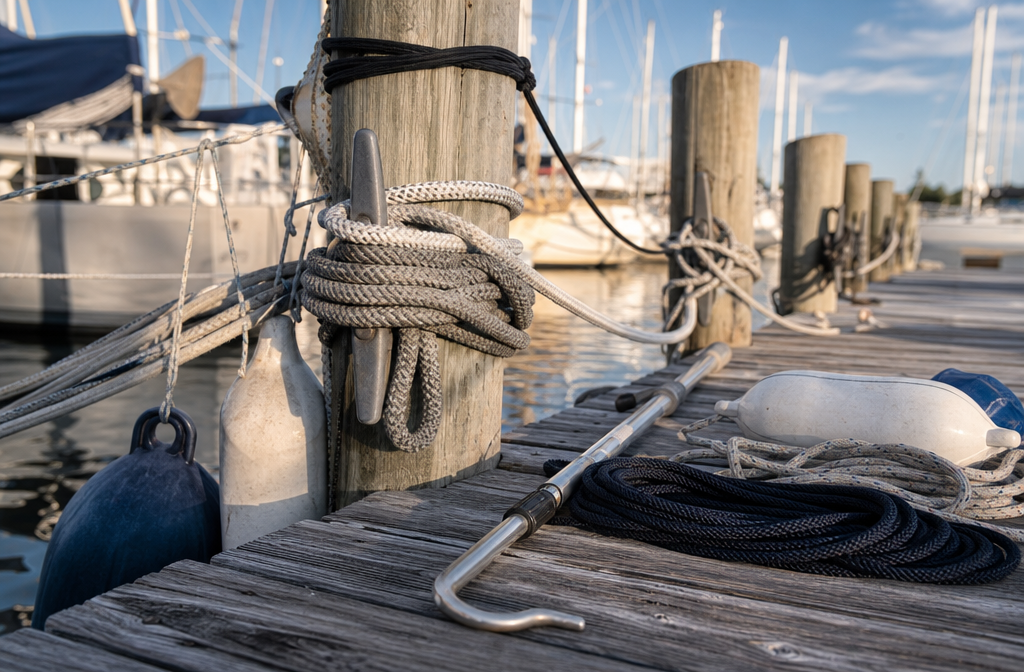
For a safe docking maneuver, you don't need professional equipment, but the basics have to be right. Fenders, lines, and a boat hook are the minimum.
Basic equipment for safe docking:
| Equipment | Function | Note |
|---|---|---|
| Fenders (min. 4) | Protection between boat and dock | Adjust size to boat weight |
| Mooring lines | Secure boat to the dock | Minimum length: 1.5 x boat length |
| Boat hook | Intercept, hand over lines | Telescopic for small boats |
| Anchoring | Securing in the wild | With sufficient chain |
| Gloves | Protection when pulling lines | Especially on long trips |
Anyone who books a houseboat with Campcruisers receives basic equipment included and an on-site briefing. This way, you start prepared, not guessing.
Docking techniques for beginners: step by step
Beginners should start with the simplest technique: docking parallel to the pier at a slight angle. This method works for most boats and in most harbors.
Step-by-step instructions:
- Reduce speed to walking pace at least 50 meters before your destination
- Adjust and secure fenders to the correct height
- Prepare lines, brief the crew
- Approach the pier at a shallow angle (approx. 20-30 degrees)
- Dock the bow first, secure the bow line immediately
- Briefly reverse the engine to pull the stern in
- Secure stern line, then breast and stern springs
- Turn off the engine, check the boat
Choose this technique if: You have a wide boat, the wind is coming from the pier side, or you are alone on board.
Choose another technique if: Strong crosswind pushes the boat away from the pier. Then it's better to dock with the bow into the wind.
Docking in strong winds: tips for difficult conditions
With wind above Beaufort 4, everything changes. The boat reacts slower, the wind takes over, and small mistakes become big problems. The most important rule: always dock against the wind, not with the wind.
Tips in strong winds:
- Upside (windward) approach: Position the boat so that the wind pushes the boat towards the dock, not away
- Choose the windward side: If possible, dock on the leeward side of the dock
- Get help: In the harbor, there is almost always someone who will take a line
- Slower than usual: In wind, you need even more patience when approaching
- Use engine support: Short counter-thrusts help stabilize the boat
At wind strengths of Beaufort 6 or more (approx. 39-49 km/h), you should generally avoid docking in the open and seek a sheltered harbor.
When is docking too dangerous?
Docking becomes dangerous when wind, current, or visibility conditions limit control over the boat. There is no clear limit, but there are clear warning signs.
Warning signs where it's better to wait:
- Wind strength Beaufort 6 or more in the open
- Strong current with no possibility of counter-hold
- Unknown water depth without sounding possibility
- Darkness without adequate lighting of the docking area
- Crew exhaustion
When in doubt, the rule is: Better to stay on the water for an hour longer and wait for better conditions than to force a risky maneuver.
How much does a docking course cost?
A targeted course for docking maneuvers in Germany costs between 150 and 400 Euros, depending on the provider and scope. Many sailing schools offer one-day practical courses that specifically train maneuvering in the harbor.
Anyone who rents a houseboat often does not need to book this course separately. Reputable rental companies like Campcruisers offer a detailed orientation directly on site. This fully covers docking, mooring, and handling the boat.
Which boats are easiest to dock?
Wide, flat boats with a low wind profile are the easiest to dock. Houseboats and canal boats are among the most straightforward options because they are slow, stable, and not very susceptible to wind.
Easy to dock:
- Houseboats and canal boats (wide hull, shallow draft)
- Motorboats up to 8 meters (manageable, responsive)
- Boats with a bow thruster (allows lateral corrections)
More challenging:
- Sailboats (high mast catches wind)
- Catamarans (wide span, difficult in tight spaces)
- Long motor yachts from 12 meters (inertia and windage increase)
How do I avoid damage when docking?
Most damage when docking is caused by two factors: excessive speed and improperly positioned fenders. Controlling these two points avoids 90 percent of all damage.
Checklist to prevent damage:
- Position fenders at the exact height of the dock edge
- Maintain approach speed below 2 knots
- Use at least four lines
- Observe edges and bollards before approaching
- Never reach by hand between boat and jetty
A common mistake: fenders hung too high. Then the boat slips underneath, and the hull hits the jetty directly.
Typical problems when docking and their solutions
Even experienced skippers know situations where docking doesn't go according to plan. The most important thing is to stay calm and abort the maneuver if necessary.
Problem: Boat drifts away from the jetty Solution: Wind is coming from the jetty side. Dock on the leeward side of the jetty or ask helpers to take off a line.
Problem: Boat approaches too quickly Solution: Immediately shift to reverse, abort maneuver, try again.
Problem: Mooring line breaks at night Solution: Check lines for wear, check knots, lay additional lines in rough seas.
Problem: Lack of mooring point in the wild Solution: Set anchor or tie line around a stable tree (with protective sleeve).
Frequently asked questions
What is the difference between docking and anchoring? When docking, the boat is attached to a fixed structure. When anchoring, the boat is held by an anchor on the bottom, with no connection to the shore.
Do I need a license for docking houseboats? In Germany, no license is often required for houseboats on inland waters, depending on the area and boat size. Campcruisers clarifies this before booking.
How long should mooring lines be? As a rule of thumb: at least 1.5 times the boat's length. For a 10-meter boat, that's at least 15 meters per line.
Can you dock a houseboat alone? Yes, but it's easier with two people. Alone, you have to coordinate steering and mooring, which requires practice.
What to do if there is no bollard at the jetty? Lay lines around jetty posts or use a mobile ground anchor. In emergencies, a boat hook helps to temporarily hold the boat.
How often should mooring lines be replaced? Polyester lines last for several years with good care. Visible chafe marks or hardening are a sign of wear and tear.
Is docking in the open nature allowed everywhere? No. Docking is prohibited in nature reserves and on private property. Check local regulations before your trip.
What is a spring line when mooring? A spring line is a rope that runs diagonally from the bow to the stern or from the stern to the bow. It prevents the boat from sliding forward or backward.
Let's get on the water now
Docking like a pro: tips for the harbor and the open nature are not secrets, but craftsmanship. Those who know the basic principles, approach slowly, position fenders correctly, and respect wind and current will dock safely, whether in a busy marina or on a secluded forest shore.
The best way to internalize these techniques is through practice. And that best starts with a well-equipped boat, solid instruction, and a beautiful route.
Ready for a houseboat vacation? Book your houseboat now with Campcruisers and start with everything you need for relaxed and safe docking.


 English
  German
  Spanish
  Italian
  Polish
  Dutch
Dutch  French
  Danish