
Last updated: May 24, 2026
Quick Answer: An awning on a motorhome is a fold-out sun protection system that is mounted directly on the side of the vehicle. For beginners: always extend it in calm weather, adjust the incline slightly forward so that rain runs off, and never leave the awning open in gusts of wind exceeding 40 km/h. With a little practice, operating it becomes routine in just a few minutes.
Key Takeaways
- A campervan awning creates up to 15 m² of additional outdoor living space without the need to set up a separate awning.
- There are manual, semi-automatic and fully automatic models. Semi-automatic cassette awnings are particularly recommended for beginners.
- Good entry-level models cost between 300 and 800 euros, while premium models from Thule, Fiamma, or Dometic range from 900 to 2,500 euros.
- The most common beginner's mistake: not retracting the awning in time when the wind picks up.
- Regular cleaning (at least once per season) significantly extends the life of the fabric.
- For small vehicles (campervans, panel vans), compact models such as the Fiamma F35 or Thule Omnistor 1200 are suitable.
- Wind stabilizers and pegs for the support poles are inexpensive accessories that prevent a lot of trouble.
- For problems such as a jammed mechanism or uneven winding, a simple visual inspection of the spring preload often helps.

What is an awning on a motorhome and what is it used for?
A camper awning is a foldable or rollable sun canopy that is attached to the side of the vehicle roof or the roof edge and can be extended as needed. It primarily serves as weather protection: shade in the sun, rain protection when having breakfast outdoors.
Practically speaking, an awning transforms the area next to the RV into a real outdoor living space. Instead of sitting inside in the midday heat or setting up a complicated awning, the awning is ready to use in two to five minutes. Anyone who has ever spent a long camping day in the blazing sun knows exactly how much quality of life such a piece of fabric can mean.
Typical applications:
- Shaded seating area for meals and relaxation
- Protection of the vehicle door and entrance area in rain
- Wind protection in combination with side awning walls
- Expansion of usable living space on campsites
What types of awnings are there for RVs?
There are three basic types, and the choice depends on the budget, vehicle size, and personal comfort requirements.
| Type | Operation | Preisspanne | Suitable for |
|---|---|---|---|
| Manual Awning | Crank or pull cord | 150–500 € | Beginner, short trips |
| Semi-automatic cassette awning | Gas spring + manual | €400–€1,000 | Occasional camper |
| Fully automatic awning | Electric motor, remote control | £1,200–£2,500 | Frequent drivers, comfort enthusiasts |
Cassette awnings are by far the most popular option. The fabric rolls up into a housing (the cassette) and is thus protected from UV radiation and dirt. Free-arm awnings Awnings without a cassette are cheaper, but the fabric is more exposed to the elements.
💡 Tip for beginners: A semi-automatic cassette awning is the ideal entry point. It is robust, easy to use and more forgiving of minor operating errors than fully automatic models.
How much does a good RV awning cost in comparison?
Good RV awnings are available from around 300 euros, with quality and longevity increasing significantly with the price. If you are using a rental RV, you don't need to worry about this, as professional providers usually equip their vehicles with awnings.
Price overview by category:
- Entry-level (€150–€400): Manual cantilever awnings, often from lesser-known manufacturers. Sufficient for occasional use.
- Mid-range (€400–€900): Semi-automatic cassette awnings from Fiamma (F45s) or Thule (Omnistor 5200). Good value for money.
- Premium (€900–€2,500): Fully automatic models from Dometic (Awning 8300), Thule (Omnistor 6300), or Fiamma (F80s). Electric, with wind sensor option.
In addition, there are assembly costs (approx. 100–300 euros at a specialist dealer) as well as optional accessories such as side panels, LED lighting, or wind stabilizers.
What do I need to consider when setting up a campervan awning?
Extending a camper van awning is straightforward, but a few basic rules prevent damage and frustration. For anyone who Awning on the RV: Operating tips for beginners searching, this section is the most important.
Step-by-step: Extending the awning (manual/semi-automatic version)
- Check the surface: Is the RV parked on level ground? A tilted position can cause the awning to not open evenly.
- Open cassette: Release retaining clips or latches (depending on model).
- Extend arms: Carefully fold the support arms downwards and outwards until they lock into place.
- Unroll the cloth. Operate the crank or pull rope slowly and evenly. Never pull jerkily.
- Adjust tilt: The front edge of the awning should be 5–10 cm lower than the roof side. This allows rainwater to drain off instead of pooling in the middle.
- Secure support poles: In windy conditions or for extended stays, anchor the support poles to the ground with tent pegs.
Important restrictions:
- Never extend when wind speeds exceed 40 km/h (Beaufort 5-6).
- Always fully retract and lock before driving.
- In case of rain: Slightly lower the awning to prevent water from pooling on the fabric.
What mistakes do beginners make when handling awnings?
The most common mistakes when handling the awning on a motorhome are easy to avoid if you know them. Beginners especially underestimate the danger of wind and neglect maintenance.
The 6 most common beginner mistakes:
- Leave the awning open in freshening wind. Wind can change quickly. Anyone who drives to the supermarket for a short time and leaves the awning out risks bent arms or a torn fabric.
- Roll up the wet cloth. Moisture in the rolled-up cloth leads to mold and material damage. Always let it dry before rolling it up.
- Cranking too fast and jerkily. That puts unnecessary strain on the spring mechanism.
- Do not anchor support poles. Without tent pegs, support poles can slip in light winds and destabilize the entire structure.
- False Inclination. Too shallow of a setting leads to water pockets on the canvas, which can stretch or tear the material.
- Forgot to roll up before departure. Happens more often than you think, especially after long camping nights. 😅
How do I properly clean and care for a motorhome awning?
The fabric of a camper van awning should be cleaned at least once per season, and more often if used intensively. Proper care doubles the lifespan of the material.
Cleaning step by step:
- Extend awning fully.
- Remove coarse dirt and leaves with a soft brush.
- Wash with lukewarm water and a mild, soap-free cleaner. No high-pressure cleaners, no solvents.
- Rinse thoroughly with clear water.
- Allow to air dry completely., before the awning is retracted.
- Optional: Treat the cloth with a UV protection spray to preserve the color.
Maintain mechanics:
- Lightly spray joints and hinges once per season with a silicone spray.
- Check the cassette for cracks or deformations.
- Check the spring preload: The fabric should wind up evenly and without excessive force.
Which awnings are suitable for small vs. large RVs?
The right awning depends on the vehicle length and the available mounting surface. For small vehicles such as campervans or panel vans, compact models are necessary, while large semi-integrated or alcove motorhomes can handle wider awnings.
Recommendations by vehicle size:
| Vehicle type | Recommended width | Suitable models |
|---|---|---|
| Campervan / Van (up to 5.5 m) | 2.0–3.0 m | Fiamma F35 Pro, Thule Omnistor 1200 |
| Semi-integrated (5.5–7 m) | 3.0–4.0 m | Fiamma F45s, Dometic PerfectRoof PR2000 |
| Alcove / Fully Integrated (from 7 m) | 4.0–5.0 m | Thule Omnistor 5200/6300, Fiamma F80s |
Whoever books a rental RV, for example via CampcruisersThe vehicle usually comes already equipped with a suitable awning. This removes the decision-making process and allows you to try out the operation directly at the campsite.
Which awning brands do camping experts recommend?
Three brands dominate the European market for motorhome awnings: Fiamma, Thule (formerly Omnistor), and Dometic. All three offer reliable products with a good spare parts network.
- Fiamma (Italy): Very common, inexpensive spare parts, easy installation. The F45s is one of the best-selling awnings in Europe.
- Thule / Omnistor (Sweden): High-quality workmanship, elegant design, somewhat more expensive.
- Dometic (Sweden): Wide range from simple to fully automatic, good integration with vehicle electronics.
For beginners, the Fiamma F45s a solid starting point: It is widely used, well documented, and available in almost every camping supply store.
How do I protect my awning in strong winds?
In strong winds, reefing is the only safe option. Those who Operating tips for beginners about the awning on the RV Always follow the principle of safety before comfort when dealing with gusts of wind.
Protective measures at a glance:
- Wind monitor: Some fully automatic awnings have built-in wind sensors that automatically retract the awning when a threshold is exceeded. Highly recommended.
- Wind stabilizers: Inexpensive bars that are stretched between the support arms and stabilize the structure in light wind.
- Tent pegs and guy lines: Anchor support poles in the ground, especially at campsites in open terrain.
- Rule of thumb: From Beaufort 4 (approx. 28 km/h, branches move) observe the awning. From Beaufort 5 (approx. 38 km/h) retract immediately.
⚠️ Important: Insurers often reject storm damage claims if the awning was demonstrably open during a wind warning. When in doubt, it's better to retract it.
What can go wrong with an awning and how do I fix problems?
Typical problems with RV awnings are usually due to operating errors or lack of maintenance and can often be fixed yourself.
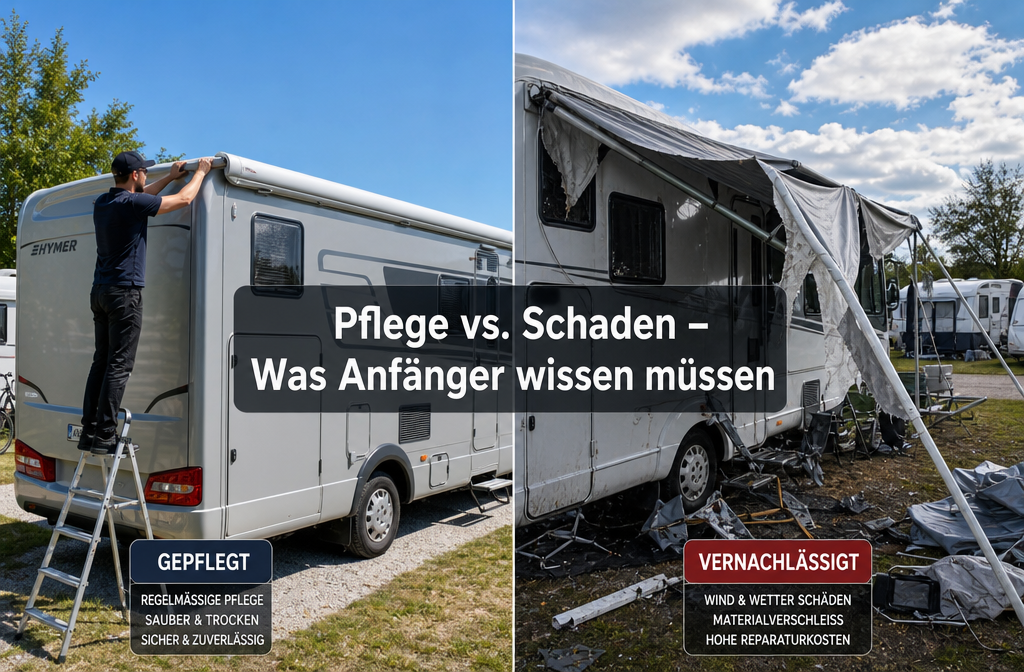
Common problems and solutions:
| Problem | Possible cause | Solution |
|---|---|---|
| Fabric rolls up unevenly. | Incorrect spring preload | Adjust preload according to manufacturer's instructions. |
| Awning is stuck when extending. | Dirt in the mechanism | Clean cassette, oil hinges |
| Cloth is sagging. | Too little spring preload | Increase spring preload (specialist workshop recommended) |
| Water is collecting on the cloth. | Tendency to be flat | Lower support arms further. |
| Arm will not lock into place. | Deformation caused by storm | Consult a specialist dealer, replace arm if necessary |
| Mold stains on the cloth | Rolled up wet | Treat with mold remover (fabric-compatible). |
For more serious damage, such as bent arms after a storm, it's worth going to a specialist dealer. Spare parts for common models like Fiamma or Thule are usually readily available.
Do I really need an awning or is it just a luxury?
An awning isn't pure luxury, but a real added value for many camping scenarios. Whether it's necessary depends on how and where you travel.
An awning is particularly worthwhile when:
- Mostly camping takes place on campsites or pitches without natural shade.
- Longer stays (more than 2 nights) are planned in one location.
- Travel to southern countries like Italy or Spain are on the agenda. For example, whoever through Tuscany with a motorhome travels, will use the awning daily.
- Families with children traveling, who need a protected outdoor area.
An awning is less important when:
- Mainly wild camping is planned in wooded areas.
- Only short overnight stops are made.
- The budget is very tight and other features have priority.
Anyone looking to rent a motorhome can find one at Campcruisers a wide selection of vehicles from various professional rental companies, many of which are already equipped with awnings.
FAQ: Awning on Motorhome
How long does it take to extend an awning on a camper van?
With a little practice, a semi-automatic cassette awning can be fully extended and secured in two to four minutes. Beginners will take a little longer the first time until they know the mechanism.
Can I install an awning myself?
Basically yes, if you are skilled and follow the assembly instructions exactly. However, for the correct sealing of the drill holes (protection against water ingress), we recommend a specialist company.
What is the difference between a cassette awning and a semi-cassette awning?
With a cassette awning, the fabric rolls into a protective housing. With a free-arm awning, the fabric is exposed. Cassette awnings are more durable and resistant to dirt.
May I leave the awning open when it's raining?
Yes, briefly, but only if there is no wind. The awning should then be slightly inclined forward so that water can drain off. The fabric must dry before being rolled up.
How often do I need to service the awning?
Cleaning once per season and oiling the mechanism is sufficient for normal use. Check more often after storms or very intensive use.
What width does my awning need?
The awning should be approximately as wide as the side of the vehicle to which it is attached, typically between 2.5 and 4.5 meters. Awnings that are too narrow offer little protection, while awnings that are too wide can put a strain on the vehicle structure.
Can I retrofit an awning?
Yes, almost all RVs can be retrofitted. A sufficiently stable roof edge or roof rail is required. The specialist dealer will check this before installation.
How much does it cost to repair a damaged awning?
That depends heavily on the damage. A new fabric costs 80–300 euros depending on the model, a new arm 50–200 euros. In case of total damage due to a storm, a complete replacement may be necessary.
Are awnings included with rental RVs?
Many rental motorhomes are already equipped with awnings. When booking through platforms such as Campcruisers The equipment of the respective vehicle can be checked in the description.
Can I also use the awning as a privacy screen?
Yes, with optional side panels (awning walls). These are attached to the side of the awning and offer additional privacy and wind protection.
Conclusion: How to properly operate an awning on a motorhome
The awning on the RV is one of the most useful features for relaxed camping, and operation is really not difficult. If you know the most important rules, namely retracting it in wind, not rolling up wet fabric, and adjusting the tilt correctly, you will quickly realize that the awning becomes a natural part of every camping stay.
Concrete next steps for beginners:
- Read the manufacturer's instructions completely before the first setup.
- Practice using the awning at home or in a quiet parking space a few times before going on a big tour.
- Get wind stabilizers and tent pegs as affordable accessories.
- Set a reminder: Retract and lock the awning before each departure.
Anyone who doesn't yet own a campervan and would like to try out the camping life can turn to Campcruisers simply a Rent a campervan and get started right away. The platform works with professional rental companies worldwide, so there's the right vehicle for every trip, whether for a Roadtrip through South Holland or a great adventure from Buenos Aires to Ushuaia.
Sitting outside, coffee in hand, awning overhead: that's how camping should be. 🏕️
Quellen
- Fiamma S.p.A. – Product Documentation and Installation Instructions F45s (2023) fiamma.it
- Thule Group – Omnistor Product Range, Technical Specifications (2022), thule.com
- Dometic Group – Awning Product Guide (2023) dometic.com
- ADAC Camping – Motorhome Accessories Guide (2022) adac.de
Tags: Awning RV, RV accessories, camping tips, extending awning, RV beginner, Fiamma awning, cassette awning, campsite shade, rent RV, rent camper, awning care, windscreen camping

 English
  German
  Spanish
  Italian
  Polish
  Dutch
Dutch  French
  Danish