
Every year, several hundred people have accidents while swimming in German inland waters, many of them near boats. If you are planning a houseboat vacation and are looking forward to a refreshing dip in the water, you should know: Swimming from a houseboat is incredibly fun, but it carries specific risks that can be almost completely avoided with a little preparation. This guide to swimming from a houseboat: Safety tips for jumping into the water shows what really matters before your feet leave the deck.
The most important things at a glance:
- Always manually measure the water depth before jumping, at least 3.5 meters for headfirst dives.
- The boat must be securely anchored or moored before anyone goes into the water.
- Children under 14 should only swim from the houseboat with a life jacket and direct supervision.
- Current, ship traffic, and underwater obstacles are the three most commonly underestimated dangers.
- A boarding ladder or a rope into the water is mandatory, not optional.
- Never swim alone, always have one person on board as a spotter.
- Alcohol and water sports do not mix, not even during a relaxing houseboat vacation.
- Lakes and rivers present fundamentally different challenges for swimmers.
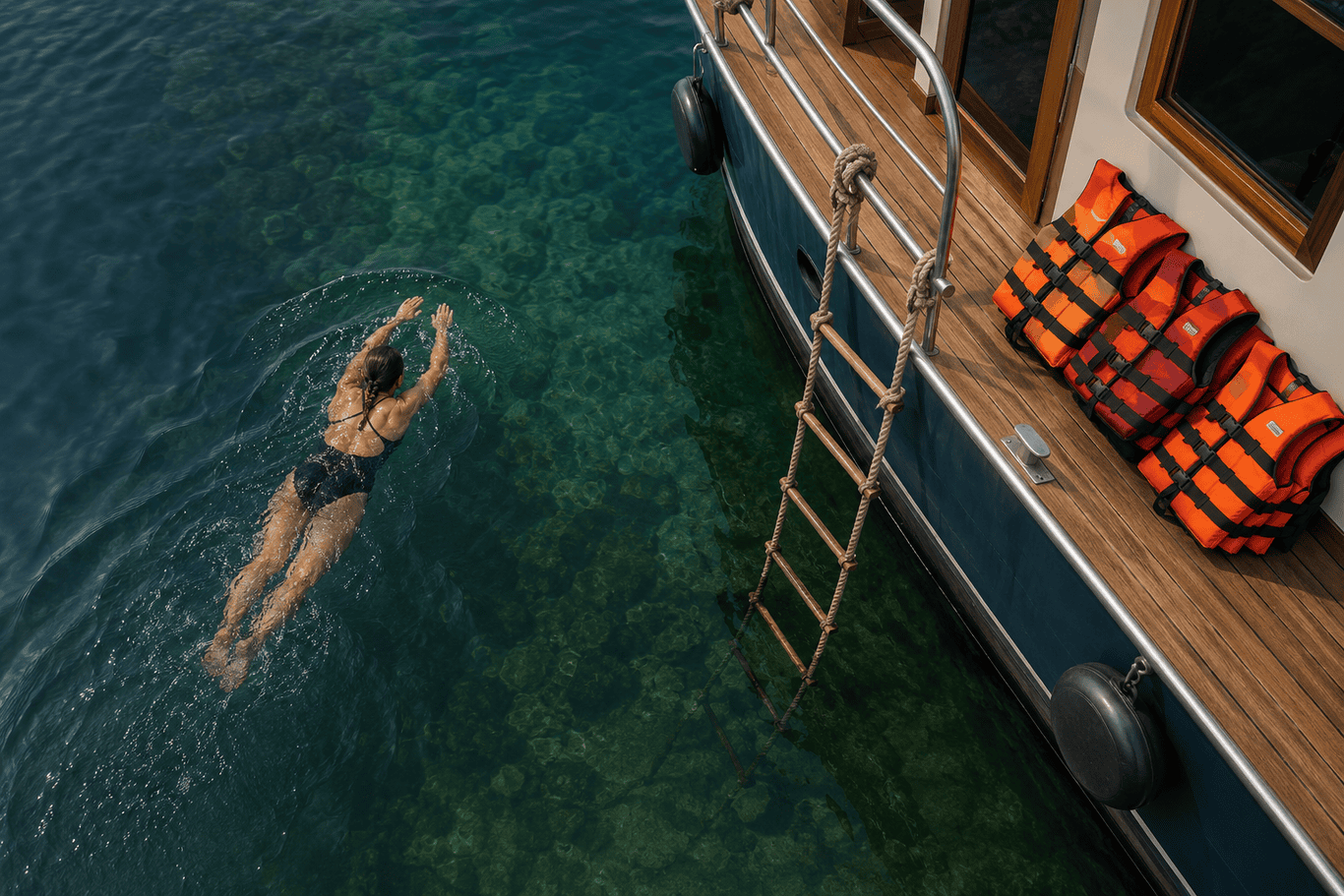
Is it really safe to jump from a houseboat?
Swimming from a houseboat is generally safe if certain conditions are met. However, the combination of unknown waters, a moving surface, and proximity to the boat itself makes a short preparation indispensable.
The biggest misconception is that calm, clear water is automatically safe water. Murky water can be deep and free of obstacles, while crystal-clear water can be surprisingly shallow or full of driftwood. Anyone who internalizes this basic rule has already taken the most important step towards safe swimming practices.
When is it safe:
- The boat is firmly anchored or properly moored.
- The water depth has been measured and is sufficient.
- No ship traffic in the vicinity.
- At least one sober person remains on board.
What are the risks when swimming from a houseboat?
The main risks when swimming from a houseboat are collision with the boat itself, insufficient water depth, currents, and hypothermia. In addition, there are dangers from ship traffic and underwater obstacles such as stones, pile remnants, or algae.
An often overlooked risk: The houseboat can drift due to wind or current, even if it seemed anchored. Swimmers who drift too far find themselves suddenly in a situation where returning to the boat costs more effort than expected. Particularly dangerous is the so-called "propeller wash" when another boat passes by and pulls the swimmer underwater.
How deep does the water need to be for swimming from the boat?
For a foot jump into the water, a depth of at least 2 meters is recommended. For a headfirst dive or a pike jump, it should be at least 3.5 meters, preferably more.
These values apply to a calm water surface without waves. With waves or if the boat is higher (e.g., on a raft or upper deck), the minimum depth must be adjusted accordingly. Always measure the depth with a sounding line, a paddle, or a weighted rope, never estimate.
| Jump type | Minimum depth | Recommended depth |
|---|---|---|
| Foot jump (low) | 1.8 m | 2.5 m |
| Foot jump (high) | 2.5 m | 3.5 m |
| Headfirst dive | 3.5 m | 5.0 m |
| Pike jump | 4.0 m | 5.0 m+ |
What do I need to consider before jumping into the water?
Before jumping into the water, there is a clear checklist: measure water depth, check surroundings for boat traffic, secure the boat, unfold the boarding ladder, and designate a lookout on board.
Specifically, that means:
- Anchor or moor the boat. No swimming as long as the boat is still drifting.
- Measure water depth. Always at the planned entry point, not next to it.
- Visual inspection underwater. Look into the water with diving goggles if possible or use polarizing sunglasses.
- Unfold rear ladder. Before jumping, not after.
- Designate a safety person. This person stays on board, keeps an eye on the swimmer, and can help in an emergency.
- Observe ship traffic. Wait at least two minutes and check if motorboats or ships are nearby.
- Check weather conditions. Get out of the water immediately if a thunderstorm is approaching.
What safety equipment do I need for swimming from a houseboat?
Minimum equipment includes a rear ladder, a lifebuoy with a throw line, life jackets for children and non-swimmers, and a first-aid kit on board.
Recommended safety equipment:
- Rear ladder: Stable, foldable ladder that reaches into the water. Without it, re-entering the boat when exhausted or panicked is almost impossible.
- Lifebuoy with 15–20 m throw line: Must be within reach and not stowed away.
- Life jacket (EN ISO 12402): For everyone who cannot swim well, and for all children.
- Whistle or signal horn: For acoustic warning in case of danger.
- Erste-Hilfe-Set: Includes thermal blanket for hypothermia.
Optional, but very useful: a waterproof mobile phone or a VHF radio system for distress calls on the water.
Are children safe when swimming from the houseboat?
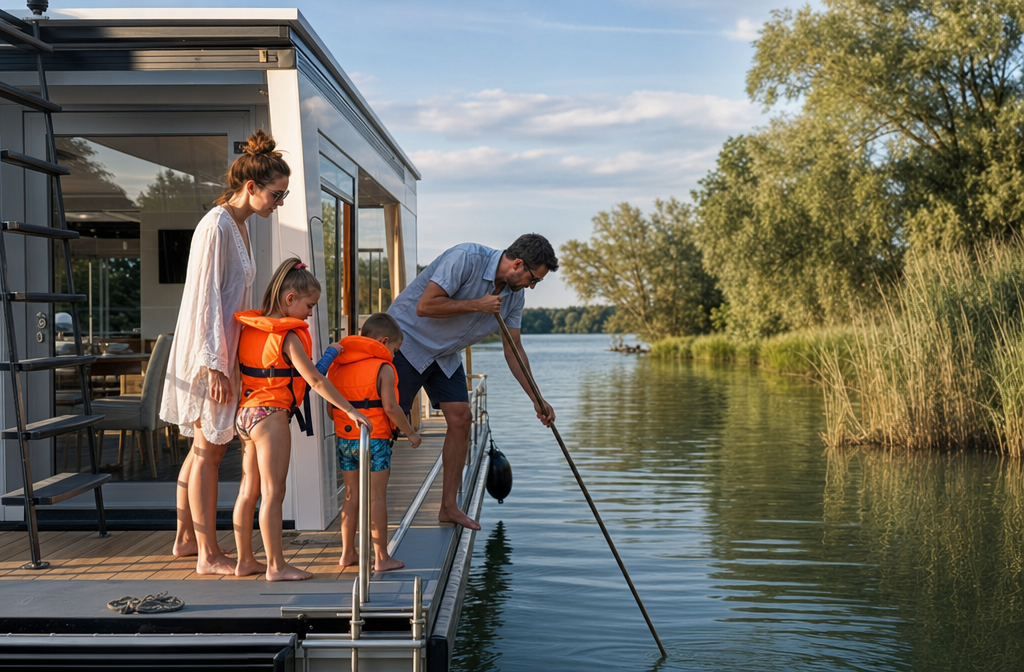
Children can swim safely from the houseboat, but only under strict conditions: life vest, direct supervision by an adult in the water or immediately at the boat, and no headfirst dives for children under 12 years of age.
Children underestimate currents and tire more quickly than adults. Particularly dangerous: children jump into the water before the stern ladder is extended because they want to imitate the adults. Therefore, the rule is: ladder first, then jump.
Children under 14 years of age should always wear a life vest when swimming from the houseboat, even if they are considered "good swimmers". In an emergency, buoyancy makes the crucial difference.
What are common mistakes when jumping from the boat?
The most common mistakes are: jumping without checking depth, no spotter on board, not extending the stern ladder, jumping when there is boat traffic, and consuming alcohol before swimming.
Another classic mistake: jumping from the side facing the wind or current. The boat can turn and hit the swimmer. Always jump into the water from the leeward side, and ensure that the boat is no longer moving.
Differences between swimming in a lake and a river from a houseboat
Lakes and rivers present fundamentally different challenges. In a lake, the main danger is hypothermia from deep water and sudden waves. In a river, it is the current that quickly pulls swimmers away from the boat and exhausts them.
Lake:
- Deep, cold water may be present below the surface (thermocline).
- Motorboat traffic is concentrated on fairways, which should be avoided.
- Wind waves can arise quickly.
River:
- Never underestimate the current, even in apparently calm water.
- Underwater obstacles like whirlpools, remains of piles, nets.
- Observe no-swimming zones in some river sections (e.g., Müritz-Elde-Wasserstraße, Havel).
- Immediately swim towards the boat after jumping in, don't fight the current.
What swimming skills should I have?
Anyone swimming from a houseboat should be able to swim at least 200 meters continuously, float safely on their back, and be able to react to unexpected situations without panic.
The "Seepferdchen" (little seahorse) badge is not sufficient for swimming from a houseboat. At least the German Youth Swimming Badge Bronze (DJSA Bronze) is recommended, which covers endurance and basic techniques. Those who are unsure should stay in the water until they have better swimming competence and limit themselves to splashing in the immediate vicinity of the boat.
How do I save myself if something goes wrong?
In a water emergency: stay calm, float on your back, conserve energy, and call loudly for help. Never swim against a strong current, but diagonally towards the shore or the boat.
If the boat is too far away: assume a back float position, breathe calmly, spread your arms. This conserves energy and keeps your head above water. Only then steer purposefully towards the nearest goal (boat, shore, buoy). A whistle on your person is worth its weight in gold in such moments.
How do I avoid accidents when swimming from a houseboat and what to do in case of sudden dangers?
The best accident prevention is a clear routine before each swim: measure depth, secure the boat, extend the ladder, designate a lookout. In case of sudden dangers like an approaching boat, immediately call out loudly, wave, and swim towards the boat's hull.
In case of thunderstorms, get out of the water immediately; lightning strikes on open water are a real danger. In case of cramps: stretch the affected leg, pull toes upwards, turn onto your back and float. In case of exhaustion: conserve energy, don't keep fighting, float and call for help.
Frequently asked questions
Can you swim from a houseboat anywhere? No. In some water sections, swimming is prohibited, for example, in navigation channels, nature reserves, or restricted areas. Check local regulations before your vacation.
How do I know if the water is deep enough? Measure with a sounding line (weight on a string) or a paddle. Never guess, never rely on water color.
Must the boat be anchored when swimming? Yes, absolutely. A drifting boat can run over swimmers or cut them off from the shore.
How long can you swim in open water? This depends on water temperature and your own condition. Below 18 degrees Celsius: a maximum of 20 to 30 minutes, after which hypothermia is possible.
What to do if someone doesn't get back into the boat? Immediately throw a lifebuoy, call emergency number 110 (police) or 112 (fire/ambulance), maneuver the boat towards the person if possible.
Are headfirst dives from the houseboat permitted? Only if the water depth has been safely measured (at least 3.5 m) and there are no obstacles. Generally not recommended for children under 12 years.
Do I need a life jacket on a houseboat holiday? It is mandatory for children and non-swimmers. For experienced adults, it is recommended when swimming near the boat, especially in currents or waves.
Can I swim from the houseboat at night? Strongly advised against. At night, obstacles and ship traffic are barely visible, and a supervising person cannot keep an eye on swimmers.
Ready for your houseboat vacation?
Swimming from the houseboat: Safety tips for jumping into the water can be summarized in a simple principle: preparation trumps spontaneity. Those who measure the water depth, secure the boat, provide a ladder, and have a sober supervising person on board can experience the jump into the water with full enjoyment. The combination of houseboat feeling and a refreshing swim is one of the most beautiful moments of a water holiday.
Involve children safely, know the local swimming rules, and when there are currents or ship traffic, it is better to wait one more time than one time too few. With this attitude, a houseboat holiday becomes an unforgettable experience for the whole family.
Ready for your houseboat holiday? Book your houseboat now at Campcruisers and start the 2026 season safely.
Meta title: Swimming from the houseboat: Safety tips for jumping in
Meta description: Swimming from the houseboat is fun but carries risks. Our safety tips for jumping into the water show you how to swim safely and relaxedly in 2026.


 English
  German
  Spanish
  Italian
  Polish
  Dutch
Dutch  French
  Danish