
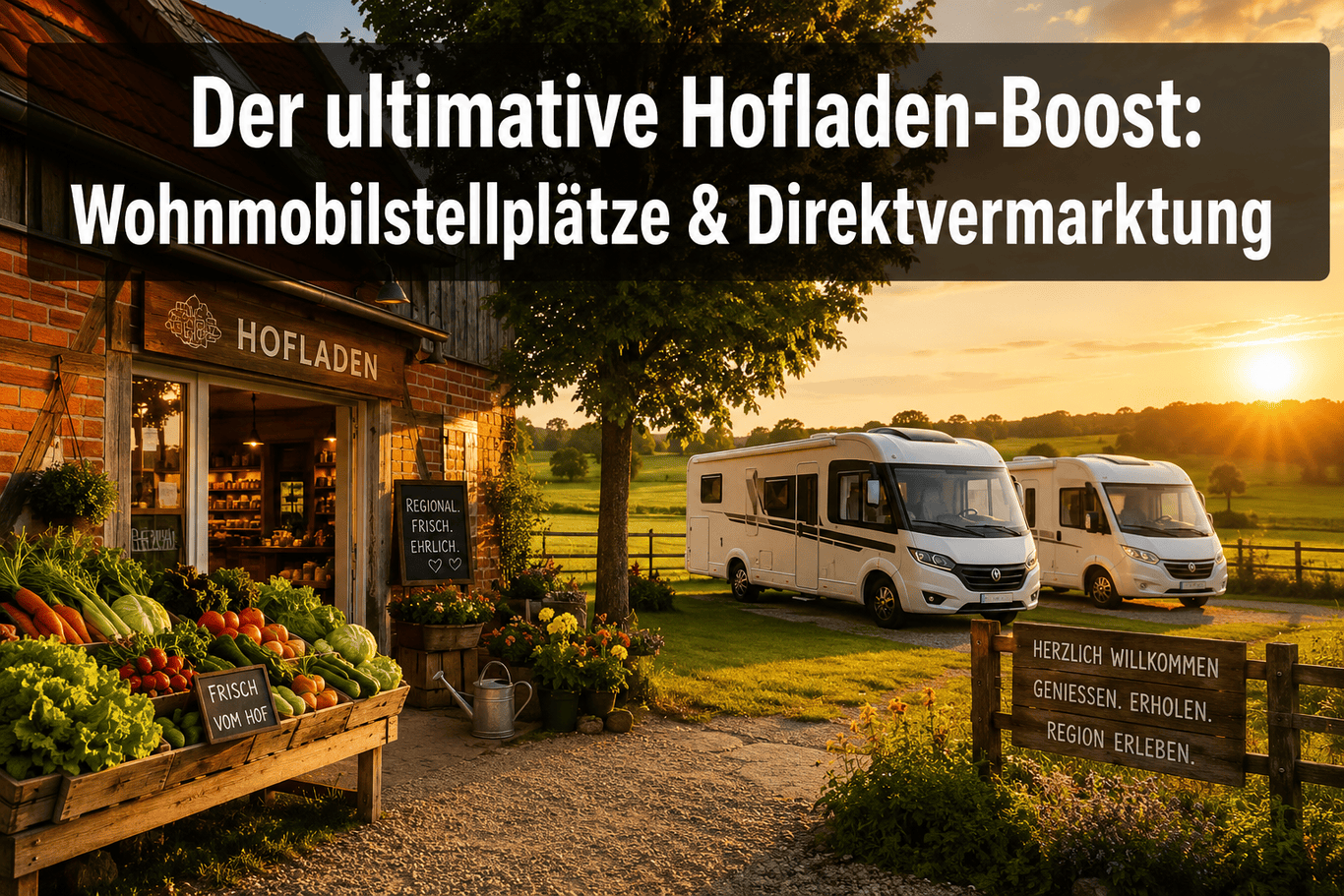
Quick Answer: Farmers who offer motorhome pitches on their farm bring purchase-powerful campers directly to their farm shop. This combination of agritourism and direct marketing significantly increases revenue per guest, because motorhome travelers tend to like buying regional products, often stay for several nights, and engage in word-of-mouth marketing. With manageable investment, a real synergy effect can be achieved, strengthening both branches of the business simultaneously.
Key Takeaways
- Camper van pitches on the farm act as a customer magnet for the farm shop because campers shop directly on site.
- Between 30 and 50 euros per night can be achieved per pitch, with an average of 100 to 120 occupied days per year.
- Legally, the camping regulations of the federal states apply in Germany from four pitches; in rural areas, only three pitches are often privileged for approval.
- The minimum investment for a simple pitch with sanitary facilities is around 20,000 euros, simple pitches without a sanitary building are considerably cheaper.
- Motorhome travelers are a particularly attractive target group for farm shops: they travel flexibly, have storage space for purchases, and appreciate regional authenticity.
- Platforms like Campcruisers enable private pitch providers to easily make their offers bookable online.
- The combination of pitches, farm shop, and other agritourism offers creates a business that clearly stands out from classic campsites.
- Common mistakes: missing building permit, too little space for large motorhomes, insufficient signage, and no online booking system.
What is a farm shop and how does it work?
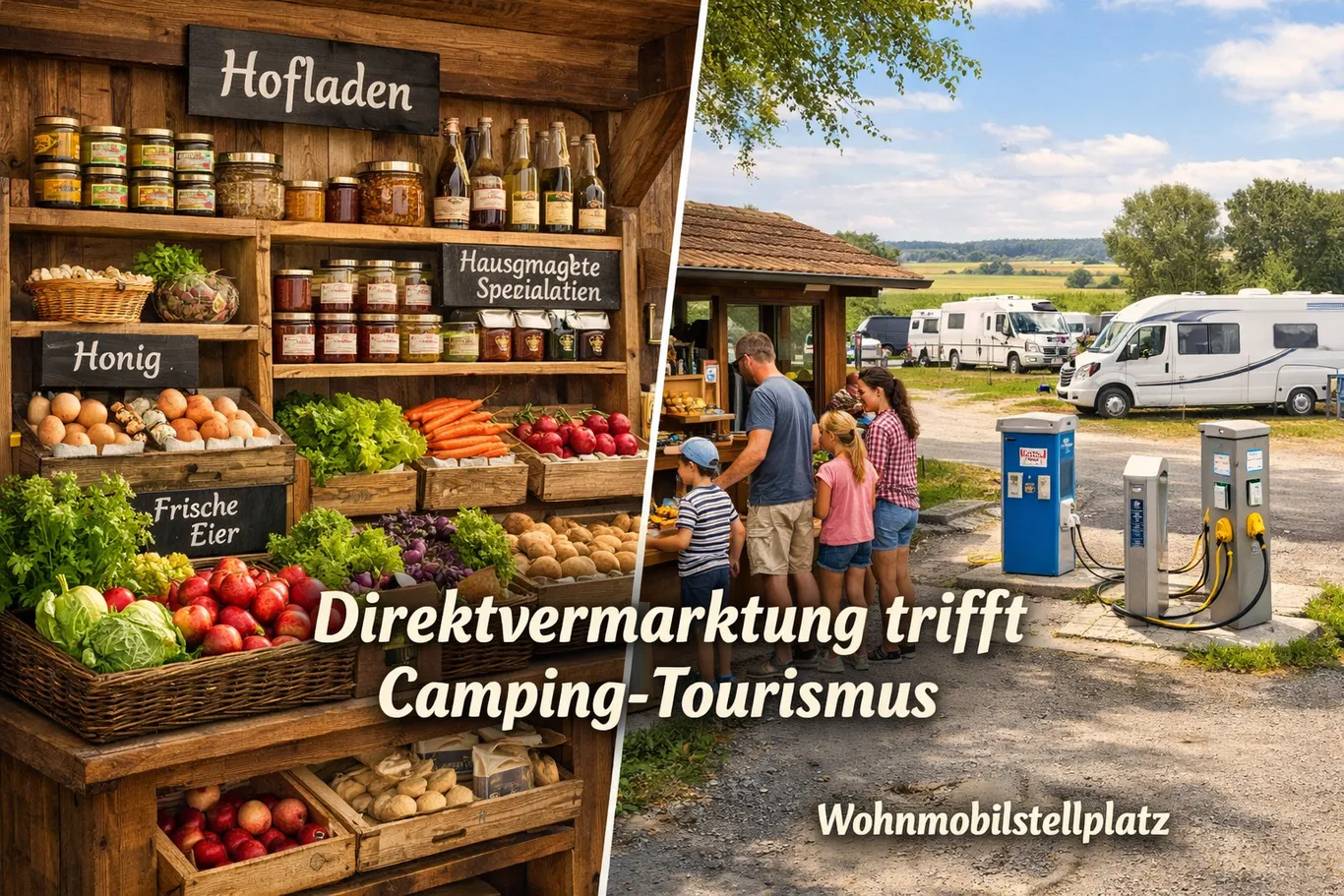
A farm shop is a sales stand or retail space operated directly on the agricultural holding, where the producer sells their products to end customers without intermediaries. The principle is simple: shorter supply chain, fresher goods, higher margin for the farmer, more transparency for the buyer.
Unlike a normal market stall or supermarket shelf, customers buy directly from the producer at the farm shop. This builds trust and a personal connection. Many farm shops supplement their assortment with processed products such as jams, cheese, sausage, or honey to increase the average basket value.
What distinguishes a farm shop from a normal market stall?
- Location: The farm shop is permanently on the farm, not a temporary offering.
- Assortment: Broader, deeper, often with in-house processing.
- Customer loyalty: Regular customers come regularly, often weekly.
- Experience factor: The visit to the farm is an experience in itself, especially for families.
The decisive disadvantage of the classic farm shop: customers have to actively come to it. Those located off the main roads constantly struggle with low foot traffic.
Why camper van pitches boost farm shop sales
The ultimate farm shop boost arises because camper van pitches solve the customer problem: they bring customers directly to the farm without the farmer having to actively advertise. Campers who spend a night or more on the farm almost automatically shop in the farm shop.
Motorhome travelers are a particularly affluent target group. They travel consciously, appreciate regional products, and have enough space in their vehicles for purchases. According to figures from the Caravaning Industrie Verband (CIVD), over 1.6 million camping vehicles are currently registered in Germany, and the demand for natural, authentic pitches away from large campsites is growing strongly.
Concrete advantages for the farm shop:
- Campers buy fresh bread, eggs, milk, and vegetables directly from the producer in the morning.
- Overnight guests shop multiple times and recommend the farm.
- Pitch guests share their experiences on social media and booking platforms.
- The farm gains visibility with a new, supra-regional target audience.
A farmer with five pitches and 100 occupied days per year can achieve around €12,500 in additional annual revenue solely from farm shop sales by campers, with an average purchase of €25 per night and guest, even before pitch fees are included.
What does it cost to set up a motorhome pitch on the farm?
The costs depend heavily on how comfortable the pitch should be. A simple natural pitch without fixed infrastructure can be realized with a few hundred euros, while a fully equipped pitch with a sanitary building can cost €30,000 or more.
Cost table by equipment level:
| Features | Investment (approx.) | Target audience |
|---|---|---|
| Simple meadow, no infrastructure | 500 – 2.000 € | Nature campers, short stays |
| Paved pitch + electricity | 3.000 – 8.000 € | Standard campers |
| Pitch + electricity + water + disposal | 8.000 – 20.000 € | Comfort campers |
| Full equipment including sanitary building | 20.000 – 50.000 € | Overnight guests, families |
Ongoing costs are added: electricity and water, waste disposal, insurance, marketing, and platform fees. Those who offer their pitch via Campcruisers pay a commission of 12% on the brokered gross revenue, with no basic fee.
Tip for cost optimization: Utilize existing buildings for sanitary facilities. This saves the largest single investment and significantly speeds up approval.
Can small businesses really make money with motorhome pitches?
Yes, even small businesses with two to five pitches can operate profitably if pitch income and farm shop sales are added together. Profitability depends less on size than on utilization and additional sales.
According to the Bavarian State Institute for Agriculture (LfL), an average of 100 to 120 occupancy days per year are realistic for motorhome pitches on farms. With a price of 35 Euros per pitch per night and four pitches, this results in an annual turnover of around 14,000 to 16,800 Euros from pitch fees alone, without farm shop sales.
When it is particularly worthwhile:
- The farm is located in a touristically attractive region.
- A farm shop or direct marketing offer is already available.
- Existing buildings can be used as a sanitary area.
- The business is already active in agritourism (holiday apartments, experience offers).
When caution is advised:
- Very remote location without proximity to tourist routes.
- No existing infrastructure and no budget for investments.
- Little time for guest care and marketing.
Legal requirements for motorhome pitches on farms in Germany
In Germany, motorhome pitches are considered structural facilities and generally require a permit. The exact rules depend on the federal state, the location of the property (inland or rural area), and the number of pitches.
The most important legal key points:
- In rural areas (§ 35 BauGB), agricultural businesses can obtain approval for up to three pitches as a "co-dependent project" if there is a spatial and functional connection to the business (Source: Landwirtschaftskammer Rheinland-Pfalz, 2022).
- From four pitches onwards, the camping regulations of the federal states apply, which include requirements for access roads (min. 5.50 m width), fire protection, drinking water supply, and wastewater disposal.
- In Bavaria, the joint announcement "Building within the scope of agricultural and forestry businesses" (revised 2021) stipulates that a few pitches can be approved in rural areas under certain conditions.
- Revenue from pitch rental is subject to VAT; a trade usually needs to be registered.
Checklist before starting:
- Submit a preliminary building inquiry to the municipal administration.
- Check the camping ordinance of your own federal state.
- Clarify nature conservation requirements (especially if located in protected areas).
- Apply for a building permit from the building supervisory authority.
- Take out business liability insurance.
- Register the business and clarify the tax situation with a tax advisor.
For binding information, always contact the responsible authorities or a lawyer, as regulations vary greatly depending on the location.
How much space is needed for motorhome pitches?
A single pitch for a motorhome should be at least 5 by 10 meters in size. Motorhomes can be up to 12 meters long and 2.5 meters wide; access roads must be designed accordingly.
Space requirements at a glance:
- Single pitch: at least 5 x 10 meter footprint.
- Access roads: at least 5.50 meters wide, accessible by fire services.
- Ground surface: load-bearing capacity for vehicles up to 3.5 tons (gross weight).
- Safety distances: minimum distances must be maintained from sewage treatment plants and cesspools (depending on the federal state).
- Privacy screens: hedges or trees between pitches are recommended for privacy.
For a facility with four pitches plus access, sanitary area, and buffer zones, one should plan at least 500 to 800 square meters. Those who already have a suitable meadow or orchard area have a clear advantage.
What equipment should a farm's motorhome pitch offer?
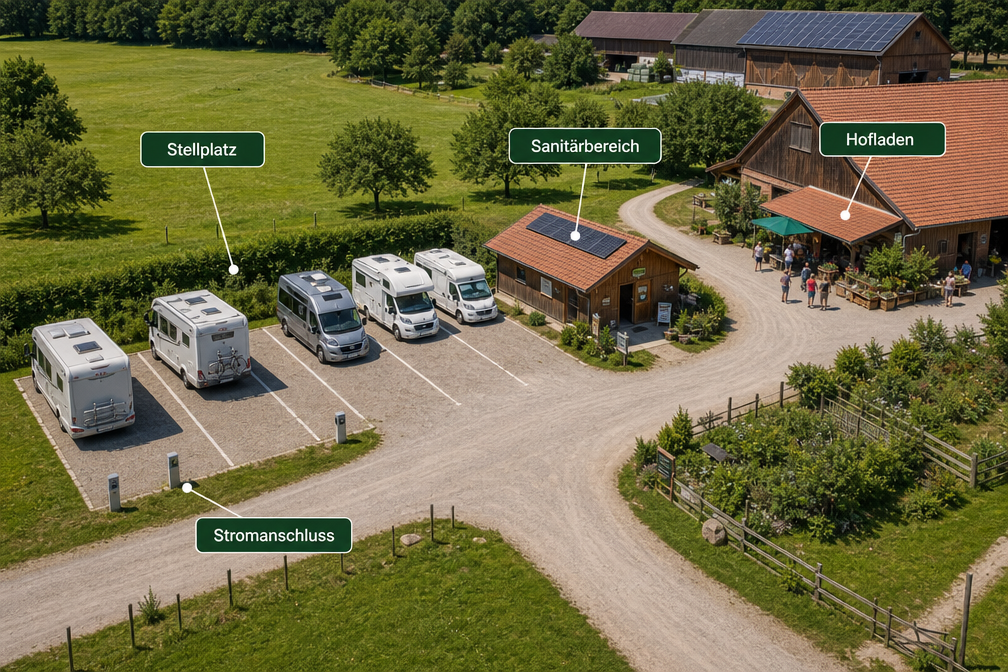
The minimum equipment depends on the target group. Little is often enough for transit travelers, while more is needed for multi-day guests.
Basic amenities (for short stays):
- Level, load-bearing ground.
- Drinking water tap nearby.
- Grey water disposal facility.
- Adequate lighting and signage.
Comfort amenities (for multi-day guests):
- CEE sockets (16 Ampere) for power connection, ideally via service columns.
- Water connection (3/4-inch thread).
- Sanitary area with shower and toilet.
- Facility for disposing of chemical toilet waste.
- WLAN, waste separation, washing and drying facilities.
Extras to boost farm shop sales:
- Signs to the farm shop directly at the pitch.
- Small welcome bag with farm products upon check-in.
- Notice with current farm shop opening hours and seasonal offers.
- Barbecue area or seating area that invites guests to linger.
Those who want to attract campers for several nights should invest in comfort. Those who want to attract passing travelers can start small and expand step by step. More inspiration for camping adventures can also be found in the article about Exploring South Holland by motorhome - Campcruisers Blog, which shows what campers value on their travels.
How can I specifically market my farm shop to motorhome travelers?
Motorhome travelers today book predominantly online and inform themselves via specialized platforms. Those who are visible there gain guests without having to actively acquire them themselves.
The most important marketing channels:
- Booking platforms: The easiest way is to list on Campcruisers, where private pitches on farms, vineyards and private properties can be booked directly. The performance package requires no base fee, only a commission of 12% on successful bookings.
- Google Business: A well-maintained Google profile with photos, opening hours and reviews is free and very effective.
- Social Media: Instagram and Facebook are well suited for showcasing seasonal products, harvest moments, and guest experiences.
- Signage: Highly visible signs on nearby roads and on motorhome routes are often underestimated.
What really attracts campers:
- Authentic photos of the farm, not stock images.
- Clear information on pitch size, electricity, water, and sanitation.
- Mention of the farm shop and current products.
- Flexible and straightforward booking with automatic confirmation.
Those who already rent out holiday apartments can easily expand their existing marketing. Those starting new should begin with a listing on Campcruisers because the platform specifically targets motorhome travelers.
Is a motorhome pitch worthwhile compared to other diversification ideas?
The ultimate farm shop boost through motorhome pitches performs very well compared to other diversification options because the investment is manageable and the synergy effect with the farm shop is immediate.
Comparison with other diversification ideas:
| Idea | Investment | Synergy effect with farm shop | Effort |
|---|---|---|---|
| Motorhome parking space | Low to medium | Very high | Low to medium |
| Holiday apartment | High | Medium | Medium to high |
| Farm café | Medium to high | High | High |
| Experience tours | Low | Medium | Medium |
| Subscription box / CSA | Low | Medium | Medium |
The motorhome parking space has a clear advantage: it brings customers directly to the farm, requires little daily care, and can be expanded step-by-step. A holiday apartment ties up more capital and requires more intensive guest care.
Combine farm shop, agritourism and overnight stay
Those who combine motorhome parking spaces, farm shop and other agritourism offers build a real experience destination. This is the step from a simple parking space to a holiday farm that keeps guests for several days.
Possible combinations:
- Parking space + farm shop + farm tours for children.
- Parking space + pick-your-own fruit and vegetables.
- Parking space + breakfast basket with farm products.
- Parking space + holiday apartment (for guests without a motorhome).
Farms that are already active in agritourism can integrate parking spaces with minimal extra effort because advertising, leisure activities, and organization are already in place. Those who are just starting can get into agritourism affordably with parking spaces and expand later.
For inspiration on what motorhome travelers want to experience on their tours, it's worth looking at articles like Adventure Italy: Through Tuscany by motorhome - Campcruisers Blog or Rent a motorhome without internet? That doesn't have to be the case., which show what expectations and needs campers bring with them.
What mistakes do farmers make when starting a farm shop?
The most common mistakes when starting a farm shop and motorhome pitch are avoidable if you know them.
The seven most common mistakes:
- No building permit obtained: Operating pitches without a permit is risky and can lead to fines and demolition orders.
- Pitches planned too small: Modern motorhomes are up to 12 meters long. Anyone who plans pitches of 6 meters will annoy half of their guests.
- No online booking system: Motorhome travelers book spontaneously and digitally. Those who can only be booked by phone will lose many inquiries.
- Missing signage: Campers won't find the farm if there are no signs on the access road.
- Farm shop and pitch not linked: If guests don't know there's a farm shop, they'll buy elsewhere.
- Too high initial investment: Anyone who builds a sanitary building immediately before demand is proven risks poor profitability.
- No liability insurance: As an operator, you are liable for damages on the premises. Business liability insurance is mandatory.
Who profits more: the farm shop or the pitch operation?
Both profit, but the farm shop gains more percentually. A pitch generates fixed income, but the farm shop can significantly increase its total revenue through camper sales without additional fixed costs.
For a farmer who already runs a farm shop, the pitch is primarily a marketing tool. For someone without a farm shop, the pitch is a standalone source of income, but offers less synergy.
Rule of thumb: Whoever combines both earns more than the sum of its parts. Those who only offer pitches without direct marketing are leaving money on the table.
Conclusion and next steps
The ultimate farm shop boost through motorhome pitches is no longer a secret tip, but has by no means been implemented everywhere yet. The combination of an authentic farm experience, regional products, and a nature-oriented pitch hits the nerve of the times: campers are looking for authenticity, farmers are looking for new sources of income.
Concrete next steps:
- Submit a preliminary building application to the municipal administration and check the camping regulations of your federal state.
- Assess the area and existing infrastructure on the farm: Which buildings could be used as sanitary facilities?
- Define the target group: transit travelers or multi-day guests? This determines the necessary equipment and investment.
- Pitch on Campcruisers platforms to become immediately visible to motorhome travelers.
- Link farm shop and pitch through signage, welcome offers, and social media presence.
- Check profitability after the first season and expand the offer step-by-step.
Those who start now still have real competitive advantages in 2026, because the market for private motorhome pitches on farms is growing faster than the supply.
FAQ
What is a farm shop? A farm shop is a direct marketing stand or retail space that a farmer operates directly on their farm to sell their own products without intermediaries. The customer buys fresh, regional goods directly from the producer.
How many motorhome pitches can a farmer offer in an external area without major permits? In many federal states, up to three pitches can be permitted as a subordinate project of an agricultural operation in an external area, provided there is a spatial and functional connection to the operation. From four pitches onwards, the respective camping regulations of the federal states apply.
How much does a farmer earn from motorhome pitches? 30 to 50 euros per pitch per night can be achieved. With four pitches and 100 occupied days per year, this results in 12,000 to 20,000 euros in annual revenue from pitch fees alone, without farm shop sales from campers.
Do I need a building permit for a motorhome pitch? Yes, in Germany, motorhome pitches are considered structures and generally require a permit. A preliminary building application to the municipal administration is the first step.
How large does a pitch for a motorhome need to be? At least 5 x 10 meters of standing space per pitch. Access roads should be at least 5.50 meters wide and accessible for fire services.
Where can I offer my camper spot online? Through Campcruisers, private parking spaces on farms and private properties can be made directly bookable. The performance package requires no basic fee, only a 12% commission on successful bookings.
Do I need to register a business if I rent out parking spaces? Commercial rental of parking spaces generally requires business registration. Furthermore, the income is subject to VAT. A tax advisor should review the individual situation.
What is the difference between a farm shop and a market stall? A farm shop is permanently established at the farm, offers a wider range of products, and creates stronger customer loyalty. A market stall is temporary, mobile, and limited to a specific weekly market day.
How do camper travelers find my parking spot? Through booking platforms like Campcruisers, Google Business, social media, and clearly visible signage on access roads. Spontaneous bookings via smartphone are particularly important for campers.
Can I combine camper spots with holiday apartments? Yes, it is even recommended. Businesses that already offer holiday apartments can integrate camper spots with minimal additional effort, thereby expanding their capacity and target groups.
Quellen
- Bavarian State Institute for Agriculture (LfL): "Reisemobilstellplätze auf dem Hof", www.lfl.bayern.de, 2025
- Chamber of Agriculture Rhineland-Palatinate: "Wohnmobilstellplätze auf landwirtschaftlichen und weinbaulichen Betrieben", www.lwk-rlp.de, 2022
- Caravaning Industry Association (CIVD): Market data camping vehicles Germany, www.civd.de
- Campcruisers GmbH: Special terms of use for providers, blog.campcruisers.com, 2025
- Herfurtner Law Firm: "Renting out parking spaces: Legal notices and tips", kanzlei-herfurtner.de
Farm Shop Parking Spot Income Calculator
Tags: Farm shop, RV pitch, direct marketing, agritourism, farm, camping, renting out pitches, agriculture, farm shop marketing, motorhome, camper, income alternatives
 English
 German
 Spanish
 Italian
 Polish
 Dutch
 French
 Danish