
Last updated: May 24, 2026
Quick Answer: A gas locker is a ventilated exterior compartment on a motorhome or caravan where gas cylinders are safely stored. There are clear safety rules for handling gas cylinders: always store cylinders upright, close valves, never store them indoors, and check for leaks. If you know these basic rules, you can travel relaxed and safe.
Key Takeaways
- 🔵 A gas box must be ventilated and made of non-combustible material.
- 🔵 Gas cylinders must never be stored indoors, in trunks, or in unventilated vehicle areas.
- 🔵 When transporting in a car, the gas cylinder must be upright, secured, and the valve closed.
- 🔵 Children and pets should not have unsupervised access to the gas box.
- 🔵 The most reliable way to detect a leak is with leak detection spray, not with an open flame.
- 🔵 Standard gas boxes for camping cost between 30 and 150 euros, depending on size and material.
- 🔵 Beginners often underestimate the importance of choosing the right pressure regulator for the respective cylinder size.
- 🔵 Electric alternatives such as power banks and induction cooktops are becoming increasingly popular as a supplement.
What is a gas locker and what is it used for?
A gas box is a specially designed, ventilated outdoor compartment that is mounted on motorhomes, caravans, or in garden areas to store gas cylinders safely and in compliance with regulations. It protects the cylinder from the elements and ensures that escaping gas can escape to the outside instead of accumulating in enclosed spaces.
Without a proper gas locker, storing liquefied gas in vehicles is not permitted in Germany. The Technische Regeln Flüssiggas (TRF) and the EN 1949 standard specify how gas systems in recreational vehicles must be designed. A gas locker is not an optional extra, but a safety element.
Who needs a gas locker?
- Motorhome and caravan owners with built-in gas systems.
- Camping enthusiasts who use gas stoves or gas heaters
- Garden owners with gas-powered grills or patio heaters
What safety rules should I observe when handling gas cylinders?
Handling gas cylinders requires consistent discipline. Gas is not toxic, but highly flammable and can lead to serious accidents if handled improperly.
The most important safety rules at a glance:
| Rule | Details |
|---|---|
| Close valve | Always after use, even for short breaks |
| Store upright. | Never transport or store bottles lying down. |
| Ensure ventilation. | The gas box must be open at the bottom or ventilated. |
| No open flames if leaking. | Use leak detection spray, never a lighter |
| Check pressure regulator | Regularly check for cracks, hardening, and leaks. |
| Note the bottle level. | Never fill above 80% (factory fill) |
Important: Gas cylinders do not belong in car trunks, living rooms or basements. Liquefied gas is heavier than air and accumulates on the floor, which can quickly become an explosion hazard in the event of a leak.
How do I store gas cylinders correctly at home?
The safest way to store gas cylinders at home is outdoors or in a specially designed, ventilated shed. Indoor spaces, basements and garages are unsuitable because escaping gas can concentrate dangerously there.
Checklist for home storage:
- ✅ Place bottle upright and stable
- ✅ Valve fully closed
- ✅ Protective cap on the valve
- ✅ Maintain a minimum distance of 1 meter from ignition sources
- ✅ Avoid direct sunlight and heat sources above 50 °C
- ✅ Store a maximum of two bottles privately (depending on state law)
- ✅ Keep children and pets away
Empty bottles are subject to the same storage rules as full ones, as they may still contain gas vapors.
How much does a standard gas box for camping or the garden cost?
A simple gas box for camping or the garden costs between 30 and 80 euros. Stainless steel models or those with an additional pressure regulator bracket are more likely to cost between 80 and 150 euros. For mobile homes, there are ready-to-install solutions that can cost between 100 and 300 euros, depending on the vehicle type and manufacturer.
Price overview by category (estimated values 2026):
| Type | Price (approx.) |
|---|---|
| Simple plastic gas box | 30–60 € |
| Stainless steel gas locker | 70–150 € |
| Built-in gas locker for motorhome | 100–300 € |
| Gas box with lock and ventilation | 80–180 € |
When buying, it is worth paying attention to the certification mark (e.g. GS mark or EN standard conformity).
What gas locker variants are there for different purposes?
Gas boxes are available in various designs, which are suitable for different purposes. The choice depends on the bottle size, the installation location, and the requirements for safety and weather protection.
The most common variants:
- Stand-up gas box: For garden and patio, freestanding, mostly made of plastic or steel
- Wall-mounted gas box: Space-saving, permanently installed, often used for gas grill connections
- Built-in gas locker on the motorhome: Firmly integrated, ventilated according to EN 1949, often with a lock
- Portable gas box: For occasional camping, lightweight plastic, for small cartridges
Those who regularly travel with a motorhome should opt for a permanently installed, certified gas locker. For the balcony or terrace, a simple model with ventilation slots is sufficient.
How do I recognize a gas cylinder leak?
The surest way to detect a gas leak is by the characteristic smell (gas cylinders are mixed with odorants so that leaks are noticeable), by hissing at the valve, or by leak detection spray. Never use an open flame to search for leaks.
Steps to take if a leak is suspected:
- Extinguish all sources of ignition immediately (stove, heater, cigarettes).
- Close the gas cylinder valve
- Open windows and doors, leave the room
- Apply leak detection spray to valve, hose and connections
- Bubbling indicates the location of the leak
- Replace defective parts, do not seal provisionally.
- In case of strong gas odor: Call the fire department (112)
Common mistake: Many campers turn on the valve and check by smell whether gas is escaping. This is unreliable and dangerous. Leak detection spray is inexpensive and belongs in every camping equipment.
Are gas cylinders dangerous for children and pets?
Yes, gas cylinders are potentially dangerous for children and pets. Children can accidentally open valves, damage hoses, or play with gas appliances. Pets, especially dogs, can chew on hoses.
Protective measures:
- Keep the gas box locked at all times (lock recommended)
- Do not install gas boxes at child height without securing them.
- Regularly check hoses and pressure regulators for damage
- Never leave pets unattended near the gas system.
- Explain and demonstrate the use of gas appliances to children only from a suitable age.
What can go wrong with a defective gas box?
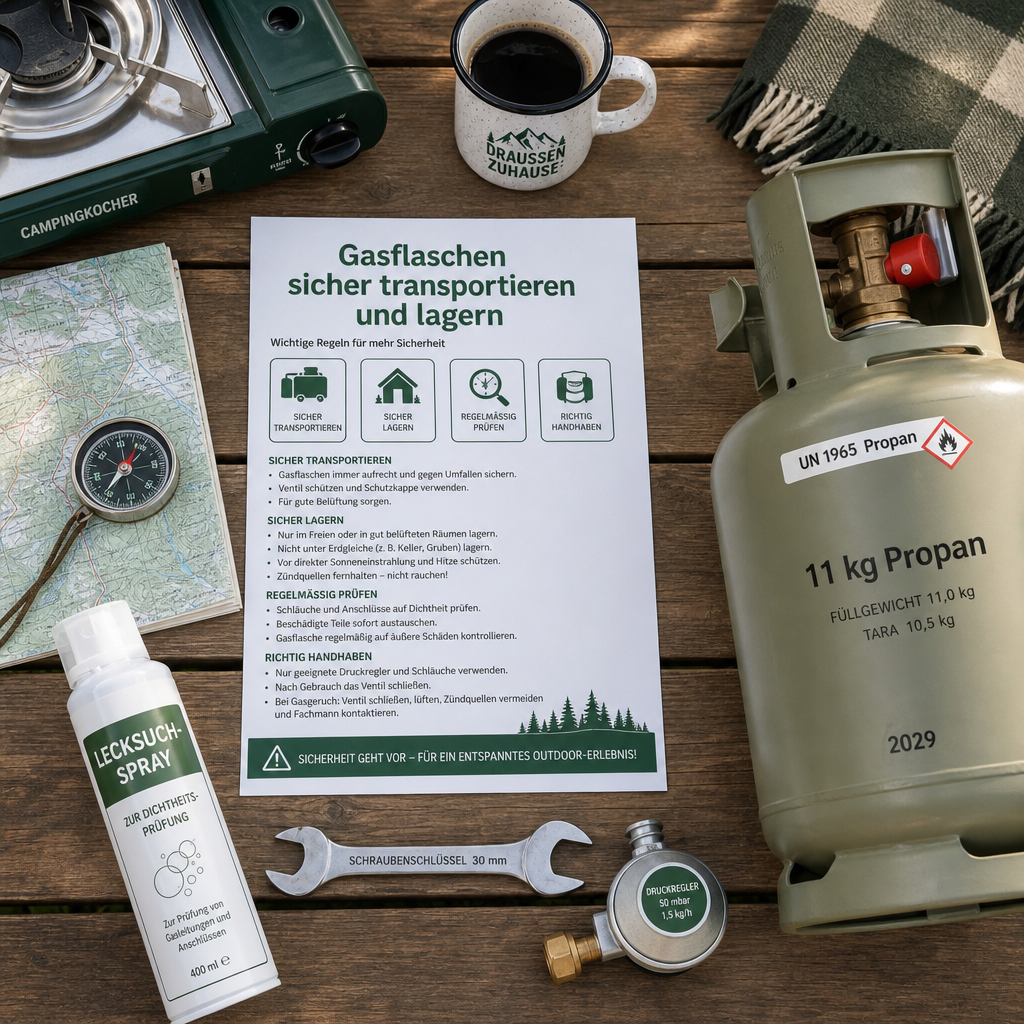
A defective gas locker is underestimated by many campers. The most common mistakes: sealing cracks in the housing with tape, ignoring blocked ventilation openings, or not replacing a broken locking mechanism.
What to absolutely not do:
- Covering or sealing the ventilation slots (Gas accumulation!)
- Seal gas locker with flammable materials
- Continue using defective hoses or pressure regulators
- Build a gas cylinder box without a bottom opening or ventilation yourself.
- Storing bottles in a damaged crate and still extracting gas
When in doubt: Replace the gas box. A new model costs significantly less than damage caused by gas leaks.
What are typical beginner mistakes when handling gas?
Beginners often make the same mistakes when handling gas cylinders: using the wrong pressure regulator, transporting the cylinder lying down, or not closing the valve after use.
Top 5 Beginner Mistakes:
- Incorrect pressure regulator: Not every regulator fits every bottle. In Germany, 30 mbar regulators are common for camping gas.
- Store bottle horizontally. Liquefied gas can get into the hose in this way and damage devices.
- Hose too long or too old: Gas hoses have an expiration date (usually printed on them) and must be replaced regularly.
- Leaving a gas cylinder in the sun. Overheating dangerously increases the internal pressure.
- No leak detection spray included. Whoever doesn't have one often notices leaks too late.
Anyone new to camping will find everything they need at the Campcruisers Blog about Camping News and Tips Regular updates on equipment and rules.
How do I transport gas cylinders safely in the car?
Gas cylinders can be transported in the car, but only under certain conditions. The valve must be closed and secured with the protective cap. The cylinder must stand upright and be secured against tipping, for example with tension belts or in a transport box.
Regulations for the Transport of Gas Cylinders in Vehicles (Germany):
- Valve closed, protective cap installed
- Bottle upright and secured against tipping
- Do not transport in the passenger compartment if possible (trunk with ventilation preferred).
- Open window slightly for air circulation.
- Maximum transport quantity for private individuals: up to 33 kg of LPG without special authorization (ADR exemption regulation)
- When driving through tunnels: Observe the rules of the respective tunnel.
Tip: When you rent a campervan, you usually don't have to worry about transporting the gas cylinder. The gas system is already permanently installed and tested. On Campcruisers.com You can find RVs at professional rental companies, where the gas system and gas box are already standard and tested.
Who is a gas box suitable for and who is it not?
A gas box is suitable for anyone who regularly cooks, heats, or grills with liquid gas and values safety and order. The gas solution is not suitable for people who do not want to deal with the technology or camp in areas where open gas is not allowed.
Gas locker: Yes or No?
| Suitable for... | Less suitable for… |
|---|---|
| Mobile home permanent camper | Short trip camper without cooking equipment |
| Grill enthusiasts in the garden | Campers in areas with gas bans |
| Families with camping kitchen | People without basic technical knowledge |
| Caravan owner | Minimalists with induction cooktops |
Those who prefer to travel without gas will find alternatives in the next section.
What alternatives are there to gas-powered appliances?
Electric alternatives to gas appliances are becoming increasingly sophisticated and suitable for everyday use in camping. Induction cooktops, power banks and solar panels are completely replacing the gas cylinder in many situations.
Overview of alternatives:
- Induction cooktop + power station: Clean, safe, no gas smell. Suitable for campsites with electricity.
- Solar panel + battery system: For self-sufficient camping without electricity. Higher initial investment, low running costs.
- Electric Camping Heater: A comfortable option for pitches with a power connection.
- Charcoal Grill: Classic alternative to gas grills, but with its own limitations (fire protection, prohibitions).
Campcruisers blog to learn about eVentje: The electric campervan that is reinventing travel inform that does not require a gas system.
For many camping enthusiasts, however, gas remains the most practical solution, especially where no power connection is available.
FAQ: The Gas Box and Gas Cylinders in Camping
Does a gas locker on a motorhome have to be lockable?
A lock is not legally required, but is strongly recommended for security reasons and to protect against unauthorized access.
How often should I replace the gas hose?
Gas hoses for camping have a printed expiration date. As a rule, they should be replaced every 10 years or if there are visible cracks and hardening.
Am I allowed to leave a full gas cylinder in the RV over the winter?
Yes, if the gas box is properly ventilated and the bottle is not damaged. The valve should be closed.
What size gas bottle is best for camping?
For short trips, 5 kg bottles are sufficient. For longer trips or heating operation, 11 kg bottles are more common.
Can I use foreign gas cylinders in Germany?
Not always. Connections and pressure regulators are different in Europe. Motorhomes rented abroad often have country-specific connections.
How do I know if my gas cylinder is still full?
By weighing: The empty weight (tare) is on the bottle. The difference to the current weight gives the fill level. Some models also have a fill level indicator.
Is a gas box also suitable for balcony use?
Yes, there are special gas boxes for gas-powered grills on the balcony. The house rules and local regulations should be checked beforehand.
What do I do if the gas cylinder valve is stuck?
Never open with force. Contact a specialist or the bottle manufacturer. Damaged valves can be dangerous.
Conclusion: Safe and relaxed on the road with gas
The gas box is not a bureaucratic obligation, but a real safety gain for every camping trip. Those who know the rules, choose the right products and check regularly can enjoy gas while camping with absolutely no worries. Store gas cylinders upright, close valves, have leak detection spray with you and never misuse the gas box as storage space for other things. These are the basics that make the difference.
Anyone looking for their next camping adventure and who doesn't want to worry about gas systems, vehicle technology, or equipment can simply book a tested RV from a professional rental company. On Campcruisers.com you'll find a large selection of campers and motorhomes for rent, where the gas system and gas box are already installed and tested as standard. Easy Camper mieten, set off and enjoy.
For inspiration on the most beautiful travel destinations, it's also worth taking a look at the best campsites in Europe or on current Rule changes for mobile homes in Germany.
Quellen
- Technical Rules for Liquefied Gas (TRF 2012), DVGW/FIGAWA, 2012
- DIN EN 1949: Requirements for the installation of LPG systems in leisure accommodation vehicles, European Committee for Standardization
- Federal Institute for Materials Research and Testing (BAM): Information sheet on liquefied petroleum gas, available at bam.de
- ADR 2023 (European Agreement concerning the International Carriage of Dangerous Goods by Road), UNECE, 2023
Tags: Gas box, gas bottles for camping, liquid gas safety, motorhome gas system, storing gas bottles, transporting gas bottles, camping safety, camping pressure regulator, detecting gas leaks, camping equipment, renting a motorhome, renting a camper


 English
  German
  Spanish
  Italian
  Polish
  Dutch
Dutch  French
  Danish