
Quick answer: Blue toilet chemicals combat odours most strongly, but are prohibited on many campsites and are harmful to the environment. Green products offer a good compromise between effectiveness and compatibility. Biological sanitary additives are the most environmentally friendly choice and are easily permitted on most modern campsites — however, they require a little more care when dosing.
The most important things at a glance:
- Blue chemicals contain formaldehyde or similar biocides and are no longer permitted on many European campsites.
- Green products are usually formaldehyde-free, but not automatically biodegradable — read the label carefully.
- Biological sanitary additives use enzymes or bacterial cultures and are the gentlest on disposal stations and nature.
- The duration of action of a filling depends on the tank size, temperature and frequency of use — not just on the product.
- For long-term travellers, biological concentrates are often the cheapest solution per use.
- Incorrect toilet chemicals can permanently damage seals, valves and cassette toilets.
- Allergy sufferers should use fragrance-free, enzyme-based products.
- If you hire a campervan from CampCruisers, you should clarify in advance which chemicals are intended for use in the vehicle.
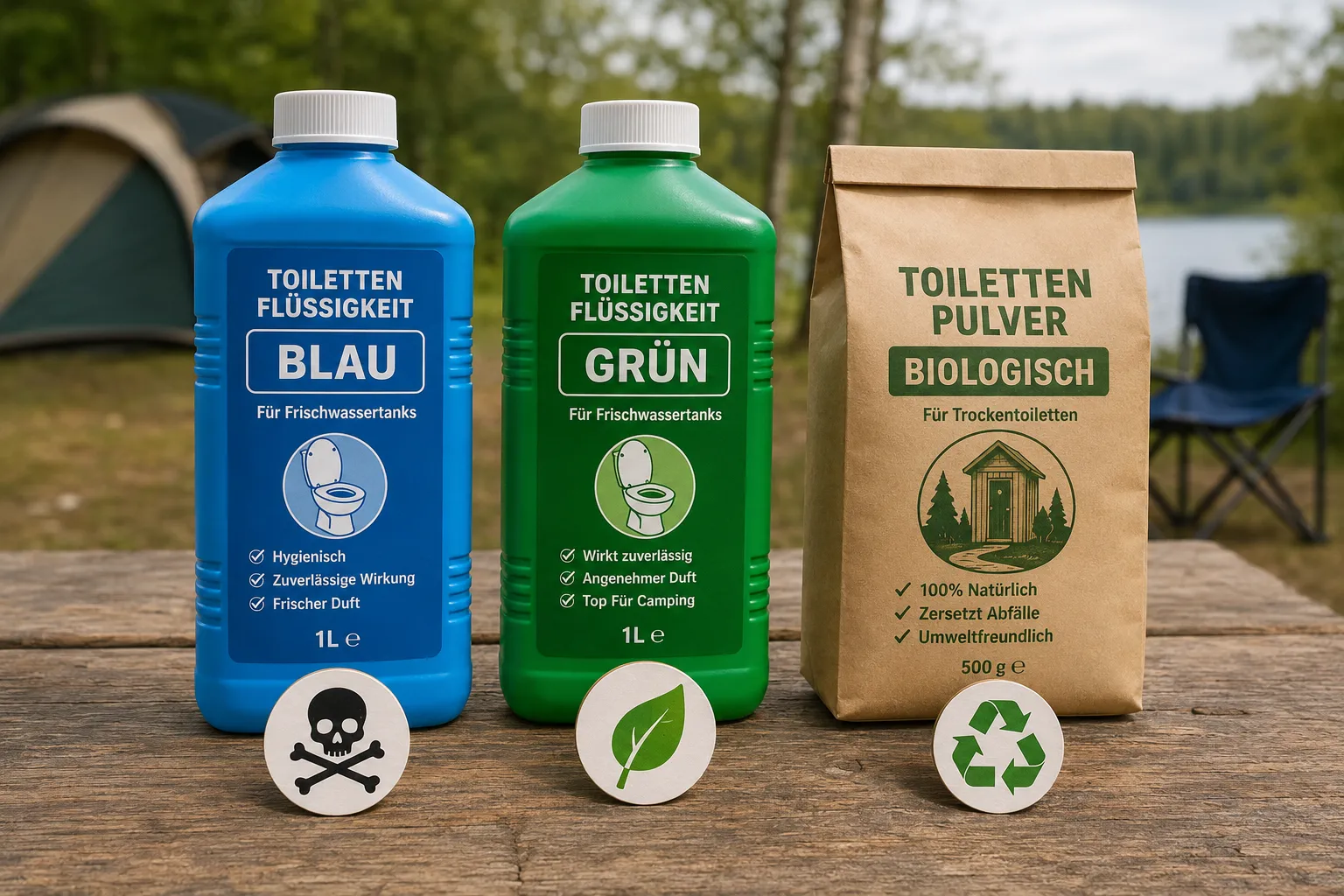
What is the difference between blue and green toilet chemicals?
Blue toilet chemicals work with strong chemical biocides — historically often formaldehyde, today often bronopol or glutaraldehyde — which kill bacteria and thereby suppress odours. Green products are usually formaldehyde-free and rely on milder active ingredients such as quaternary ammonium compounds or herbal fragrances.
The key differences at a glance:
| Characteristic | Blaue Chemie | Grüne Chemie |
|---|---|---|
| Active ingredient | Biocides (Bronopol, glutaraldehyde) | Milder compounds, often synthetic |
| Odour control | Very strong | Good to very good |
| Biodegradable | No | Partial |
| Campsite approval | Often restricted | Mostly allowed |
| Price (approx.) | Inexpensive | Medium |
| Seal compatibility | Can attack rubber | More compatible |
Important: "Green" on the packaging is not a protected term. Some manufacturers use it purely for marketing purposes, without the product actually being more environmentally friendly. Always look for certifications such as the Blue Angel or OECD 301 biodegradability.
Which toilet chemical is the most environmentally friendly?
Biological sanitary additives based on enzymes or bacteria are clearly the most environmentally friendly option. They actively break down organic waste instead of just chemically suppressing it, and are fully biodegradable according to OECD 301B.
Products such as Thetford Aqua Kem Green, Dometic GreenCare or Campa Bio are explicitly recommended on many campsites and may even be disposed of directly in special areas in some countries — which would be unthinkable with blue chemicals.
Choose biological chemicals if:
- You are travelling on campsites with strict environmental regulations (especially Scandinavia, Austria, the Netherlands).
- You are planning longer tours and disposal options are scarce.
- You use a vehicle with a fixed tank or grey water system.
How expensive are biological sanitary additives for camping and motorhomes?
Biological products cost a little more to buy than blue chemicals, but are often competitive per application. A 1.5-litre concentrate costs between 12 and 20 euros and is sufficient for 15 to 25 tank fills, depending on the dosage.
For comparison: inexpensive blue chemicals cost around 5–8 euros per litre, but need to be dosed more frequently and potentially cause additional costs due to campsite requirements or damage to seals.
Rule of thumb for cost calculation:
- Small cassette tank (15–18 litres): approx. 75–100 ml additive per fill
- Medium tank (20–25 litres): approx. 100–150 ml
- For biological concentrates: price per application often under 1 euro
Can I also avoid odour problems with biological toilet chemicals?
Yes — but with one limitation: biological products take a little longer to take full effect because enzymes and bacteria first have to become active. With correct dosage and regular use, however, odour problems are no more frequent than with chemical alternatives.
Tips for odour-free results with bio-chemicals:
- Always add enough water to the tank (at least 2–3 litres before first use).
- Do not overdose — more product does not automatically mean less odour.
- Do not leave the tank standing for too long, especially in heat above 30 °C.
- Do not forget the rinse water additive (upper tank) — it prevents deposits in the hose.
Practical tip: In very high temperatures (southern Europe in summer), many experienced motorhome owners recommend increasing the dosage of biological products by 20–30 % and emptying the tank more frequently.
Which toilet chemical is best for sensitive waste water systems?
For sensitive systems — including cassette toilets with rubber seals, older fixed tanks and toilets with diaphragm valves — biological or certified seal-compatible green products are the safest choice.
Blue chemicals with aggressive biocides can make rubber seals brittle over time and cause valves to stick. This is particularly a risk with rented vehicles because you do not know the condition of the seals.
Recommendation by toilet type:
- Cassette toilet (Thetford, Dometic): Green or biological chemicals, observe the manufacturer's product-specific recommendation.
- Fixed tank with disposal pump: Exclusively biological products that do not attack pump parts.
- Separating toilet: No classic toilet chemicals required — only litter in the solids container.
- Chemical toilet (classic, e.g. Porta Potti): Blue chemicals work technically here, but are often problematic on campsites anyway.
What happens if I use the wrong toilet chemicals?
The consequences range from mild odour problems to expensive damage. Anyone who uses blue chemicals in a system designed for biological products risks killing off the beneficial bacteria cultures — which, paradoxically, leads to more odour, not less.
Specific risks with incorrect chemicals:
- Damage to rubber seals and valves (repair costs: 50–200 euros depending on model)
- Rejection at disposal stations on campsites
- Fines in countries with strict environmental regulations (e.g. Netherlands, Sweden)
- Poor odour control due to incorrect dosage or incompatible active ingredients
Common mistake: Mixing blue and biological chemicals. This immediately neutralises the bacterial cultures of the organic products and renders both products ineffective.
Which toilet chemical is suitable for which type of toilet?
Not every product is suitable for every system. The manufacturer's recommendation in the vehicle handbook is the first point of contact — especially for rented motorhomes via CampCruisers, where the guarantee may be invalidated if the wrong care is taken.
Basic rule: the more modern and environmentally sensitive the system, the more likely you should be to use biological products. Older systems can often tolerate both, but campsite approval still speaks in favour of green or biological chemicals.
Is there allergy-free toilet chemical for people with sensitive skin?
Yes. Enzyme-based biological products without synthetic fragrances are the best choice for allergy sufferers. Many conventional products — including green ones — contain perfumes that can trigger skin irritation or respiratory problems.
What allergy sufferers should look for when buying:
- „Perfume-free“ or „fragrance-free“ on the packaging
- No quaternary ammonium compounds (can irritate mucous membranes)
- Certification by Dermatest or similar institutes
- Products based on pure enzymes/bacteria (e.g. Aqua Kem Organic)
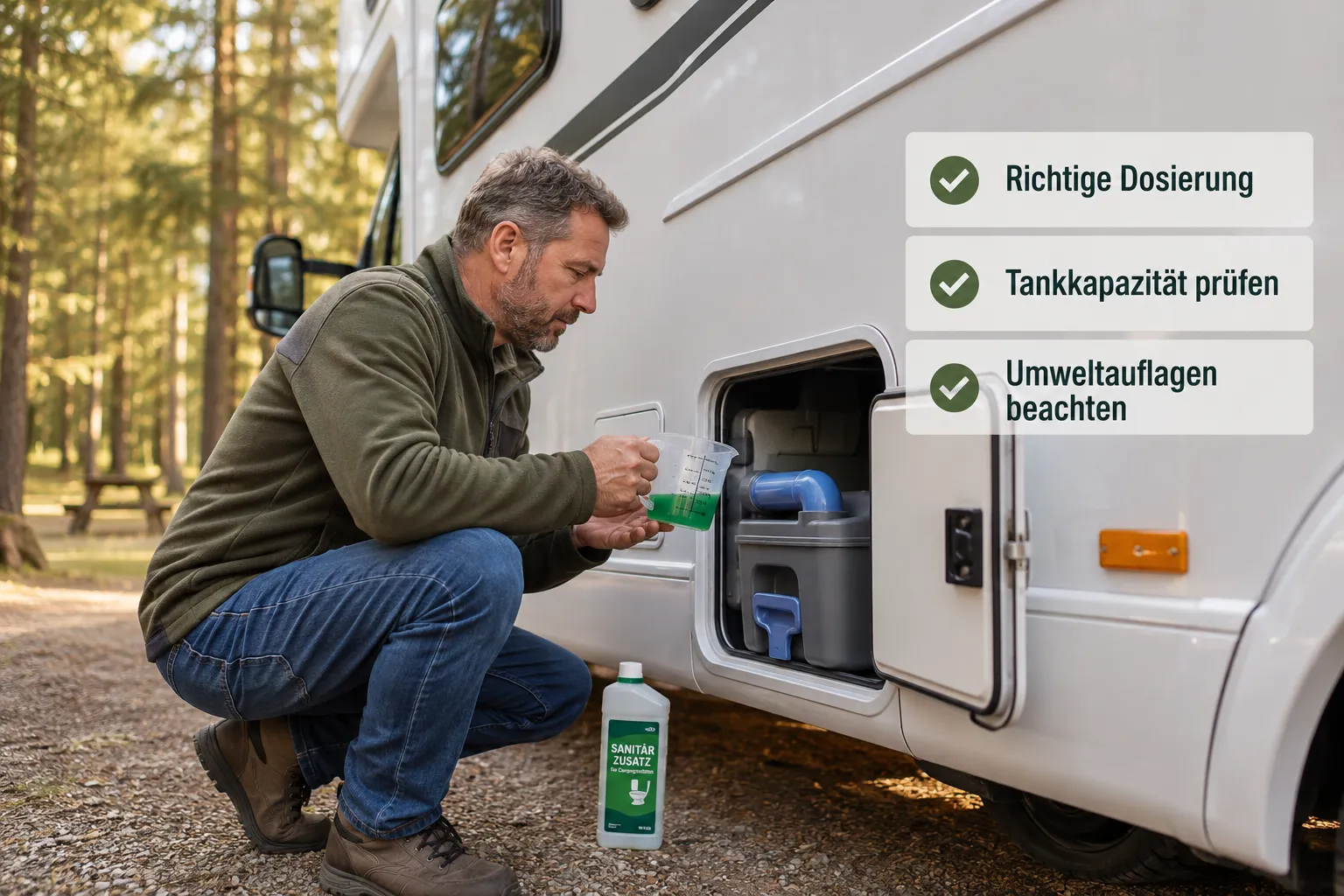
How long does a dose of toilet chemical last in the tank?
A correctly dosed filling of toilet chemical usually lasts reliably for 3 to 7 days — depending on tank size, outside temperature, frequency of use and product type. In heat above 25 °C, the effect degrades more quickly.
Biological products can remain effective for up to 10 days under optimal conditions (moderate temperature, regular use) because the bacterial cultures are continuously active. Blue chemicals, on the other hand, lose their effect linearly over time.
Rule of thumb: Empty the tank when it is two-thirds full — not when it is full. This prevents odour breakthroughs and protects the system.
Which toilet chemical is best for long camping trips?
For trips lasting more than two weeks — especially through different countries with different disposal regulations — biological sanitary additives in concentrated form are the most practical choice. They are universally accepted, space-saving and cost-efficient.
Checklist for long-term travellers:
- Buy concentrate instead of ready-to-use solution (saves weight and space)
- Research the disposal regulations of the destination countries in advance
- Plan for a spare supply for at least 4–6 weeks
- Don't forget rinsing additive for the upper tank
What are the most common mistakes when choosing toilet chemicals?
The biggest mistake is simply buying the cheapest product without paying attention to compatibility with your own system and the campsites you are visiting.
The five most common mistakes:
- Using blue chemicals on campsites, which only allow green or biological products.
- Over- or under-dosing — both extremes lead to odour problems.
- Mixing products, especially biological with chemical biocides.
- Forgetting the upper tank additive — without it, deposits form in the flushing mechanism.
- Ignoring manufacturer's recommendation, especially for rented vehicles.
Which toilet chemicals should I not use in the chemical toilet system?
Never fill household cleaners, bleach or toilet duck products into camping toilet systems. These products are not designed for closed tanks, destroy seals within a few weeks and can release toxic gases.
Also unsuitable: products that are explicitly marketed for boat toilets or septic tanks — these have different active ingredient concentrations and can overload cassette toilets.
Never use:
- Household toilet cleaners (e.g. WC-Ente, Domestos)
- Bleach or chlorine products
- Alcohol-based disinfectants
- Products without explicit camping toilet approval
Frequently asked questions about toilet chemicals
Can I simply replace blue toilet chemicals with biological ones? Yes, but rinse the tank thoroughly beforehand. Residues of blue chemicals immediately neutralise the bacterial cultures of biological products.
Is green toilet chemical automatically biodegradable? No. „Green“ is not a protected term. Only products with OECD 301B certification or the Blue Angel are demonstrably biodegradable.
Which chemicals does Thetford recommend for its cassette toilets? Thetford officially recommends its own Aqua Kem line, including Aqua Kem Green and Aqua Kem Organic for environmentally conscious users.
Am I allowed to transport toilet chemicals in an aeroplane? Liquid toilet chemicals are subject to dangerous goods regulations and are prohibited in hand luggage. Strict quantity restrictions apply to checked baggage — it’s best to buy at the destination.
How do I dispose of toilet chemicals correctly? Exclusively at official disposal stations at campsites or service stations. Never in nature, in normal toilets or in household waste.
How much water belongs in the lower tank before the first use? At least 2 litres of water plus the recommended amount of toilet chemical. This prevents deposits and activates biological products correctly.
Does biological chemistry also work in winter? To a limited extent. Below 5 °C, bacterial cultures are hardly active. For winter camping, it is better to use green chemical products or store the tank heated.
How much does a campsite disposal station cost? Most European campsites offer disposal free of charge or for €1–3. Some require proof that no blue chemicals have been used.
Conclusion: Making the right choice
The decision in „The right toilet chemical: Blue, green or biological?“ is not a matter of personal taste, but a practical trade-off between system compatibility, campsite regulations and travel duration.
Specific recommendations:
- Short trips to well-known campsites: Green chemistry is the safe middle ground — well tolerated, accepted everywhere, easy to dose.
- Long-term travel through Europe: Biological concentrates are the most economical and universally accepted solution.
- Allergy sufferers and sensitive skin: Enzyme-based, fragrance-free biological products without exception.
- Rented motorhomes (e.g. via CampCruisers): Always check the vehicle documentation and, if in doubt, choose biological products — they protect the system and avoid liability risks.
Once you have switched to biological toilet chemicals and understood the dosage, you rarely want to go back. The environment, the disposal stations and the seals of the vehicle will thank you.


 English
  German
  Spanish
  Italian
  Polish
  Dutch
Dutch  French
  Danish