
Last updated: May 24, 2026
Quick Answer: A double floor in a motorhome is a hollow intermediate floor that is installed between the actual vehicle floor and the living space floor. This cavity serves as additional storage space, as cable routing for water and electrical cables and as a heat protection layer against cold from below. Motorhomes with a double floor are particularly suitable for year-round camping and longer journeys.
Key Takeaways
- A double floor creates up to several hundred litres of additional storage space, depending on the vehicle size and model.
- It protects water pipes and tanks from freezing, making winter camping much more comfortable.
- Brands such as Hymer, Knaus Tabbert, Bürstner and Dethleffs offer double floors as standard or as an option.
- Retrofitting is possible, but complex and should be carried out by specialist companies.
- A double floor increases the unladen weight of the vehicle, which must be taken into account when planning the payload.
- For compact vehicles under 5.5 metres, a double floor is often less worthwhile, as the weight advantage is missing.
- Regular checks for moisture and mould in the cavity are essential.
- When buying, be sure to pay attention to the accessibility of the maintenance flaps and tank emptying.
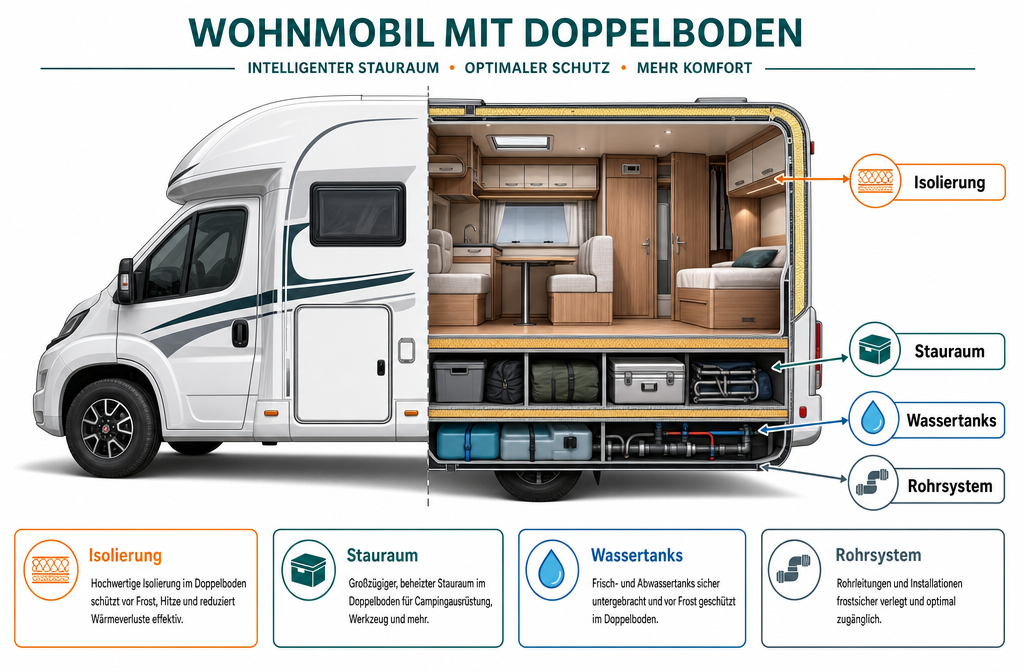
What exactly is a double floor in a motorhome?
A double floor is a constructive cavity between the chassis floor and the visible living area floor of a motorhome. This space is typically 15 to 30 centimetres high and extends over most of the vehicle length.
At its core, a double floor consists of three levels:
- Lower level: the actual vehicle floor (chassis)
- Cavity: Space for tanks, pipes, insulation and storage space
- Upper level: the walk-on living area floor with maintenance flaps
Fresh water and waste water pipes, electrical cables and often also heating system pipes run within this cavity. Many manufacturers also integrate the fresh water tanks and gas bottles there. The cavity is accessible via flaps in the floor or side storage compartments. The concept of „Double floor in the motorhome: What is it and what is it good for?“ can therefore be summarised in one sentence: It is a multifunctional intermediate space that combines storage space, cable routing and thermal protection in one.
What are the advantages of a double floor when camping?
The biggest advantage is the combination of storage space, frost protection and clean cable routing, which no other vehicle concept combines so compactly.
The most important advantages at a glance:
| Advantage | Explanation |
|---|---|
| 🗄️ More storage space | Hundreds of litres of extra space for equipment, tools, camping chairs |
| ❄️ Frost protection | Pipes and tanks are protected from sub-zero temperatures |
| 🔇 Sound insulation | The cavity dampens driving noise and vibrations |
| 🌡️ Thermal insulation | Cold from below is slowed down, the interior stays warmer |
| 🔧 Tidy technology | Cables and pipes disappear invisibly into the floor |
For year-round campers, frost protection is often the decisive argument. Anyone travelling in Scandinavia or the Alps in winter knows how quickly frozen water pipes can ruin a trip. Also take a look at our article about the Adventure through Tuscany with a motorhome which shows how important good vehicle equipment is for relaxed travel.
What does it cost to install a double floor in a motorhome?
The costs vary greatly depending on the vehicle, effort and operation. As a rough guide: A professional retrofit costs in Germany, according to experience, between 2.000 und 8.000 Euro, depending on vehicle size, material selection and whether tanks and pipes need to be re-laid.
When buying a new motorhome with a double floor, the surcharge is often cheaper than a later retrofit. Many manufacturers offer it as standard equipment or as an option for 500 bis 2.500 Euro surcharge.
Cost factors at a glance:
- Vehicle size (length and width of the floor)
- Whether new tanks should be integrated
- Quality of insulation materials
- Arbeitszeit des Fachbetriebs
- Whether existing lines need to be relocated
Important: A retrofit should always be carried out by a certified motorhome company, as faulty seals can lead to moisture damage.
How much additional storage space is available with a double floor?
This depends heavily on the vehicle model and the height of the cavity. For a medium-sized motorhome (approx. 6.5 to 7.5 metres long) are 200 bis 600 Liter additional storage space realistic if tanks and technology are already accommodated.
Some manufacturers specify concrete storage space dimensions for their models. Hymer, for example, advertises double floors with over 400 litres of accessible storage space in certain B-Class models in addition to the integrated tanks.
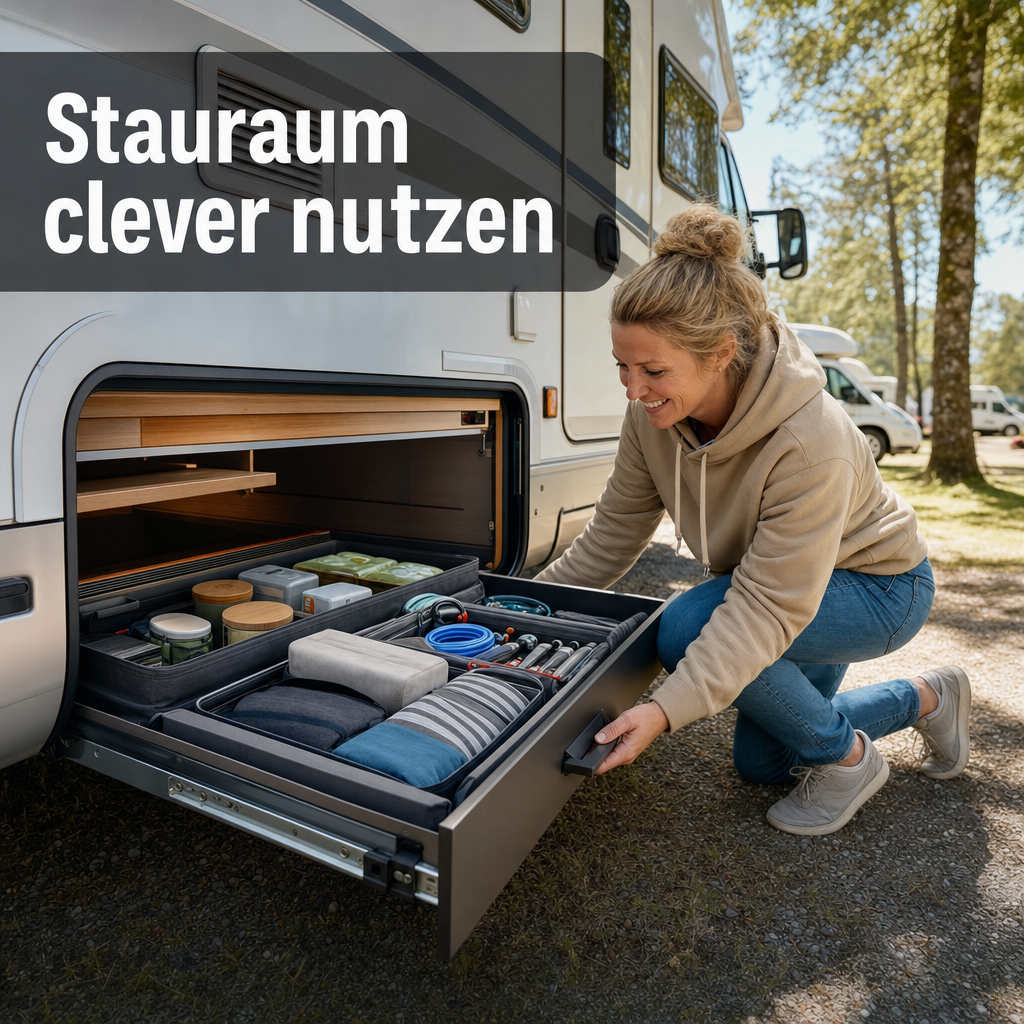
What typically fits into the double floor?
- Camping chairs and tables
- Awning Accessories
- Toolboxes
- Hoses, cables, adapters
- Winter equipment (snow chains, ice scraper)
- Sports equipment (bicycle helmets, hiking boots)
Is it possible to retrofit a double floor yourself?
Technically, retrofitting yourself is possible, but not recommended for most campers. Installation requires manual skills, knowledge of plumbing and electrical engineering, and the right tools.
Reasons why a specialist company is the better choice:
- Faulty seals lead to condensation and mould in the cavity
- Incorrectly laid pipes can burst in freezing conditions
- Structural interventions in the vehicle floor can jeopardise approval
- Warranty claims on the vehicle may become void
If you still want to do it yourself, you should limit yourself to simple installations, such as inserting insulating mats into an existing cavity. For everything that concerns pipes and tanks: use a specialist company.
Which motorhome brands have a double floor as standard?
Several European manufacturers offer double floors as standard or as a common option. The best known include:
- Hymer (B-Klasse, Exsis-i, ML-T): Double floor with integrated tanks and heating often standard
- Knaus Tabbert (Van Ti, Sky Ti): Double floors in the Ti line as a trademark
- Bürstner (Lyseo, Ixeo): Double floors in higher-end equipment lines
- Dethleffs (Globebus, Esprit): Double floor as an option or standard equipment
- Carthago (C-Tourer, Chic C-Line): Known for high-quality double floors with frost protection
The „Ti“-Linien (Semi-integrated) from many manufacturers are particularly often equipped with double floors, as the chassis there allows more height for a cavity.
What are the disadvantages of a double floor in a motorhome?
A double floor is not a panacea. It has some disadvantages that should be known before buying.
The main disadvantages:
- Additional weight: A double floor with tanks and insulation can add 80 to 150 kilograms to the unladen weight. This reduces the payload, which is particularly relevant for vehicles up to 3.5 tonnes. It is worth reading our article about Motorhomes up to 3.5 tonnes and the topic of overloading.
- Higher vehicle: The double floor increases the vehicle's centre of gravity and overall height, which is relevant for underpasses and car parks.
- Maintenance effort: Pipes and tanks in the cavity are more difficult to access than with classic side storage compartments.
- Risk of condensation: Poorly sealed double floors can accumulate moisture.
- Higher acquisition costs: Models with a double floor are usually more expensive.
How does a double floor protect against cold and moisture?
The cavity of the double floor acts as a natural buffer zone between the cold chassis floor and the heated living space. Many manufacturers also fill this space with insulating material such as polystyrene, polyurethane foam or mineral wool.
How frost protection works in concrete terms:
- Water tanks and pipes are located in the tempered cavity, not on the outside of the vehicle.
- The vehicle heating (usually diesel or gas heating) also directs warm air through the double floor.
- The insulation layer prevents ground temperatures below freezing from reaching the pipes.
This is a real game-changer for winter camping: while motorhomes without a double floor often have to work with heating cables on the pipes at freezing temperatures, everything in the double floor remains automatically protected as long as the heating is running.
What should you consider when buying a motorhome with a double floor?
When buying, you should not only look at whether a double floor is present, but also how it is constructed and how well it remains accessible.
Checklist for purchase:
- How many and how large are the maintenance flaps?
- Are the tanks accessible from the outside or only from the inside?
- Can the waste water be completely emptied?
- Which insulation is installed (polystyrene vs. PU foam)?
- Is there a heating connection for the cavity?
- What is the extra weight due to the double floor?
- Does the overall weight still fit the driving licence category? (It's worth taking a look at the new EU driving licence regulations)
Decision rule: Those who frequently camp in autumn and winter or plan longer trips should prioritise the double floor. Those who only travel in summer and want to save weight can do without it.
How do you properly care for and maintain a double floor?
A double floor needs regular attention, especially after winter. The most common cause of damage is moisture that has penetrated, which forms mould in the cavity.
Maintenance routine (recommended: once a year, ideally in spring):
- Open all the maintenance flaps and check the cavity for moisture and mould.
- Check pipes for cracks or leaks.
- Empty and rinse the waste water tank completely.
- Disinfect the fresh water tank (tablets or citric acid solution).
- Check insulation for damage.
- Check flaps and seals for wear.
A well-maintained double floor will easily last the entire life of the vehicle. Neglect, on the other hand, can lead to expensive damage to pipes and floor structure.
What mistakes should you avoid when using a double floor?
Three mistakes happen particularly often, and all three are avoidable.
Mistake 1: Not completely emptying the waste water tank before winter
Residual water freezes and can burst the tank or pipes. Always empty completely and blow out with compressed air.
Mistake 2: Using the cavity as a rubbish dump
Damp objects, food scraps or organic material in the double floor promote mould and odours. Only store dry, clean objects.
Mistake 3: Ignoring overloading
The additional storage space tempts you to pack more. This can quickly lead to overloading, especially with vehicles under 3.5 tonnes. Always keep an eye on the permissible gross weight.
Is a double floor suitable for all types of motorhome?
No, not every motorhome benefits equally from a double floor. Suitability depends heavily on the vehicle type and planned use.
Motorhome types and double floor suitability:
| Vehicle type | Double floor sensible? | Why? |
|---|---|---|
| Vollintegrierter (7–9 m) | ✅ Very well suited | Plenty of space, high base weight already present |
| Semi-integrated (6–7.5 m) | ✅ Well suited | Classic double floor class |
| Alcove (6–7 m) | ✅ Possible | Less common, but feasible |
| Panel van (Van, 5–6 m) | ⚠️ Limited | Low headroom, weight critical |
| Compact camper (<5.5 m) | ❌ Mostly not sensible | Too little space, weight disadvantage outweighs the benefits |
For panel vans and compact vehicles, there are often better alternatives such as optimised side storage compartments or roof boxes. The double floor only unfolds its full potential from a vehicle length of about 6 metres.
FAQ: Double floor in the motorhome
What is the difference between a double floor and normal storage compartments?
Storage compartments are externally accessible flaps on the side. A double floor is an internal cavity under the living area floor that also accommodates pipes and tanks and acts as a thermal buffer.
Can I camp in winter with a motorhome without a double floor?
Yes, but with more effort. External heating cables on the pipes and regular emptying of the tanks are then necessary. A double floor makes winter camping much more comfortable.
How can I tell if the double floor is sealed when buying used?
Open all flaps and check for water stains, mould or damp insulation with a torch. If in doubt, commission a specialist company to carry out a moisture measurement.
Does a double floor increase the resale value?
Generally, yes. Motorhomes with a double floor are considered better equipped and are more popular with buyers, especially if winter camping is a consideration.
How heavy is a typical double floor?
The cavity with insulation and floor panel alone can weigh 40 to 80 kilograms. With integrated tanks and pipes, it quickly adds up to 100 to 150 kilograms.
Can the double floor also be used for gas bottles?
Yes, many manufacturers integrate the gas locker into the double floor. This is safer than external mounting, as gas pipes are shorter and better protected.
How long does a professional retrofit take?
Depending on the scope, between 3 and 10 working days. Complex installations with new tanks and heating system connections can take longer.
Do I have to declare the double floor to the MOT?
If structural changes are made to the vehicle or new tanks are installed, the change must usually be registered. Consult a specialist company and the responsible testing centre in advance.
Conclusion: Is a double floor worthwhile in a motorhome?
The question „Double floor in a motorhome: What is it and what is it good for?“ can be answered clearly: For anyone planning more than just summer camping, a double floor is one of the most sensible investments in motorhome equipment. It combines storage space, frost protection and clean technology management in a construction that makes everyday life on the campsite noticeably easier.
Anyone buying a vehicle with a double floor should pay attention to the accessibility of the flaps, the quality of the insulation and the overall weight. Anyone wanting to retrofit should commission a specialist company and realistically plan the costs.
Ready for your next trip? Whether with a double floor or without: At Campcruisers you will find a large selection of motorhomes from professional rental companies worldwide. Simply enter your desired destination, select your vehicle and Rent a campervan — camping can be that uncomplicated. 🚐
For inspiration on where your trip could take you, check out our articles about Explore South Holland with a motorhome or that Adventure from Buenos Aires to Ushuaia an.
Quellen
- Hymer GmbH & Co. KG – Product Documentation B-Class and Exsis-i Models (2023), hymer.com
- Knaus Tabbert AG – Vehicle Brochures Van Ti and Sky Ti (2023), knaus.de
- ADAC – Motorhome Guide: Technology and Equipment (2022), adac.de
- Caravaning Industrie Verband (CIVD) – Market Data and Vehicle Categories (2023), civd.de
Meta Title: Double Floor in the Motorhome: What is it and what is it for?
Meta Description: What is a double floor in a motorhome and what advantages does it offer? Everything about storage space, frost protection, costs, brands and maintenance – explained concisely.
Tags: Double floor motorhome, motorhome storage space, winter camping, motorhome equipment, buying a motorhome, motorhome technology, frost protection for motorhomes, camping tips, renting a motorhome, renting a camper, year-round camping, retrofitting a motorhome


 English
  German
  Spanish
  Italian
  Polish
  Dutch
Dutch  French
  Danish