
Water swallows light, movement blurs subjects, and salt spray destroys expensive camera lenses in minutes. Anyone who engages in photography on water and wants to capture the best boat shots needs more than luck and a beautiful sunset. With the right settings, appropriate equipment, and a few clear rules, shots are created that truly inspire.
The most important things at a glance:
- A shutter speed below 1/500 s freezes movement on the water and prevents blur.
- A polarizing filter is the most effective accessory for water shots.
- Smartphones with IP68 certification are sufficient for occasional photos, but a system camera offers significantly more flexibility.
- Golden hour and blue hour are the best times of day for boat photography.
- Camera protection against splash water is not an optional extra, but a must.
- Lakes and seas require different settings due to light and waves.
- Typical mistakes include a crooked horizon, excessively high ISO values, and a lack of foreground.
- Houseboat trips offer unique perspectives that land trips simply cannot provide.
What equipment do I need for photography on the water?
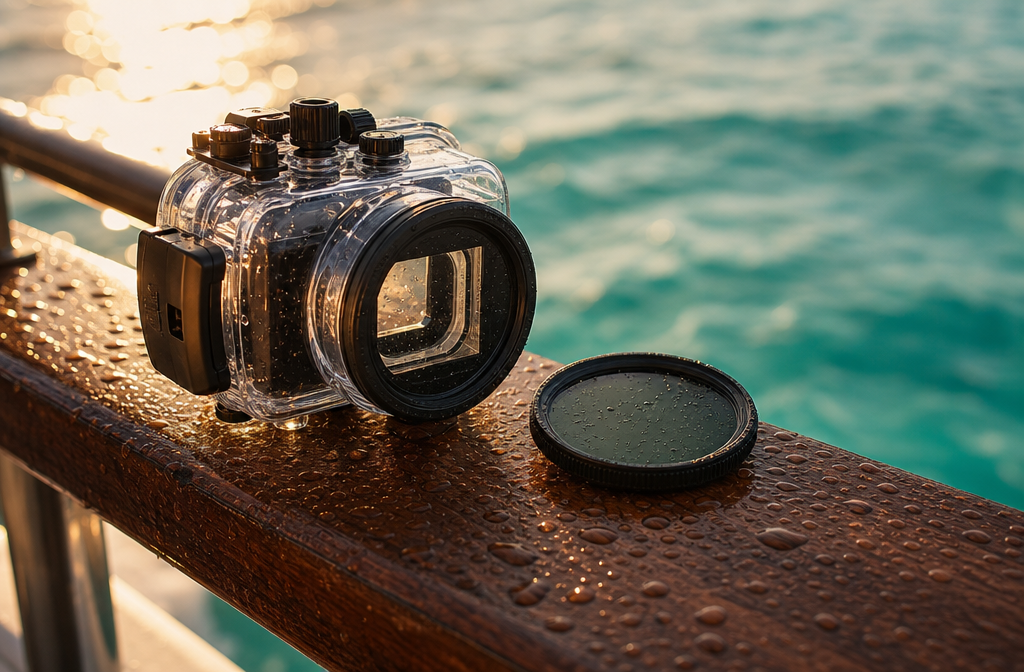
For good boat photos, you don't need the most expensive equipment, but the choice of equipment determines image quality and durability. A weatherproof housing or protective cover, a polarizing filter, and a camera with manual mode are the three most important components.
Basic Equipment for Boat Photography:
- Camera: Mirrorless system camera or DSLR with APS-C or full-frame sensor
- Lens: A fast standard zoom (e.g., 24-70mm f/2.8) covers most situations
- Polarizing filter (CPL): Reduces reflections on the water surface and saturates colors
- Weatherproof camera cover: Silicone or hardshell covers from approx. 30 Euros, underwater housings from approx. 80 Euros
- Quick release strap: Prevents the camera from going overboard
- Microfiber cloths: Dab saltwater off the lens immediately, don't wipe
Those traveling on a houseboat have the advantage of a stable platform. This also allows for heavier equipment that would be impractical on a kayak or sailboat.
Which camera types are best suited for boat photography?
Mirrorless system cameras are currently the best choice for boat photography because they are lightweight, fast, and often weatherproof. Compact cameras with built-in zoom are a good second option for uncomplicated snapshots.
| Camera type | Image quality | Weatherproofness | Price (approx.) | Recommendation |
|---|---|---|---|---|
| Mirrorless system camera | Very good | Often present | from 800 Euros | Best all-round choice |
| DSLR | Very good | Partially available | from 600 Euros | Good, but heavier |
| Compact camera | Good | Rare | from 200 Euros | For beginners |
| Action cam (e.g. GoPro) | Medium | Very good | from 250 Euros | Ideal for movement |
| Smartphone | Sufficient | IP68 models | variable | Okay for everyday use |
Decision rule: Those who photograph seriously and are often on the water should invest in a mirrorless camera with weather protection. For occasional holiday photos on a houseboat, a current smartphone with a good camera system is sufficient.
How much does a good waterproof camera cost?
A fully waterproof camera for use up to a depth of one meter starts at around 250 Euros (e.g. Olympus Tough series or Ricoh WG-7). Those looking for an underwater housing for a system camera will pay between 150 and 600 Euros, depending on the manufacturer and camera model.
For most houseboat vacationers, waterproof housing for their existing camera is the more affordable and flexible solution. Fully waterproof cameras often have smaller sensors and less manual control.
What are the most important camera settings for boat photos?
The three crucial settings for photography on the water are shutter speed, aperture, and ISO. The right combination depends on whether you want to freeze movement or deliberately blur it.
What aperture and ISO for boat shots?
- Shutter speed: 1/500 s or faster freezes waves and boat spray. For silky water (long exposure from a tripod), at least 1-2 seconds
- Aperture: f/8 to f/11 provides maximum depth of field for landscape shots on the water. f/2.8 to f/4 for portraits on the boat with a blurred background
- ISO: As low as possible, ideally ISO 100-400. In low light, it's better to risk ISO 800-1600 than a blurry shot
- White balance: Set manually to "Cloudy" or "Shade" to get warm tones. Auto white balance often makes water shots too cool and pale
Quick setting for bright days: Aperture priority (Av), aperture f/8, ISO Auto with a maximum of 800, exposure compensation -0.3 to -0.7 EV, because water and sky often trick the camera into underexposing.
How do I protect my camera from spray?
The simplest protective measure is a neoprene or silicone cover combined with a UV filter on the lens. Saltwater is more aggressive than freshwater and can damage contacts and seals within hours.
Protective measures at a glance:
- Wipe the camera body with a slightly damp cloth (freshwater) after each use, then dry it
- Never touch the camera with wet hands when the housing is open
- Do not leave the camera in direct sunlight; overheating damages the sensor
- Desiccant bags in the camera bag prevent condensation on cool nights
- For sea trips: carry compressed air spray to clean contacts
Common mistake: Many photographers wipe away saltwater drops with a dry cloth, thereby spreading salt crystals that scratch the glass. Always rinse or dab with freshwater first.
When is the best time of day for boat photos?
The golden hour (approx. 30-60 minutes after sunrise and before sunset) and the blue hour (shortly before and after) provide the most beautiful light for boat photography. The midday light between 11 am and 3 pm creates harsh shadows and oversaturated reflections.
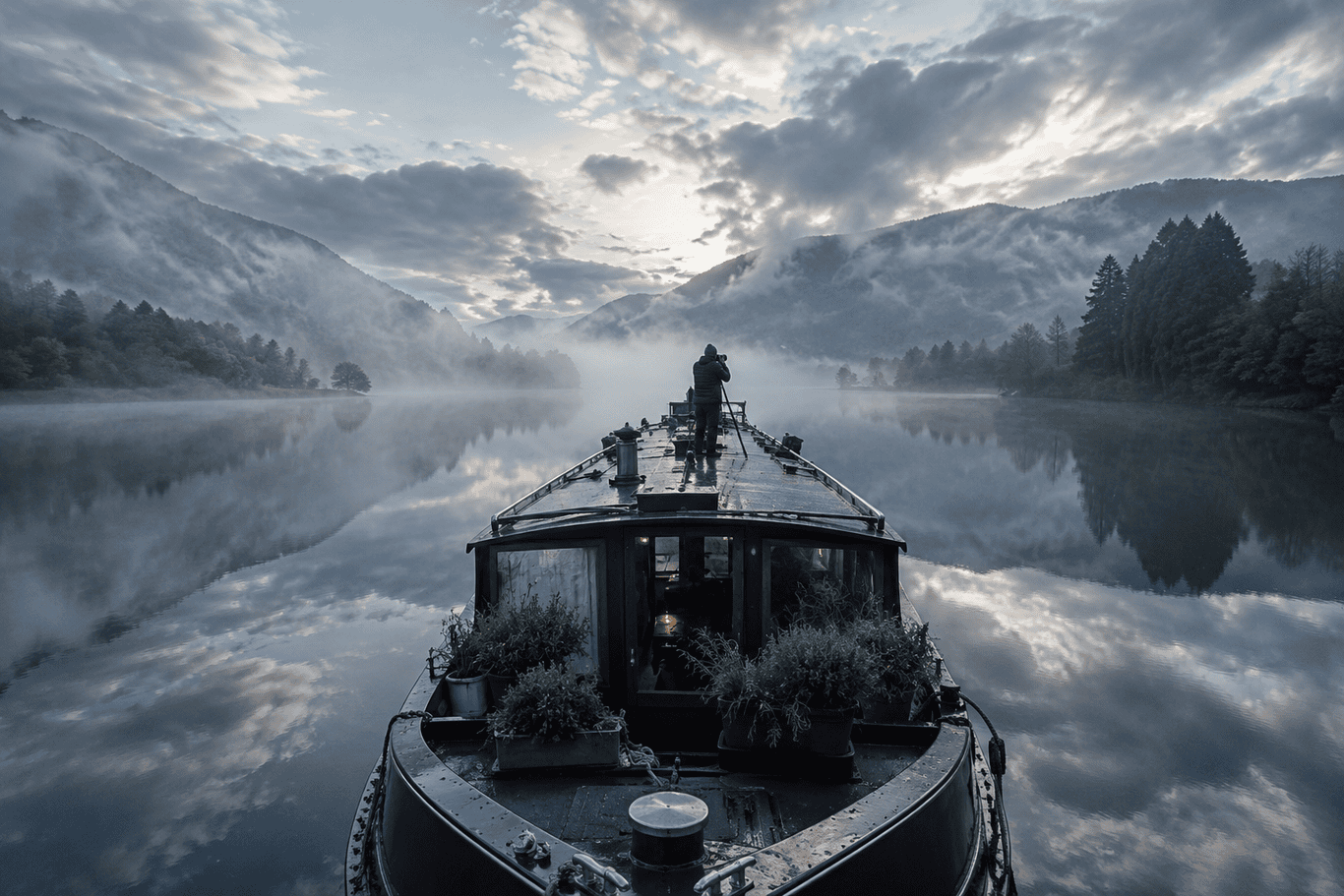
On houseboats, early morning is particularly valuable: the water is calmer, the mist is still low, and other boats are hardly on the move. This tranquility can hardly be imitated photographically.
How do I compose an exciting boat photo?
A strong boat photo needs three elements: a clear foreground (e.g., railing, rope, anchor), an interesting middle subject (boat, person, jetty), and a meaningful background (coast, sky, other boats). The most common mistake is an empty, unstructured composition.
Composition rules for water shots:
- Horizon line: Always align straight, never crooked, unless as a conscious stylistic decision
- Rule of thirds: Place the horizon on the lower or upper third, never in the middle
- Leading lines: Jetties, ropes, bow waves lead the eye through the image
- Reflections: Use calm water as a natural mirror, keep the camera low
- Change perspective: Photograph from the belly on deck instead of always standing upright
What are typical mistakes when shooting boats?
The most common mistake in water photography is a crooked horizon. This is followed by overexposure due to water reflections, lack of composition, and insufficient camera protection.
The seven most common mistakes:
- Horizon not aligned (activate camera grid)
- Shutter speed too slow on a moving boat
- No polarizing filter, although reflections dominate the image
- ISO too high in the hope of more light, instead of opening the aperture
- Camera unprotected within splash range
- Always photographing from the same perspective
- Placing subjects too centrally instead of using the rule of thirds
What are the differences between boat photography on lakes and seas?
Lakes offer calmer water, softer light due to surrounding forests, and less salt spray. Seas provide more dramatic conditions, stronger contrasts, and more movement, but also require more camera protection.
- Lakes: Long exposures work well due to calm surface, reflections are more intense, colors appear warmer
- Seas: Shorter shutter speeds necessary, salt protection mandatory, light is often harsher and more contrasted
- Houseboats on inland waters: Ideal for calm compositions, fog photography, and long evening shots without strong waves
Can I also take boat photos with my smartphone?
Yes, modern smartphones with triple-camera systems (e.g., iPhone 16 or Samsung Galaxy S25) deliver very good results for daylight shots on the water. The limitations become apparent in low light, fast movement, and when you want to edit heavily afterwards.
Smartphone tips for boat photos:
- Activate grid lines for a straight horizon
- Use HDR mode in strong backlight
- Use pro mode or an app like Halide for manual control
- Use a waterproof protective case or underwater case from approx. 20 Euros
- No optical zoom over 3x, quality drops significantly
What types of boats are best to photograph?
Sailboats are photographically rewarding due to their elegant lines and the dynamism under full sail. Houseboats, on the other hand, offer a calm, homey aesthetic that works particularly well for lifestyle shots.
- Sailboats: Best photographed from another boat or from the shore, backlight with sails deployed
- Motorboats: Emphasize bow wave and speed, short shutter speed
- Houseboats: Morning and evening atmosphere, reflections, everyday moments on board
- Kayaks and SUPs: From a bird's-eye view or at water level for dramatic effect
Frequently asked questions about boat photography
Do I need a tripod on the boat? A classic tripod is hardly useful on a moving boat because vibrations cause blur. A GorillaPod, which can be attached to the railing, is the better alternative.
What is the difference between a UV filter and a polarizing filter? A UV filter mechanically protects the lens but has little optical effect. A polarizing filter reduces reflections on water and glass and saturates colors; it is significantly more valuable for water shots.
How do I prevent my photos on the water from looking too blue? Set the white balance manually to "Cloudy" or "Shade". Alternatively, shoot in RAW format and adjust the color temperature in post-processing.
Can I photograph on the boat in the rain? Yes, with a weatherproof camera or protective cover. Rain creates interesting surface textures and dramatic lighting moods that are not possible in sunshine.
How much storage space should there be? At least one 64 GB card, better two 128 GB cards as backup. RAW files from a full-frame camera can be 25-40 MB per image.
Is a drone worth it for boat photography? Absolutely, as long as local regulations permit. Aerial shots from a drone over water are particularly impressive because the top-down perspective reveals patterns and colors invisible from the boat.
How do I protect my smartphone on the boat? A waterproof case with a lanyard that goes around your wrist. Smartphones don't float, and falling into the water usually means total loss.
What does "magic light" mean in photography? The term describes the soft, warm light of the golden hour shortly after sunrise and before sunset. It casts long shadows, emphasizes textures, and gives water surfaces a golden hue.
Conclusion: Get started on the water now
Photography on the water and the best boat pictures don't happen by chance, but through preparation. The right camera settings, a polarizing filter, camera protection, and an awareness of light and composition make the difference between a snapshot and a picture you'll want to frame.
Houseboats are one of the most beautiful platforms for water photography ever. You are close to the water, have time to wait for the perfect light, and experience moments that no hotel room can offer. Morning fog over a quiet lake, the play of the evening sun on the water's surface, the slow glide past reedy banks. These are the subjects that will be remembered.
Ready for a houseboat vacation? Book your houseboat now with Campcruisers and bring your camera.


 English
  German
  Spanish
  Italian
  Polish
  Dutch
Dutch  French
  Danish