
Every year, thousands of vacationers board a rented houseboat for the first time — and most of them have never steered a boat before. This sounds like a recipe for chaos, but it isn't. With the right preparation, a houseboat vacation is one of the most relaxing and exciting forms of travel imaginable. This guide on the subject Renting a houseboat for beginners: Everything you need to know before your first trip answers all important questions — from costs and licenses to the most common beginner mistakes.
What you should know at a glance:
- For many houseboats in Germany, you don't need a boat license — it depends on the horsepower and region.
- Daily rates range from 100 to 500 euros, depending on the season and boat size.
- Houseboats are well-suited for families with children, but require clear safety rules on board.
- The Mecklenburg Lake District is considered one of the best regions for beginners in Germany.
- Spring and early summer (May to June) are the ideal travel times for beginners.
- Typical houseboats offer space for 4 to 10 people.
- An introduction by the rental company is mandatory — take it seriously.
- Breakdown assistance is usually included in the rental price or can be reached through the rental company.
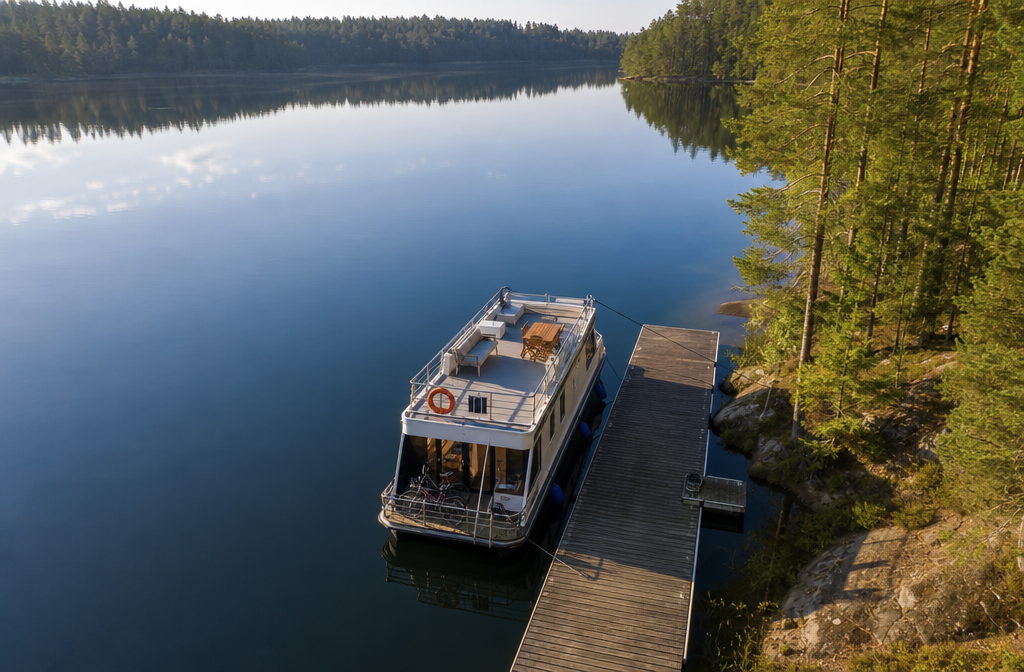
What does it cost to rent a houseboat per day?
The daily costs for a rented houseboat in Germany are roughly between 100 and 500 euros, depending on boat size, season, and region. For a week with 4 to 6 people, total prices from 700 to 2,500 euros are realistic.
Cost factors at a glance:
| Factor | Inexpensive | Medium | Premium |
|---|---|---|---|
| Boat size | 2–4 people | 4–6 people | 6–10 people |
| Daily rate (approx.) | 100–180 Euro | 180–320 Euro | 320–500 Euro |
| Season | Nebensaison | Pre-/post-season | High season (July–Aug) |
| Region | Inland, less well-known | Mecklenburg, Brandenburg | Popular waterways |
Additional costs that are often forgotten: fuel (for motorized boats), mooring fees (approx. 10–25 Euros per night), final cleaning, and a deposit (frequently 300–1,000 Euros). Booking in the off-season often saves 30 to 40 percent compared to the peak summer price.
What license do I need for a houseboat?
In Germany, many houseboats do not require a license — specifically, if the engine power is less than 15 HP. As soon as the boat has more power or you are traveling on certain federal waterways, the Sportboat License Inland (SBF Binnen) becomes mandatory.
- Under 15 HP / under 11 kW: No license needed on inland waters.
- From 15 HP: SBF Binnen required.
- On maritime shipping routes (e.g., Lake Constance): SBF See or Lake Constance Skipper Patent required.
- Some rental companies also require a minimum age of 18 or 21 years.
Important: Even without a license requirement, there is a legal duty of care. Anyone operating a boat must know the basic navigation rules. Instruction by the rental company does not replace practical experience but is a good start.
Are houseboats difficult to steer for beginners?
No — houseboats are significantly easier to steer than most beginners expect. Speeds are low (mostly 5–10 km/h), the waterways are manageable, and the instruction by the rental company covers all essential maneuvers.
The biggest challenge for beginners is docking, because boats react sluggishly in the water and wind and currents play a role. Tips for the first docking:
- Go slower than seems necessary — boats hardly brake.
- Prepare mooring lines before approaching the dock.
- When windy: always moor against the wind, not with the wind.
- No haste: Better a second attempt than a damaged boat.
Most rental companies offer a 1 to 2-hour practical instruction directly at the starting harbor. You should make full use of this and actively ask questions.
What do I need to consider when boating a houseboat?
When boating a houseboat, the Inland Navigation Regulation (BinSchStrO) and regional regulations apply. The following points are particularly relevant for beginners:
- Rule of the right of way: Just like on the road, you must drive on the right on waterways.
- Speed limits: Mostly 8–12 km/h, even less in protected zones.
- Lock operation: Locks must be registered; observe right-of-way rules.
- Anchoring: Only allowed in designated areas.
- Alcohol: Driving a boat is prohibited from 0.5 per mille.
- Nature reserves: Many lakes and rivers have protected zones that may not be entered.
A common mistake: Beginners underestimate the effect of wind and current. Even in calm weather, a crosswind can cause the boat to drift significantly. Therefore, always plan for more space than you think you need during maneuvers.
Differences between different types of houseboats
Not every houseboat is the same. The choice of the right type significantly influences comfort, handling, and costs.
The most important types:
- River cruiser / Canal boat: Shallow draft, ideal for canals and shallow waters. Good for beginners.
- Pontoon houseboat: Wide, stable platform — very comfortable, but less maneuverable. More suited for calm lakes.
- Catamaran houseboat: Two hulls, very stable, more space. Requires a bit more practice to steer.
- Classic narrowboat: Narrow and long, typical for English canals, but also available in Germany. Inexpensive, but narrow locks require precision.
For beginners, a river cruiser or pontoon boat with a moderate engine is recommended — easy to steer, sufficient living comfort, and well-suited for most German waters.
Best regions in Germany for houseboating
The Mecklenburg Lake District is the most popular and beginner-friendly region for houseboat holidays in Germany. It offers over 1,000 lakes, well-developed marinas, and calm waterways without strong currents.
Top areas for beginners:
- Mecklenburg Lake District: Germany's largest inland waterway area, ideal for families and first-time boaters.
- Brandenburg / Spreewald: Picturesque canals, little traffic, nature-oriented cruising.
- Masuria (Poland, border region travel): For adventure seekers who want to travel a bit further.
- Rhine-Main-Danube Canal: For more experienced beginners, as there is more commercial shipping traffic.
Those renting a houseboat for the first time should prefer areas with little commercial shipping traffic and many opportunities to maneuver. The lake district fulfills both criteria.
What is part of the basic equipment on a houseboat?
Reputable rental companies will deliver the boat with complete safety equipment. Nevertheless, it is worthwhile to know what must be on board and what you should bring yourself.
Mandatory equipment (provided by the rental company):
- Life jackets for all persons on board
- Fire extinguisher and smoke detector
- Anchor and lines
- Navigation light
- First aid kit
- Ship's papers and proof of insurance
What you should bring yourself:
- Waterproof clothing and rubber boots
- Sun protection (UV exposure is higher on the water)
- Nautical charts or area app (e.g. Navionics)
- Flashlight
- Power bank for devices
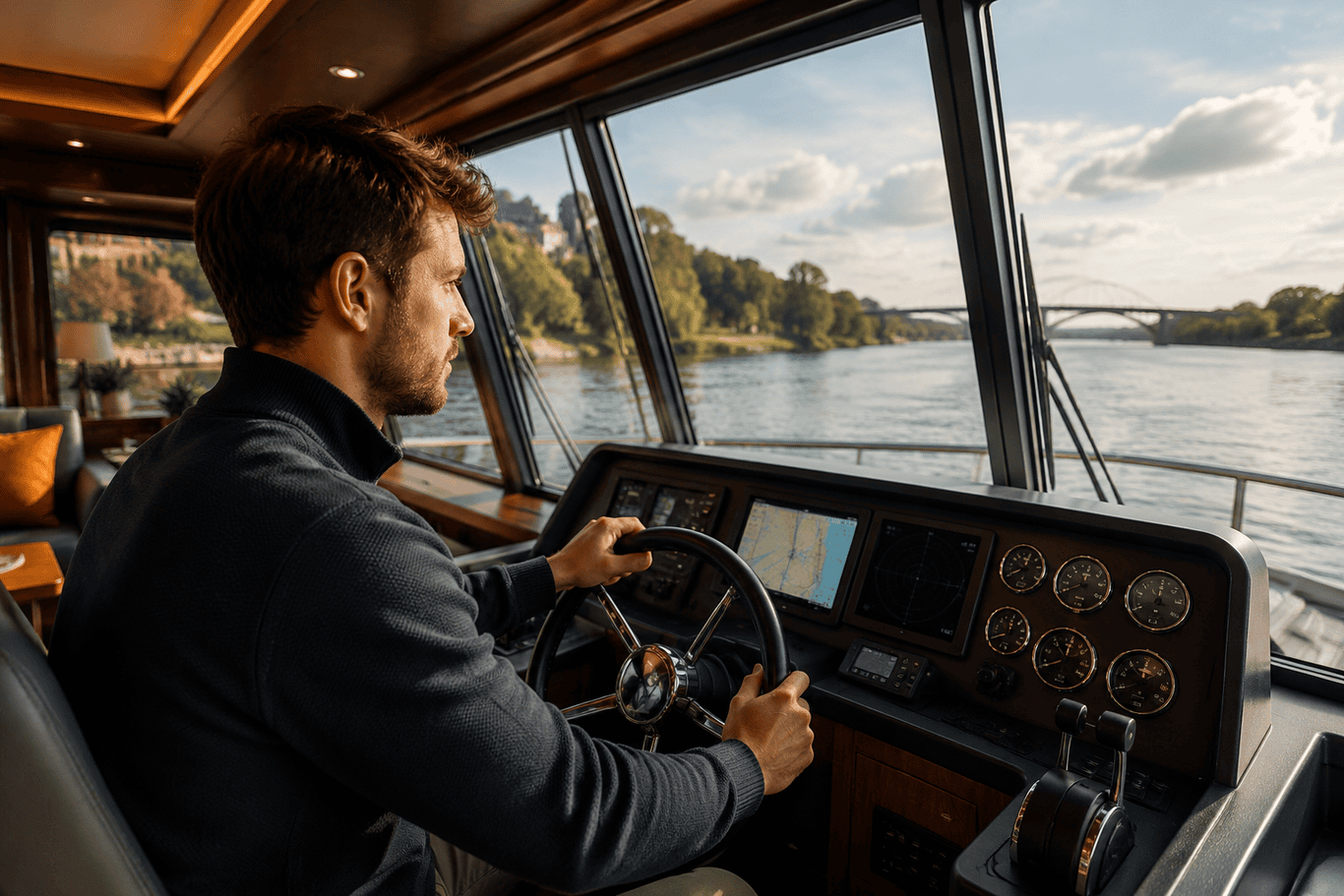
Common mistakes beginners make when renting a houseboat
The most expensive mistake is overestimating one's own abilities in the first few hours. Most damage occurs when docking or in locks — and almost always due to excessive speed.
The most common beginner mistakes:
- Docking too fast: The boat has a lot of mass and hardly brakes. Take off the throttle earlier.
- Not taking the briefing seriously: Many skip parts of the briefing — a mistake that backfires.
- Ignoring the weather: The weather can change quickly on the water. Check the weather app daily.
- Planning too much at once: Houseboat holidays are about slowing down. Planning to travel 50 km daily will cause unnecessary stress.
- Do not report damages to the security deposit: Report minor damages to the landlord immediately – don't wait until you return the boat.
How many people fit on a houseboat?
Most rental houseboats are designed for 2 to 10 people. The most common configuration is boats for 4 to 6 people with 2 to 3 sleeping cabins.
- 2–4 people: Compact boats, affordable, easy to steer.
- 4–6 people: Standard size, good value for money, ideal for families.
- 6–10 people: Larger boats, more comfort, but also more steering effort and higher costs.
Rule of thumb: It's better to book a boat with one more cabin than you need – privacy on board makes the holiday more relaxing, especially on longer trips.
What does houseboat insurance cost?
For rented houseboats, liability insurance is usually included in the rental price. The landlord takes out their own comprehensive insurance for the boat – as the renter, you are only liable for self-inflicted damages up to the amount of the agreed deductible.
The deductible varies between 500 and 2,500 Euros depending on the provider. Those who want to be on the safe side can book liability reduction from the landlord or through travel insurance providers, which reduces the deductible to 0 to 300 Euros. The costs for this are usually between 10 and 30 Euros per day.
What is the best season for a houseboat holiday?
May to June is the best travel time for beginners: The weather is pleasant, the areas are not yet overcrowded, and prices are below peak season levels.
- May–June: Quiet, green, little traffic – ideal conditions for beginners.
- July–August: Peak season, lots of activity on the water, highest prices, but also guaranteed warm weather.
- September: Golden autumn, quieter than summer, often still warm enough.
- October-April: Many rental companies have closed; not recommended for beginners.
Are houseboats suitable for children and families?
Yes, houseboats are excellently suited for families with children — provided clear safety rules are consistently observed. The low speeds, the manageable living space, and the proximity to nature make a houseboat holiday one of the most family-friendly holiday formats ever.
Important safety rules with children on board:
- Always put life jackets on children as soon as they are on deck.
- Never leave children unattended in deck areas.
- Establish clear rules for behavior when docking and in locks.
- Assess the swimming ability of children — do not overestimate it.
What to do if the houseboat has a breakdown?
Stay calm and call the rental company — this is the first and most important step. Reputable rental companies offer 24/7 breakdown assistance, and the emergency number should always be readily available.
Immediate measures in case of a breakdown:
- Securely anchor the boat or tie it to a dock.
- Call the rental company or breakdown service.
- Document the situation (photos, time, GPS position).
- Do not attempt any unauthorized repairs on the engine or technical systems.
- In case of danger to people: Dial emergency number 110/112.
Most breakdowns involve the propeller (ropes or debris), engine problems, or electrical issues. An experienced technician from the rental company is usually on-site within a few hours.
Frequently asked questions about renting a houseboat for beginners
Do I need to be able to swim to rent a houseboat? There is no legal obligation, but it is highly recommended. All persons on board should have at least basic swimming skills, and life jackets should be available at all times.
How far in advance should I book? For the high season (July–August), at least 3 to 6 months in advance. In the low season, 4 to 6 weeks are often sufficient.
Can I also spend the night on a houseboat? Yes, that is standard. Houseboats are fully equipped with sleeping cabins, kitchen, bathroom, and often air conditioning or heating.
Do I need special clothing or equipment? Sturdy footwear (no heels), a waterproof jacket, and sun protection are sufficient for most tours. Rubber boots are practical when docking.
What happens if I cause damage? You are liable up to the amount of the agreed deductible. Always report damage to the lessor immediately—not just upon return.
Can I dock wherever I want? No. Docking is only permitted at designated jetties, harbors, or approved anchorages. Many areas have well-developed networks of guest moorings.
Is there a minimum travel duration? Most lessors require at least 3 to 7 days. Weekly rentals (Saturday to Saturday) are most common.
Are pets allowed on board? That depends on the lessor. Many allow dogs, but require an additional deposit or a surcharge.
Ready for the adventure? Here's how to get started
A houseboat holiday is not a luxury for experienced sailors—it is one of the most accessible forms of travel imaginable. Once you have experienced the quiet glide over still lakes and canals, you will hardly want to travel any other way. The combination of freedom, nature, and the feeling of steering your own floating home is simply incomparable.
The most important steps to get started: choose the region and season, book the right boat for your group size, take the orientation seriously, and plan realistic daily stages. You will learn the rest on the water.
Ready for your houseboat vacation? Book your houseboat now with Campcruisers and start your adventure on the water—with no prior knowledge required.


 English
  German
  Spanish
  Italian
  Polish
  Dutch
Dutch  French
  Danish