
}
Last updated: May 24, 2026
Quick Answer: The water system in a motorhome consists of a fresh water tank, a pressure pump, a boiler, and a waste water tank. Fresh water is pumped through pipes to the sink, shower, and kitchen — the used water then flows into the waste water tank. Both tanks must be regularly filled, emptied, and cleaned to ensure the system remains hygienic and functional.
Key Takeaways
- 🚿 Fresh water tank + pressure pump + waste water tank Form the basic framework of every RV water system.
- 📏 Typical tank sizes: 80–150 liters fresh water, 60–120 liters waste water — depending on the vehicle class.
- 🧼 Tanks should be at least twice per season thoroughly cleaned and disinfected.
- ❄️ Frozen pipes are a common winter problem — antifreeze is mandatory at temperatures below 0 °C.
- A retrofit complete system costs between 300 and 1,500 euros, depending on the features.
- 🦠 Poor water hygiene can lead to Legionella growth — a real health risk.
- 🔧 Small leaks can often be repaired yourself; major damage belongs in a specialist workshop.
- 🏕️ Large tanks are particularly important for wild campers and travelers without daily campsite access.
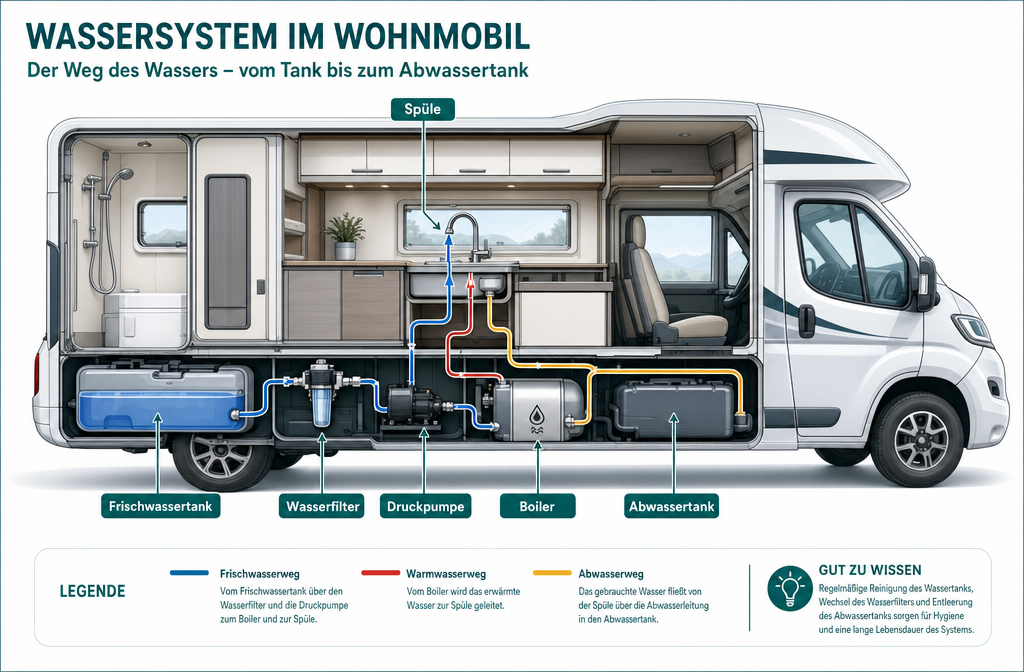
What are the most important components of an RV water system?
The water system in the RV consists of several coordinated components. If one component fails, the entire system no longer functions reliably.
Here's an overview of the core components:
| Component | Function |
|---|---|
| Fresh water tank | Stores clean drinking water (usually 80–150 L) |
| Pressure pump | Pumps water from the tank to the dispensing points |
| Pressure switch / Pressure vessel | Keeps the water pressure constant, protects the pump |
| Boiler / Water heater | Heats water for shower and kitchen (5–10 L capacity typical) |
| Piping system | Connects all components (hoses, pipes, fittings) |
| Water filter | Retains suspended solids and germs |
| Wastewater tank | Collect used greywater (not blackwater!). |
Important: The wastewater tank in the RV only collects gray water—that is, water from sinks, showers, and the kitchen. Toilet wastewater (black water) is collected separately in the cassette toilet or a separate black water tank.
What size should fresh and wastewater tanks normally be?
Roughly speaking, allow 10–15 liters of fresh water per day for one person with moderate consumption. A 100-liter tank is therefore sufficient for two people for about three to five days without refilling.
Guideline values by vehicle type:
- Compact campervan (up to 5.5 m): 40–80 L fresh water, 30–60 L waste water
- Semi-integrated/Alcove (5.5–7 m): 80–120 L fresh water, 70–100 L waste water
- Fully integrated / Liner (over 7 m): 120–200 L fresh water, 100–150 L waste water
Choose larger tanks if… if you frequently wild camp, plan long stages without campsites, or travel with several people. If you mainly stay at campsites with a water connection, you can get by with smaller tanks.
⚠️ Attention weight: Water weighs 1 kg per liter. A full 100-liter tank adds up to 100 kg — a significant factor for vehicles up to 3.5 tons of permissible total weight. More on this in the Guide to motorhomes up to 3.5 tons and overloading.
Differences between permanently installed and mobile water tanks
Permanently installed tanks are standard in most motorhomes and caravans. Mobile canisters, on the other hand, offer more flexibility - but also clear disadvantages.
Permanently installed tanks:
- Directly integrated into the vehicle, usually made of polyethylene (PE)
- Fillable via an external filler opening
- Automatically connected to the pressure pump
- Greater comfort, no lugging
Mobile water canister / rolling container:
- Flexibly deployable, also usable as a supplement
- Cheaper to purchase.
- Manual filling and connection required
- Often smaller capacity (10–30 L)
Conclusion: For occasional campers on short trips, mobile canisters may be sufficient. Those who travel regularly or plan longer tours — such as a Journey through Tuscany or through South Holland - clearly benefits from a permanently installed system.
What mistakes can you make in water management in a motorhome?
The most common mistakes happen not while driving, but when dealing with water — and they can be expensive or even hazardous to your health.
The most common mistakes at a glance:
- Let the tank stand for too long — stagnant water in warmth is a breeding ground for bacteria.
- No water filter — unfiltered filling from unknown sources increases the risk of contamination.
- Emptying the wastewater tank too late — a full tank smells and can overflow.
- No winter draining - Residual water in pipes freezes and bursts hoses or pumps.
- Wrong cleaning products — aggressive chemicals attack seals and tank walls.
- Mix-up of fresh water and waste water connection — sounds absurd, but it happens on crowded campsites.
💡 Pro Tip: After each trip, completely empty the tank and let it dry slightly open. This prevents mold and odors.
How much does a good water system for a camper cost?
The costs depend heavily on whether you are retrofitting or buying or renting a vehicle with standard equipment.
Cost estimate for a retrofit system:
| Equipment level | Scope | Estimated costs |
|---|---|---|
| Base | Tank + Pump + simple pipes | €300–€500 |
| Standard | + Boiler, Filter, Pressure vessel | €500–€900 |
| Comfort | + Combination water heater, tank level indicator, UV filter | 900–1,500 € |
Installation costs by a specialist workshop are added on top – depending on the effort, an additional 200–600 euros. Those who rent a motorhome naturally don't have to worry about this investment: the system is already in place and maintained.
How do I clean the water tanks properly and hygienically?
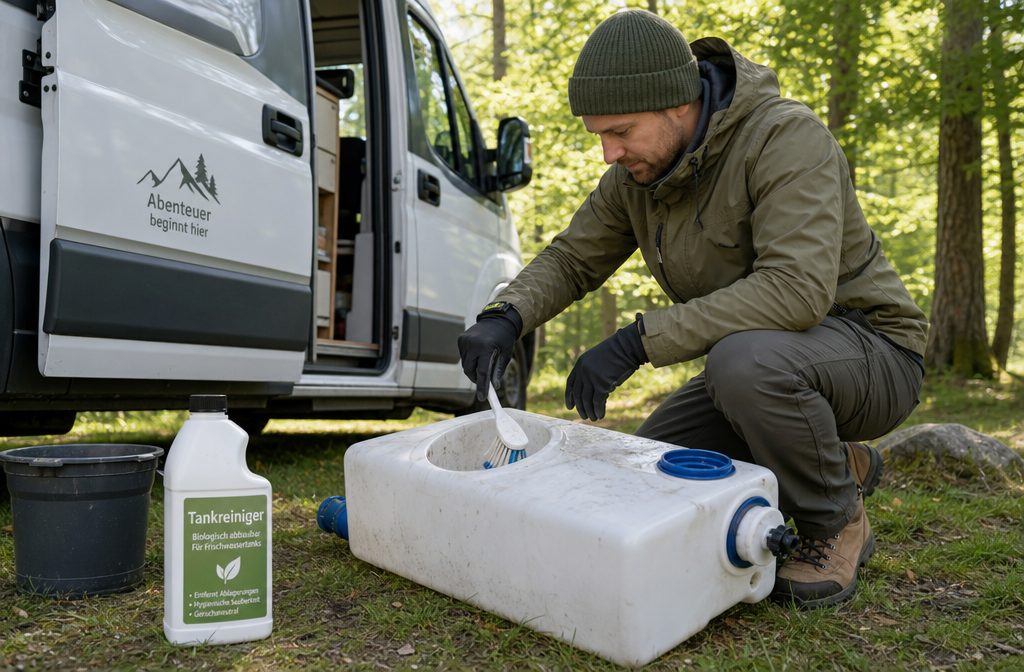
Tanks should be cleaned at least twice per season - once at the beginning of the season and once before storage. Those who travel a lot should clean more often.
Step-by-Step Cleaning:
- Completely empty the tank — open all taps, briefly run the pump.
- Fill cleaning agent — dose special tank cleaners (e.g. chlorine- or silver-based) according to the manufacturer's instructions.
- Fill with water — approx. 10–20 liters are sufficient for the cleaning solution.
- Distribute - Briefly turn on the pump so that the solution reaches all pipes and the boiler.
- Observe the application time. — depending on the product, from 30 minutes to several hours.
- Rinse thoroughly. — rinse at least twice with fresh water.
- Also clean the waste water tank. — rinse with warm water and a mild cleanser.
Suitable means: Special RV tank cleaners (e.g. chlorine dioxide-based), no household cleaners with aggressive surfactants.
What optional equipment makes sense for water tanks?
Some extras make life on the road significantly more pleasant — and protect the equipment in the long term.
- Tank level indicator: Digitally displays the fill level of fresh and waste water tanks - no more guessing.
- UV Water Sterilizer: Kills germs in fresh water without using chemicals.
- Fine filter (0.1–1 micron): Retains suspended solids, limescale, and microorganisms.
- Anti-freeze heater: Electric heating tapes around pipes and tanks – indispensable for winter campers.
- Water softener: Useful in regions with hard water, protects boilers and fittings.
- External fill level indicator: Practical for filling, so nothing overflows.
For which campers are large water tanks important in the first place?
Large tanks are especially worthwhile for wild campers, long-term travelers, and anyone who is off the beaten path. If you head to a campsite with a water connection every day, you don't need a 150-liter system.
Large tanks are useful for:
- Wild campers without fixed infrastructure
- Travelers in regions with infrequent supply points (e.g., long-distance travel to Argentina — from Buenos Aires to Ushuaia)
- Families with higher daily consumption
- Long-term travelers (away for weeks to months)
Small tanks are sufficient for:
- Weekend trips to campsites
- Travelers who want to shower and do laundry every day — but always need to be near connections
What to do if the water tank freezes or leaks?
Frozen fuel tank: Never thaw with open flames or a hot air gun in a confined space - risk of fire. Instead, place the vehicle in a heated garage and allow it to thaw slowly. Heating tapes on vulnerable lines prevent the problem.
Leaky tank or lines:
- Small cracks in the tank: Special PE welding sets or epoxy resin repair kits can help temporarily.
- Leaky hose connections: Tighten hose clamps or replace seals — often a 10-minute repair.
- Major damage to the tank: Replacement by a specialist company is recommended, as improper repairs can lead to contamination.
Can you repair a water tank yourself? Small leaks at connections and hoses: yes, with craftsmanship. Cracks in the tank housing: only temporary—a permanent solution requires expertise and the right materials.
What maintenance intervals does a campervan water system require?
A well-maintained water system will last for many years without problems. The effort required is manageable if you proceed regularly.
Recommended maintenance intervals:
| Interval | Measure |
|---|---|
| After every trip | Empty the tank, open the taps, let dry. |
| Start of season | Flush system, check seals, change filter |
| Every 6 months | Tank disinfection, check pipes for limescale |
| Annually | Check pump and pressure tank, inspect boiler anode |
| Before winter storage | Completely empty the system and blow it out with compressed air. |
What are the health risks of poor water hygiene in a campervan?
Poor water hygiene is no trivial offense. Stagnant water at temperatures between 25 and 45 °C is an ideal breeding ground for Legionella — Bacteria that can cause severe pneumonia (Legionnaires' disease). Elderly people and people with weakened immune systems are particularly at risk.
Further risks:
- E. coli and other intestinal pathogens through contaminated filling sources
- Mold growth in pipes and boilers after long periods of inactivity
- Chemical contamination due to unsuitable cleaning agents
Prevention: Use regular disinfection, water filters, short dwell times for fresh water, and only tested filling sources.
FAQ: Water System in a Motorhome
How long can water stay in the fresh water tank?
At cool temperatures and with a clean tank, a maximum of 3–5 days. In summer, in warm weather, water should not be left standing for longer than 1–2 days.
Can I fill the tank directly with tap water?
Yes, tap water from the public network is generally suitable in Germany, Austria and Switzerland. Always check abroad - if in doubt, use a fine filter.
Does the wastewater tank need to be emptied at a campsite?
Greywater cannot simply be discharged into nature in Germany. Campsites provide disposal stations for this purpose. Many wild camping areas also have regulations — always check beforehand.
What happens when the pressure pump fails?
Without a functioning pump, no water comes out of the pipes. A spare pump or a manual canister as a backup makes sense on long trips.
How do I know if my water tank has limescale?
Whitish deposits on fittings, reduced water flow and a chalky taste are typical signs. Descaling agents (specifically for motorhome systems) help.
Is a water filter mandatory?
Legally no, but highly recommended from a hygienic point of view—especially when filling from unknown sources.
How much electricity does the pressure pump consume?
Typical 12V pressure pumps consume 3–8 amps during operation. Since they only run for a short time, the total consumption is low.
Can I also use the wastewater tank as a gray water tank for garden water?
Greywater from the RV contains soap, food scraps, and germs—it is not suitable for garden irrigation and is also not permitted in many regions.
Conclusion: Well-equipped for any tour
The water system in a motorhome is the heart of travel comfort—and understanding it makes traveling more relaxed. Regular cleaning, the right tank size for your travel style, and a few useful extras make the difference between a stress-free tour and unnecessary breakdowns along the way.
If you don't have your own vehicle yet, you don't have to sacrifice comfort: Via Campcruisers can be a Rent a campervan, which is already equipped with a fully installed water system — serviced, inspected and ready to travel. Whether Tuscany, South Holland or Patagonia: The platform brokers vehicles from professional rental companies worldwide, so you can concentrate on the essentials — the adventure.
For inspiration on where your next trip could be, it's worth taking a look at the best campsites in Europe or the Camping Guide for the Black Forest.
Now Rent a camper at Campcruisers and here we go! 🚐💧
Quellen
- German Environment Agency: Information on Legionella in Drinking Water Systems — environment agency.de
- ADAC Camping & Motorhome: Guide to Water Supply in Motorhomes — adac.de
- DIN 2001-3: Drinking water supply from small installations and non-stationary systems (German Institute for Standardization)
Tags: RV Water System, Fresh Water Tank, Wastewater Tank, RV Tips, Camping Water System, RV Tank Care, Rent an RV, Rent a Camper, Wild Camping, RV Maintenance, Legionella in RVs, Camping Equipment


 English
  German
  Spanish
  Italian
  Polish
  Dutch
Dutch  French
  Danish