
Only 12 volts from the leisure battery, but laptop, coffee machine and hairdryer want to see 230 volts - a single device solves this voltage problem. With the right inverter in the motorhome, 230V devices can be operated self-sufficiently without the need for a campsite with a power connection.
Quick answer: An inverter converts the 12V DC voltage from your leisure battery into 230V AC voltage - exactly what normal household appliances need. For most motorhomes, a device between 300 and 2000 watts is sufficient. Anyone who wants to operate devices with an electric motor or sensitive electronics absolutely needs a pure sine wave inverter.
The most important things at a glance:
- Inverters convert 12V DC to 230V AC, enabling true self-sufficiency
- Pure sine wave inverters are more expensive, but suitable for all devices; modified sine wave models only for simple consumers
- The wattage of the inverter must be at least equal to the highest inrush current of your most powerful device
- Cables that are too thin and missing fuses are the most common installation errors - and potential causes of fire
- Without sufficient battery capacity (at least 100 Ah lithium or 200 Ah AGM), an inverter is pointless
- Costs: simple models from approx. €50, high-quality devices with a pure sine wave €150-600
- For occasional users, a power station can be the simpler alternative
- An inverter will not damage the battery if it is connected correctly and protected against deep discharge
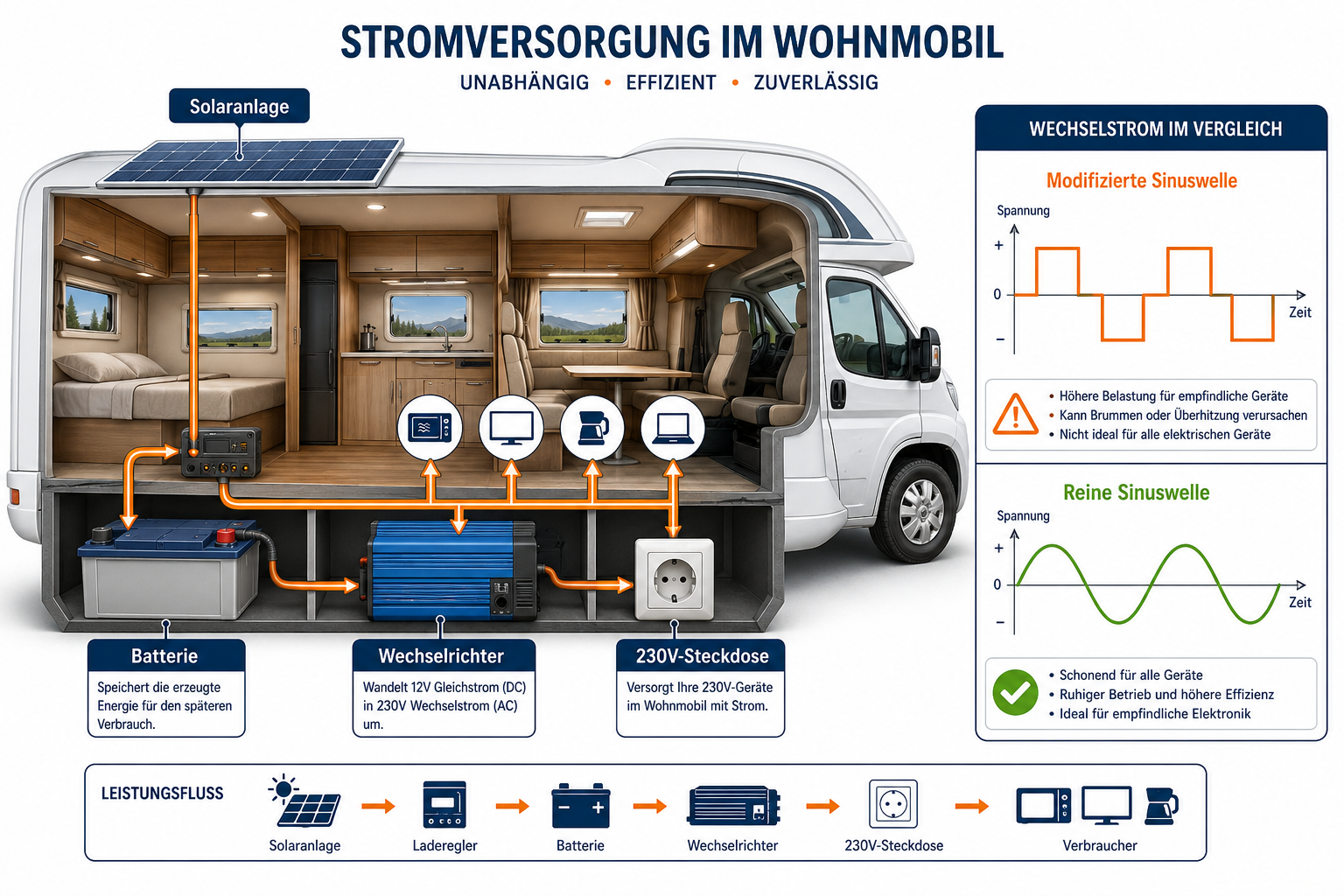
What is an inverter and how does it work in a motorhome?
An inverter is an electronic device that converts direct current (DC) into alternating current (AC). In the motorhome, this specifically means that the 12V energy from the leisure battery is converted into 230V/50Hz alternating current, as it comes from every German household socket.
There are two basic types:
- Pure Sine Wave: Generates a clean, sinusoidal alternating voltage - identical to the mains current. Suitable for all devices, including sensitive electronics, devices with electric motors (refrigerator, drill) and medical devices.
- Modified Sine Wave: Generates a stepped approximation of the sine wave. Cheaper, but problematic for devices with electric motors, dimmers, some chargers and sensitive electronics. Sufficient for simple consumers such as light bulbs or simple chargers.
Decision rule: If in doubt, always buy the pure sine wave inverter. The price difference is small, the difference in compatibility is significant.
Which devices can I operate with an inverter in my motorhome?
In principle, all 230V devices can be operated, as long as the wattage of the inverter is sufficient. The following categories are practically relevant:
| Device | Typical power | Pure sine needed? |
|---|---|---|
| Laptop | 30–90 W | Recommended |
| Coffee machine | 600–1200 W | Ja |
| Hair dryer | 1000–2000 W | Ja |
| Electric toothbrush (charging) | 5–15 W | No |
| Compressor refrigerator (230V) | 80–150 W | Ja |
| Drill | 500–1200 W | Ja |
| Charging tablet/smartphone | 5–30 W | No |
| CPAP machine | 30–60 W | Ja |
Not recommended: Kettle (1500–3000 W), induction hob and oven draw so much power that the battery would be empty within minutes. A gas hob is the more sensible solution here.
How many watts can an inverter in a campervan supply at maximum — and how much do you really need?
The maximum power of an inverter depends on the model and ranges from 150 W to over 3000 W. However, it is not only the rated power that is decisive, but also the Starting power (Peak Power), which can briefly be two to three times the rated power.
How to calculate your needs:
- List all the devices you want to use at the same time
- Add their rated powers
- Multiply the highest individual value by 2 (for inrush current)
- The result is your minimum rated power
Example: Coffee machine (1000 W) + Laptop (60 W) = 1060 W rated power. Inrush current of the coffee machine: approx. 2000 W. Recommendation: Inverter with 1500–2000 W rated power.
How much does a good inverter for my campervan cost?
The price range is wide, but so are the differences in quality. As a rough guide:
- Simple modified sine wave models (150–500 W): 30–80 €
- Pure sine wave models (300–1000 W): 80–250 €
- Pure sine wave models (1000–2000 W): 200–500 €
- High-quality brand devices (Victron, Studer, Mastervolt): 300–1500 €
Well-known and reliable brands are Victron Energy, Renogy, Ective and Votronic. Cheap models without a CE marking and without overheating protection should always be avoided — they are a fire hazard.
What should I consider when buying an inverter?
When buying an inverter for a campervan, five criteria count:
- Waveform: Pure sine wave for all applications, modified sine wave only for very simple consumers
- Rated power and peak power: Both values must match the planned device usage
- Protection functions: Over-temperature protection, short-circuit protection, deep discharge protection and reverse polarity protection are mandatory
- Connection type: Direct battery connection via cable lugs (for devices over 300 W) or cigarette lighter (only for small consumers up to approx. 150 W)
- Efficiency: A good inverter should have an efficiency of at least 85–90%
What mistakes can you make when installing an inverter?
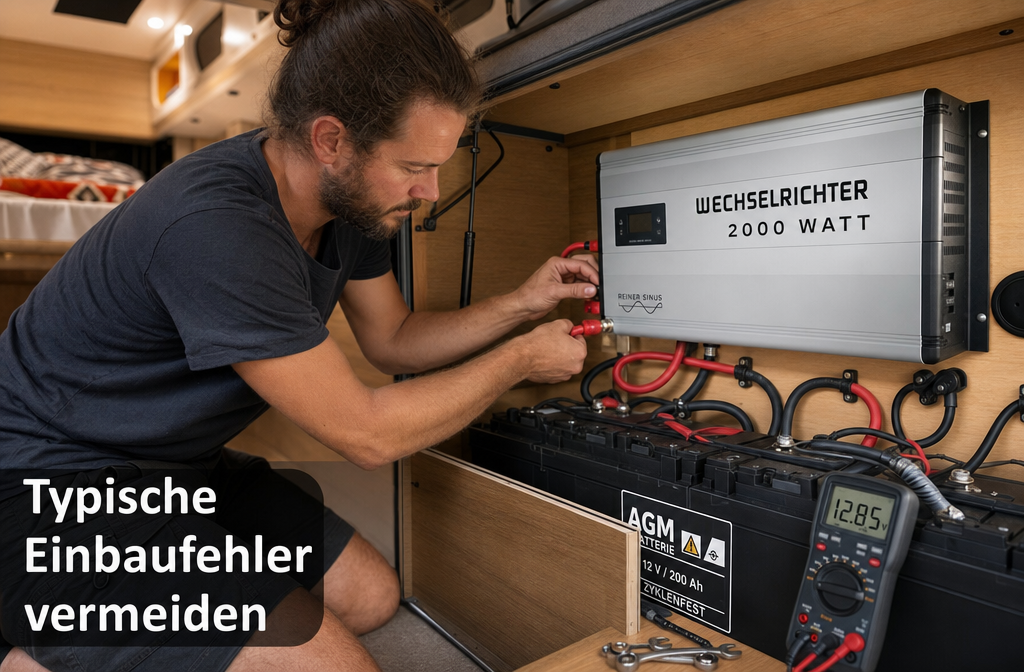
Installation errors with the inverter are not only annoying — they can destroy devices or cause fires. The most common mistakes:
- Cables that are too thin: A 1000 W inverter draws around 90–100 amps at 12V. This requires cable cross-sections of at least 16–25 mm², depending on the cable length. Thin cables overheat.
- No fuse on the positive terminal of the battery: A fuse (cartridge fuse or circuit breaker) must be located as close as possible to the battery — no more than 30 cm from the positive terminal.
- Incorrect installation location: Inverters need air circulation. Installation in an enclosed compartment without ventilation leads to overheating and failure.
- Leaving the inverter on standby permanently: Even when idle, many devices consume 5–20 W. Overnight, this adds up to a considerable battery load.
- Battery too small: A 1000 W inverter will drain a 100 Ah AGM battery in less than an hour. Lithium batteries are clearly superior here.
Can an inverter damage my battery?
A correctly connected inverter with integrated deep discharge protection will not damage the battery. It becomes problematic if the inverter drains the battery below the critical discharge voltage — for AGM batteries, this is around 11.8 V, and for lithium batteries, around 10.5 V (depending on the BMS).
To be on the safe side, also use an external battery monitor or a Battery Management System (BMS) that automatically switches off the inverter when the minimum voltage is reached.
Are inverters the same for small and large motorhomes?
No. The requirements differ significantly depending on the type of vehicle and how it is used:
- Small campervan / VW-Bus conversion: A 300–600 W inverter is sufficient for a laptop, lights and occasional charging. Prefer space-saving models.
- Medium motorhome (6–7 m): 1000–1500 W covers most everyday appliances. A combination with 100–200 Ah lithium is recommended.
- Large motorhome or RV: 2000 W and more, often combined with an inverter charger (combination device) that also charges from mains power.
Anyone renting a motorhome through CampCruisers should check before travelling whether an inverter is already installed and what power it has — this will determine which devices can be taken along.
How long does an inverter last in continuous operation?
Quality devices from brand manufacturers are designed for continuous operation and, if installed correctly and with sufficient ventilation, will last 5–10 years or longer. Cheap models without thermal protection overheat during continuous operation and often fail after just a few months.
Rule of thumb: Inverters that are continuously operated at over 80% of their rated power age faster. Anyone buying a 1000 W inverter should only load it with a maximum of 700–800 W on a continuous basis.
What alternatives are there to an inverter?
A permanently installed inverter is not the best solution for everyone. Alternatives at a glance:
- Powerstation / Portable Power Station: Ready-made unit with built-in battery, inverter and charge controller. Easy to use, no installation required. Ideal for occasional campers or rental motorhomes. Disadvantage: more expensive per watt-hour, not permanently integrated.
- Campsite with mains power: Cheap and easy, but limits self-sufficiency.
- Use 12V devices: Many devices are also available in 12V versions (compressor fridge, USB chargers, 12V coffee machines). Saves the detour via the inverter and is more efficient.
- Gas-powered appliances: Cooking, heating and hot water with gas is widespread in motorhomes and more energy-efficient than electrical alternatives.
Who really benefits from an inverter in a motorhome?
An inverter is worthwhile if at least one of the following conditions applies:
- You regularly use 230V devices that do not have a 12V alternative (laptop with proprietary power supply, coffee machine, CPAP device)
- You are often without a mains power connection (wild camping, remote pitches)
- You already have a sufficiently large battery and solar system installed
- You want real self-sufficiency without dependence on campsites
Not a worthwhile purchase for someone who exclusively stays on campsites with a power connection or only occasionally needs to charge a smartphone.
Frequently asked questions
Which inverter do I need for a laptop? A 150–300 W pure sine wave inverter is sufficient for most laptops. Pay attention to the power consumption of the power supply, which is printed on the device.
Can I operate an inverter from the cigarette lighter? Yes, but only for very small consumers up to about 150 W. The cigarette lighter is fused at 10–15 amps in most vehicles.
How big does my battery need to be for a 1000 W inverter? For sensible operation, at least 100 Ah lithium (usable: ~100 Ah) or 200 Ah AGM (usable: ~100 Ah). More is always better.
Does an inverter have to be installed by an electrician? Not legally required, but recommended. Faulty wiring is a common cause of fire. If you are not sure, you should hire a professional.
Does an inverter consume power when no device is connected? Yes. The idle consumption is 5–20 W depending on the model. Therefore, the inverter should be able to be deactivated via a switch when it is not in use.
What does „2000W Peak“ mean on the packaging? That's the peak power that is only available for a few seconds (inrush current). The continuous power (rated power) is the relevant value for normal operation.
Can I combine an inverter with a solar system? Yes, this is the most common and sensible combination. The solar system charges the battery, the inverter taps the energy when needed.
Does an inverter also work in the cold? Most devices work down to -20 °C, but start more slowly at very low temperatures. Lithium batteries lose significantly more capacity in the cold than the inverter itself.
This is what you do now
Anyone planning to start using a self-sufficient 230V supply in a motorhome should proceed in this order: First determine the actual power requirements of the desired devices, then ensure the appropriate battery capacity and only then select the inverter according to wattage and waveform. A pure sine wave inverter from an established manufacturer with at least 1000 W rated power is the right choice for most motorhomes. If you are unsure whether the installation is worthwhile, you can first test a portable power station — this gives you a good feel for the actual consumption before money flows into a permanently installed solution.


 English
  German
  Spanish
  Italian
  Polish
  Dutch
Dutch  French
  Danish