
Those who take over a houseboat or sailing boat for the first time almost always underestimate the same thing: the knots. Not the navigation, not the docking, not the weather. The knots. Yet a single incorrectly tied knot determines whether your boat stays at the dock at night or drifts three kilometers further away in the morning. The good news: You don't need a nautical education for everyday life on the water. This knot guide for beginners shows you exactly the 3 knots you absolutely must master before you set off.
The three knots every beginner needs to know are the Bowline, the Cleat Hitch, and the Clove Hitch. Those who master these three reliably will get through any houseboat vacation and most outdoor activities reliably.
What you will take away from this article
- The Bowline, the Cleat Hitch, and the Clove Hitch cover 90 percent of all situations on the water.
- All three knots can be learned without tools, courses, or prior knowledge.
- Beginners usually make the same mistake: they practice too rarely and only under ideal conditions.
- Rope material affects how well a knot holds, especially in wet conditions.
- An incorrectly tied knot can either come undone on its own or tighten so much that it can no longer be untied.
- Nautical knots and outdoor knots overlap significantly, the three basic knots work in both areas.
- Regular practice in 10-minute sessions is more effective than a long learning marathon.
- For critical situations such as safety systems or climbing, one should rely on certified knots and professional instruction.
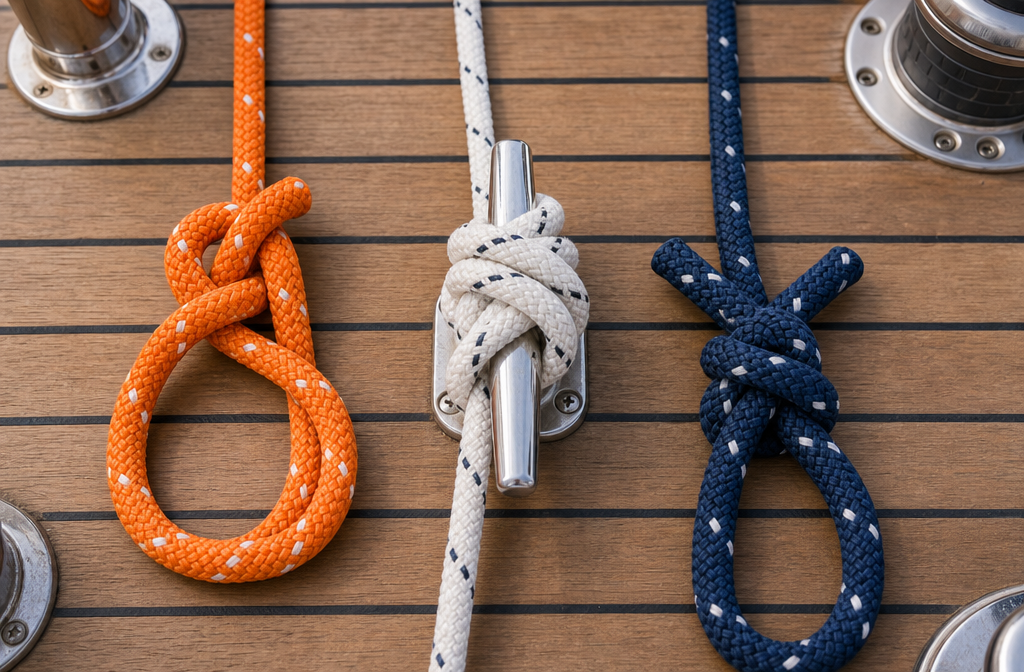
What are the 3 most important knots for beginners
For beginners on the water and in the outdoors, three knots are indispensable: the Bowline, the Cleat Hitch and the Clove HitchEach of these knots solves a concrete problem that you regularly encounter, and all three can be learned solidly in a few hours.
Palstek (Bowline) The bowline forms a fixed, non-tightening loop at the end of the rope. It is considered one of the most reliable knots of all because it does not tighten under load and can still be easily untied afterward. Use: Mooring to a bollard, securing loops, rescue operations.
Belegnknoten (Cleat Hitch) This knot connects a rope to a cleat, such as those found on every boat dock and on every houseboat. It can withstand enormous tensile forces and can still be quickly untied. Use: Mooring a boat to the dock, attaching fenders.
Webleinstek (Clove Hitch) A quickly tied knot that fastens a rope to a bollard, post, or branch. It is not as secure as the bowline but is significantly faster to tie. Use: Temporary mooring, tent lines, tarp attachment.
Anyone who knows these three knots in their sleep is well-equipped for any houseboat vacation or camping trip.
Why do I need knots in the outdoors at all?
Knots are the oldest tool of humanity, and they are still indispensable in the outdoor and boating sectors. They replace carabiners, screws, and hooks in situations where you don't have any of them with you.
Specific situations where you need knots:
- Mooring a boat to a dock or bollard
- Attaching fenders (bumper guards) to the boat's edge
- Tensioning a tarp or sun sail
- Securing cargo on the roof
- Emergency repairs to a sail or ropes
Without basic knowledge, you resort to improvised solutions in these moments that often don't hold. A boat that detaches from the dock at night is not only annoying but can be expensive.
How do I learn knots quickly and easily?
You learn knots fastest by repeated practice with a short piece of rope in your hand, not just by watching videos. Three to five repetitions daily for a week are enough to reliably master a knot.
Step-by-step learning plan:
- Select one knot, not all three at once.
- Repeat the steps slowly once while looking at instructions.
- Tie the same knot ten times in a row without looking.
- Repeat the next day, this time with one hand or with closed eyes.
- Only start the next knot when this one is mastered.
A piece of rope about 60 to 80 centimeters long is ideal for practicing. Thicker is better for beginners because you can see the individual steps better.
What mistakes do I make as a beginner when tying knots?
The most common mistake is to practice a knot only under perfect conditions and then realize on the boat that it no longer works with wet hands and thick rope. Beginners also often tie the correct shape but in the wrong direction, which weakens or destabilizes the knot.
The most common mistakes at a glance:
- Practice knots only dry and in peace, never under time pressure or with wet hands
- Learn the steps by heart without understanding why the knot holds
- Use rope that is too thin or too smooth, which slips
- Do not tighten the knot firmly enough after tying
- Use one knot for all situations instead of choosing the right one
Decision rule: If you are not sure if a knot will hold, tie it again and test it with a strong pull before leaving the boat.
What materials are best for tying knots?
For beginners, twisted ropes made of polypropylene or polyester are best. They are grippy, hold knots well, and are inexpensive. Smooth, braided lines are more difficult because knots tend to slip in them.
| Rope type | Grip | Knot holds | Recommendation |
|---|---|---|---|
| Twisted polyester | High | Very good | Ideal for beginners |
| Braided nylon | Medium | Good | Advanced |
| Smooth Dyneema rope | Low | Bad | Not for knots |
| Hemp rope | High | Very good | Good for practicing |
For houseboat holidays, the ropes are usually already on board. Nevertheless, it is worthwhile to bring a short practice rope to refresh the knots before setting off for the first time.
Are these 3 knots suitable for camping or also for sailing?
Yes, all three basic knots work in both camping and sailing. The bowline and the clove hitch are classic all-purpose knots used in seamanship, climbing, and outdoor camping. The cleat hitch is specific to cleats, so it is primarily relevant on boats.
Differences between nautical and outdoor knots: Nautical knots are often designed not to loosen under load, but still to be untied afterwards. Outdoor knots like the clove hitch prioritize speed. In practice, the categories overlap considerably, and the three basic knots cover both areas.
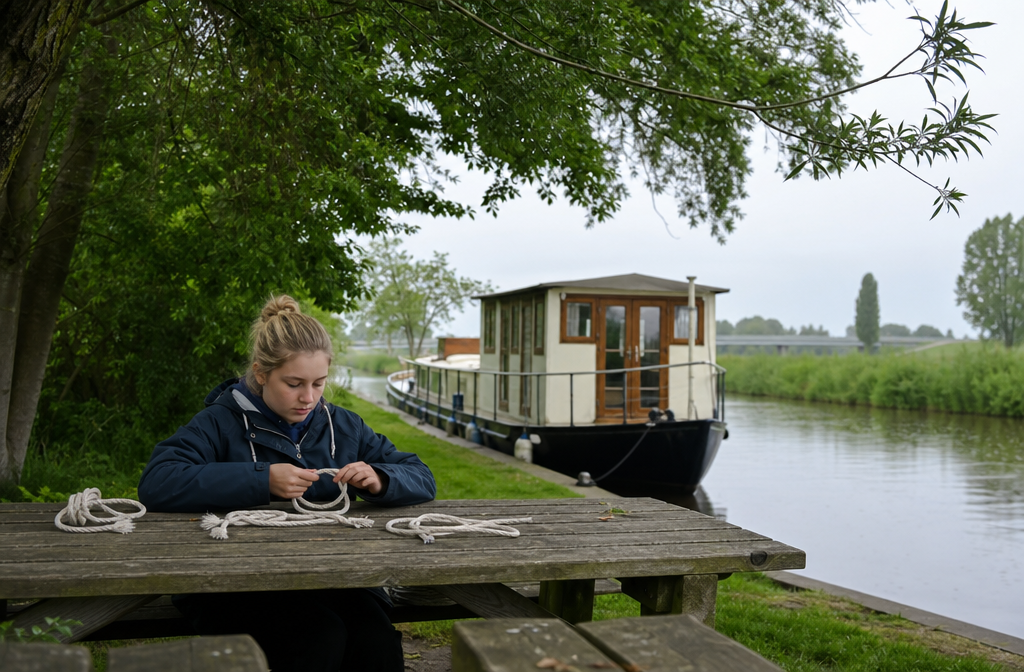
How do I practice knots correctly without getting confused?
Always practice only one knot per session and only move on to the next when the first one works without thinking. Those who learn all three simultaneously will confuse the steps and become insecure.
Practical practice tips:
- Always have a short piece of rope with you, for example in your jacket pocket
- Practice for five minutes every day before your vacation, not one hour at a time
- Practice knots with your non-dominant hand too
- Ask someone to watch and correct
- Count a knot as "learned" only when it's tied correctly three times in a row on the first try
What happens when a knot is not tied correctly
A incorrectly tied knot fails in one of two ways: it comes undone under load, or it tightens so much that it cannot be untied. Both scenarios are problematic, the first dangerous, the second frustrating and potentially expensive.
A boat that comes loose from the dock can drift into other boats, cause damage, and in the worst case be lost. A knot that cannot be untied must be cut, ruining the rope.
When to ask a professional: For safety systems for people, when climbing, or for heavy loads, you should always rely on certified techniques and professional guidance. The three basic knots are sufficient for normal boating operations, but not a solution for safety-critical applications.
Tips to ensure knots hold securely the first time
A knot holds securely when it is tied correctly, tightened firmly, and is suitable for the specific situation. Three simple checks before letting go are sufficient.
Safety check before setting off:
- Check the knot for correct form again, no twisted loops
- Test firmly in the direction of pull
- Ensure the free end of the rope is long enough (at least 10 cm remaining length)
Furthermore: Trust wet rope less than dry rope. Many knots slip more easily when the rope is wet, especially with synthetic materials. If in doubt, add an extra half hitch for security.
Can knots be learned without special equipment?
Yes, absolutely. All you need is a piece of rope about 60 to 80 centimeters long. No apps, no courses, no books are absolutely necessary, although good step-by-step instructions make getting started easier.
Many experienced sailors recommend starting with a piece of old clothesline. It's grippy, inexpensive, and forgiving of beginner mistakes. If you don't have one handy, just use a shoelace or a piece of packing string.
Frequently asked questions
How long does it take to learn a knot? With daily practice of five to ten minutes, a simple knot will be reliably tied after three to five days. More complex knots like the bowline often take a week.
Do I need to learn knots before a houseboat vacation? Yes, absolutely. The lines are on board, but no one will tie them for you. Anyone who masters the three basic knots will moor securely and sleep more soundly.
Is the bowline really that important? Yes. The bowline is the most versatile knot for water activities. It holds reliably, can be untied, and forms a secure loop. If you only learn one knot, this should be it.
Can I use the same knot for all situations? No. Each of the three basic knots has its purpose. Tying a cleat hitch to a bollard works less well than a clove hitch, and vice versa.
What is the difference between a knot and a hitch? In German usage, "Knoten" usually refers to a connection within the rope itself, while "Stich" describes a connection to an object. In everyday language, the terms are often mixed up, and the difference is not crucial for beginners.
Which rope is best for practicing? Twisted polyester rope with a diameter of 8 to 10 millimeters is ideal. It is easy to grip, holds knots well, and is available in any hardware store.
Are YouTube videos for learning knots good? They help with initial understanding but do not replace practicing with the rope in hand. Watching a video and tying along simultaneously is the most effective combination.
What do I do if a knot can no longer be untied? Insert a marlinspike or a sturdy pin into the loop and lever it. In an emergency, the rope must be cut.
Here's how it continues
Learning knots is not rocket science, but it requires a little discipline. Those who take the beginner's guide to knots seriously and practice these 3 knots diligently before going on the water have a decisive advantage: they can concentrate on what matters, on the water, the scenery, and the moment.
Take a piece of rope today and practice the bowline. Tomorrow, the cleat hitch. The day after tomorrow, the clove hitch. After a week, you'll be ready.
Ready for your houseboat vacation? Book your houseboat now with Campcruisers and experience why a relaxing trip on the water with the right basic knowledge is twice as much fun.


 English
  German
  Spanish
  Italian
  Polish
  Dutch
Dutch  French
  Danish