
Anyone who has ever tried to balance a pan on a stove in gentle swells knows: Cooking on the water is a discipline of its own. Cooking on the water: Galley tips is therefore not a niche topic, but real everyday life for thousands of houseboat and sailing boat travelers. With the right equipment, a bit of planning, and the right food on board, the ship's galley quickly becomes the favorite spot on board.
What does galley mean on a boat?
The galley is the kitchen on board a boat or ship. It is usually compact, functional, and equipped in a confined space so that all basic cooking needs can be met.
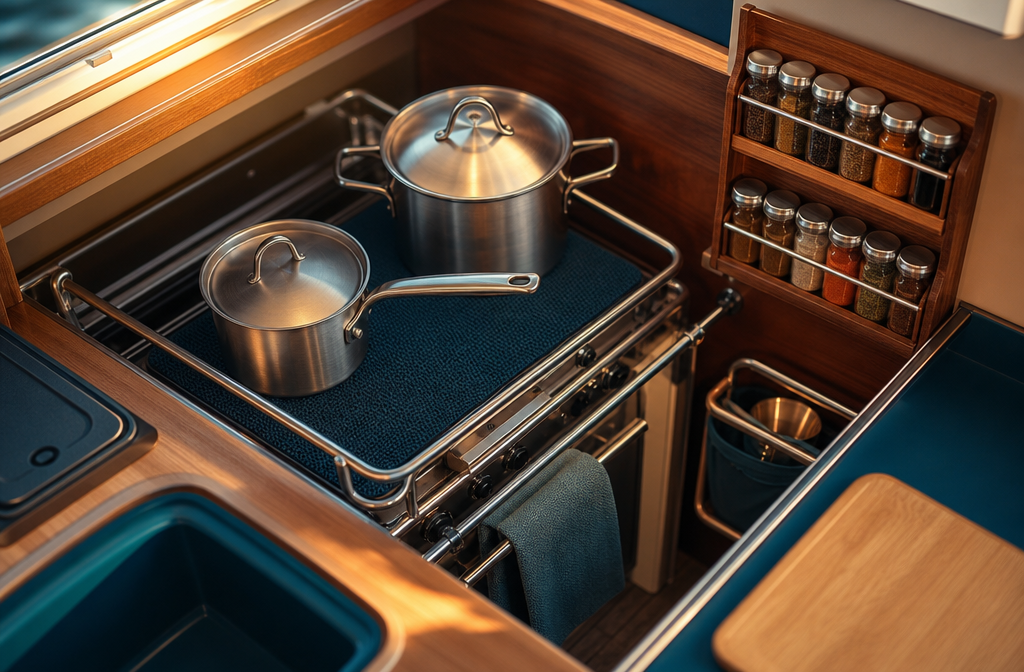
The term comes from Dutch („kombuis“) and originally referred to the cooking area on ships. On modern houseboats and sailing yachts, the galley is often built in an L or U shape, with fiddle rails (restraining bars on the work surface), built-in stoves, and space-saving storage areas. Anyone who really wants to understand Cooking on the water: Galley tips must start by understanding this special space.
What cooking equipment is useful in a boat galley?
For most boat kitchens, gas stoves with gimbal suspension, a compact pressure cooker, and an immersion blender are the most sensible investments. Electrical appliances with high power consumption are usually problematic on board.
Here is an overview of the most common options:
| Device | Advantage | Disadvantage |
|---|---|---|
| Gas stove (gimbal) | Stable in rough seas, fast | Gas cylinders required |
| Induction hob | Clean, precise | High power consumption |
| Spirit cooker | Inexpensive, simple | Slow, fire hazard |
| Pressure cooker | Fast, energy-saving | Learning curve for operation |
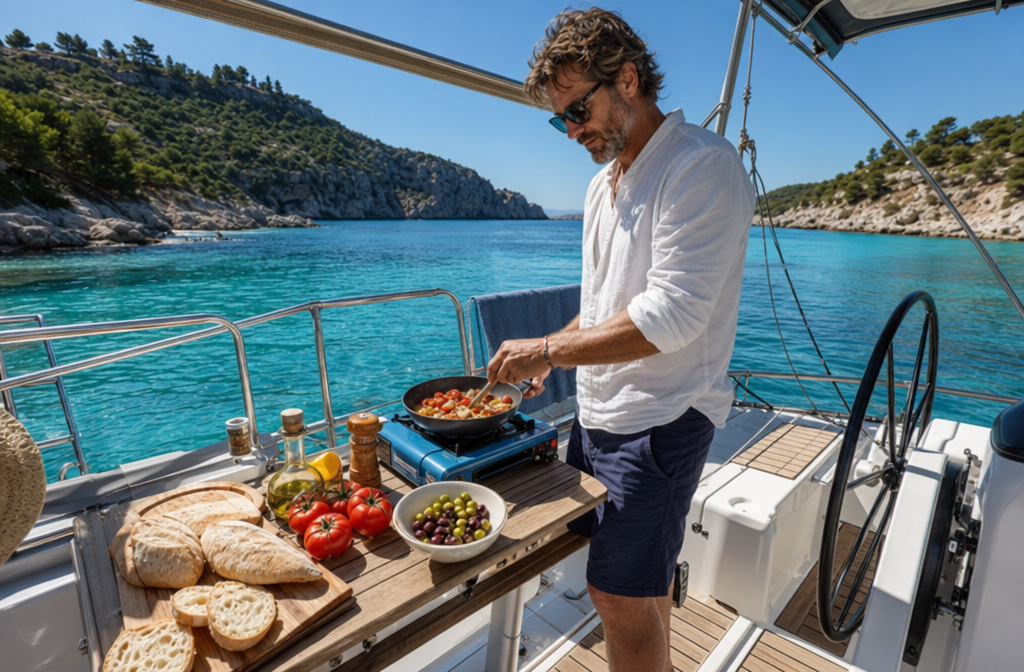
| Camping stove | Flexible, inexpensive | Only for calm water |
For houseboat travelers with shore power connection, an induction hob is certainly worthwhile. On sailing yachts without external power supply, gas remains the most reliable choice.
How does a gimbal stove work on boats?
A gimbal stove is a cooking stove mounted on a gimbal suspension that self-balances with ship movements, keeping pots and pans horizontal. This is not a luxury in rough seas, but a matter of safety.
The suspension allows for a tilt of usually 30 to 45 degrees in both directions. In addition, good gimbal stoves have pot holders (so-called "Pot Clamps") that secure pots even with stronger rolling. Anyone cooking on a sailboat should exclusively use such a stove once they head out into open water.
Important: Always wear a heat-resistant glove when cooking in rough seas and never leave cooking unattended.
How do I cook safely on the high seas without tipping over?
Safe cooking at sea requires three things: a gimbal stove, non-slip mats, and the right cooking technique. Those who observe these basic rules can easily prepare a hot meal even in a Force 4 wind.
Specific safety tips:
- Always secure pots: Consistently use pot holders on the stove
- Reduce hot liquids: Fill pots to a maximum of two-thirds
- Use non-slip mats: Silicone mats under cutting boards and bowls prevent slipping
- Wear an apron: Protects against splashes from unexpected movements
- Prefer simple dishes: In rough seas, prefer one-pot dishes over multi-stage cooking processes
- Never cook alone: Always have someone nearby who can help
A classic mistake: Leaving coffee pots or open pots on the stove when you briefly leave the cockpit. This regularly ends with burns or chaos in the galley.
Cooking on a sailboat without electricity: What options are there?
Without shore power or a generator, gas, alcohol, and solid fuel are primarily available as energy sources on a sailboat. Gas is by far the most practical and common solution.
Alternatives at a glance:
- Propane/butane gas: Most commonly used solution, good availability in marinas, easy to handle
- Alcohol stove: Safer in case of leaks (alcohol burns with water extinguishable), but significantly slower
- Solid fuel tablets: Only suitable for emergencies or very short trips
- Solar-powered induction: Possible if sufficient solar capacity is available (at least 400 Wp recommended)
For houseboat travelers who book through Campcruisers, the power supply is often already taken care of, as many houseboats have shore power connections or powerful onboard generators.
What are typical dishes for the onboard galley?
Onboard galley means: fast, nutritious, delicious, and with few pots. Classics include one-pot pasta, lentil soup, fried rice with vegetables, and fish dishes.
The best onboard galley dishes meet four criteria: they require little water, can be prepared with one heat source, the ingredients are long-lasting, and they taste good even when reheated.
Tried and tested recipe ideas:
- Pasta with tomato sauce and tuna (everything can be canned)
- Lentil dhal with coconut milk and ginger
- Fried rice with egg and soy sauce
- Beetroot soup with yogurt
- Wraps with hummus, roasted vegetables, and feta
Tip for cooking on the water: Tips for the galley: Meals that can be prepared before the boat sets sail save time and nerves at sea.
How do I keep food fresh on a boat for a long time?
Fresh food stays fresh longest on a boat when stored cool, dry, and well-ventilated. A good cooler or an onboard refrigerator is essential.
Practical storage rules:
- Vegetables: Cabbage, carrots, onions, and garlic keep for several weeks without refrigeration
- Bread: Wrap in linen cloths, not plastic (otherwise it molds quickly)
- Eggs: Can be kept unrefrigerated for up to two weeks if they have not been washed
- Canned goods: Ideal onboard supplies, always label with expiration date
- Vacuum packaging: Significantly extends the shelf life of cheese and cold cuts
Coolers with good insulation (Yeti-type or similar) keep ice for up to five days. For longer trips, a 12-volt compressor refrigerator is worthwhile.
What foods are good for sailing?
The best foods for sailing trips are those that can be stored with little or no refrigeration, are resistant to moisture, and provide a lot of energy. Canned goods, legumes, nuts, and durum wheat pasta are absolute onboard classics.
Recommended onboard provisions:
- Pasta, rice, couscous, lentils
- Canned goods (tomatoes, beans, tuna, chickpeas)
- Nuts, dried fruits, muesli bars
- Oil, soy sauce, Tabasco, dried herbs
- UHT milk, coconut milk in Tetrapaks
- Hard cheese (Parmesan, Manchego)
What to avoid: raw meat without reliable refrigeration, lettuce and berries (spoil quickly), glass bottles (risk of breakage).
What cooking utensils do I really need on a boat?
Less is more. A good onboard kitchen needs a pot, a pan, a cutting board, a sharp knife, and a sieve. Everything else is a bonus.
The essential onboard kitchen equipment:
- 1 large stainless steel pot with lid (3-4 liters)
- 1 non-stick pan (24 cm)
- 1 pressure cooker (optional, but very useful)
- Sharp chef's knife + cutting board with rubber feet
- Sieve, ladle, spatula
- Stackable plates and cups (melamine or stainless steel)
- Non-slip silicone mats
Buy everything made of stainless steel or melamine, no glass and no porcelain. It won't survive the first bump against the hull.
What are the biggest mistakes when cooking on the water?
The most common mistake is a lack of preparation: If you only realize at sea that important ingredients are missing or the gas supply is empty, you have a problem. The second biggest mistake is underestimating rough seas while cooking.
Top mistakes at a glance:
- Too little gas reserve: Always carry a full spare bottle
- Fresh food without a plan: Spoils quickly if there is no cooling capacity
- Too complicated recipes: Multi-course meals in rough seas are dangerous and stressful
- No safety belt in the galley: In heavy rolling, a hip belt is mandatory
- Open flames unattended: Never leave the stove burning
- Filling pots too full: Hot water spills over quickly
How do I cook healthily and balanced on a sailboat?
Healthy cooking on board is possible if you rely on a good mix of legumes, whole grains, canned vegetables, and fresh ingredients for the first few days of the trip. Vitamin deficiency is not an issue on short trips, but it is relevant on long journeys.
Practical strategy: Plan for fresh vegetables and fruit for the first two to three days. After that, switch to shelf-stable alternatives: canned tomatoes, pickled vegetables, dried fruit. Multivitamin supplements are useful on long bluewater voyages.
What does a good onboard kitchen setup cost?
A solid basic kitchen setup costs between 200 and 600 Euros. Those who already have a gimbal stove on board can manage with 100 to 200 Euros for pots, utensils, and safety equipment.
Cost estimate (2026):
- Gimbal gas stove (installation): 300-800 Euros
- Compressor refrigerator (12V): 400-900 Euros
- Pot and pan set (stainless steel): 80-150 Euros
- Non-slip mats, pot holders, utensils: 30-80 Euros
- Pressure cooker: 50-120 Euros
For houseboat travelers who book through Campcruisers, the galley is usually already fully equipped, so no additional investments are necessary.
Frequently asked questions about cooking on board
What is the difference between a galley and a pantry? A galley is the complete cooking area with a stove and sink. A pantry refers more to a small storage room or a kitchenette without a complete cooking area.
Can I use a normal oven on a houseboat? Yes, if the houseboat has sufficient shore power or a strong generator. Many modern houseboats already have a built-in oven.
How safe is cooking with gas on a boat? Very safe, if the system is regularly maintained, gas hoses are checked for cracks, and a gas detector is installed. Gas is heavier than air and collects in the bilge area, so good ventilation is important.
How much gas do I need for a week on the boat? As a rule of thumb: a 5 kg propane gas bottle is sufficient for about 7 to 10 days with normal use (3 meals a day). Always carry a spare bottle.
Can I grill on a boat? Yes, with a special boat grill (stern grill or railing grill). Open charcoal grills are not recommended for fire safety reasons; gas grill attachments are the better choice.
How do I clean the galley at sea? Use dish soap sparingly, as it enters the water. Use biodegradable dish soap. Wipe off coarse residues with paper towels first, then rinse with little water.
What do I do if I run out of gas while at sea? Use emergency supplies: Canned goods, crispbread, nuts, and dried fruit require no preparation. Alternatively, carry a camping stove with a gas cartridge as a backup.
Do I need to consider special insurance when cooking on a boat? Generally not, but in case of damage due to improper gas use, the boat insurance may refuse coverage. Always check the insurance terms and conditions.
Ready for adventure on board?
Cooking on the water: Tips for the galley show one thing above all: With the right preparation, the onboard kitchen is not a compromise, but a real experience. The feeling of cooking a steaming lentil soup in your own galley after a long day on the water, while the sunset streams through the porthole, is simply unbeatable.
Those who want to experience this for themselves don't have to buy their own boat right away. The easiest way to dive into the world of onboard cooking is a houseboat vacation, where everything is already on board.
Ready for your houseboat vacation? Book your houseboat now with Campcruisers and discover how much fun cooking on the water really is.


 English
  German
  Spanish
  Italian
  Polish
  Dutch
Dutch  French
  Danish