
Every year, hundreds of distress calls are reported in German coastal waters and on inland lakes alone, many of which could have ended much more favorably with the right preparation and a clear head in a crisis situation. If you are on a houseboat and wonder what to do in a real emergency on board, you don't need panic, but a plan. This guide shows you how to react correctly in case of an accident, when to call for help, and how to get yourself and your fellow travelers home safely.
Short answer: In an emergency on board, the rule is: stay calm, assess the leak or damage, make an immediate emergency call (Channel 16 on VHF or emergency number 112), inform the crew, and put on safety equipment. Don't wait until the situation escalates.
What you need to know immediately
- Channel 16 on VHF radio is the international distress channel at sea, always leave it on.
- The German Maritime Search and Rescue Service (DGzRS) can be reached around the clock.
- Everyone on board should know where life jackets, fire extinguishers, and signaling devices are located.
- A Mayday call has priority over all other radio traffic, worldwide.
- Legally, you are obliged to report an accident, even if no one was injured.
- Sea rescue in Germany is free for shipwrecked individuals; there can be exceptions in cases of gross negligence.
- Many accidents happen due to lack of preparation, not solely due to bad weather.
- A VHF marine radio training (SRC) only takes a weekend and can save lives.
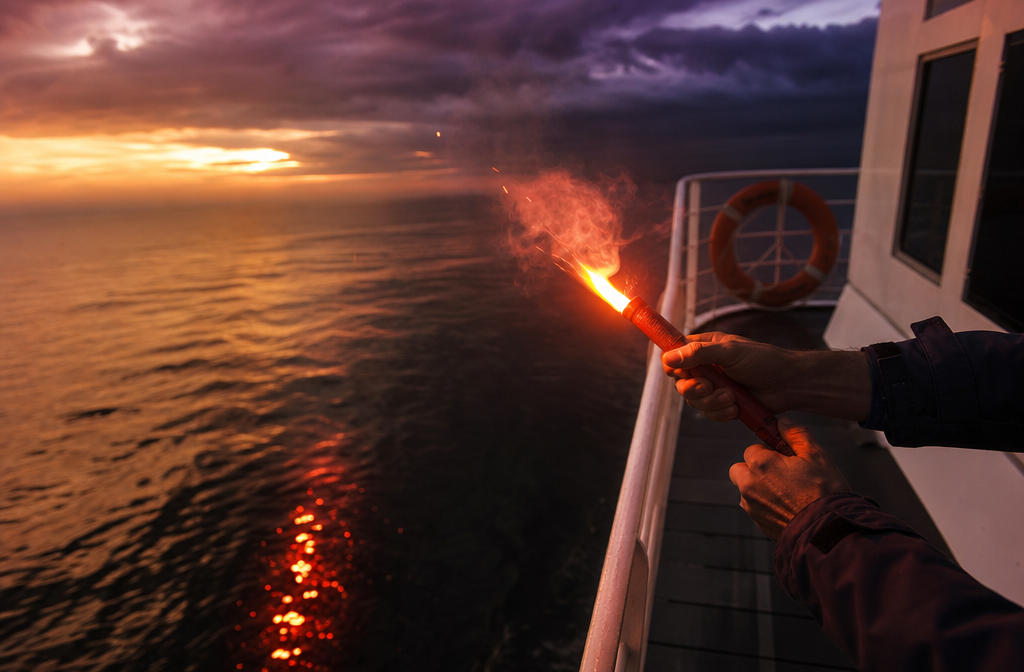
What are the first steps in case of a boat accident?
Once damage occurs, the order of your reaction matters more than speed. The first three minutes often determine whether a situation remains controllable or escalates.
Step 1: Assess the situation. Is the boat in immediate danger of sinking? Is there fire, injured persons, or uncontrolled flooding? State the problem out loud so everyone on board is informed.
Step 2: Make an emergency call. Don't wait to solve the problem yourself. Send the emergency call first, then act further. At sea: Mayday call on channel 16. On inland lakes: Emergency number 112.
Step 3: Put on safety equipment. Life jackets for everyone, activate the bilge pump in case of flooding, have fire extinguishers ready in case of fire.
Step 4: Set anchor or keep the boat on courseto avoid further danger, if possible.
Step 5: Brief the crew and guests. Assign everyone a task. Panic arises primarily when people have nothing to do.
Common mistake: Many skippers first try to fix the problem themselves and only call for help when it's too late. Call first, act in parallel.
How do I alert rescue services at sea?
The fastest and most reliable way to alert rescue services is the Mayday call on VHF channel 16. An EPIRB (Emergency Position Indicating Radio Beacon), which automatically sends a satellite signal, also works as an alternative.
Mayday call step by step:
- Set VHF radio to channel 16, transmission power to 25 watts.
- Say "Mayday" three times.
- State the ship's name three times.
- Provide position (GPS coordinates or description).
- Describe the nature of the emergency.
- State the number of people on board.
- Further relevant information (sinking boat, fire, injured persons).
For those without VHF radio: Emergency call 112 via mobile phone, but mobile reception at sea is often unreliable. An EPIRB or PLB (Personal Locator Beacon) is therefore indispensable for longer trips.
What safety equipment do you need in an emergency?
The minimum equipment for houseboats and recreational boats depends on the area of operation, but this basic equipment should be on every boat:
| Equipment | Purpose | Mandatory/Recommended |
|---|---|---|
| Life jackets (CE-certified) | One per person | Duty |
| Handheld VHF radio | Distress calls and communication | Recommendation |
| Fire extinguisher (Class B/C) | Engine fires, electrical fires | Duty |
| Signaling devices (flares, hand flares) | Location marking | Recommendation |
| Bilge pump (manual and electric) | Combat water ingress | Recommendation |
| First aid kit | Injury treatment | Duty |
| EPIRB or PLB | Automatic alert | Recommendation |
Check the equipment before every trip. Expired flares or depleted fire extinguishers are worthless in a real emergency.
Differences between different types of marine emergencies
Not every mishap is the same. The right reaction depends heavily on the type of emergency.
- Water ingress/Sinking: Activate bilge pump immediately, seal leak (emergency plug, cushion, sealant), send Mayday, prepare life raft.
- Fire on board: Switch off engine, use fire extinguisher, consider wind direction (turn boat so fire is blown away from the wind), make emergency call immediately.
- Collision: Check damage, contact the other party, inform police and insurance, record accident report.
- Engine failure: Set anchor, set sails if available, send Pan-Pan call (less urgent than Mayday), wait for towing assistance.
- Man overboard: Immediately shout "Man overboard", throw lifebuoy, note position (GPS marker), initiate maneuver, make emergency call.
The most common mistake is to misjudge the type of emergency and start the wrong chain of reactions.
When should the crew be evacuated
The boat is only abandoned as a last resort. A sinking boat is still a better rescue device than the open water, as long as it stays afloat.
Evacuate if:
- The boat is sinking uncontrollably and can no longer be saved.
- Fire is spreading uncontrollably and the boat becomes a trap.
- An explosion is imminent (smell of gas, uncontrolled engine fire).
- Rescue services order the evacuation.
Before evacuation: Deploy and secure the life raft, put on life jackets, take emergency equipment (water, signaling devices, EPIRB), send a distress call and give your position.
Most common mistakes in a maritime emergency
Most avoidable disasters at sea have a common cause: underestimation.
- Sending a distress call too late: Many wait until the situation is hopeless. Calling early costs nothing.
- Not wearing life jackets: Especially in calm weather, life jackets are often omitted, although inattention increases precisely then.
- Lack of positional knowledge: Anyone who does not know or cannot communicate their GPS coordinates significantly hinders rescue.
- Incorrect prioritization: Trying to save the boat before securing the people.
- Panic among the crew: Almost always arises when no clear division of roles has been discussed in advance.
Costs of maritime rescue for private sailors
In Germany, sea rescue by the DGzR S is generally free of charge for shipwrecked persons, as the DGzR S is financed exclusively by donations. This also applies to foreign nationals in German waters.
The situation is different for:
- Salvage costs for the boat itself: These can be considerable and range from a few hundred to several thousand euros, depending on the effort involved.
- Gross negligence: In certain cases, persons who set sail despite a storm warning or operate without mandatory equipment can be held liable for costs.
- Abroad: In other countries (e.g., USA, parts of Southern Europe), rescue operations for private individuals may be subject to charges.
Therefore, water sports liability and comprehensive insurance is strongly recommended for every houseboat driver.
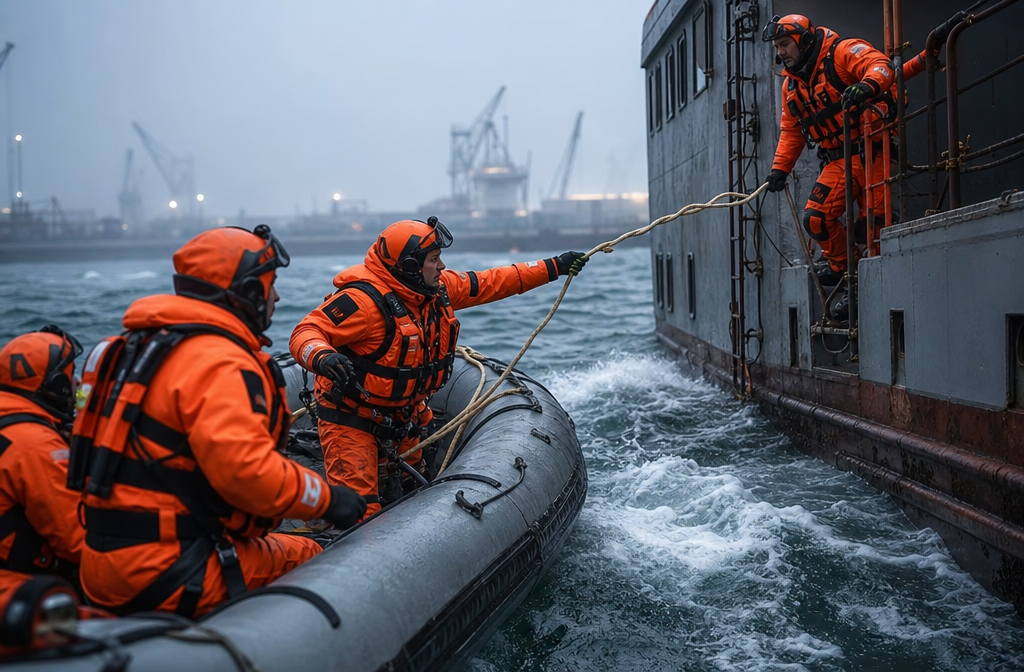
How does professional sea rescue work
The DGzR S operates over 60 stations on the North and Baltic Seas and reaches the scene of an operation within an average of 30 to 45 minutes. On inland lakes, the DLRG and fire department are responsible for water rescue.
The process of a professional sea rescue:
- Emergency call received by the MRCC (Maritime Rescue Co-ordination Centre) Bremen.
- Coordination of the nearest available unit.
- Rescue boat or helicopter is dispatched.
- On site: Situation assessment, initial medical care, rescue of persons.
- Subsequently, salvage of the vessel, if possible.
What training helps in maritime emergencies
A weekend of training can make the difference between life and death. These courses are particularly relevant for houseboat drivers:
- SRC (Short Range Certificate): VHF marine radio certificate, mandatory for many areas, teaches the correct Mayday call and radio communication.
- First aid course with a focus on water: Specifically for boating, includes resuscitation, hypothermia, drowning.
- Inland/Sea boating license: Teaches safety basics and emergency management.
- STCW Basic Safety Training: For ambitious sailors, international standard.
Many yachting schools and water sports associations also offer these courses as compact weekend courses.
What happens legally after an accident
After an accident, German maritime law applies, and the reporting obligation must be taken seriously. Every skipper is obliged to report accidents involving personal injury or significant property damage to the water police or the responsible Waterways and Shipping Office.
Important legal points:
- Accident report: Mandatory for personal injury, collisions, and significant property damage.
- Duty to assist: Anyone who passes by a maritime emergency without helping is committing a criminal offense (Paragraph 323c StGB).
- Insurance notification: Damage must be reported to the insurance company within the deadline.
- Alcohol at the helm: Driving is prohibited from 0.5 per mille on maritime shipping routes, and from 1.6 per mille, criminal consequences are threatened.
Checklist for emergency preparedness on boats
Check off these points before every trip:
- Are life jackets available for all persons on board and worn?
- Is the VHF radio switched on, Channel 16 active?
- Is the GPS position known and communicable?
- Are fire extinguishers checked, not expired?
- Are distress signals available and within their expiry date?
- Is the first-aid kit complete?
- Are emergency numbers known (DGzRS: Channel 16, Emergency call 112)?
- Has the weather report for the area been retrieved?
- Have all fellow travelers been informed about the emergency plan?
- Is the bilge pump functional?
Which countries have the best sea rescue services?
Germany (DGzRS), Great Britain (RNLI), the Netherlands (KNRM) and the Scandinavian countries are internationally regarded as role models in sea rescue. These services are characterized by short reaction times, professionally trained crews and modern equipment.
Anyone traveling in the Mediterranean or in non-European waters should inform themselves in advance about the local rescue structures, as these vary considerably. In some regions, there is hardly any organized sea rescue, which makes self-responsibility and equipment on board even more important.
Frequently asked questions
What does Mayday mean and when can I use it? Mayday is the international distress signal at sea and may only be used in immediate danger to life, i.e., when the boat is sinking, burning, or people are in acute danger. Misuse is punishable.
What is the difference between Mayday and Pan-Pan? Mayday signals immediate danger to life. Pan-Pan is an urgent distress call without immediate danger to life, for example, in case of engine failure or an injured person requiring medical advice.
Do I have to wear a life jacket on a houseboat? In Germany, there is no general obligation for adults to wear a life jacket on inland vessels, but for children under twelve years of age, wearing a life jacket on deck is mandatory. For all others, it is strongly recommended, especially in bad weather.
How long does it take for the DGzRS to arrive? The DGzRS states an average response time of approximately 30 to 45 minutes, depending on position and weather conditions. In coastal waters, it can be significantly faster.
Is sea rescue in Germany free of charge? Rescuing people by the DGzRS is free of charge. However, salvage costs for the boat may be incurred and should be covered by comprehensive insurance.
What to do in case of man overboard? Immediately shout "Man overboard", throw a lifebuoy, mark the position in the GPS, do not lose sight of the boat, send a distress call, and initiate a maneuver to reach the person.
Can I make a distress call with my mobile phone? Yes, via 112, but mobile reception at sea is often unreliable. VHF radio on channel 16 is more reliable and is monitored by rescue control centers around the clock.
What happens if I don't report an accident? Failure to report an accident involving personal injury or significant property damage is a misdemeanor or offense and can lead to fines or criminal consequences.
How to properly prepare for your next houseboat vacation
An emergency on board doesn't have to be a nightmare if you're prepared. The most important steps: Learn the correct Mayday call, check your safety equipment before every trip, assign clear roles to your crew, and always know your position. Those who have internalized these basics can act calmly and effectively even in stressful situations.
And the best part? With the right preparation, you can fully concentrate on the experience: gliding over calm canals, docking in small harbors, waking up with a view of the water. Houseboat trips are among the most relaxing and beautiful forms of travel, and with the knowledge from this guide, you'll be prepared for anything.
Ready for your houseboat vacation? Book your houseboat now with Campcruisers and start your adventure on the water with peace of mind.


 English
  German
  Spanish
  Italian
  Polish
  Dutch
Dutch  French
  Danish