
Last updated: May 24, 2026
Quick Answer: Anyone who doesn't know the dimensions of their motorhome risks damaged vehicles, fines, and blocked routes. Height, width, and length determine which bridges are passable, which campsites remain accessible, and whether a vehicle is even legally allowed on public roads. The most important standard dimensions in Germany: up to 4.0 m height, up to 2.55 m width, and up to 12.0 m length (for vehicles without trailers).
Key Takeaways 🚐
- Height is the most critical dimension: Many bridges, parking garages and underpasses are limited to 2.0–3.5 m.
- Most motorhomes in Germany are 2.3–2.5 m wide and 5.4–8.0 m long.
- Campsites in Europe often have entrance heights between 2.8 m and 3.5 m — always check beforehand!
- Narrower and shorter vehicles are for Beginners and narrow country roads significantly less stressful.
- The vehicle size directly influences the Fuel consumptionLarger vehicles consume measurably more.
- For Families offer vehicles from approx. 6.5 m in length significantly more comfort and storage space.
- Parking spaces in Germany have standard widths of 3.0–4.0 m — it gets tight with wide vehicles.
- The exact vehicle height should always with air conditioning, roof box or pop-up roof can be measured.
- Anyone wanting to rent a motorhome should know the dimensions. before booking compare with the planned route.
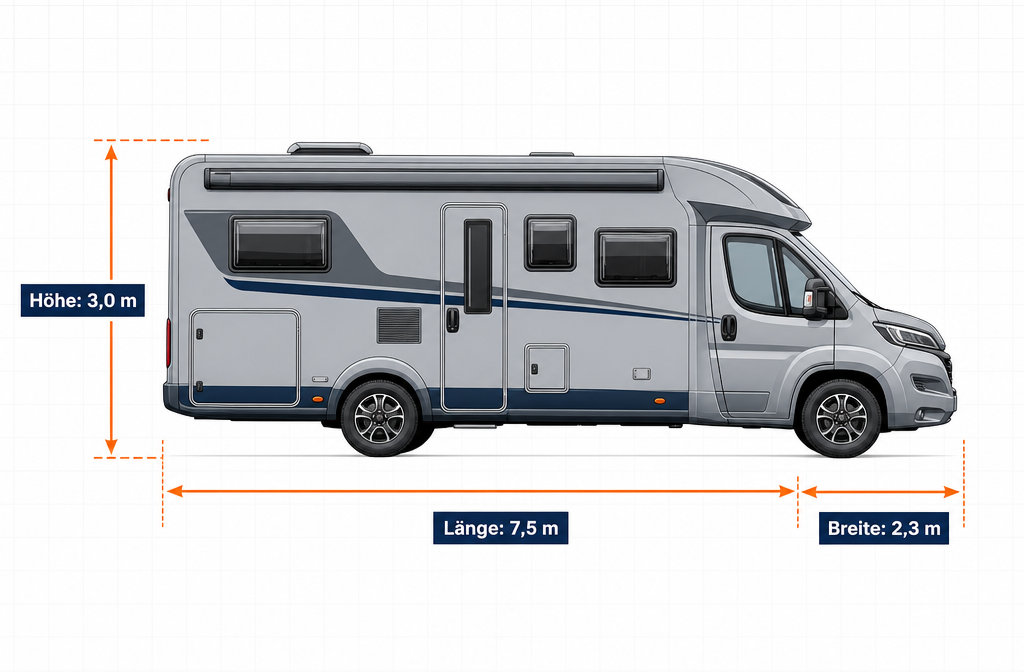
What are the standard dimensions for a motorhome in Germany?
In Germany, clear legal upper limits apply to motorhomes in accordance with the Road Traffic Licensing Regulations (StVZO). The maximum vehicle width is 2.55 m, the maximum height 4.0 m and the maximum length 12.0 m (for motor vehicles without trailers).
In practice, most RVs operate well below these limits:
| Vehicle class | Typical length | Typical width | Typical height |
|---|---|---|---|
| Panel van/Camper van | 5.4–6.4 m | 2.0–2.2 m | 2.5–2.8 m |
| Semi-integrated | 6.5–7.5 m | 2.2–2.5 m | 2.8–3.1 m |
| Fully integrated | 7.0–9.0 m | 2.3–2.55 m | 3.0–3.5 m |
| Alcove | 6.5–8.0 m | 2.3–2.55 m | 3.0–3.5 m |
Important: These values are typical market averages. Actual dimensions vary significantly depending on the manufacturer and model. Always use the vehicle document (registration certificate part I) as the definitive source.
What RV classes are there by length and width?
The RV class largely determines which travel styles and routes are realistic. Basically, there are four main classes that differ greatly in length, width, and thus maneuverability.
Compact vehicles (Panel Van/Campervan): Length up to approx. 6.4 m, width up to 2.2 m. Ideal for city driving, narrow mountain roads and spontaneous trips. If you want to cruise through Tuscany, you'll be much more relaxed in a compact van - more on that in the Adventure Tuscany with the RV.
Mid-Range (Semi-Integrated): Length 6.5–7.5 m, width 2.2–2.5 m. The compromise between living comfort and maneuverability. For most travelers, the most practical choice.
Large Vehicles (Fully Integrated/Alcove): From 7.0 m in length, width up to 2.55 m. Maximum living comfort, but limited flexibility on narrow streets and small parking spaces.
How do you measure the clearance height for my RV — and how do I accurately measure the height?
The clearance height of your vehicle corresponds to the total height of the motorhome in ready-to-drive condition. That sounds simple, but has a few pitfalls.
This is how to measure correctly:
- Vehicle on level ground park.
- All Superstructures in driving position bring: Close skylight, retract pop-up roof (if present), fold in antennas.
- With a Measuring tape or laser rangefinder measure from the ground to the highest point.
- Air conditioning, solar system or roof box factor in — these often increase the overall height by 10–30 cm.
- Record the result and Visible in the driver's cab. affix (e.g. on a sticker on the dashboard).
💡 Practical tip: Many vehicle documents specify the manufacturer's height without antennas or air conditioning. The actual driving height can be 10–20 cm higher than that.
Common mistake: Relying blindly on the information in the vehicle registration document without considering attachments.
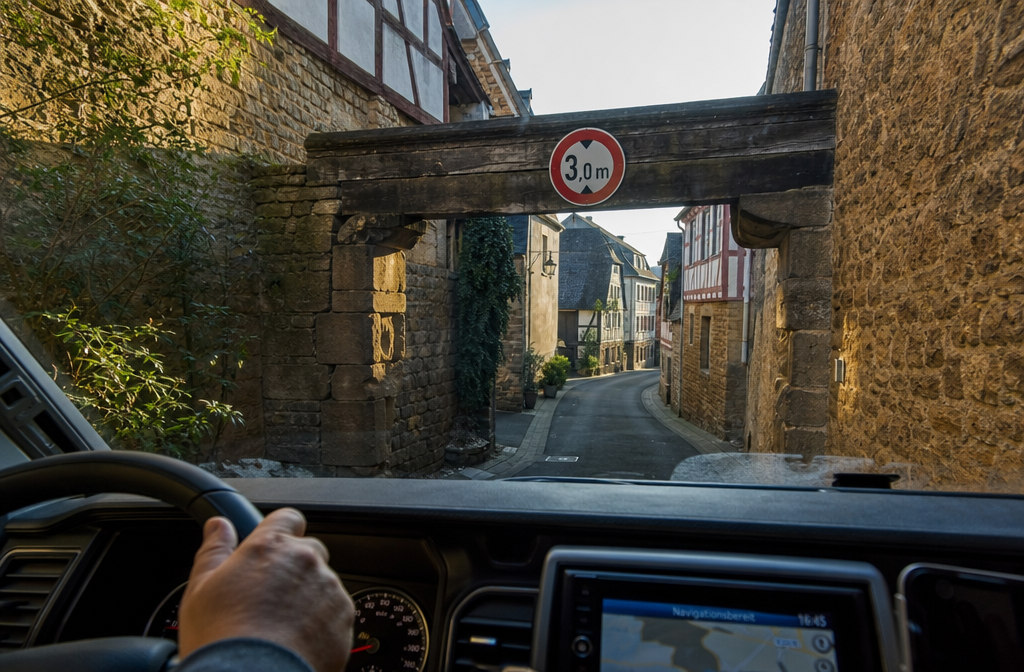
What happens if my RV is too tall for a bridge?
In the best-case scenario: the vehicle doesn't fit through and you have to turn around. In the worst-case scenario: expensive total loss, road closure, and legal consequences. Bridge collisions with motorhomes are not a rare occurrence in Germany — insurance companies speak of several hundred cases per year (estimate based on industry reports, no official statistics).
What are the specific threats:
- Significant vehicle damage (roof structure, air conditioning, solar system)
- Damage to the bridge with personal liability
- Possible administrative offenses or criminal consequences in case of gross negligence
- Trip cancellation, towing costs
Prevention:
- Use a navigation system with motorhome mode and set vehicle height (e.g., Garmin Camper series or TomTom Trucker)
- Check maps for height restrictions on unfamiliar routes
- When in doubt, get out and estimate the height before entering.
How much width do I need for narrow country roads?
For narrow country roads and mountain passes: vehicles under 2.2 m wide are significantly less stressful. Many single-track roads in Southern Europe, Ireland or Scotland are designed for oncoming traffic with normal cars — a 2.5 m wide motorhome becomes a real challenge there.
Rule of thumb:
- Under 2.2 m wide: Hardly any restrictions on European roads
- 2.2–2.35 m: Easy to handle, occasionally narrow
- Over 2.35 m: Significantly restricted on narrow country roads and in old towns
Whoever through South Holland with the RV travels, will find that vehicle width plays a crucial role, especially in cities and on dike roads.
What RV dimensions are allowed for campsites?
Most European campsites accept vehicles up to a length of 8.0–9.0 m and a height of 3.0–3.5 mHowever, there is no uniform regulation - each operator sets its own limits.
Typical restrictions on campsites:
- Entrance height: frequent 2.8–3.5 m (Barriers or Gates)
- Maximum parking space length: 8.0–10.0 m on standard plots
- Width of access roads: partly under 3.0 m on older systems
Always clarify before booking:
- Are there height restrictions at the entrance?
- What is the maximum parking space size?
- Are the access roads suitable for wide vehicles?
Anyone who wants to rent out or find their own parking space can do so on the Campcruisers Blog on the topic of renting out pitches further practical information.
What do I need to consider regarding parking lots and parking spaces?
Public parking spaces and RV parking spaces (Aire/Sosta/Rastplatz) often have different requirements than campsites. Parking garages are off-limits for most RVs — entrance heights of 2.0–2.1 m are standard.
Important points for parking spaces:
- Standard width a parking space plot in Germany: 3.0–4.0 m. With a vehicle width of 2.5 m, there is little margin for error.
- Service station for fresh and waste waterCheck if the vehicle can approach far enough.
- OverhangsWith long vehicles, rear or front overhangs can cause problems on uneven parking spaces.
- Weight restrictionsSome pitches have ground load-bearing limits — relevant for heavy fully integrated motorhomes. It's worth taking a look at the Guide to motorhomes up to 3.5 tons and overloading.
What RV dimensions are most practical for beginners?
For beginners: Smaller is more relaxed.A panel van or compact semi-integrated motorhome up to 6.5 m long and under 2.3 m wide can be driven like a large van — no class C driving license required, easy to park, and problem-free on almost all roads.
Recommendation for beginners:
- Length: maximum 6.5 m
- Width: Under 2.3 m
- Height: under 3.0 m
- Weight: under 3.5 t (no C driver's license required)
The new EU driving licence regulations allow driving motorhomes up to 4.25 t with class B licenses from 2026 — this considerably expands the selection for beginners.
Choose a larger vehicle if: you're traveling with family, planning longer trips, and already have experience with vans or small vans.
What RV dimensions are best suited for families?
Families with children need above all Sleeping areas, storage space and a functional kitchenThis usually means: vehicles from 6. 5 m lengthAn alcove motorhome offers a particularly high sleeping capacity in a compact space due to the bed above the driver's cab.
Family-friendly dimensions:
- Length: 6.5–8.0 m (4–6 sleeping places possible)
- Width: 2.3–2.5 m (more interior width = more living comfort)
- Height: 3.0–3.3 m (Interior headroom)
Compromise: The longer the vehicle, the more limited the route freedom. Families should consider whether they prefer more comfort or more flexibility.
What are typical mistakes when choosing a camper size?
The most common mistake: choosing the vehicle based on living comfort and ignoring the driving characteristics. An 8.5 m long fully integrated motorhome feels great in the showroom - less so on a single-lane mountain road in Provence.
The five most common mistakes:
- Underestimating vehicle height — Add-on parts not included.
- Too big for the planned route — narrow old towns, mountain passes, small campsites not considered.
- Driver's license class not checked — Vehicle over 3.5 t without a C driving license.
- Pitch size ignored — Vehicle doesn't fit on the booked parking spaces.
- Weight underestimated — Fully loaded vehicle exceeds the permissible total weight.
Points 3 and 5 can become expensive — more on that in the Guide to Fines for Overloading.
How do the dimensions affect fuel consumption?
Larger vehicles consume more — that's no surprise, but the extent is often underestimated. A compact van (approx. 5.5 m, 3.0 t) realistically consumes on the highway 8–11 liters of diesel per 100 km. A large fully integrated motorhome (8.5 m, 5.5 t) arrives on 13–18 liters — depending on wind resistance, load, and driving style.
Factors influencing consumption:
- Frontal area (Width × Height): Larger cross-section = more air resistance
- Total weightEvery additional 500 kg noticeably increases fuel consumption.
- Roof superstructuresAir conditioners, solar panels and roof boxes increase the drag coefficient
On a 2-week trip covering 3,000 km, the difference between a compact and a large vehicle quickly becomes apparent. 200–300 Euros additional fuel costs from (estimated at €1.80/l diesel, as of 2026).
FAQ: Motorhome dimensions and clearance heights
What is the height of most RVs?
The majority of registered motorhomes in Germany are between 2.8 m and 3.5 m Overall height. Panel vans are often lower (from approx. 2.5 m), alcoves and fully integrated motorhomes often reach 3.0–3.5 m.
What does "clearance height" mean on a sign?
The sign indicates the maximum vehicle height permitted to pass at this point. Vehicles that are taller than this are not allowed to use the route—regardless of whether they would actually fit.
What height is listed in the vehicle registration?
The vehicle height is entered in the registration certificate part I (field J). This information often corresponds to the body height without attachments. Air conditioning systems, solar panels or roof boxes can increase the actual height by 10–30 cm.
Am I allowed to drive a 2.55 m wide motorhome everywhere in Germany?
Yes, 2.55 m is the legal maximum width for motor vehicles in Germany (StVZO §32). This is permitted on public roads. Restrictions may apply due to traffic signs (e.g., "No passage for vehicles exceeding X m width").
How do I find routes suitable for my RV?
Special navigation devices or apps with a motorhome mode (e.g. Garmin Camper, CamperPilot, Park4Night) take into account the height, width, and weight of the vehicle when planning routes.
What is the difference between a panel van and a semi-integrated motorhome?
A panel van is based on a production vehicle (e.g., Fiat Ducato) and retains the original body. A semi-integrated motorhome has a separate living area built on a chassis, offering more interior space, but is also larger and heavier.
Can I drive a motorhome with a B driving license?
In Germany, motorhomes up to 3.5 t can be driven with a Class B license. Since the new EU regulation in 2026, it is also possible to drive up to 4.25 t with a Class B license under certain conditions. Details on this can be found in the current driving license regulations for motorhomes.
What is the minimum height for RV parking spaces in Germany?
There is no legal minimum height for parking space entrances. In practice, most parking spaces have no height restriction, but entrances with barriers or gates may be limited to 2.8–3.5 m.
How does length affect turning?
The turning radius increases considerably with the vehicle length. A 6 m long panel van has a turning radius of about 12–13 m, while an 8.5 m long fully integrated motorhome can require 15–18 m or more.
Conclusion: The right dimensions make the journey.
Knowing your RV dimensions: Why height, width and length are important (clearance heights!) is not a dry theoretical question — it’s the difference between a relaxed trip and one that ends with damaged bodywork or a blocked route. Knowing your vehicle dimensions means you can plan better, drive more safely and discover more.
Actionable Next Steps:
- Note dimensions: Find the vehicle height (including attachments), width and length from the vehicle documents and display them visibly in the driver's cab.
- Check route: Before each trip, check height and width restrictions with a motorhome-suitable navigation system or app.
- Inquire about campsite in advance. Always confirm entrance height and parking space size when arriving at unfamiliar destinations.
- Select the appropriate vehicle: Beginners start with compact vehicles, families choose according to sleeping space requirements.
- Rent and try out a motorhome: Anyone who doesn't have their own vehicle yet can test different sizes — on Campcruisers.com Motorhomes of all classes are available for booking, from compact campervans to spacious family motorhomes. Simple Rent a campervan ... and experience the perfect size for yourself! 🚐✨
Quellen
- Road Traffic Licensing Regulations (StVZO), §32 — Dimensions of Vehicles and Vehicle Combinations. Federal Ministry of Justice. laws-on-the-internet.de
- ADAC Motorhome Guide — Dimensions, Weights and Driving Licence Classes. ADAC e.V. adac.de
- Caravanning Industry Association (CIVD) — Market Data and Vehicle Statistics. civd.de
Tags: RV Dimensions, Clearance Height, RV Height, RV Width, RV Length, Campsite Entrance, RV Rental, Beginner RV, RV Classes, Parking Space, RV Fuel Consumption, RV Tips


 English
  German
  Spanish
  Italian
  Polish
  Dutch
Dutch  French
  Danish