
Last updated: June 9, 2026
Anyone renting a houseboat for the first time often has one question at the top of their worry list: What actually happens if I'm in front of a lock? The good news: Locks made easy is not a slogan, but a reality. With the right knowledge and some preparation, even an absolute newcomer can master this key situation of inland navigation in a relaxed and safe manner. This guide for houseboat newcomers takes away your nervousness and shows you step by step what really matters.
The most important things at a glance:
- Locks are structures that transport boats between different water levels by filling or emptying a chamber.
- Most recreational locks in Germany, the Netherlands, and France are beginner-friendly and well-signposted.
- A typical lockage takes between 10 and 30 minutes, depending on the lock size and crowd.
- The most common beginner mistakes are entering too quickly, improperly secured lines, and lack of communication with the lock keeper.
- Sufficient fenders and good lines are the most important equipment when passing through a lock.
- Solo travelers can navigate a houseboat through a lock if they know the procedures.
- Lock fees vary greatly by region and waterway, but are often between 0 and 20 Euros per passage.
- Strong winds and currents require special caution when entering and exiting.
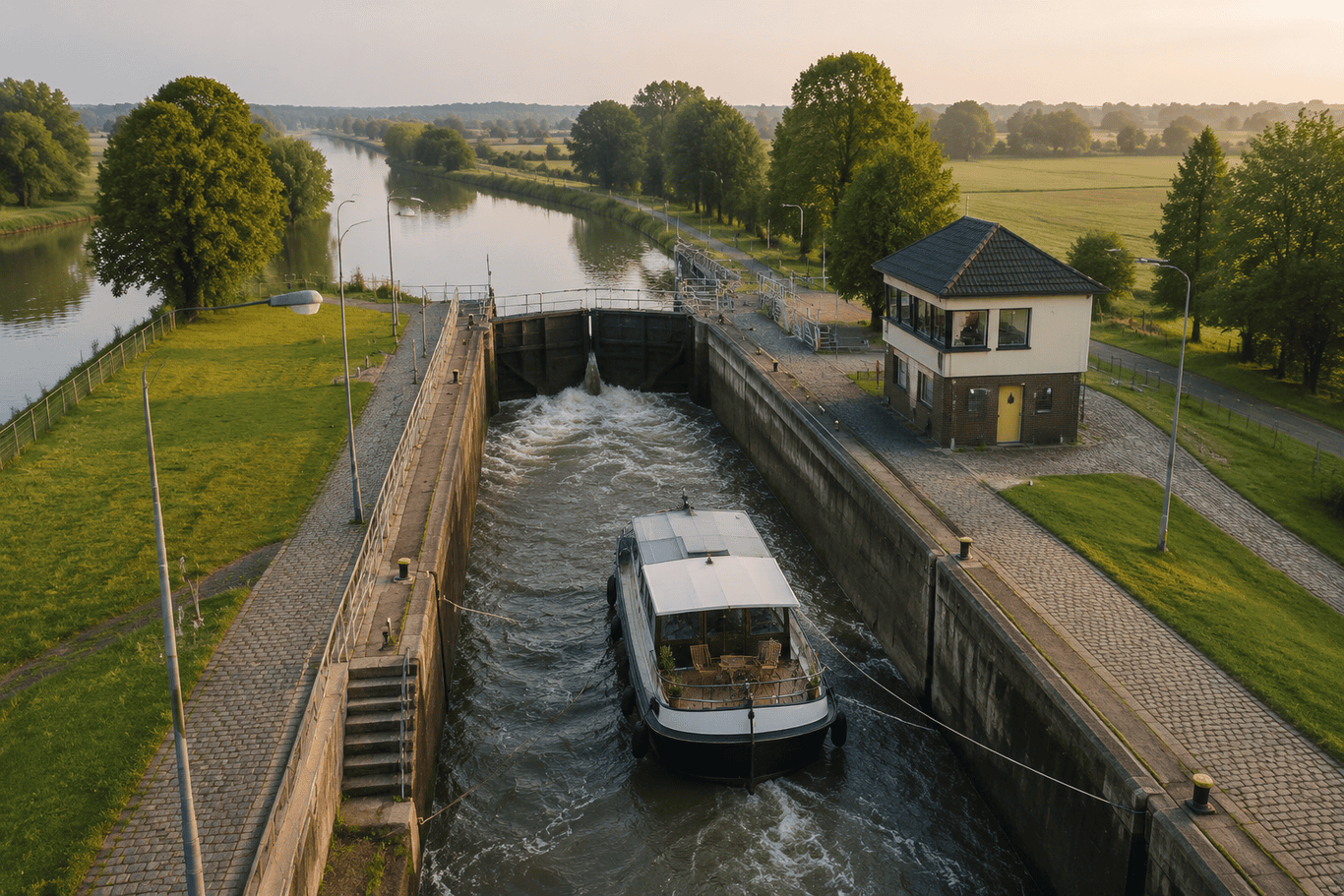
What are locks and how exactly do they work?
A lock is a hydraulic engineering structure that enables ships to overcome height differences in a river or canal. Without locks, many waterways would simply not be navigable, as rivers and canals rarely run at a uniform height.
This is how the principle works:
- Entry: The boat drives into the lock chamber, a kind of watertight corridor made of concrete or stone.
- Gates close: The lock gates close behind the boat.
- Adjust water level: By opening valves (gates), water is directed into the chamber (filling) or drained (emptying).
- New level reached: When the water level matches that of the next canal section, the front gates open.
- Exit: The boat leaves the lock at the new level.
The difference in height that a lock bridges is called lift height. This can range from a few centimeters to several meters, depending on the waterway.
What are the differences between various lock types?
Not all locks are the same. For houseboat novices, it is helpful to know which types they might encounter because the procedure and difficulty level differ.
| Lock type | Features | Beginner suitability |
|---|---|---|
| Manual lock | Operation by lock keeper | Very good |
| Automatic lock | Traffic light or button operation | Good, with instruction |
| Self-service lock | Boat skipper operates everything themselves | Medium |
| Lock or boat lift | Mechanical lift for boats | Rare, well signposted |
| Tidal lock | Dependent on tides | For experienced users only. |
For beginners are manned locks with a lock keeper the most pleasant. He gives signals, explains the process and helps with questions. Automatic locks, as found on many canals in the Netherlands or France, are also easy to master as long as you know the traffic light signals.
What does it cost to pass a houseboat lock?
Lock fees depend heavily on the region and waterway. In Germany, many federal waterways are free for recreational boats, while fees are common in France and the Netherlands.
Rough orientation by region (as of 2026):
- Germany (Federal waterways): Mostly free for recreational boats under a certain length.
- France (Canaux du Midi, Bourgogne): Day passes or week passes via Voies Navigables de France (VNF), approx. 10 to 30 Euros per day depending on boat class.
- Netherlands: Many locks are free, some municipal locks charge small fees (1 to 5 Euros).
- Mecklenburg Lake District: State-owned locks are free for recreational boats.
Tip: When booking via Campcruisers, you will find out directly which lock fees apply to your planned route. This way, there are no nasty surprises.
Which locks are easiest for beginners?
Manned locks on calm inland canals with low lift heights are best suited for newcomers. Routes on the Mecklenburg Lake District, the Burgundy Canal in France, or on Dutch canals are particularly recommended, where lock keepers are often friendly and experienced in dealing with holidaymakers.
Characteristics of a beginner-friendly lock:
- Lift height under 2 meters
- Lock keeper on site
- Clear traffic light signals
- Sufficient space in the chamber
- Floating bollards or mooring hooks on the wall
Who is houseboating with locks suitable for, and who is not?
Houseboating with locks is suitable for everyone who is willing to learn a few basic rules and stay calm when things get a bit hectic. It is not a sport for extreme situations, but neither is it a breeze without any preparation.
Well suited for:
- Families with children from about 8 years old (as active helpers on deck)
- Couples looking for an adventure together
- Groups with a clear division of tasks
- People with experience in sailing or motorboating
Less suitable for:
- People with severe fear of heights (at high lift heights)
- Solo travelers with no boating experience on busy waterways
- Groups that don't manage clear communication on board
Most common mistakes of houseboat newcomers when locking
Locking made easy also means learning from others' mistakes before you make them yourself.
The seven most common beginner mistakes:
- Entering too fast: The approach speed should be below walking speed. Anyone approaching too fast risks collisions with the lock wall.
- Ropes too short or too long: A rope that is too short will break when the water level rises. A rope that is too long will get tangled. Rule of thumb: keep the rope loose and long enough for the full stroke range.
- Forgetting fenders: Fenders (protective cushions) must be deployed before entering, not just in the chamber.
- No communication with the lock keeper: Always pay attention to signals and ask if in doubt before acting.
- Leaving the engine running while locking: Once the boat is safely moored, turn off the engine or put it in neutral to avoid exhaust fumes in the confined chamber.
- Releasing the rope before the gates are open: Patience is important. Only leave when the lock keeper gives the signal.
- Panic in currents in the chamber: Turbulence occurs during filling. Stay calm, hold the rope, stabilize the boat with slight rudder corrections.
How should I behave properly in a lock with other boats?
In a lock, you often share space with other boats. Respect, clear communication, and patience are the most important virtues here.
- Entry order: Whoever waits first, enters first, unless the lock keeper orders otherwise.
- Keep your distance: Maintain at least 1 to 2 meters distance to the neighboring boat.
- Do not cross lines: Each boat secures its own lines to its own bollards.
- Stay calm: No full throttle, no hasty maneuvers. Everyone benefits from a calm process.
- Offer help: Experienced lock users are happy to help newcomers. Don't hesitate to ask.
What equipment do I need for safe lockage?
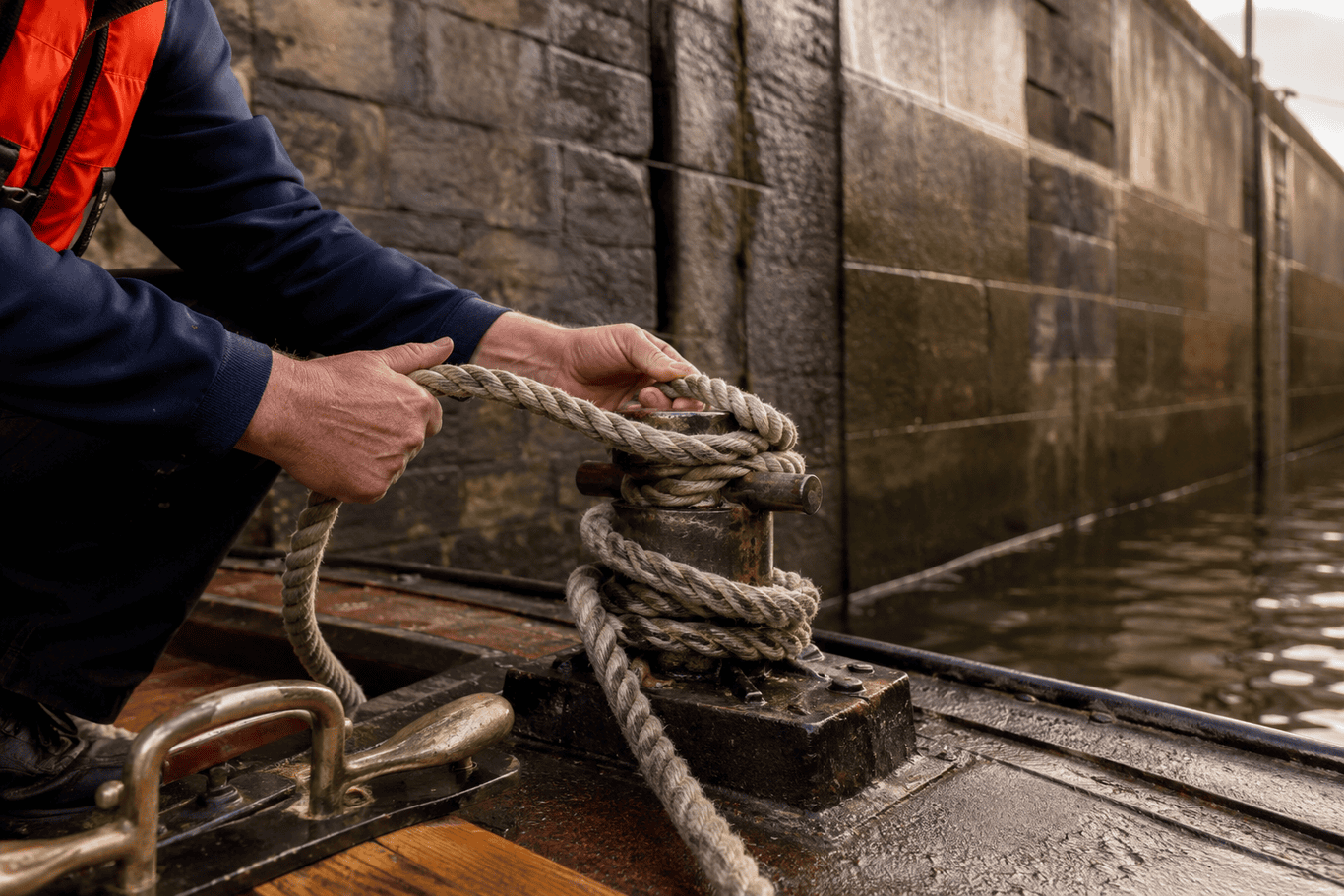
For safe lockage, a manageable basic equipment is sufficient, which is usually already on board most rental boats.
Lock checklist:
- At least 4 fenders of appropriate size
- At least 2 lock lines (each at least 10 meters long)
- Gloves for mooring
- Boat hook (for grabbing bollards or hooks on the lock wall)
- Horn (for communication with the lock keeper)
When booking a houseboat through Campcruisers, this basic equipment is usually included in the rental price. Ask the provider if you are unsure.
What do I need to consider in a lock during strong wind or current?
With wind and current, the difficulty of lockage increases significantly. Those who are familiar with these conditions can react calmly instead of panicking.
- Strong crosswind when entering: Enter slowly and with slight counter-rudder. If necessary, wait briefly until a gust has subsided.
- Current in the chamber: Turbulence occurs during filling or emptying. Hold the rope taut, but not rigid, so the boat can swing slightly.
- Current at the lock exit: Rivers often have a current after the lock. Before exiting, orient yourself briefly in which direction the current is pulling.
- Basic rule in bad weather: When in doubt, wait. No schedule is worth taking a risk.
How long does a typical lockage take?
A typical lock operation takes between 10 and 30 minutes. The exact duration depends on the lift height, the number of boats in the chamber, and the lock's utilization.
- Small lock, low lift height, no rush: approx. 10 to 15 minutes
- Large lock, several boats, waiting time: 30 to 60 minutes
- Automatic lock without attendant: often faster, but dependent on the system
When planning your route, it is advisable to allow at least 30 minutes per lock, including waiting time.
Can I steer a houseboat through a lock by myself?
Yes, that is possible, but requires a little more preparation and a calm approach. Solo skippers must manage both the helm and the ropes, which requires a clear strategy.
Tips for solo travelers:
- Automatic locks are easier than manual ones because no communication with an attendant is necessary.
- Secure the boat to a bollard beforehand, then disembark and tie the rope.
- Choose short, manageable locks, especially at the beginning.
- At manned locks: inform the lock keeper in advance that you are alone. They are usually happy to help.
- Lockage alone is more demanding on busy waterways than on quiet canals.
Frequently asked questions about lockage with a houseboat
Do I need a license for a lock? In Germany, no license is required for houseboats up to a certain size on inland waters. The exact regulations vary depending on the federal state and waterway. When booking through Campcruisers, you will be informed about the requirements for your booked boat.
How do I know if a lock is suitable for my boat? The lock dimensions (length, width, clearance height) are indicated on nautical charts and in guidebooks. Your rental boat has fixed dimensions that you should know before your trip.
What do the red and green lights at a lock mean? Red means: wait, do not enter. Green means: entry permitted. Some locks have additional signals for requesting lockage (e.g., a button or a pull rope).
Am I allowed to leave the engine running in the lock? Technically yes, but out of consideration for other boats and due to exhaust fumes in the narrow chamber, the engine should be in neutral or off as long as the boat is tied up.
What happens if I miss the lock? Nothing serious. Just wait for the next lockage to take place. Manned locks have fixed operating hours, which you should check in advance.
Are locks in operation at night? Most recreational locks have fixed operating hours and are closed at night. Plan your daily stages so that you arrive before closing time.
How should I behave if the boat drifts in the lock? Hold the rope and steer against it with small rudder corrections. Don't panic, the turbulence during filling is normal and subsides quickly.
Can I lock with children? Yes, children are often thrilled by it. Important: Everyone wears life jackets, children remain on deck under supervision during lockage and do not touch ropes unless they are trained to do so.
What happens next: Your first houseboat vacation awaits
Lockage made easy is not a myth, but the result of good preparation. Those who know the basic principles, have the right equipment with them, and stay calm will quickly realize that lockage is one of the most beautiful moments of a houseboat trip. It is the moment when you feel that you are truly part of the waterway.
The first lockage may still feel a bit unusual. The second is already more routine. And from the third one at the latest, you'll smile when you see the green light.
Ready for your houseboat vacation? Book your houseboat now with Campcruisers and start your adventure on the water, with everything you need for relaxed lockage.
Lockage checklist before entering
Meta title: Locks made easy: Guide for houseboat beginners
Meta description: Locks made easy: Our guide for houseboat beginners explains step-by-step how locks work, what they cost, and how to avoid common mistakes.


 English
  German
  Spanish
  Italian
  Polish
  Dutch
Dutch  French
  Danish