
Anyone who has ever traveled through Germany on a houseboat knows this moment: The engine is running on low, the boat rocks gently, and the mighty lock gate slowly closes in front of you. What many travelers initially consider an annoying interruption regularly turns out to be one of the most beautiful moments of the entire vacation. Lock romance is not a cliché, but a real quality of water tourism that you only truly understand when you are in the middle of it.
The most important things at a glance:
- Lock romance describes the special travel experience surrounding passing locks and weirs on inland waterways
- Waiting times at locks usually last between 15 and 60 minutes, depending on lock size and traffic volume
- Passing a lock is easily manageable for beginners with instruction and does not require professional boat licenses for sports boats under certain sizes
- There are over 400 locks on inland waterways in Germany, many of them in visually impressive regions
- Waiting at the weir offers time for conversations, nature observation, and real deceleration
- Typical lock fees for sports boats are between 0 and 20 Euros per passage, often free on certain waterways
- Families with children especially benefit from the experiential quality of a lock passage
- Common mistakes when locking can be easily avoided with a little preparation
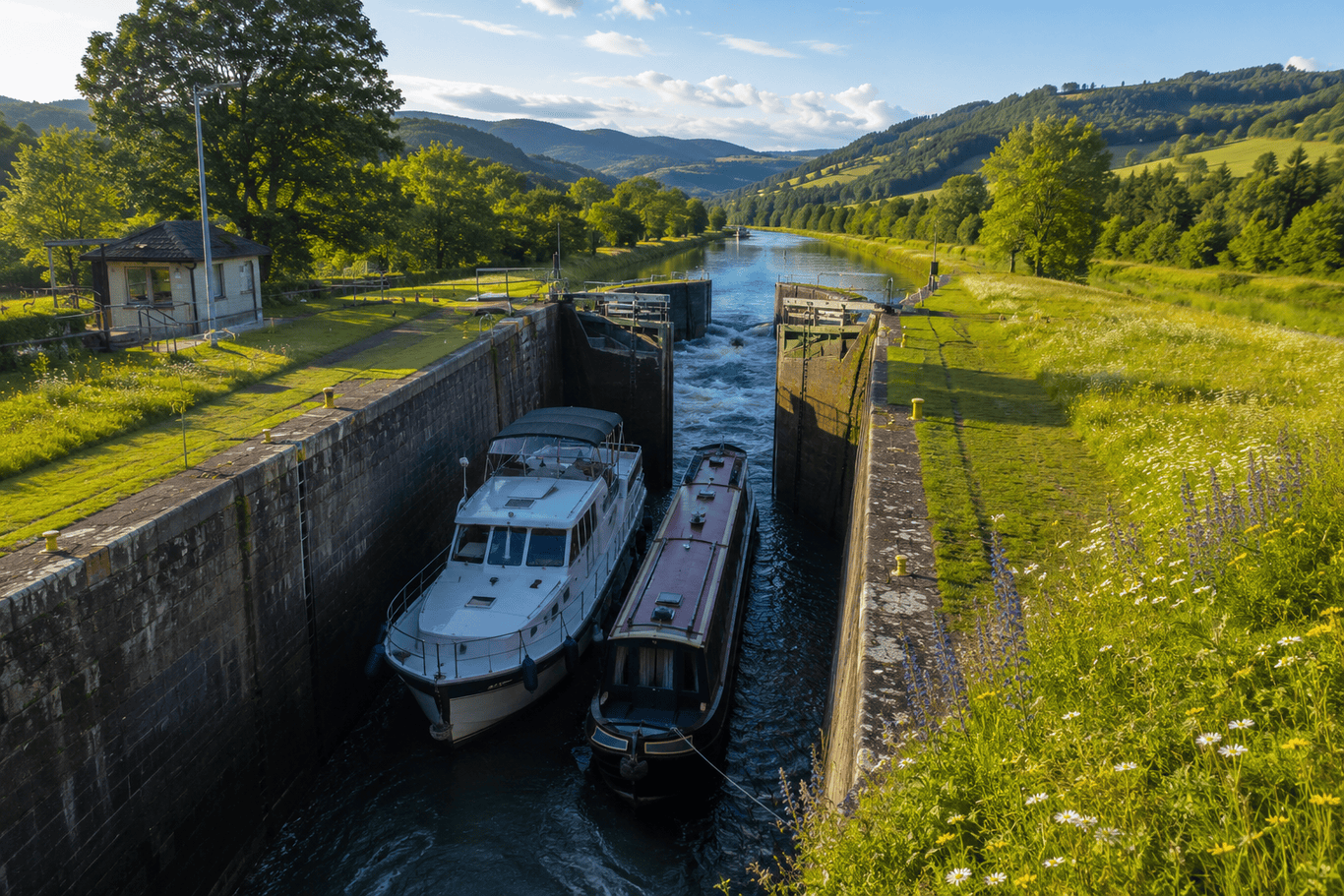
What exactly is lock romance?
Lock romance describes the feeling of deceleration, connection, and adventure that arises when a boat passes through a lock. It's not just about the technical process, but the entire atmosphere: the sound of water flowing into the chamber, the mighty gates made of steel or wood, the view of the lock house, and the often picturesque surroundings.
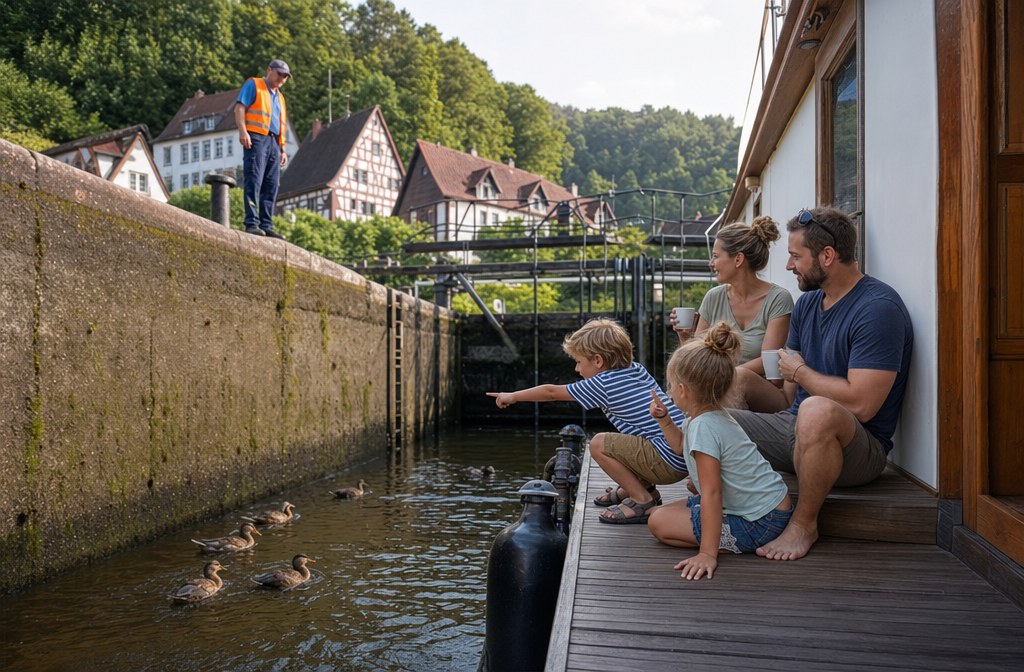
For houseboat travelers, the lock is a natural stopping point that dictates the rhythm of the journey. Instead of highway rest stops, here you'll find towpaths, ducks, lock keepers with local knowledge, and sometimes even a small kiosk. Lock romance is ultimately an invitation to slow down more than you're used to in everyday life.
What makes this moment so special?
- The feeling of being in a different time zone as the lock chamber fills or empties
- Direct contact with lock keepers who often have years of stories about the waterway
- The acoustic backdrop of flowing water, seagulls, and distant church bells
- Sharing the experience with other boaters in the same chamber
How does a lock work and why do you have to wait?
A lock is a hydraulic structure that bridges differences in height between two water levels. Boats enter the chamber, the gates close, and then water is either let in or let out until the boat is at the level of the next canal section. This takes time, and that's precisely the core of lock romance.
The reason for waiting is purely physical: water has to be moved. With a height difference of five meters and a chamber volume of several hundred cubic meters, this simply takes time. In addition, there's entry, mooring, exit, and possibly waiting times if the lock is occupied by traffic from the other side.
Typical procedure for passing through a lock:
- Registration by radio or intercom at the waiting area before the lock
- Entry into the chamber after a signal from the lock keeper
- Mooring to bollards or floating pontoons in the chamber
- Water is let in or out (5 to 20 minutes)
- Signal to exit, release lines, proceed
Which locks in Germany are particularly romantic?
Some of Germany's most beautiful locks are located in regions that are among the most popular houseboat areas anyway. The most romantic experiences arise where technology and nature are particularly close.
Top locks for houseboat travelers:
| Lock | Waterway | Besonderheit |
|---|---|---|
| Eddersheim Lock | Main | Historic lock house, wine region |
| Petershagen Lock | Weser | Idyllic Weser Uplands |
| Strullendorf Lock | Main-Danube Canal | Franconian hill country |
| Lehnitz Lock | Havel | Berlin Lake District, nature reserve |
| Kochendorf Lock | Neckar | Medieval surroundings |
While the Mecklenburg Lake District offers fewer classic locks, it has weirs and passages that provide a similar experience. If you travel along the Havel or the Main, you will notice that each lock has its own character.
What does it cost to pass a lock?
Many locks on German inland waterways are free for pleasure boats and houseboats. On federal waterways operated by the Waterways and Shipping Office (WSA), pleasure boats generally do not incur lockage fees. On some state or municipally operated waterways, fees of between 5 and 20 Euros per lockage may apply.
Anyone booking a houseboat through Campcruisers usually receives all relevant information on lock fees for the respective area directly with the booking. It is worth researching in advance which route contains how many locks in order to plan the trip realistically.
Which boats can go through a lock?
In principle, all boats can pass through a lock as long as they fit into the chamber and do not exceed the permissible dimensions. Houseboats, motorboats, sailboats (with occasionally lowered masts) and canoes are regularly found on German inland waterways.
Keep important dimensions in mind:
- The length and width of the boat must match the chamber size
- Passage height under bridges is often more critical than the lock itself
- Draft must match the water level of the route
Houseboats, such as those bookable through Campcruisers, are specially designed for inland waterways and usually pass through the locks of the respective areas without problems.
What are common mistakes when locking?
Most mistakes when locking happen due to impatience or lack of preparation. Locks are not obstacles, but structured processes that work smoothly with a little attention.
The most common errors:
- Entering too early: Always wait for the lock keeper's signal
- Ropes too short: The chamber changes the water level, the rope must be able to follow
- Entering too fast: Slowly and controlled, never enter the chamber with speed
- Not securing lines: Even short locking times require secured lines
- Forgetting radio: Many locks require advance notification via VHF radio
How long does a typical lockage take?
A typical lockage, including entry, water level change, and exit, takes between 15 and 45 minutes. At busy locks, the waiting time beforehand can be an additional 30 to 60 minutes, especially during the peak season between June and August.
This waiting time is precisely the essence of lockage romance. Those who perceive it as a break rather than a delay have the best experiences. Making coffee, playing cards, observing the surroundings, chatting with the neighboring boat.
Is lockage suitable for beginners?
Yes, absolutely. Anyone renting a houseboat with an introduction usually receives practical training on lockage before the journey begins. Most lock keepers on German waterways are experienced in dealing with holiday boaters and actively assist with mooring.
Beginners should not be intimidated by the lock. The technology is manageable, and the lock keeper gives clear signals. Those who stay calm and drive slowly make very few mistakes.
What happens if you make a mistake during lockage?
Minor mistakes, such as entering too quickly or a poorly placed line, usually result in a friendly correction from the lock keeper. Serious damage to the boat or the lock almost exclusively occurs due to gross negligence or ignoring instructions.
In case of damage to your own boat, the boat insurance, which is usually included in the rental price or can be booked as an option for rented houseboats, will cover it. Damage to the lock itself is rare and is handled by liability insurance in case of doubt.
What legal requirements do I need for a lock?
For recreational boats on German inland waterways: anyone operating a boat with more than 15 HP (11 kW) generally requires the Sportboat License Binnen (SBF Binnen). On some waterways, especially in Mecklenburg-Vorpommern, there are simplified regulations for holiday boats up to a certain engine power.
Anyone booking a houseboat through Campcruisers is clearly informed during the booking process which license is required for the chosen area. Without a valid license, you should not operate a motorized boat on federal waterways.
Are there alternatives to lockage?
On some routes, locks can be bypassed by transfer points or canals, but this is practically irrelevant for houseboats. The alternative would be to choose areas without locks, for example, parts of the Mecklenburg Lake District or certain coastal waters.
However, those who have experienced lockage romance once do not want to miss it anymore. Waiting at the weir is not a disadvantage of water tourism, but one of its most beautiful unique selling points.
How safe is lockage for families?
Locks are very suitable for families as long as basic safety rules are followed. Children should wear life jackets during lockage and should not be on the outer areas of the boat while the chamber is being filled or emptied.
Many families report that the lock is an absolute highlight of the trip for children. Watching the rising or falling water, the large gates, the lock keeper with his hand signals, this is often more exciting for children than any amusement park.
Frequently asked questions
Do I need to book a lock in advance? Yes, many locks on German waterways require advance notification via VHF radio on channel 10 or 22. Some also have intercom systems at the waiting area. The exact requirements are stated in the area guides.
Can I operate a lock alone with a houseboat? This is possible, but challenging. At least a second person on board is recommended to hold lines and help with mooring.
What does "lock free" or "lock occupied" mean? Signal lights at the lock indicate whether the chamber is ready for entry (green) or still occupied (red). Never enter on red.
How many locks can you manage per day? Four to eight locks per day are realistic, depending on the route and waiting times. More than ten locks in one day turns a vacation into work.
Am I allowed to leave the boat during locking? Generally no. While the chamber is being filled or emptied, at least one person should be at the helm or on the lines.
What does a lock on the Main cost? On the Main, as a federal waterway, locks are free for sports boats and houseboats. Fees may only apply on certain side waters or in other federal states.
Can you lock at night? Many locks have fixed operating hours and are closed at night. The exact times vary depending on the lock and season and should be checked before the trip.
What is a lockkeeper and how do I communicate with them? The lockkeeper operates the lock and gives signals by traffic light, hand signals, or radio. Friendliness and patience are the best communication strategy.
Ready for your houseboat vacation?
Lock romance is not accidental. It arises when you consciously embrace the pace of the water, understand the technology, and see breaks not as a loss, but as a gain. Anyone who has stood in a lock chamber while the water slowly rises and the boat lifts understands why houseboat travelers return to the waterways again and again.
Germany's most beautiful locks are waiting to be discovered. And the best way to do that is from the deck of a houseboat, with a cup of coffee in hand and no time pressure in the world.
Ready for your houseboat vacation? Book your houseboat now with Campcruisers and experience lock romance up close.
Lock time calculator for your route
Total lock time:
Of which waiting time:
Of which transit:
 English
  German
  Spanish
  Italian
  Polish
  Dutch
Dutch  French
  Danish