
Around 400,000 recreational boats are out on inland waters in Germany alone, and the number of houseboat vacationers continues to grow every year. What many underestimate: Every trip leaves traces, whether you see them or not. The rules of conduct on the water: Consideration for nature are therefore not bureaucratic red tape, but the difference between an ecosystem that flourishes and one that is slowly tipping over.
The most important things first: Anyone on the water is moving in a sensitive habitat. Driving slowly, keeping a distance from shore zones, not throwing trash into the water, and respecting nature reserves are the four cornerstones of responsible watersports. Those who know and live these rules not only protect nature but also secure the future of water tourism for everyone.
The most important rules of conduct for watersports for environmental protection
The central rules can be divided into four areas: speed, distance, waste, and noise. Anyone who consistently observes these four points covers the majority of all ecological risks.
- Reduce speed: Especially near the shore, in reed zones, and in nature reserves: slower than allowed is almost always better. Wash destroys spawning grounds and erodes bank vegetation.
- Maintain minimum distance from shores: In Germany, many federal states prescribe a minimum distance of 25 to 100 meters from vegetated shore zones. This distance protects breeding birds and amphibians.
- No trash in the water: Plastic, cigarette butts, fishing waste, and food scraps belong in closed containers on board, not overboard.
- Minimize noise: Loud music and unnecessary engine hum disturb wild animals, especially at dusk and during the breeding season from March to July.
- Avoid chemicals: Boat cleaners, antifouling paints and engine oils can get into the water. Biodegradable alternatives are readily available today.
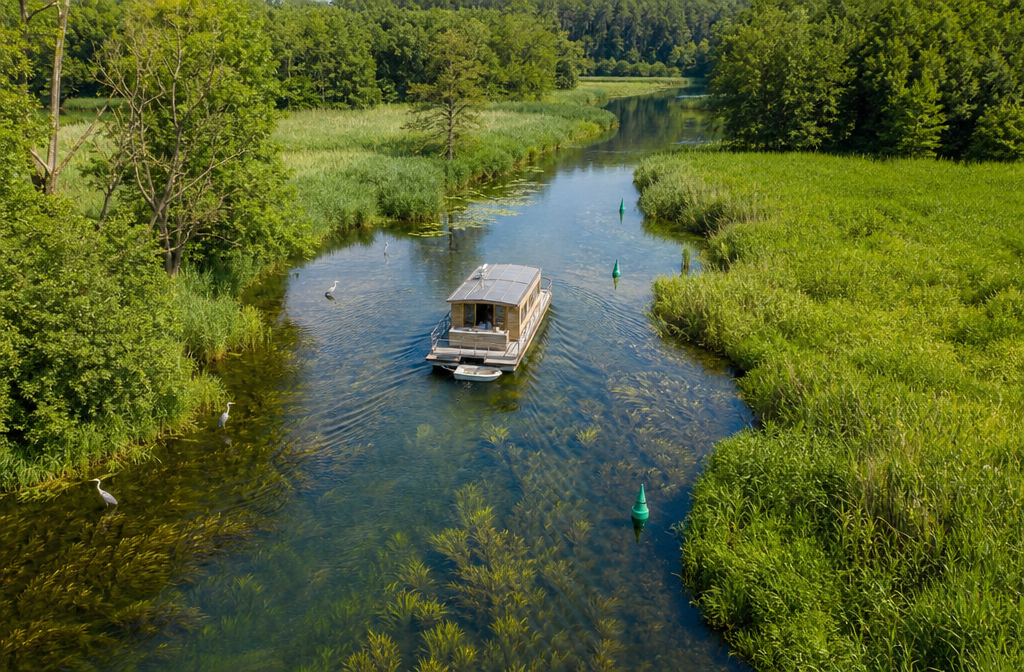
How do I avoid environmental damage when boating?
Environmental damage from boating usually doesn't result from individual dramatic events, but from the sum of small oversights. Those who develop concrete routines avoid most problems from the outset.
Before the trip:
- Check if your route passes through designated nature reserves and download up-to-date charts.
- Check the engine for oil or fuel leaks.
- Pack waste bags, biodegradable cleaning agents, and an oil absorption mat.
While underway:
- Throttle down early before reed and seagrass beds.
- Anchor only on sand or gravel bottoms, never on seagrass meadows or coral reefs.
- Avoid feeding animals. Bread and chips are proven to harm waterfowl.
After the trip:
- Dispose of wastewater and sewage only at approved disposal stations.
- Clean the hull without phosphate-containing agents.
Those who make these steps a habit no longer need a checklist; it becomes automatic at some point.
What impact do motorboats have on water ecology?
Motorboats burden bodies of water on several levels simultaneously. The strongest effect is mechanical: waves and propeller wash erode banks, destroy spawning grounds, and tear aquatic plants from the bottom. In addition, there is noise, exhaust fumes, and the entry of lubricants.
According to the Federal Environment Agency (2022), recreational boats are among the relevant sources of pollutants in heavily trafficked inland lakes, particularly due to two-stroke engines, which can release up to 30 percent of fuel unburned. Modern four-stroke and electric motors significantly reduce this input.
The most important ecological impacts:
| Factor | Impact | Affected species |
|---|---|---|
| Wave action | Bank erosion, spawning ground destruction | Pike, carp, amphibians |
| Engine noise | Stress reactions, flight behavior | Waterfowl, fish |
| Fuel input | Oxygen depletion, algal growth | Entire ecosystem |
| Anchoring on seagrass | Habitat destruction | Microorganisms, fish |
Are there differences between behavior on lakes and seas?
Yes, the differences are considerable. Lakes are closed systems in which pollutants and mechanical disturbances cannot dilute. Seas have larger buffer zones but are more complex due to currents and tides.
On lakes, in particular:
- Speed limits are stricter, often 6 km/h near the shore.
- Nature reserves are more frequent and cover larger areas.
- Nutrient input leads to algal blooms more quickly.
On coastal waters and seas:
- Seagrass meadows and tidal flats are extremely sensitive, anchoring is often forbidden there.
- Seasonal restricted areas protect seals, seabirds, and migratory birds.
- In the Baltic Sea, particularly strict rules apply to wastewater discharge due to the low salinity.
Which water sports are least damaging to nature?
Muscle-powered sports are least damaging to nature. Canoeing, kayaking, stand-up paddling, and rowing produce no motor-driven waves, no fuel input, and minimal noise.
Ranking by environmental impact (low to high):
- Kayaking and canoeing
- Stand-up paddling
- Sailing (without auxiliary engine)
- Electric boats
- Houseboats with modern four-stroke engine
- Motorboats with two-stroke engine
- Jet skis and personal watercraft
Houseboats with electric motors or modern diesel drives fall in the middle range, especially if wastewater is disposed of correctly and speed is consistently reduced.
Typical mistakes by water sports enthusiasts regarding nature conservation
The most common mistakes are not due to bad intentions, but simply a lack of knowledge. Those who know them do not make them.
- Driving too fast near shores: The wave impact is underestimatedly damaging even at moderate speeds.
- Anchoring in seagrass meadows: From above, it looks like free sandy bottom, but it is a protected habitat.
- Feeding wild animals: Bread makes ducks and swans sick and attracts rats.
- Ignoring nature reserve signs: Many water sports enthusiasts do not know the symbols.
- Discharging greywater directly: Even "clean" rinsing water with detergent harms the body of water.
- Noise at dusk: This is exactly when many animals are active and particularly sensitive to disturbance.
How do I protect fish and aquatic animals during my tour?
Fish and aquatic animals are primarily protected by three measures: reduce speed, keep distance, and avoid artificial light at night. Underwater noise from engines disturbs fish orientation and can seriously affect spawning behavior.
Specific protective measures:
- Maintain a distance of at least 50 meters from reed beds, especially from March to July.
- Switch off underwater lighting at night or dim it significantly.
- Avoid sudden engine surges that create pressure waves.
- When fishing: release fish gently, use barbless hooks.
What equipment do I need for environmentally conscious water sports behavior?
The good news: environmentally friendly equipment is affordable today and often more practical at the same time. Basic equipment for responsible boating costs between 50 and 200 Euros in addition to standard equipment.
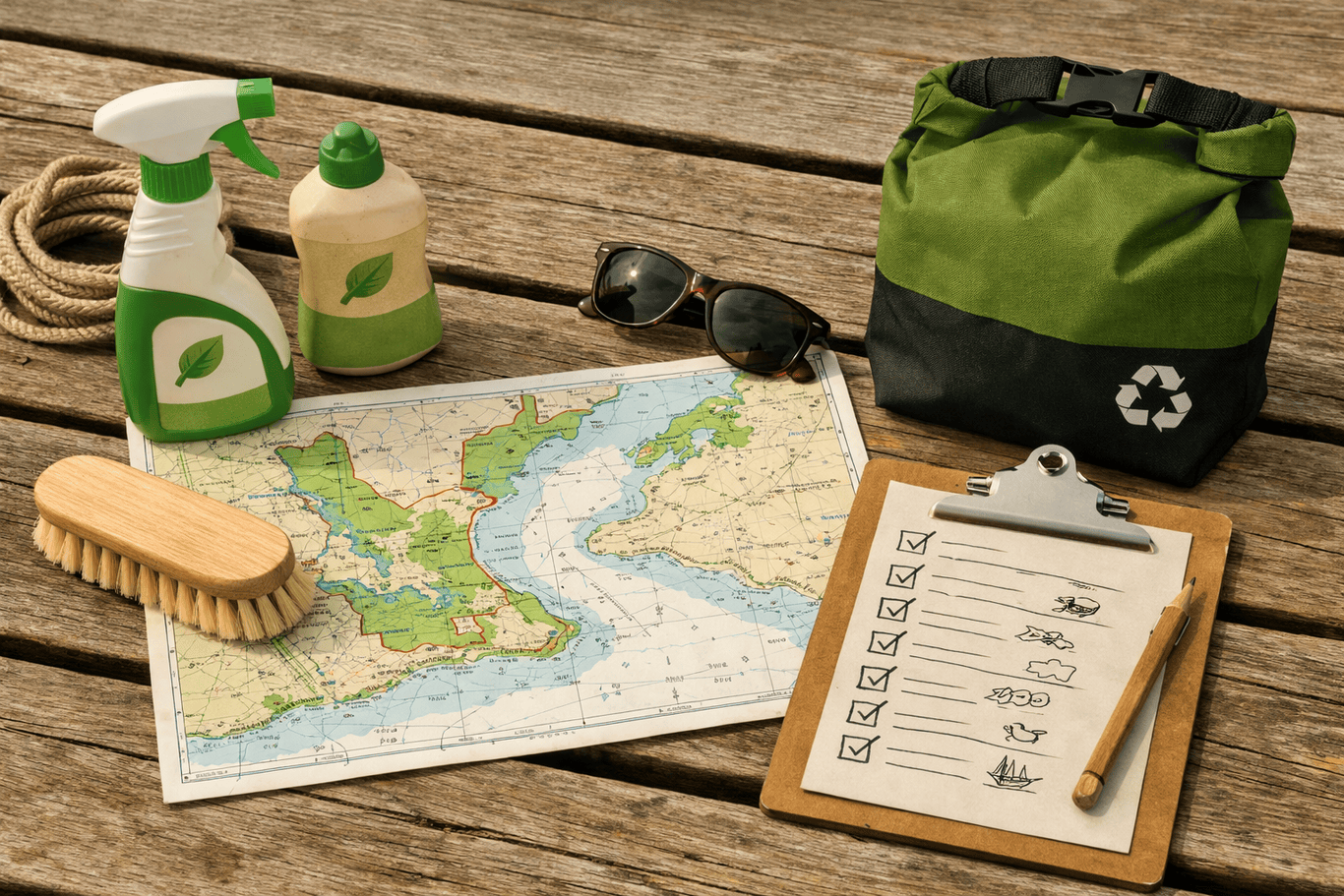
Recommended equipment:
- Biodegradable cleaning and rinsing agents
- Oil absorption mat for the engine compartment
- Closed waste bin with a lid
- Current water charts with designated protected areas (digital or paper)
- Polarized sunglasses (help to recognize underwater vegetation)
- Anchor with chain boom (prevents dragging on the bottom)
For whom are these rules of conduct particularly important?
The rules of conduct on the water: Consideration for nature apply to all water sports enthusiasts, but are particularly relevant for houseboat holidaymakers and charter boaters. These groups spend several days on the water, moor in different places and use waterways more intensively than day-trippers.
Those renting a houseboat for the first time often have no experience with waterway regulations. That's why a brief briefing by the rental company, as Campcruisers offers as standard, is worth its weight in gold. Families with children should also actively discuss the rules, as children often spontaneously want to feed animals or throw stones into the water.
What happens if you violate environmental protection rules on the water?
Violations of environmental protection rules on the water can be expensive. In Germany, fines of between 50 and 50,000 euros can be imposed, depending on the federal state and the severity of the violation. Intentional pollution of waterways is even a criminal offense under Paragraph 324 of the German Criminal Code (StGB), which can be punished by imprisonment.
Common grounds for fines:
- Driving in closed protected areas: 50 to 500 Euros
- Discharging wastewater: up to 5,000 Euros
- Exceeding speed limits: 50 to 250 Euros
- Oil discharge: up to 50,000 Euros, plus liability for cleaning costs
How do I recognize sensitive nature reserves on the water?
Nature reserves on the water are marked by yellow buoys, signs on shore piles, and specific symbols on nautical charts. Those who do not know these signs may unknowingly enter restricted areas.
Identification features:
- Yellow buoys with crossed-out anchor symbol: Anchoring prohibited
- Green signs with bird or fish symbol: Nature reserve, often with time indication
- Red buoys: No-go zone or restriction
- On digital maps (e.g., Navionics): Protected areas marked as colored zones
Recommendation: Check the current edition of the waterway map before each tour, as protected areas can be extended seasonally, especially during the breeding season.
How much does an eco-friendly boat trip cost?
An environmentally friendly boat tour does not cost significantly more than a conventional one. The biggest cost factors are the choice of boat and the equipment. A houseboat with an electric motor is sometimes 10 to 20 percent more expensive in the charter price than a comparable diesel boat, but it saves fuel costs.
Additional costs for environmentally conscious equipment: 50 to 200 euros one-time. Fines for violations, on the other hand, can quickly cost ten times as much. Ecological behavior is therefore not only the right thing to do, but also the cheaper option in the long run.
Frequently Asked Questions
May I anchor on a lake wherever I want? No. In Germany, anchoring outside designated anchorages is prohibited in many waters, especially in nature reserves and over seagrass meadows. Always check the current water charts.
From what speed does damaging wash occur? Already from 6 km/h, wash near the shore can damage spawning grounds. In sensitive zones, the rule is: drive as slowly as possible, not just as slowly as required.
Are electric motors really more environmentally friendly? Yes, significantly. They do not cause fuel pollution, less underwater noise, and no exhaust fumes. For houseboat tours on inland waters, they are the best choice.
What do I do with greywater and blackwater on the houseboat? In Germany, greywater and blackwater must not be discharged directly into the water. Disposal only at approved pump-out stations, which are available at most marinas.
May I feed waterfowl? This is strongly discouraged. Bread and human food harm waterfowl and promote overpopulation, which puts a strain on the ecosystem.
How do I know if I am in a nature reserve? Yellow buoys, signs on shore posts, and colored zones on nautical charts indicate protected areas. Digital map apps show these zones in real-time.
Do I as a houseboat renter have to complete special training? In Germany, no license is required for houseboats up to a certain size. However, an introduction by the rental company is mandatory and usually includes information on environmental protection rules.
What do I do if I discover an oil spill on the water? Immediately inform the responsible water police or the emergency number 110/112. Do not try to clean up the spill yourself.
This is how it continues: consideration as a travel attitude
The rules of conduct on the water: consideration for nature are not a restriction, they are the framework that makes water tourism possible in the long term at all. Those who drive slowly, keep their distance, dispose of waste properly, and respect protected areas experience not less, but more: calmer waters, more wildlife, untouched riverbanks.
The next step is simple: Before booking, look at the water map of the planned route, mark protected areas and pack a small environmental kit. This takes an hour and makes a difference.
Ready for your houseboat vacation? Book your houseboat now with Campcruisers and experience how beautiful responsible travel on the water can be.
How environmentally conscious is your boat tour?
1. How far do you keep from overgrown banks?
2. Where does waste go on your tour?
3. Do you check protected areas before the trip?
4. Do you feed waterfowl or fish?
5. What is your annual budget for environmentally friendly boat maintenance?


 English
  German
  Spanish
  Italian
  Polish
  Dutch
Dutch  French
  Danish