
Australia has more than 500,000 kilometres of signposted roads, many of which lead through landscapes that you simply cannot reach by bus or plane. Anyone who wants to explore Down Under with the camper and experience Australia up close gets a freedom that no hotel in the world can offer: wake up by the sea in the morning, drive through the rainforest at midday, sleep under the Southern Cross in the evening.
What you should know at a glance:
- A campervan road trip in Australia realistically costs between 80 and 200 AUD per day, depending on the type of vehicle and the season.
- The East Coast (Sydney to Cairns) is the best beginner route, well developed and with many campsites.
- Camping in the Outback is possible, but dangerous without preparation, especially in the Australian summer.
- The best time to travel for most regions is April to October (Australian autumn/winter).
- Wild camping is legal in Australia in designated areas, but not freely accessible everywhere.
- Families, couples and solo backpackers will each find suitable campervan options.
- Offline navigation and an Australian SIM card are not a luxury, but a must.
- Typical mistakes made by German campers: Underestimating distances, no water reserve, incorrect insurance cover.
- Campcruisers has an extensive range of rental vehicles from various professional campervan rental companies in Australia.
- Booking early is worthwhile, especially for the period from June to August.
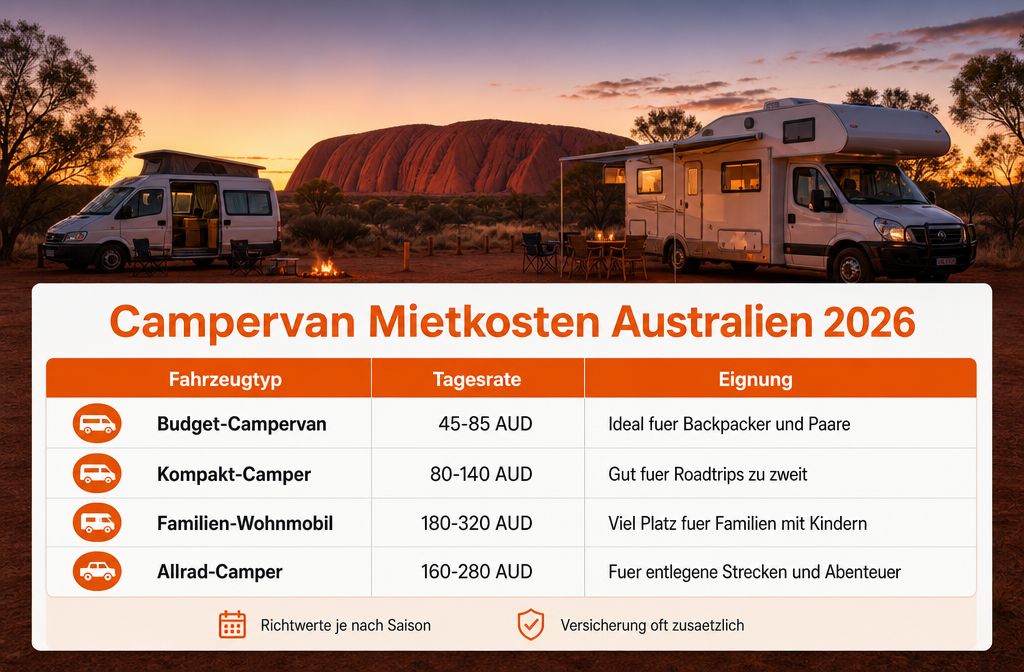
What does a camper road trip in Australia really cost?
A realistic budget for a campervan road trip in Australia is 80 to 200 AUD per day for the vehicle alone, plus living expenses. Backpacker campervans (simple 2-person vehicles without shower) are available from approx. 50–80 AUD per day, fully equipped motorhomes for families cost 150–250 AUD and more.
In addition to that:
- Fuel: Petrol and diesel cost different amounts in Australia depending on the region and year; in the Outback, the price can be significantly higher than in the city. Roughly plan 20–40 AUD per 100 km for a campervan.
- Camping fees: Free spaces (Free Camps) exist, official campgrounds cost 10–45 AUD per night.
- Food: Self-catering in the camper saves a lot, calculate with 20–40 AUD per person per day.
- Insurance: Many rental companies offer basic insurance, but the excess can be several thousand AUD. A reduction to zero costs extra.
Decision rule: Anyone travelling for 4 weeks and travelling as a couple should expect a total budget of at least 5,000–7,000 AUD, without flights. If you are on a tight budget, choose a simple backpacker van and consistently use Free Camps.
Which campervan routes are the best for beginners?
For first-time campers in Australia, the East Coast from Sydney to Cairns is by far the most recommendable route. The roads are well developed, campsites are densely populated, and the route can be flexibly designed in 2–6 weeks.
Overview of recommended beginner routes:
| Route | Länge (ca.) | Dauer | Schwierigkeit |
|---|---|---|---|
| Sydney → Byron Bay | 800 km | 5–7 Tage | Very easy |
| Sydney → Cairns (East Coast) | 2,800 km | 3–6 weeks | Easy |
| Melbourne → Adelaide (Great Ocean Road) | 900 km | 7–10 days | Easy |
| Perth → Broome (West Coast) | 2,200 km | 2–4 weeks | Medium |
| Darwin → Alice Springs (Stuart Highway) | 1,500 km | 7–14 days | Challenging |
For advanced drivers the Gibb River Road in Western Australia or the Oodnadatta Track are worthwhile, but these tracks require a 4WD vehicle and significantly more preparation.
How safe is camping in Australia's Outback?
Camping in the Outback is safe with proper preparation, but the risks are real and should not be underestimated. Heat, lack of water and lack of mobile phone coverage are the biggest dangers, not wild animals.
Safety checklist for the Outback:
- At least 10 litres of water per person per day carry, plus reserve.
- Leave your itinerary with a trusted person or the local Visitor Centre.
- Satellite Communicator (e.g. Garmin inReach) take with you, no mobile network in the Outback.
- Check the vehicle for Outback suitability: spare tyres (better two), sand ladders, tools.
- Never drive or hike in extreme heat (over 40°C).
- Only drive on roads with „4WD only“ signs with a suitable vehicle.
Common mistake: German travellers underestimate the distances between petrol stations in the Outback. On the Stuart Highway, distances can be 250 km or more.
What do I need to consider when renting a campervan in Australia?
When renting a campervan in Australia, four points are crucial: vehicle type, insurance, mileage and booking time. If you misjudge these, you'll pay extra or end up with an unsuitable vehicle.
What you should pay attention to:
- Minimum age: Most rental companies require 21 years, some 25 years for larger vehicles.
- Driving licence: A German driving licence is recognised in Australia, an English translation or an international driving licence is still recommended.
- Insurance excess: The standard excess is 3,000–7,500 AUD. A reduction to zero is possible, but costs an extra 20–40 AUD per day.
- Mileage regulations: Many offers have unlimited mileage, some have daily limits. Be sure to check.
- One-way rental: Sydney → Cairns or Melbourne → Sydney as one-way is often possible, sometimes even cheaper than a return trip.
Campcruisers is a platform specialising in Australia road trips, offering various vehicle categories and assisting with route planning. First-time bookers should look directly there for packages with included insurance reduction.
Are there cheap camper options for backpackers?
Yes, the Australian campervan rental market has a broad entry-level segment for backpackers. The cheapest options are so-called Backpacker-Campervans, i.e. converted minibuses or simple vans with a sleeping area, cool box and camping stove, but without a fixed bathroom.
Options for tight budgets:
- Budget campervan (2 people): 50–80 AUD/day, no shower, campsite toilet facilities necessary.
- Campervan with wet cell: 90–130 AUD/day, for more comfort and flexibility.
- Buy a used van: Buy in Australia, sell again after the trip. Works well for stays of 3+ months, but requires time and research.
Tip: For backpacking trips of 4–12 weeks, renting through Campcruisers is often cheaper and less stressful than buying a van, because insurance and breakdown assistance are already included.
Which time of year is best for a campervan trip in Australia?
The best time to travel depends on the region, but as a rule of thumb: April to October is ideal for most parts of Australia. During this time it is mild in the south and dry in the north.
| Region | Best time to travel | Avoid |
|---|---|---|
| East Coast (Sydney–Cairns) | April–October | Dec–Feb (heat, cyclones in the north) |
| Outback (Red Centre) | May–September | Nov–Mar (extreme heat) |
| West Coast (Perth–Broome) | April–October | Nov–Mar (cyclone season in the north) |
| Tasmania | November–March | June–August (cold, stormy) |
| Tropical North (Darwin) | May–October (dry season) | Nov–April (monsoon) |
High season in Australia is June to August (Australian winter), when prices rise and popular campsites are booked up early. Anyone travelling during this time should 3–6 months in advance book.
What are typical mistakes that German campervanners make in Australia?
The most common mistake is underestimating distances. Australia is almost as big as Europe, and what looks like „a day trip“ on the map can mean 600 km.
Other typical mistakes:
- Allowing too little time: Many book 2 weeks for the east coast, but need at least 3–4 weeks to avoid just rushing through.
- No water reserve: Particularly dangerous in the Outback.
- Wrong insurance: Some German travel insurances do not cover campervan damage. Always read the small print.
- Campsite not booked: In high season, popular parks such as Purnululu National Park are booked up weeks in advance.
- Forgetting to drive on the left: The first few days are challenging, especially at junctions and when overtaking.
- No offline maps: In areas without mobile network, Google Maps is useless without prior download.
How does wild camping work legally in Australia?
Wild camping (often called „Free Camping“ in Australia) is legal on designated public land, not on private land or in national parks without permission. There is a well-developed network of free campsites that can be found via apps such as WikiCamps Australia or Campermate.
Where is Free Camping allowed?
- On designated „Rest Areas“ and „Roadside Stops“ on highways.
- In certain State Forests and Crown Land areas (varies by state).
- In areas explicitly designated as "Free Camp" or "Self-Contained Area".
Where is it prohibited?
- In National Parks without a booked campsite.
- On private property without permission.
- In many urban areas and coastal towns.
Self-Contained Certification: Some regions only allow free camping for vehicles with their own wastewater tank and toilet. Campcruisers vehicles are equipped and certified accordingly, which gives more freedom in choosing a location.
What equipment should I pack for a camper trip?
A well-equipped campervan comes with basic equipment, but you should bring some things yourself or buy them locally.
Essential extras:
- Satellite Communicator for Outback trips (e.g. Garmin inReach Mini)
- First aid kit (Australian pharmacies have good kits)
- Sun protection SPF 50+ and insect repellent (containing DEET against mosquitoes and sandflies)
- Camping chairs and a small table (often not included in the rental vehicle)
- Water canister (10–20 litres extra)
- Power bank and solar charging station for devices
- Offline maps on your smartphone (Maps.me or Google Maps offline)
You don't need to bring: Sleeping bags (bed linen usually included), cookware (usually included), camping gas (provided on site or bought cheaply).
Which campsites are the most beautiful along the east coast?
The east coast has some of Australia's most famous campsites, from wild beach camps to fully equipped resorts. Particularly recommended are:
- Noosa North Shore (Queensland): Directly on the beach, only accessible by ferry, 4WD recommended.
- Cape Tribulation (Queensland): Rainforest meets coral sea, breathtaking scenery.
- Byron Bay Hinterland Campgrounds: Relaxed atmosphere, popular with backpackers.
- Murramarang National Park (NSW): Kangaroos at the campsite, directly by the sea.
- Airlie Beach (Queensland): Starting point for Whitsunday excursions, well-equipped campgrounds.
Booking: Campsites in national parks are booked via the respective State Park websites (e.g. Queensland Parks, NSW National Parks). Book early, especially for public holidays and school holidays.
Are campervans suitable for families or just for singles?
Campervans are explicitly suitable for families, as long as the vehicle is the right size for the group. For families with children, vehicles from 6 metres in length with a fixed double bed and separate sleeping areas are recommended.
Family checklist:
- Choose a vehicle with at least 4 berths.
- Pay attention to child safety belts and child seat compatibility.
- A fridge (not just a cool box) for storing food is important when travelling with children.
- A fixed shower and toilet in the vehicle make everyday life much easier.
- Check campsites with a playground and pool beforehand (many Australian Holiday Parks have both).
Campcruisers offers family vehicles with appropriate equipment, including child seat attachments and larger water capacities.
How can I ensure internet and navigation in the camper on the road?
Offline navigation and a local SIM card are the two most important technical measures for a stress-free Australia road trip. In many rural areas there is no mobile network, so preparation is crucial.
Practical solution:
- Australian SIM card Buy directly at the airport (Telstra has the best network in the Outback, Optus and Vodafone are cheaper, but with poorer coverage outside the cities).
- Offline maps Download before departure: Google Maps (for cities and main roads) and Maps.me or Gaia GPS (for Outback tracks).
- WikiCamps Australia App: Displays campsites, free camps and petrol stations even offline, indispensable.
- Satellite Communicator: Indispensable for Outback trips, enables emergency calls and message exchange without a mobile network.
Tip: Telstra prepaid SIMs with large data volumes cost approximately AUD 30–50 for 28 days and cover most inhabited regions.
Frequently asked questions about camper road trips in Australia
Do I need an international driving permit for Australia?
A valid German driving licence is recognised in Australia. An international driving permit is not mandatory, but recommended as it contains an official English translation and avoids misunderstandings with authorities.
How far in advance should I book a campervan?
In high season (June–August) at least 3–6 months in advance. In low season, 4–8 weeks lead time is often sufficient.
Am I allowed to drive on Outback tracks with a normal campervan?
Not all Outback tracks are suitable for normal campervans. Many unpaved tracks require a 4WD vehicle. Some rental companies contractually exclude driving on unpaved roads, which can invalidate the insurance.
How does waste water disposal work in the camper?
Grey water (dishwater) may be disposed of at designated disposal stations in campsites. Black water (toilet) only at special Dump Points, which can be found via the WikiCamps App.
Is Australia with a camper more expensive than with a hostel?
When travelling as a couple or in a group, the campervan is often cheaper than a hostel plus a rental car because accommodation and transport are combined. For solo backpackers, the hostel is usually cheaper.
Which animals do I need to watch out for in the camper?
Kangaroos are the biggest danger on the roads, especially at dusk. Avoid driving at night if possible. Snakes and spiders can occur in warm camping areas, always shake shoes and keep tents closed.
Can I take a campervan to Tasmania?
Yes, by ferry (Spirit of Tasmania) from Melbourne to Devonport. The crossing takes approximately 9–10 hours, vehicle spaces must be booked separately.
What happens if the campervan breaks down?
Reputable rental companies like Campcruisers offer 24/7 breakdown assistance. In the Outback, the waiting time can be long, so a Satellite Communicator is also useful.
Experience Australia up close, but start prepared
Exploring Down Under with a camper and experiencing Australia up close is one of the most rewarding forms of travel, but only if the planning is right. Anyone who realistically assesses distances, chooses the right time of year, carefully selects the vehicle and technically secures themselves will experience a trip that no package deal can replace.
Concrete next steps:
- Define route and travel period (East Coast for beginners, Outback for experienced).
- Book campervan early via Campcruisers, compare insurance options.
- Organise Australian Telstra SIM and offline maps before departure.
- Download WikiCamps Australia App and pre-book first campsites.
- Borrow or buy a Satellite Communicator for Outback stages.
- Leave itinerary with a person you trust and keep in regular contact.
Australia awaits with more than 500,000 kilometres of road, and most of it is only seen from the driver's seat of a campervan.


 English
  German
  Spanish
  Italian
  Polish
  Dutch
Dutch  French
  Danish