
Quick answer: The best camping axe for splitting firewood for the campfire is a compact splitting maul axe with a head weight between 800 g and 1.2 kg, a handle made of hickory or fiberglass, and a wedge-shaped blade. For most campers and RV travelers, the Fiskars X11 or a comparable axe in this weight class is the ideal compromise between impact power and portability.
The most important things at a glance:
- For campfire wood, a compact splitting axe with a head weight of 800–1,200 g is perfectly adequate.
- Hickory handles dampen vibrations better than plastic, fibreglass is more shatter-resistant and requires less maintenance.
- Beginners should start with a longer handle (40–50 cm) because the leverage makes the technique easier.
- Cheap axes under €30 often have poor blade heat treatment – it's not worth it.
- The €50–100 price segment offers the best value for money for occasional campers.
- Professionals swear by Gransfors Bruks and Hultafors, but Fiskars offers hardly worse results for recreational users.
- Regular sharpening and oiling of the blade doubles the life of an axe.
- When splitting wood, always work with a safe distance and a stable surface – a chopping block is a must.
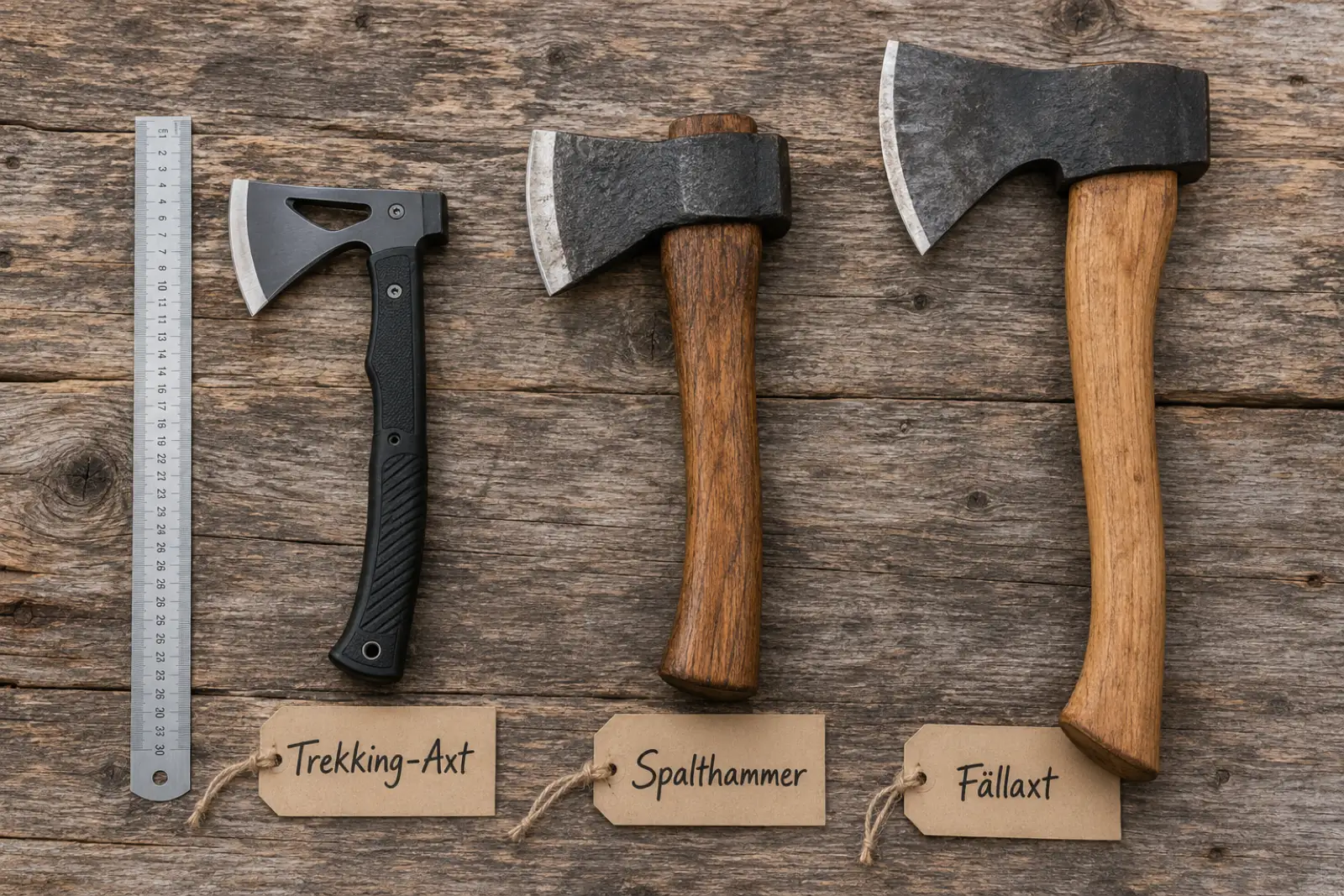
What makes a good camping axe?
A good camping axe for splitting firewood for the campfire needs three things: the right blade geometry, a balanced weight and a non-slip handle. Everything else is secondary.
Blade geometry: For splitting, you need a wide, wedge-shaped grind that drives the wood apart instead of cutting it. A thin cutting geometry (like with felling axes) gets stuck in the wood.
Weight and balance:
- Too light (under 600 g): You have to make too many strikes, which quickly leads to fatigue.
- Too heavy (over 1.5 kg): Impractical for short camping trips and a problem during transport.
- Ideal: 800 g to 1.2 kg head weight.
Handle material comparison:
| Material | Advantages | Disadvantages |
|---|---|---|
| Hickory | Vibration damping, tradition, repairable | Can break, needs maintenance |
| Fibreglass | Shatter-resistant, low-maintenance | More vibration, not repairable |
| Plastic | Cheap, lightweight | Short lifespan, poor feel |
Decision rule: If you rarely use the axe and don't want to bother with maintenance, choose fibreglass. If you camp regularly and value feel, go for hickory.
How much should I pay for a camping axe?
For a solid camping axe for splitting wood, 50 to 100 euros is the realistic entry into reasonable quality. Below 30 euros, the heat treatment of the blade is often inadequate, which means that the cutting edge quickly becomes blunt or breaks.
Price segments at a glance:
- Under €30: Only for occasional use, short lifespan, often poor workmanship.
- 30–60 €: Fiskars segment, solid for recreational campers, good value for money.
- 60–120 €: Hultafors, Husqvarna – professional quality for regular use.
- Over €150: Gransfors Bruks, Wetterlings – hand-forged axes with a lifetime guarantee.
Common mistake: Buying the most expensive axe, but then never sharpening or maintaining it. A 60-euro axe that is regularly maintained beats a 200-euro axe that is neglected.
Which camping axe is best for beginners?
Beginners benefit most from an axe with a longer handle (40–50 cm), medium weight and a clearly defined striking zone. The Fiskars X11 (head weight approx. 1 kg, handle length 45 cm) is considered the standard recommendation for beginners in 2026 because it is forgiving to handle and inexpensive to purchase.
What beginners should pay particular attention to:
- Choose a handle with finger grooves or a rubber grip that won't slip even when wet.
- Don't buy too short „Hatchet“ axes – they require more precision and are more prone to errors.
- Practise with dry, split logs before moving on to green or knotty wood.
Decision rule: If you've never used an axe before, choose an axe with a 45 cm handle and a maximum head weight of 1 kg – this gives enough leverage without losing control.
Difference between a splitting axe and a trekking axe
A splitting axe has a wide, wedge-shaped head that drives wood fibres apart. A trekking axe (also hatchet or hand axe) is lighter, narrower and designed for felling and chopping, not primarily for splitting.
For the campfire, the splitting axe is clearly superior because campfire wood is typically split into logs, not felled. However, if you are travelling on foot and need to save weight, take a trekking axe and accept that splitting requires more effort.
Brief comparison:
| Property | Splitting axe-hammer | Trekking axe / hatchet |
|---|---|---|
| Blade shape | Wide, wedge-shaped | Narrow, thin |
| Weight | 800 g – 1.5 kg | 400 – 700 g |
| Ideal for | Splitting firewood | Chopping branches, tent peg |
| Transport | Rucksack, campervan | Rucksack, belt |
Can a camping axe be used for other tasks?
Yes, but with limitations. A compact splitting axe-hammer can shorten branches, drive in tent pegs and carry out emergency work in the forest. However, it is unsuitable for precise felling or carving.
Campervan travellers who rent a vehicle via CampCruisers and want to make spontaneous campfires are best served with a multi-purpose axe in the medium weight range. They don't need a specialised felling axe, but a pure trekking axe is frustratingly inefficient when splitting.
Which camping axe is the easiest to transport?
For maximum portability, axes with handle lengths under 40 cm and a weight under 700 g are recommended. Classics include the Gransfors Bruks Small Forest Axe (approx. 600 g) or the Fiskars X7 (approx. 1.1 kg total).
Tips for transport:
- Always transport with a protective cover (Axe Mask) – protects the blade and prevents injury.
- When in a campervan, it is best to store it in a tool compartment or external storage space, not loose in the vehicle.
- When flying: axes must be transported in checked baggage (IATA regulations).
What are typical mistakes when splitting wood with an axe?
The most common mistake is splitting without a stable surface. Anyone splitting directly on the ground runs the risk of the axe slipping or the wood rolling away.
The five most common mistakes:
- No chopping block: Splitting wood on the ground is dangerous and inefficient.
- Incorrect swing path: The axe must hit vertically, not at an angle.
- Too wet or too green wood: Freshly cut wood is difficult to split; dry wood is much easier.
- Knotty wood without preparation: Always avoid knots laterally or split the wood at the edges first.
- Blunt blade: A blunt axe bounces off instead of penetrating – increased risk of injury.
Are expensive axes really better than cheap ones?
In the segment above 80 euros, yes, below that not necessarily. The main difference lies in the steel quality and the heat treatment of the blade. High-quality axes (Gransfors Bruks, Hultafors) hold their sharpness longer, are forged more evenly and have better balance.
For someone who camps three times a year, a Fiskars axe for 50–60 euros is perfectly adequate. Anyone who splits wood several times a month or uses the axe professionally will benefit from the durability of a premium axe.
Decision rule: Under 5 camping trips per year → mid-range (€50–80). Over 10 trips or regular use → premium (€100–200).
Which camping axe do professionals recommend for splitting wood?
Forestry professionals and experienced campers regularly mention three models: Gransfors Bruks Splitting Maul (for a lot of wood), Hultafors Outdoor Axe (all-rounder) and Fiskars X11 (best value for money). The best camping axe for splitting wood for a campfire ultimately depends on the usage profile.
Top recommendations by category:
- Best value for money: Fiskars X11
- Best premium axe: Gransfors Bruks Splitting Axe
- Lightest transport axe: Gransfors Bruks Small Forest Axe
- Best beginner axe: Husqvarna Kompakthacke
How do I properly care for and sharpen my camping axe?
A camping axe should be cleaned and dried after each use and re-sharpened if necessary. If you do this consistently, you will enjoy a good axe for decades.
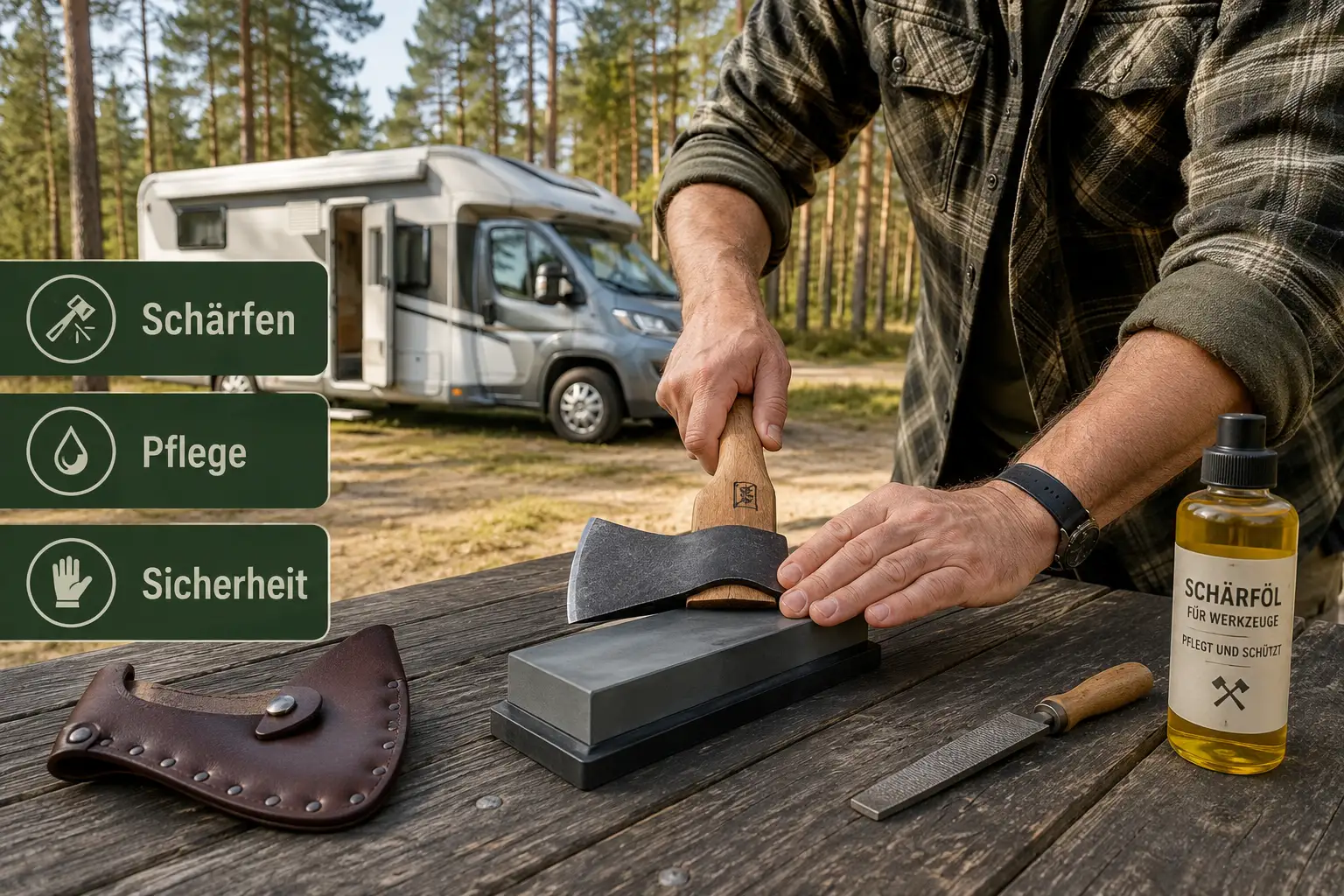
Step-by-step care routine:
- Wipe the blade with a dry cloth and dissolve resin residue with a little oil.
- Check the blade and handle for damage.
- Re-sharpen the cutting edge with a sharpening stone (grit 200–400), keeping the angles even (approx. 20–25 degrees per side).
- Rub the blade thinly with linseed oil or gun oil to prevent rust.
- Treat the wooden handle (if present) with linseed oil, especially the head end.
- Store with a protective cover, dry and not in direct sunlight.
Sharpening interval: With regular use every 5–10 splitting sessions, with occasional use once per season.
What safety equipment do I need when splitting wood?
At the very least, cut-resistant gloves and sturdy footwear with steel toe caps are mandatory when splitting wood. If you split regularly, you should also wear a cut-resistant apron.
Safety checklist:
- ✅ Cut protection gloves (class 1 or higher)
- ✅ Closed shoes, ideally with steel toe cap
- ✅ Stable chopping block (at least 30 cm diameter, 30 cm height)
- ✅ Safe distance: No one within 3 metres when striking
- ✅ Always transport the blade with a protective cover
What to do if the camping axe doesn't penetrate the wood properly?
If the axe gets stuck or bounces, it's almost always due to one of three problems: blunt blade, wrong striking angle or unsuitable wood. The solution is correspondingly simple.
Diagnosis and solution:
- Axe bounces: Blade is blunt → re-sharpen.
- Axe is stuck in the wood: Blade geometry too thin or wood too green → loosen the axe by turning it, use dry wood or take a splitting hammer.
- Wood does not splinter: Knotty wood → start at the edges, not in the middle.
- Strike hits at an angle: Check swing technique, strike more slowly and in a more controlled manner.
Tip: If you have stubborn logs, place the axe on the log and strike both together on the chopping block – this works particularly well with knotty pieces.
Frequently Asked Questions
What axe size is most practical for a campervan? An axe with a handle length of 40–50 cm fits into most external storage compartments of a campervan and is at the same time effective enough for firewood. Models such as the Fiskars X11 or Husqvarna Kompakthacke are ideal for this.
Can I bring a camping axe in the CampCruisers campervan rental vehicle? Yes, personal camping equipment such as axes can be brought along. The axe must be stored safely, always with a protective cover, and must not endanger other objects or people.
How do I know if my axe is sharp enough? The simplest test: Place the blade lightly on your fingernail (without pressure). If it catches, it is sharp. If it slips off, it needs to be re-sharpened.
Is an axe or a saw better for a campfire? For splitting already sawn wood, the axe is superior. For shortening branches and trunks, a folding or bow saw is more efficient. Many campers take both with them.
How long does a good camping axe last? An axe in the segment above 60 euros lasts easily 20–30 years with regular care. Gransfors Bruks axes are sometimes passed down through generations.
Do I have to sharpen the axe after every camping trip? Not necessarily. After a weekend with normal use, it is sufficient to clean and oil the blade. Re-sharpening is only necessary if the nail test shows that the cutting edge has become blunt.
What is the difference between sharpening and grinding? Sharpening (with a sharpening stone or file) removes little material and keeps the cutting edge sharp. Grinding (with a grinding machine) reshapes the blade and is only necessary in the event of severe damage.
Can a broken axe blade be repaired? Smaller chips can be repaired with a file or a coarse sharpening stone. Larger cracks or breaks mean that the axe needs to be replaced – a broken blade is a serious safety risk.
So you can find the right axe for your next camping trip
The best camping axe for splitting firewood for a campfire is not a universal answer, but a question of the usage profile. If you rarely camp and have little luggage, a light Fiskars axe for 50–60 euros is the best option. If you are on the road regularly, you should invest in a Hultafors or Gransfors Bruks – the price difference pays for itself over the years.
Concrete next steps:
- Estimate usage frequency: How often per year will the axe actually be used?
- Clarify the transport route: Rucksack, motorhome or car determines the acceptable size.
- Set a budget: Less than 10 trips per year → £40-£70. More → £80-£170.
- Sharpen the axe before the first use – many axes come from the factory only roughly sharpened.
- Get a chopping block before the first blow falls.
Anyone who rents a motorhome via CampCruisers and spontaneously plans campfire evenings should plan the axe as a permanent piece of luggage – together with a protective cover, sharpening stone and a small bottle of linseed oil. That's all it takes.
Meta title: The best camping axe for splitting wood – Guide 2026
Meta description: Which camping axe is really the best for splitting wood for the campfire? Comparison, price tips, care instructions and professional recommendations for campers and motorhome travellers in 2026.


 English
  German
  Spanish
  Italian
  Polish
  Dutch
Dutch  French
  Danish