
Quick answer: Fires develop faster in a motorhome or boat galley than in normal households, because gas cookers, confined spaces and flammable materials come together in a confined space. A compact fire extinguisher (class ABC or F) and a fire blanket are the two most important safety devices for every galley. Both cost less than 50 euros together and can save lives.
The most important things at a glance
- 🔥 Kitchen fires in a motorhome or on a boat escalate in seconds, not minutes
- A class F fire extinguisher is specially designed for fat fires and belongs in every galley
- A fire blanket is ideal for small flames on the hob, costs little and requires no maintenance
- Fire extinguishers must be inspected every two years by a specialist company
- The most common mistakes: wrong type of extinguishing agent, wrong application, no distance from the flame
- Motorhome renters at CampCruisers should check that fire extinguishers are on board before departure
- Powder extinguishers are cheap, but leave massive damage in the vehicle
- CO₂ extinguishers are clean, but unsuitable for fat fires
- Fibre glass fire blankets are more heat-resistant than wool ones
- Storage location must be easily accessible and clearly visible, never hidden behind cupboards
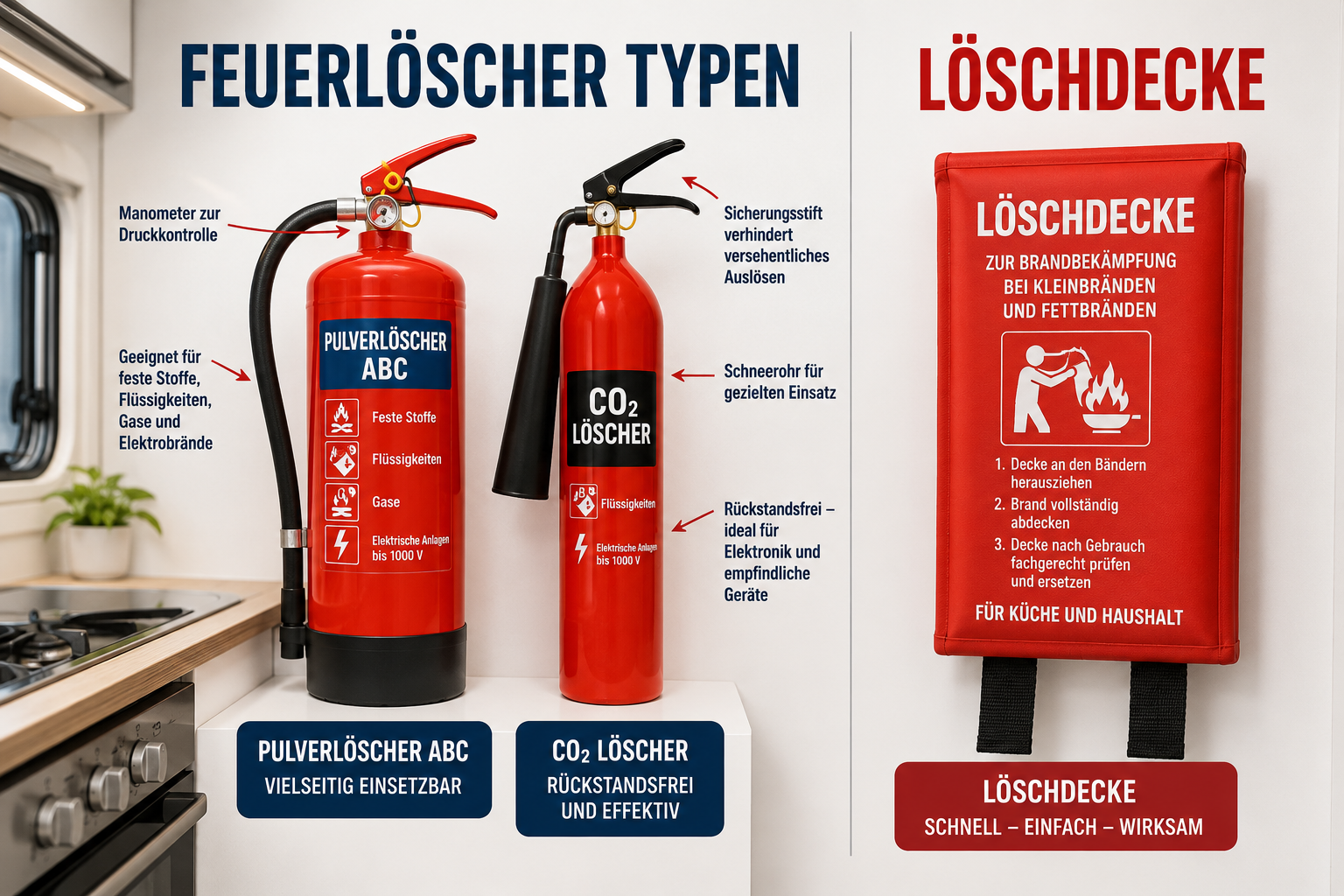
What are the main differences between fire extinguishers and fire blankets?
Fire extinguishers and fire blankets both fulfil the function of „Fire extinguisher and fire blanket: Lifesaver for the galley“, but in completely different ways. The fire extinguisher actively fights fires with extinguishing agent (powder, CO₂ or foam), while the fire blanket smothers a fire by depriving it of oxygen.
| Characteristic | Fire extinguisher | Fire blanket |
|---|---|---|
| Operating principle | Extinguishing agent interrupts combustion | Oxygen deprivation by covering |
| Suitable for | Class A, B, C, F depending on type | Small hob fires, fat fires (small) |
| Maintenance | Specialist inspection every 2 years | None, one-off visual inspection |
| Cost | 20–80 € | 5–20 € |
| Damage to the vehicle | Powder: considerable; CO₂/foam: less | No damage |
| Single use | No (multiple with CO₂) | Yes (dispose of after use) |
Decision rule: Anyone who can only choose one device should take a class F foam extinguisher. Anyone who combines both is equipped for all typical galley scenarios.
What types of fire extinguishers are there for the galley?
Three types are seriously suitable for the galley: powder extinguishers (ABC), foam extinguishers (ABCF) and CO₂ extinguishers. Each has clear strengths and weaknesses in motorhome or boat use.
Powder extinguisher (ABC): Cheap and versatile, but the extinguishing powder settles in every corner of the vehicle and permanently damages electronics, textiles and surfaces. Only as a last resort for the galley.
Foam extinguisher (ABCF): The best choice for galleys. Class F means: suitable for fat fires. Leaves less damage than powder. Recommended minimum size: 1 kg or 1 litre.
CO₂ fire extinguisher: Clean, no residue, good for electrical appliances. But: Unsuitable for fat fires and, on boats, must be handled with particular care due to the pressure vessel.
Compact tip for campervans: A 1 kg foam extinguisher with Class F approval fits under the driver's seat or in a kitchen drawer and is the most sensible combination of performance and space requirement.
How much does a good fire extinguisher for the galley cost?
A solid fire extinguisher for use in a campervan or boat costs between 20 and 80 euros, depending on the type and size. Foam extinguishers with Class F approval (1 kg) are available from around 25–35 euros. CO₂ extinguishers start at around 40 euros.
In addition, there are maintenance costs: An expert inspection every two years costs between 15 and 30 euros, depending on the provider. Anyone who ignores this risks not only invalid insurance, but also an extinguisher that fails in an emergency.
Total costs over 10 years (estimate, assumption: 2 inspections per year at €20): approx. 220–280 euros including initial purchase. That's less than a camping weekend.
How long does a fire extinguisher last and when does it need to be replaced?
Fire extinguishers do not have a fixed expiry date like food, but must be checked regularly. According to DIN EN 3 and the requirements of the German property insurers, an inspection by a specialist company is required every two years.
After 20 years at the latest, manufacturers recommend replacing the container, even if the extinguisher appears outwardly intact. Practical: Anyone who buys their extinguisher in 2026 should have their first inspection in 2028.
When to replace immediately:
- Pressure gauge shows negative pressure (pointer in the red area)
- Visible corrosion or dents on the container
- Safety seal is missing or damaged
- Extinguisher has already been used, even if only briefly
Can I maintain a fire extinguisher myself or do I have to have it inspected?
Anyone can carry out a simple visual inspection themselves, but not the legally required maintenance. In Germany, BGV A1 (accident prevention regulation) stipulates that fire extinguishers must be inspected by a specialist.
Self-check (recommended monthly):
- Pressure gauge in the green area?
- Safety seal intact?
- No external damage?
- Easily accessible and not obscured?
The official maintenance is carried out by an approved specialist company. Costs and addresses can be found via the Bundesverband Brandschutz-Fachbetriebe (bvbf.de).
How do I use a fire blanket correctly in the event of a kitchen fire?
Using a fire blanket correctly takes less than ten seconds, but if used incorrectly it can make the fire worse. The blanket is placed over the flame, not thrown, and must protect the user's hands.
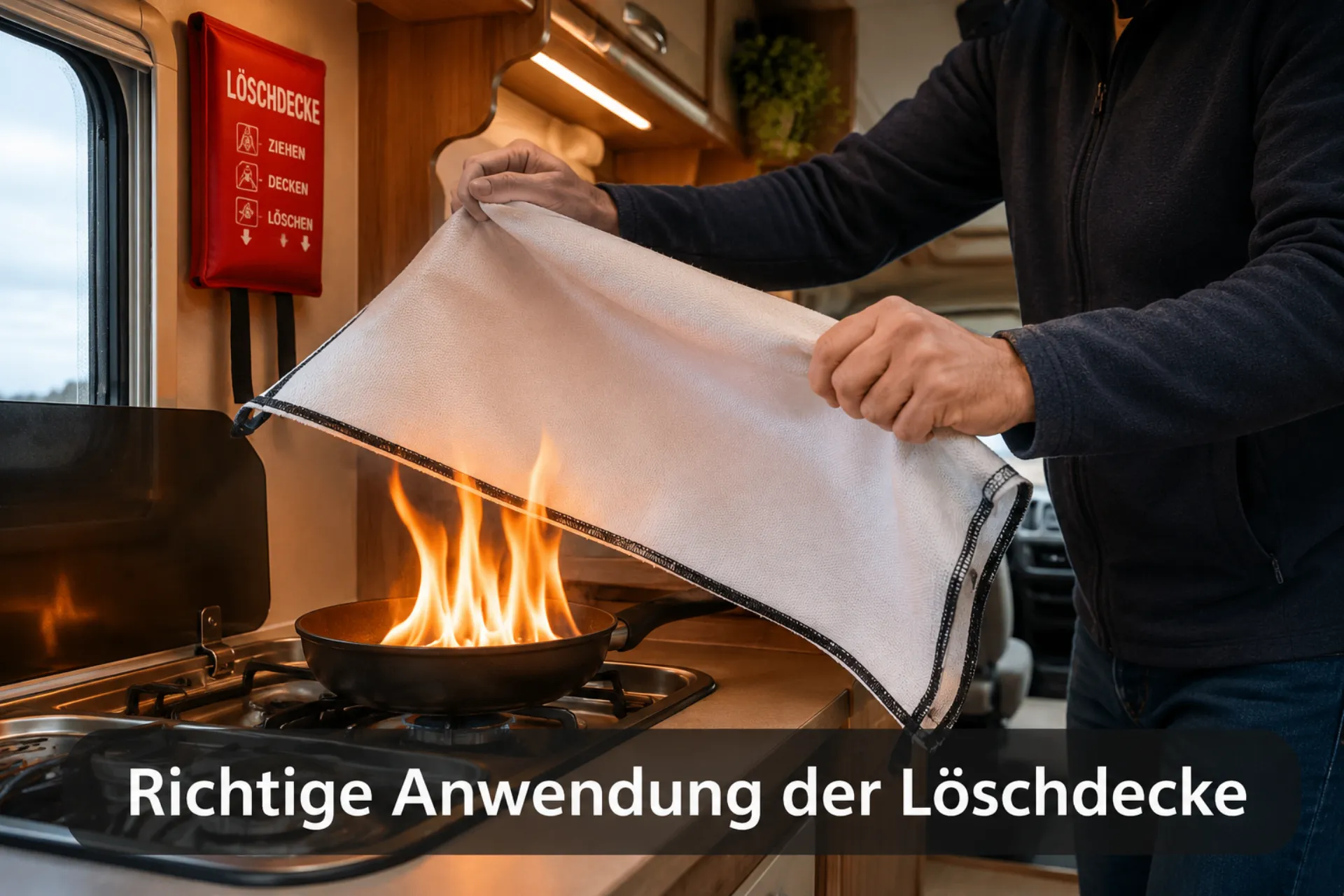
Step-by-step:
- Pull the blanket out of the cover (pull on the loops, not on the fabric)
- Hold the blanket in front of you, keeping your hands hidden behind the top edge
- Cover the flame from the front, protecting your own hand
- Lay the blanket flat and completely over the pot or pan
- Turn off the hob
- Wait at least 30 minutes before removing the blanket (risk of re-ignition)
Common mistake: Let the blanket fall onto the flame from above instead of covering it from the side. Hot air or grease can spray out and cause burns.
Which fires can I extinguish with a fire blanket and which not?
A fire blanket is only suitable for small, local fires on the hob, i.e. a burning pan or a small fire in a pot. It is unsuitable for larger fires, fires on walls or electrical fires.
Suitable:
- Fat fire in the pan (Class F, small)
- Burning napkin or small piece of textile on the hob
Not suitable:
- Fires that have already spread to cupboards or walls
- Electrical fires (Class E)
- Liquid gas fires on the pipe
Rule of thumb: If the flame is larger than the blanket, leave the vehicle immediately and call the fire brigade (112).
What mistakes do people make when extinguishing kitchen fires?
The most common mistakes in kitchen fires in campervans are: pouring water on a fat fire, getting too close to the flame and hesitating for too long. Pouring water on burning fat leads to an explosive fat explosion that causes serious burns.
The five most common mistakes:
- Using water in the case of fat fires (life-threatening)
- Open windows or doors and thus supply oxygen
- Use the wrong extinguisher (powder instead of foam)
- Wait too long and hope the fire goes out on its own
- Remove the fire blanket too early and risk reignition
Who are fire extinguishers and fire blankets particularly important for?
Fire extinguishers and fire blankets as life savers for the on-board kitchen are particularly relevant for motorhome travellers, camping fans with gas cookers and anyone who cooks on boats. In these environments, the risk of fire is increased due to gas systems, confined spaces and limited escape routes.
Particularly at risk:
- Motorhome renters who are not yet familiar with the vehicle (e.g. vehicles rented via CampCruisers)
- Families with children on board
- People who cook with the windows closed in bad weather
Are fire extinguishers for motorhomes and boats different from normal fire extinguishers?
Not fundamentally, but the requirements for compactness, corrosion resistance and fastening are higher. For boats, the Inland Waterways Regulations (BinSchStrO) prescribe specific requirements; for motorhomes, there is no legal obligation, but insurers recommend at least a 1 kg extinguisher.
On boats, extinguishers made of stainless steel or with a plastic coating are recommended, as salty air corrodes normal steel containers. For motorhomes, compact brackets are important so that the extinguisher does not fly around while driving.
How do I store fire extinguishers and fire blankets correctly on board?
Both devices must be stored within easy reach, clearly visible and protected from heat. The extinguisher does not belong in the boot or under the mattress, but near the kitchen, but not directly above the cooker.
Optimal storage locations:
- Fire extinguisher: wall bracket next to the kitchen, at eye level
- Fire blanket: in the drawer directly under the cooker or on the wall next to it
- Never behind closed cupboards or under luggage
Temperature range for extinguishers: most are approved for -20 °C to +60 °C. In summer in the motorhome, temperatures inside can exceed 70 °C, so ensure adequate ventilation.
What to do if the fire extinguisher does not work?
If the fire extinguisher fails in an emergency, leave the vehicle immediately and call the fire brigade. Do not attempt to repair the extinguisher or fight the fire in any other way if the fire is already out of control.
Common causes of failure: expired maintenance, loss of pressure due to corrosion, blocked nozzle due to old extinguishing agent. Anyone who checks their extinguisher regularly (pressure gauge, seal, condition) significantly reduces this risk.
Emergency plan for the on-board kitchen:
- Switch off the cooker (if safely accessible)
- Leave the vehicle immediately
- Close doors (slows down the spread of fire)
- Call 112
- Do not return
Frequently Asked Questions (FAQ)
As a motorhome renter, do I have to bring my own fire extinguisher? That depends on the rental company. With CampCruisers, you should check before departure whether a fire extinguisher and fire blanket are on board. If in doubt, pack your own fire blanket (costs under 15 euros).
Can I reuse a fire blanket after use? No. After a real fire, the fire blanket must be disposed of and replaced, as the fibreglass structure may be damaged.
What size fire blanket do I need for the on-board kitchen? 120 × 120 cm is the standard size and is sufficient for all typical cooker fires in the motorhome. Larger formats (180 × 120 cm) are intended for people who have set themselves on fire.
Is a fire extinguisher required by law in a motorhome? Not in Germany for private motorhomes. Different rules apply to commercially used vehicles and boats.
How do I recognise a high-quality fire extinguisher? Look for CE marking, DIN EN 3 approval, Class F suitability and a pressure gauge in the green range. Brands such as Gloria, Jockel or Amerex are well-known manufacturers.
Can I use powder extinguishers in the motorhome? Technically yes, but the extinguishing powder settles everywhere and is almost impossible to remove. A foam extinguisher makes much more sense in a motorhome.
What is the difference between fibreglass and wool fire blankets? Fibreglass blankets are more heat-resistant (up to approx. 500 °C) and better suited for fat fires. Wool blankets are cheaper, but less effective at high temperatures.
How often should I check the fire blanket? A quick visual inspection once a year is sufficient: cover intact, blanket completely inside, no damage.
Conclusion: Safety in the campervan kitchen is not a question of budget
A fire extinguisher and fire blanket as life savers for the campervan kitchen are not optional extras, but basic equipment for anyone who cooks while travelling. The combination of a Class F foam extinguisher and a fibreglass fire blanket costs less than 50 euros and is ready for use in just a few minutes.
Concrete next steps:
- Buy a foam extinguisher (1 kg, class F) and attach it to the wall near the kitchen with a wall bracket
- Buy a fire blanket (120 × 120 cm, fibreglass) and store it directly under the hob
- Include both devices in the checklist before each trip
- Make a note of the maintenance date for the extinguisher in two years' time
- Briefly instruct all passengers on where the devices are and how they work
Anyone who implements these five steps is well prepared for the most common fire scenarios in the campervan kitchen without investing a lot of money or time.
Quellen
- Bundesverband Brandschutz-Fachbetriebe e.V. (bvbf.de) – Maintenance intervals and specialist companies
- DIN EN 3 – European standard for portable fire extinguishers
- BGV A1 – Accident prevention regulation Principles of prevention (DGUV)
- Binnenschifffahrtsstraßen-Ordnung (BinSchStrO) – Fire protection requirements for boats


 English
  German
  Spanish
  Italian
  Polish
  Dutch
Dutch  French
  Danish