
Quick answer: Magnetic hooks and nano tape are the most effective methods for attaching objects in motorhomes, rental cars or rental motorhomes without drilling holes. Magnetic hooks work on metallic surfaces and carry between 1 and 30 kg depending on the model, while nano tape adheres to almost any smooth surface and can be removed without residue. Both solutions are cheap, easy to use and indispensable for camping enthusiasts.
The most important things at a glance:
- Magnetic hooks are ideal for metal walls, refrigerators and steel frames in the motorhome
- Nano tape adheres to glass, tiles, painted walls and plastic without adhesive residue
- Neodymium magnets carry significantly more weight than simple ferrite magnets
- Nano tape loses adhesion in moisture and heat, but can be washed and reused
- Both products cost between 5 and 20 euros in the entry-level segment and are available online and in DIY stores
- Anyone who rents a motorhome (e.g. via CampCruisers) protects the deposit by drilling-free attachment
- Both methods work poorly on wallpaper, rough plaster surfaces or uneven tiles
- Secure heavy objects over 5 kg better with special adhesive hooks or screws
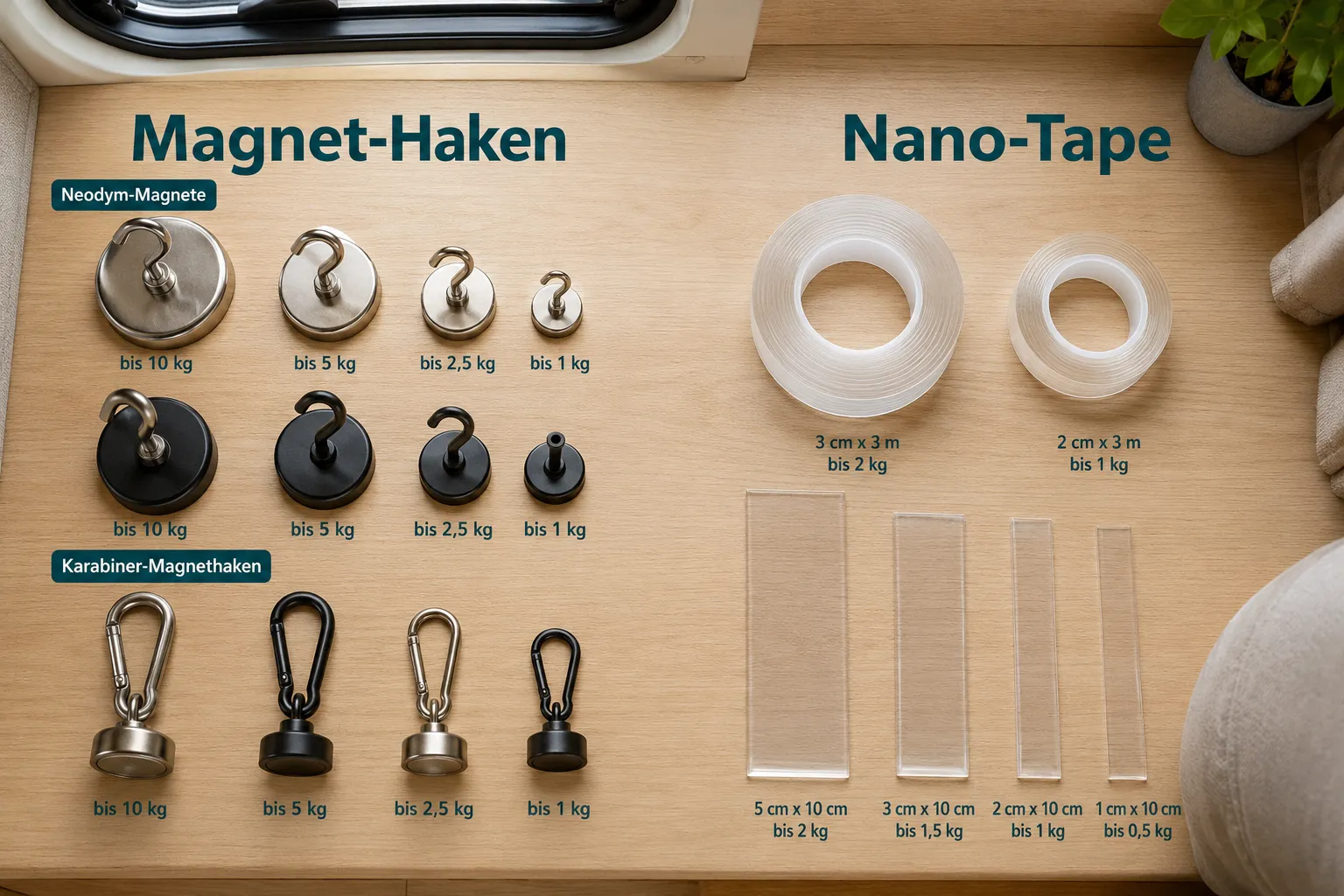
What are magnetic hooks and how do they work?
Magnetic hooks are hooks that are attached to a magnet instead of a screw or adhesive point. They adhere to ferromagnetic surfaces such as steel, iron or certain stainless steel alloys and can be repositioned at any time.
The most common types at a glance:
- Neodymium magnetic hooks: Very strong rare-earth magnets, compact, can hold up to 30 kg (depending on size)
- Ferrite magnetic hooks: Cheaper, weaker version, suitable for items under 2 kg
- Carabiner magnetic hooks: Combination of magnet and carabiner, practical for bags or ropes
- Swivel magnetic hooks: Rotatable head, ideal for tight corners in the campervan
Important: Not every metal surface is magnetic. Aluminium, copper and most types of stainless steel do not react to magnets. In the campervan, steel frames, refrigerator walls and cupboard doors are often magnetic, but aluminium exterior walls are not.
What is nano tape and how does it differ from normal adhesive tape?
Nano tape (also known as Gecko tape or double-sided nano adhesive tape) adheres not through adhesive, but through Van der Waals forces, i.e. microscopically small electrostatic attractive forces between the tape surface and the substrate. The result: no residue, no damage, and the tape can be reused several times after washing.
Nano Tape vs. normal double-sided adhesive tape:
| Property | Nano Tape | Normal Adhesive Tape |
|---|---|---|
| Residue | None | Often yes |
| Reusable | Yes (after washing) | No |
| Adhesion to rough surfaces | Bad | Medium |
| Temperature resistance | Limited (~60°C) | Varies |
| Price | 5–15 € | 2–8 € |
Nano-Tape vs. Magnetic Hooks: Which is better for which surfaces?
For metallic surfaces, magnetic hooks are the superior choice because they adhere without surface contact and leave no residue. Nano-tape is better suited if the surface is smooth, non-metallic and clean, for example on tiles, glass or painted walls.
Decision rule:
- Choose Magnetic Hooks, if the surface is ferromagnetic (steel refrigerator, steel wall, metal door)
- Choose Nano Tape, if the surface is smooth and non-metallic (glass, tiles, plastic, painted wood)
- Choose neither, if the surface is rough, porous or wallpapered
Common mistake: Apply nano-tape to a slightly roughened or dusty surface. The adhesion will then break down within hours, especially if there is weight attached to it.
How much weight can magnetic hooks and nano tape support?
The load-bearing capacity depends heavily on product quality, substrate and temperature. As a rule of thumb:
- Neodymium magnetic hook (small, 20 mm): 3–8 kg
- Neodymium magnetic hook (large, 40+ mm): up to 30 kg
- Nano tape (1 cm wide, 10 cm long): approx. 1–2 kg
- Nano tape (3 cm wide, 20 cm long): approx. 3–5 kg
Practical tip: Manufacturer's specifications apply to vertical pull. With lateral or angled pull, as occurs in a moving campervan, the load-bearing capacity is reduced by 30–50%. For items that must remain secured during the journey, always plan with a safety buffer.
Heavy objects such as toolboxes, bicycle racks or shelves over 5 kg do not belong on nano tape, but on screws or special adhesive hooks with a certified load capacity.
What mistakes happen when attaching magnetic hooks?
The most common mistake is the incorrect assessment of the surface. Many campervan owners assume that all metal surfaces are magnetic, which is not true.
The five most common mistakes:
- Test aluminium walls: Check before buying whether the surface is actually magnetic (a simple fridge magnet is sufficient as a test)
- Hanging objects that are too heavy: Overloading magnetic hooks until they slip and leave scratches
- Placing magnets too close to electronics: Strong neodymium magnets can damage credit cards, smartphones and older hard drives
- Scratching a magnet on a painted surface: Without a protective pad, the magnet drags across the paint and leaves marks
- Stacking magnets: Several magnetic hooks placed directly next to each other weaken each other
Where can I buy magnetic hooks and nano tape and how much do they cost?
Both products are widely available and affordable. Simple ferrite magnetic hooks are available from about £3 in discount stores, while high-quality neodymium versions cost between £8 and £25 depending on the load-bearing capacity. Nano tape rolls (2 m) are available for £5 to £15.
Sources of supply:
- Online: Amazon, eBay, Temu (cheap, but quality varies greatly)
- DIY store: OBI, Hornbach, Bauhaus (good quality, on-site advice)
- Camping accessories retailers: Dethleffs-Zubehör, Fritz Berger, Reimo (specialising in motorhome applications)
Anyone renting a motorhome through CampCruisers should pack a small starter set of magnetic hooks and nano tape before travelling. It saves a lot of problems when organising the interior without risking the deposit.
Who are magnetic hooks and nano tape best suited for?
These fixing methods are ideal for anyone who cannot or does not want to make permanent changes to walls.
Perfect use cases:
- Motorhome renters: No drill holes, no deposit losses
- Camping fans in rented flats: Organise the kitchen and bathroom without damage
- Vanlife beginners: Quickly customisable interiors without prior DIY knowledge
- Seniors or people with limited mobility: Easy to install without a drill
Less suitable for:
- Heavy loads over 5 kg (better: screws or certified adhesive hooks)
- Damp permanent environments such as outdoor areas or shower walls (nano tape dissolves in permanent moisture)
- Rough or uneven surfaces (wallpaper, exposed concrete, coarse plaster)
Where should I not use magnetic hooks and nano tape?
Both methods have clear limits that are often underestimated.
Keep your hands off in these situations:
- Wallpapered walls: Nano tape tears off the wallpaper when removed
- Freshly painted walls: Paint is not yet fully cured, tape can peel off paint
- Hot surfaces: Proximity to the cooker or exhaust air causes nano tape to soften and peel off
- Proximity to electronics: Strong neodymium magnets damage magnetic strips, pacemaker wearers should be careful
- Uneven tiles or joints: Nano tape only sticks to the elevation, not in the joints, which drastically reduces the load-bearing capacity
How do I attach pictures or small shelves without drilling?
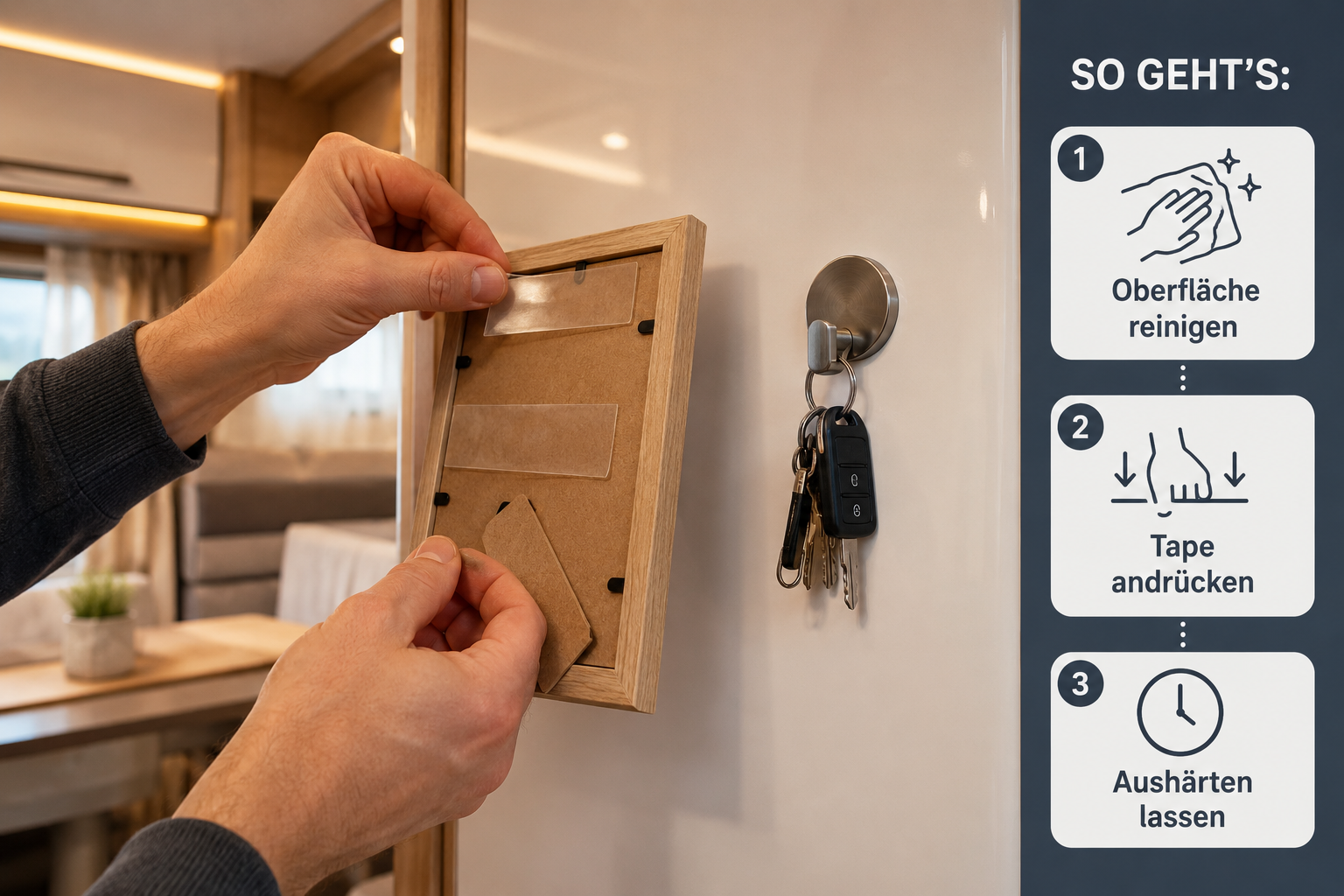
For pictures and light decorative objects (up to approx. 2 kg), nano tape is the easiest solution. For heavier objects such as small shelves, special adhesive hooks with a load-bearing capacity are recommended.
Step-by-step for nano tape:
- Clean the surface with isopropyl alcohol and allow to dry completely
- Cut nano tape to the back of the object and press on
- Peel off the protective film and press the object firmly against the wall (for at least 30 seconds)
- Allow to cure for at least 1 hour before applying weight
- To remove: slowly peel off parallel to the wall, never tear off vertically
For shelves: Adhesive hooks from brands like tesa or Command (3M) are specifically designed for higher loads and have certified load capacity specifications. These are more reliable than generic Nano-Tape for objects over 1.5 kg.
How long do magnetic hooks and Nano-Tape last?
Magnetic hooks theoretically last indefinitely as long as the surface remains magnetic and the hook is not overloaded. Nano-Tape lasts for several months to years under optimal conditions, but loses adhesion due to heat, humidity and dust accumulation.
Lifespan in practice:
- Nano-Tape in a motorhome (temperature fluctuations, vibration): 3–6 months before first cleaning
- Nano-Tape in stable interiors: 12–24 months without maintenance
- Magnetic hooks: Several years, wear only through mechanical damage
Nano-Tape can be reactivated by washing with warm water. Simply peel off, rinse under running water, allow to dry and reattach.
Can I use magnetic hooks on tiles or wallpaper?
Magnetic hooks only work on tiles if there is a ferromagnetic layer underneath, which is rarely the case. Nano-Tape adheres well to smooth, glazed tiles, but poorly to uneven or matte tiles and not at all to joints. Nano-Tape should never be used on wallpaper.
Alternatives for tiles:
- Suction cup hooks (for smooth, non-porous tiles)
- Special tile adhesive hooks (tesa Powerstrips Waterproof)
- Drilling with a tile drill (permanent but irreversible)
Alternative attachment methods to magnetic hooks
If neither magnets nor Nano-Tape are suitable, there are proven alternatives:
- Command Strips (3M): Adhesive hooks with defined load capacity, removable without residue, widely used
- Suction cup hooks: Ideal for glass and smooth tiles, but pressure-dependent
- Hook and loop fastener (Velcro): Good for flat objects such as tablets or remote controls
- Tension cords and nets: In the motorhome for luggage and objects while driving
- Hanging organiser: Hung over doors or cabinet edges, without any fastening
Frequently asked questions
Can Nano-Tape be used on wood? Yes, Nano-Tape adheres well to smooth, varnished wood. On untreated, rough wood, adhesion is unreliable because the microfibres do not find a continuous contact surface.
Does Nano-Tape leave stains on white walls? If removed cleanly (parallel to the wall, slowly), Nano-Tape leaves no residue. If it is torn off, traces may remain. Freshly painted walls are a risk.
How strong are neodymium magnetic hooks really? A neodymium magnetic hook with a diameter of 20 mm can hold up to 8 kg vertically, according to the manufacturer. In a motorhome during driving movements, you should hang a maximum of 3–4 kg on it.
Can I use Nano-Tape in the motorhome bathroom? Yes, for a short time, no, not permanently. Steam and moisture loosen the adhesion within a few weeks. For bathrooms, it is better to use tesa Powerstrips Waterproof.
Are neodymium magnets dangerous? Strong neodymium magnets can affect credit cards, magnetic strips and older pacemakers. For pacemaker wearers: consult your doctor before using strong magnets.
How do I remove Nano-Tape without damaging the wall? Peel off slowly and parallel to the wall, never vertically. For stubborn areas, a little heat (hair dryer on low setting) helps to reduce adhesion.
Does Nano-Tape also work in the motorhome in winter? At temperatures below 5°C, Nano-Tape becomes stiff and loses adhesion. Bring the surface to room temperature before applying.
Can I use magnetic hooks for bicycle racks on the motorhome? No. Bicycles weigh 10–15 kg, plus driving vibrations. Certified bicycle carriers with screw mounting are required for this.
Conclusion: Drilling is a thing of the past
Magnetic hooks and Nano-Tape are the most practical solutions in 2026 for anyone who wants to attach objects in a motorhome, rental car or rented flat without leaving any damage. The key lies in choosing the right product for the respective surface, a realistic view of the load-bearing capacity and careful preparation of the surface.
Concrete next steps:
- Test surfaces in your own motorhome or rental vehicle with a simple fridge magnet before buying magnetic hooks
- Pack a Nano-Tape set (various widths) and 2–3 neodymium magnetic hooks as basic equipment
- Always secure heavy objects with certified adhesive hooks or screws
- Check the Nano-Tape regularly and clean with warm water if the adhesion deteriorates
- Anyone renting a campervan through CampCruisers should have the starter kit ready before departure to organise the interior according to their own needs immediately


 English
  German
  Spanish
  Italian
  Polish
  Dutch
Dutch  French
  Danish