
Quick answer: Yes, mobile washing machines for motorhomes work – but only really well if the model, water connection and power supply are suitable for the vehicle. If you choose the right machine and follow a few basic rules, you can wash clothes on the go without any problems. Anyone who simply buys any device and hopes that it will work will soon be disappointed.
The most important things at a glance:
- There are two main types of mobile washing machines for motorhomes: compact top loaders and manual spin dryers.
- Power consumption ranges from 150 to 500 watts depending on the model – significantly less than a household machine.
- The weight varies between 3 and 12 kg, which is relevant for small motorhomes.
- A special fixed water connection is not absolutely necessary – many models work with a water tank.
- Suitable for small to medium laundry loads (1–3 kg per wash).
- Intended more as a supplement for families with children, not as a complete replacement for the campsite washing machine.
- Typical faults: incorrect installation, too much detergent, overloading the on-board power system.
- Well-known brands: Panda, Giantex, Camry, Dometic.
- Durability in continuous use: realistically 2–5 years with regular use.
- Cost: between 50 and 350 euros, depending on equipment.
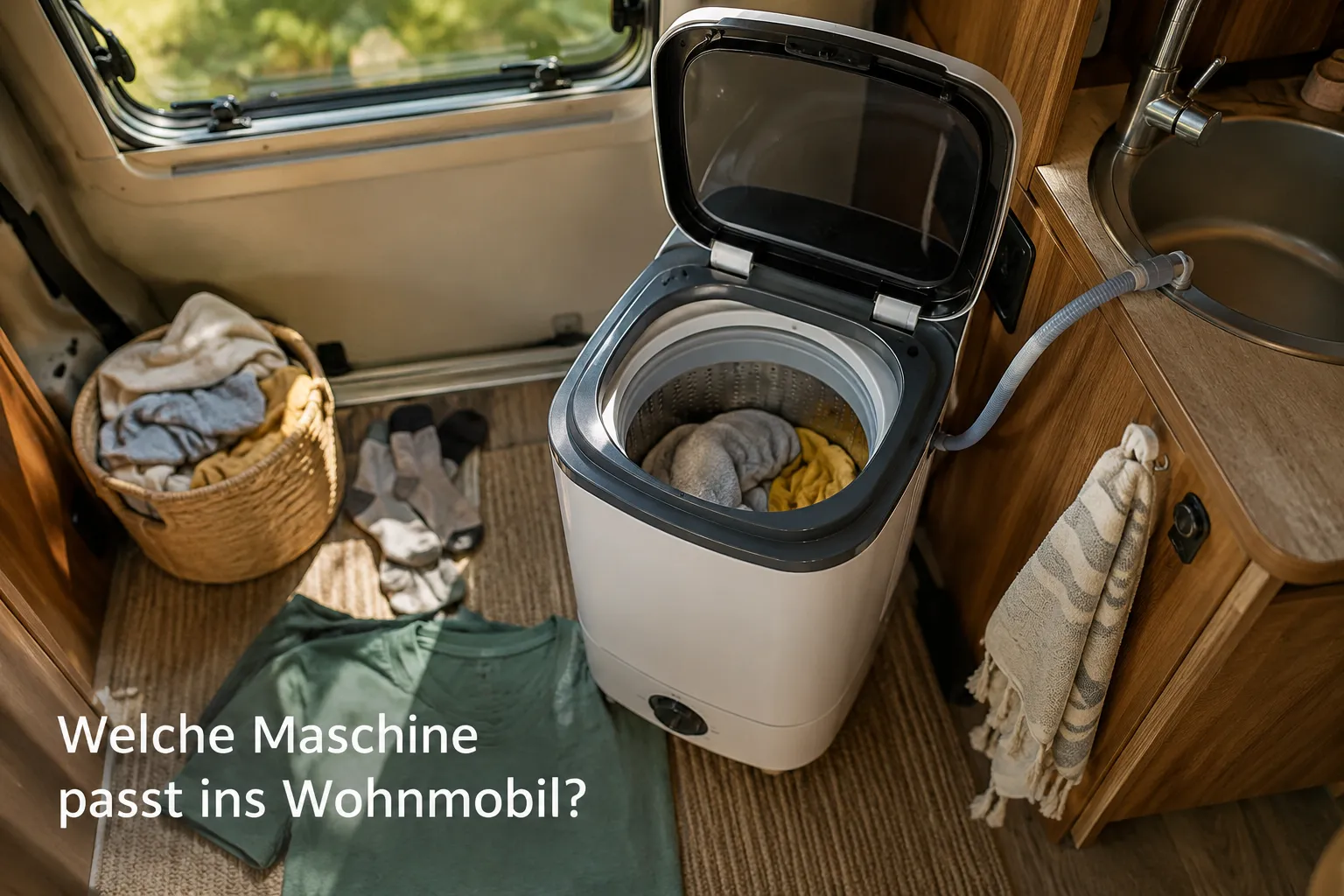
What does a mobile washing machine for motorhomes really cost?
Mobile washing machines for motorhomes cost between 50 and 350 euros, depending on type, capacity and brand. Manual spin models (also called 'Camping-Wäscheschleuder') are available from 50 euros, while electric compact machines with heating function and spin cycle are more likely to cost between 150 and 300 euros.
Rough price overview:
| Type | Preisspanne | Kapazität | Besonderheit |
|---|---|---|---|
| Manual spin dryer | 50–90 € | 1–2 kg | No electricity needed |
| Electric top loader (basic) | 90–160 € | 2–3 kg | No heating programme |
| Electric top loader (with heating) | 160–350 € | 2–4 kg | Real washing programmes |
| Built-in model (compact) | 300–700 € | 3–5 kg | Permanent installation required |
In addition, there are running costs: detergent for delicates (liquid detergent recommended), occasional maintenance and – if operated via mains electricity – minimal electricity costs. If you are on campsites with an electricity meter, you will pay less than 5 cents per wash for a 45-minute wash at 200 watts consumption (estimated value at €0.30/kWh).
Decision rule: If you wash a maximum of 2–3 times a week and are travelling alone or as a couple, you will be well served by an electric top loader for around 130–180 euros. A manual spin dryer is perfectly adequate for occasional washers.
Which mobile washing machine is best suited for small campervans?
The following applies to small campervans and camper vans: Weight and footprint are more important than capacity. Models weighing less than 6 kg and with a footprint of no more than 40 × 40 cm can be easily accommodated even in cramped vehicles – for example under the bench seat or in the storage space under the bed.
Particularly popular in the Vanlife community are models such as the Panda Portable Washer or inexpensive no-name top loaders from online retailers, which are often sold under the label “Mini Washing Machine“. These devices typically have:
- Capacity: 2–3 kg of laundry
- Dimensions: approx. 38 × 38 × 50 cm
- Weight: 5–8 kg
- Connection: hose to tap or manual filling
If you drive a converted panel van, you should also check whether the vehicle has a drainage option for the dirty water. Without a fixed drain, the water has to be emptied manually – which is doable, but annoying in the long run.
How much power does a mobile washing machine consume in a camper?
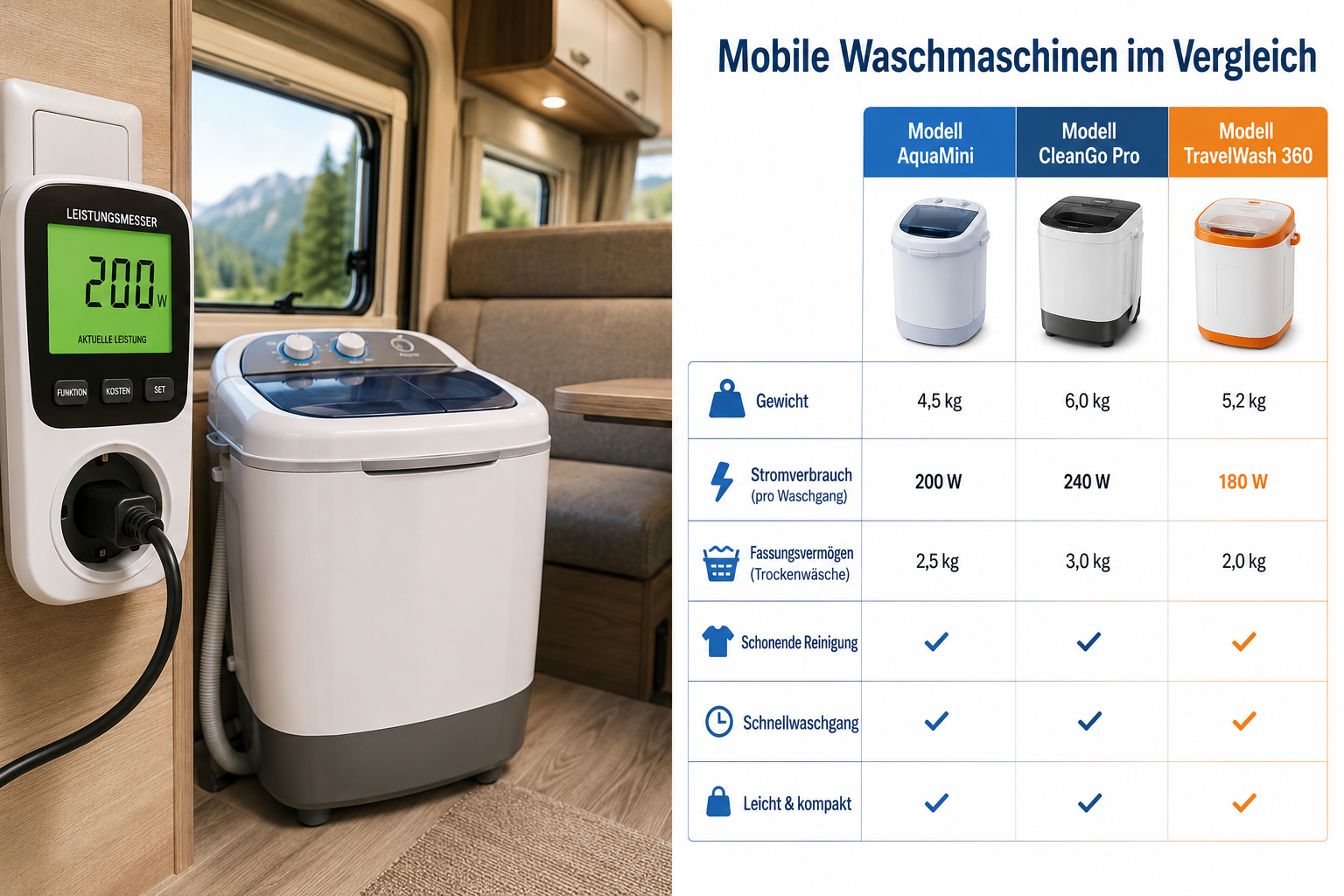
Electric mobile washing machines consume between 150 and 500 watts during operation, depending on the model. Models without a heating function usually range from 150–250 watts, while appliances with hot water heating can draw up to 500 watts for a short period.
This is not a problem for campervans with a mains hook-up. However, if you rely on self-sufficiency and drive with solar panels and lithium batteries, you should do the maths: A 45-minute wash at 200 watts draws around 0.15 kWh from the battery. With a 100 Ah battery (12V, which corresponds to approx. 1.2 kWh of usable capacity), this is easy to cope with – as long as the fridge, air conditioning and kettle are not running at the same time.
Important: Models with a built-in heating element (for hot wash water) are less suitable for solar operation. If you are washing self-sufficiently, you should prefer cold wash programmes and fill the vehicle with hot water from the boiler beforehand.
Can you use a normal household washing machine in a campervan?
No, this does not work in practice. Standard household machines need 1,500 to 2,500 watts, a fixed water connection with sufficient pressure, a drain and a stable, vibration-free installation. None of these points can be met in a normal campervan.
Even on campsites with 16-amp mains electricity, the inrush current of a household machine would be a problem for the fuse. In addition, these appliances weigh 50–80 kg – this eats up payload and significantly changes the handling.
Exception: Some large motorhomes and luxury liners (over 9 metres) have a compact built-in washing machine with 3–5 kg capacity and 800–1,000 watts fitted as standard. But this is a different category than mobile camping washing machines.
What are typical mistakes when installing and operating a mobile washing machine?
The most common mistake is to simply place the machine on the floor and start it – without checking whether the vehicle is level. Mobile washing machines spin less efficiently and wear out faster if they are tilted.
The most common mistakes at a glance:
- Too much detergent – Excessive sudsing overloads small pumps and leaves residue. Rule of thumb: half the dosage compared to household machines.
- Overloading – More laundry than specified stuffs the drum and damages the motor.
- Not emptying dirty water in time – In models without an automatic pump, the water overflows if you don't pay attention.
- No surge protection – Voltage fluctuations on some campsites can damage cheap appliances. A simple surge protection adapter helps.
- Operation while driving – Never. The machine can tip over, water can leak and cause short circuits.
Which brands of mobile washing machines are there?
The following brands and model types are common on the German market:
- Panda (USA/Asia): Very popular in the vanlife scene, good spare parts availability
- Giantex: Cheap entry-level models, often under 100 euros
- Camry: Mid-price segment, solid workmanship
- Dometic: Well-known camping brand, more expensive but more robust devices
- Costway: Often on Amazon, positioned similarly to Giantex
Tip: Brand names are often misleading with cheap models – many devices come from the same factories and only differ in the label. What really matters: customer reviews on the durability of the pump and hose system.
How heavy are mobile washing machines, and do I need a special water connection?
Mobile washing machines for camping weigh between 3 and 12 kg, depending on the type. Manual spin dryers are around 3–5 kg, electric top loaders around 6–10 kg, compact built-in appliances around 10–15 kg.
In most cases, a fixed water connection is not required. Most models offer two options:
- Hose to the tap (standard tap attachment, often included)
- Manual filling by jug or bucket
If you want to install the machine permanently, you can place a T-piece branch on the cold water pipe of the motorhome. This is a simple intervention that anyone with basic knowledge of plumbing can do themselves.
Which types of laundry are suitable, and what do I have to consider during the washing process?
Mobile washing machines are well suited for everyday laundry, underwear, T-shirts, socks and light casual clothing. Bed linen, jeans, fleece jackets and sleeping bags are too heavy or bulky for most devices.
The following applies to the washing process:
- Prefer cold wash programmes (protects the machine and battery)
- Use liquid detergent instead of powder
- Check laundry for coarse dirt beforehand and pre-treat if necessary
- Empty dirty water into the designated drains on the campsite, do not simply tip it onto the ground
Are mobile washing machines suitable for families or more for singles?
For singles and couples mobile washing machines are a real solution that can make the campsite laundrette unnecessary. For families with children they are more of a useful addition – the amount of laundry quickly exceeds the capacity of small appliances.
A family with two children realistically produces 1–2 kg of laundry per day. With a 3 kg machine, this means: wash daily or supplement at the campsite. If you accept that, you can still save money and be more independent.
Decision rule: If you are travelling alone or as a couple and wash a maximum of 3–4 times a week, you will get along well with a mobile machine. Families with more than 2 children should be realistic and plan the machine as a supplement, not as a main solution.
How long does a portable washing machine last with constant use?
With regular use (3–5 times a week), a lifespan of 2–4 years is realistic for cheaper models. Higher quality devices from Dometic or comparable brands last 4–6 years with the same use.
The most common wear parts are the water pump, the hoses and the seals. Cleaning the machine after each season, checking hoses for cracks and storing the device dry will noticeably extend its lifespan.
Frequently Asked Questions (FAQ)
Can I operate a portable washing machine without mains power? Yes, if the vehicle has a sufficiently sized on-board battery. Models without a heating function consume 150–250 watts and are suitable for solar operation.
How loud are portable washing machines? Most models generate 60–75 decibels when spinning – comparable to a normal conversation or a running fan. You should be considerate at night on the campsite.
Can I permanently install the machine in the campervan? Yes, this is possible with a T-piece on the cold water connection and a fixed drain. However, the effort is rarely worthwhile for occasional users.
How large can the laundry be? Individual items of clothing should not fill the drum to more than two thirds. It's better to wash large towels or jeans separately.
Does a portable washing machine also work in winter? At temperatures below 5 °C, pumps and hoses can freeze. This is not a problem in a heated campervan, but the device should never overwinter in an unheated vehicle.
Which detergent is best suited? Liquid detergent for delicates in half dosage. Powder detergent often does not dissolve completely in small machines and can clog pumps.
Do I have to dispose of the dirty water specially at the campsite? Most campsites have special wastewater disposal stations. Simply tipping dirty water onto the ground is prohibited in many countries and is harmful to the environment.
Are there portable washing machines with a heat pump? No, this is not technically feasible for this device class. If you insist on hot water washing, you must heat the water beforehand and fill it manually.
Conclusion: Is a portable washing machine worthwhile for the campervan?
The question 'Portable washing machines for the campervan: Does it work?“ can be clearly answered: Yes – with the right expectations. If you are a solo traveller or couple planning longer tours and don't want to constantly look for laundrettes, you will find a practical and inexpensive solution in a compact electric top-loader machine. If you have a small budget and rarely wash, a manual spin dryer is a good option.
Concrete next steps:
- Check the power supply: Mains power or solar system, and how much capacity is available?
- Measure the space available: Record the floor space and storage space in the campervan.
- Realistically assess the amount of laundry: How many people, how often per week?
- Select the model according to capacity and weight – not by price alone.
- Test it on the campsite during the first use before dispensing with wastewater infrastructure.
If you want to hire a campervan and try out camping life before investing in your own equipment, you will find a good selection of vehicles at CampCruisers – ideal for testing whether a portable washing machine suits your own travel style.


 English
  German
  Spanish
  Italian
  Polish
  Dutch
Dutch  French
  Danish