
Quick answer: Thermal mats for windows are multi-layered insulating mats that have been specially developed for motorhome and camping vehicle windows. In summer, they reduce the amount of heat that enters through solar radiation and, in winter, they keep the cold out by acting as a thermal barrier between the pane of glass and the interior. For motorhome travellers, they are one of the most cost-effective measures for climate control.
The most important things at a glance:
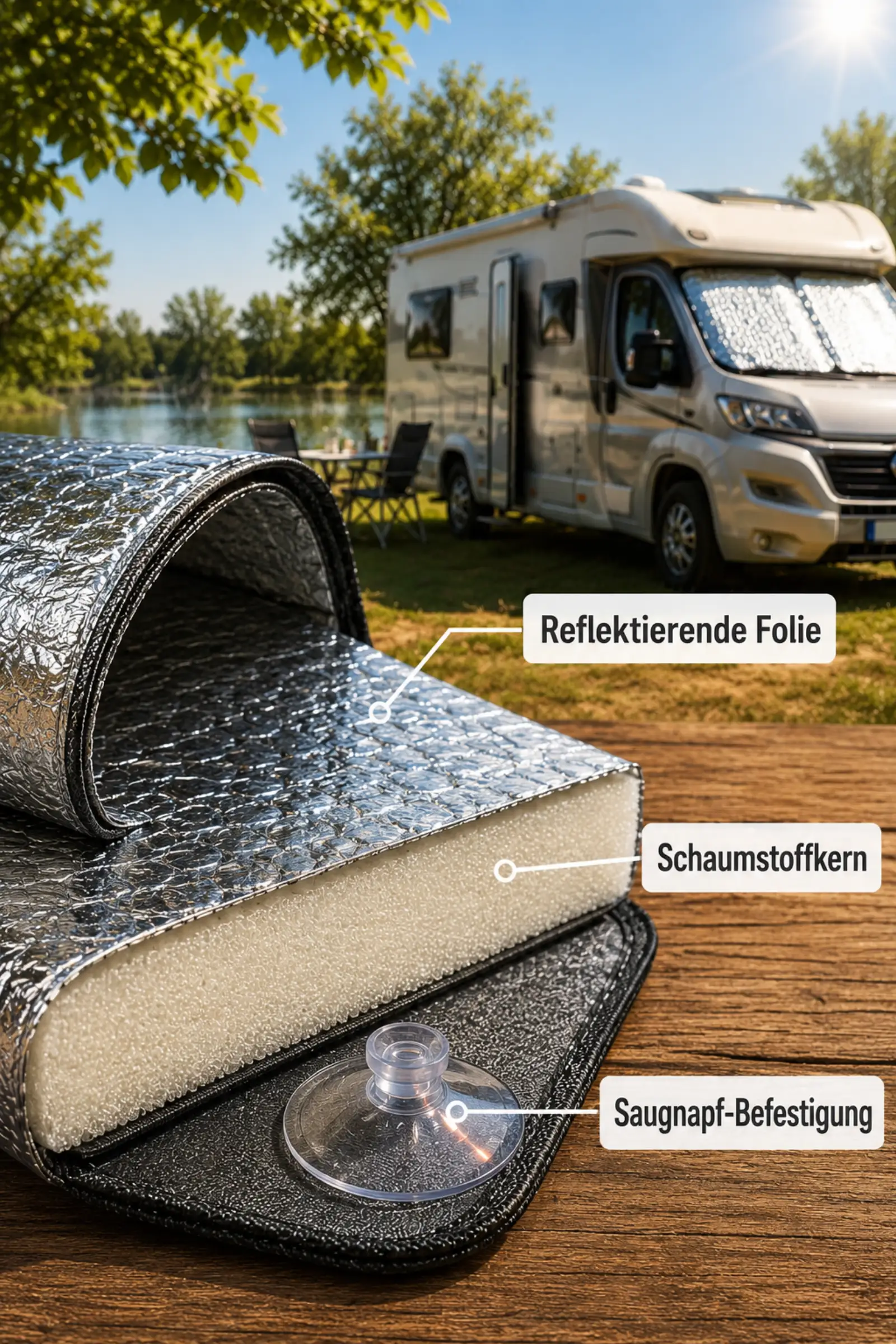
- Thermal mats typically consist of several layers: reflective aluminium foil, foam core and often a soft inner lining
- They work in both directions: sun protection in summer and heat protection in winter
- Good thermal mats cost between 15 and 80 euros per window, depending on size and material
- Custom-made versions fit the vehicle exactly, universal mats can be cut to size
- For rental motorhomes at CampCruisers, thermal mats are a simple retrofitting solution without drilling or gluing
- Assembly is usually done using suction cups, Velcro or magnetic strips, so it is completely reversible
- Quality mats last five to ten years with good care
- DIY versions made of Reflektix or aluminium insulating mat are cheap and effective
What are thermal mats and how exactly do they work?
Thermal mats for windows are insulating covers that are attached directly to or in front of the window pane. Their functional principle is based on three physical mechanisms: reflection, absorption and convection.
The outer aluminium layer reflects solar radiation before it enters the interior as heat. The foam core (usually polyethylene or polyurethane) interrupts the heat conduction between the cold pane and the warm interior. The air layer between the mat and the glass also acts as a buffer against convection.
What it looks like in practice:
- In summer: The mat blocks up to 95% of direct sunlight (manufacturer specifications vary) and prevents the greenhouse effect in the vehicle
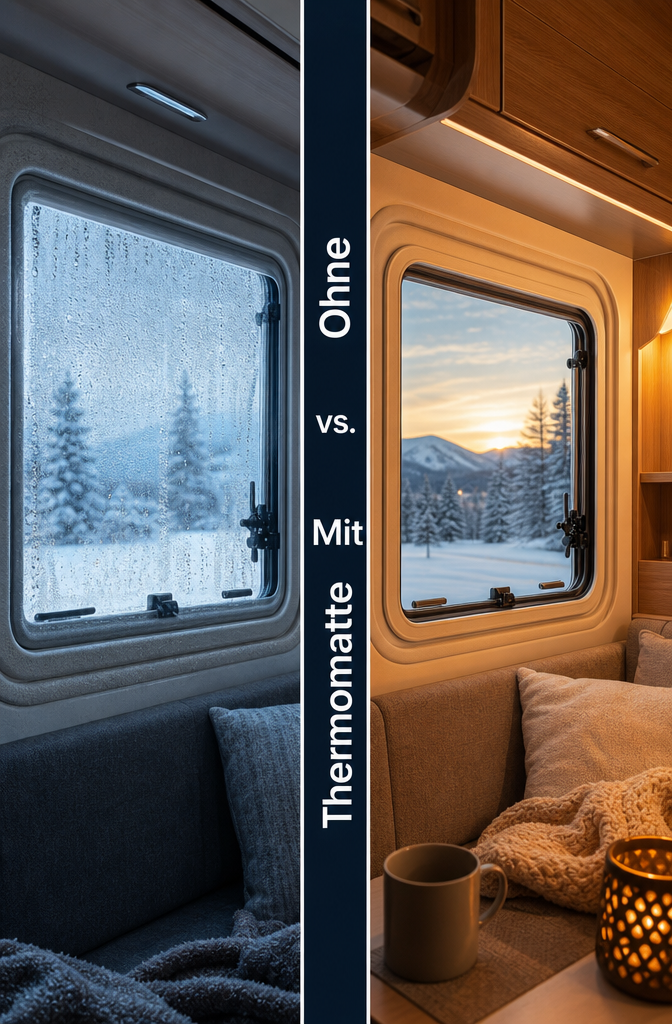
- In winter: The mat reduces heat loss through the glass and prevents condensation from forming on the pane
- All year round: Better privacy on the campsite as a bonus
Important for motorhome drivers: Windows account for up to 30% of the total heat loss area in poorly insulated vehicles (estimate based on typical vehicle constructions). Thermal mats address exactly this weakness.
What costs do I have to budget for good thermal mats?
For a complete motorhome (driver and passenger windows, rear window, side windows), the budget is realistically between 80 and 300 euros, depending on vehicle size and quality level.
Price overview by category:
| Category | Price per window | Suitable for |
|---|---|---|
| Simple universal mats | 5–15 € | Occasional campers, short trips |
| Mid-range (cut to size) | 15–35 € | Regular users, good fit |
| Custom-made premium mats | 40–80 € | Full-time campers, maximum insulation |
| Self-built (Reflektix/Alu-Iso) | 2–8 € | Handwerklich begabte Camper |
Those who rent their campervan through CampCruisers can bring their own thermal mats or buy inexpensive universal mats on site. Custom-made versions are only worthwhile from the third or fourth use.
Common mistake: Too cheap mats without proper edge sealing create thermal bridges. Better to buy one less mat and focus on quality instead.
Are thermal mats better than normal curtains or roller blinds?
For motorhomes, thermal mats are clearly superior to curtains or simple blinds in terms of insulation. Curtains offer privacy but hardly any thermal separation. Blinds are somewhere in between.
Direktvergleich:
- Gardinen: Good privacy screen, minimal insulation, inexpensive
- Thermo-Rollos: Mediocre insulation, permanently installed, comfortable to use.
- Thermomatten: Best insulation performance, slightly more effort when packing and unpacking, flexible in use
Thermal mats are particularly useful when extreme temperatures prevail: high summer in the south of France or winter camping in Scandinavia. For lukewarm spring days, a good roller blind is often sufficient.
Decision rule: Those who regularly camp at temperatures below 5 °C or above 30 °C should use thermal mats. Those who travel mainly during the transitional season can get by with thermal blinds.
What materials are best suited for thermal mats?
The best thermal mats for windows combine a reflective outer layer with an insulating core. Three materials dominate the market.
- Polyethylene foam with aluminum lamination (e.g. Reflektix): Lightweight, inexpensive, very good reflection properties, easy to cut to size
- Polyurethane foam with aluminum foilSlightly heavier, better compressive strength, holds its shape longer
- Mehrschicht-Verbundmatten (e.g. Hindermann, Brunner): Professional construction with fleece inside, no scratching of the pane, best fit
Hands off pure styrofoam boards: They insulate, but are bulky, break easily, and are difficult to store.
How can I properly attach thermal mats to my windows?
Installation depends on the fastening system. Most thermal mats for motorhomes are installed without tools, making them ideal for rental vehicles.
Schritt-für-Schritt-Montage:
- Measure window size (width × height, plus note frame dimensions)
- For universal mats: Cut the mat to size, seal the edges with tape.
- Choose a mounting method: Suction cups (for smooth panes), Hook and loop fastener (for frames), Magnetic strips (for metal frames)
- Apply the mat from top to bottom, smooth out air bubbles.
- Ensure complete edge coverage, leaving no gaps.
Common mistake: Attach mats too loosely. Every gap at the edge is a thermal bridge. It's better to cut the mat 1–2 cm larger and attach it slightly overlapping.
What mistakes should I avoid when buying thermal mats?
The biggest mistake is buying without precise measurements. Universal mats that don't seal properly only provide a fraction of the possible insulation.
Die häufigsten Kauffehler:
- Falsche Größe: Always measure with a tape measure, don't rely on vehicle model information.
- Zu dünnes Material: Below 8 mm foam thickness, the effect is limited in winter.
- Keine Innenverkleidung: Bare aluminum foil inside scratches the windows and looks unfinished.
- Schlechte Befestigung: Mats that are only loosely placed can fall down while driving or let drafts in.
- Falsche Erwartungen: Thermal mats do not replace proper vehicle insulation, they complement it.
For which types of apartments or rooms are thermal mats most worthwhile?
In a camping context, thermal mats for the windows are most worthwhile in vehicles with large window areas and poor basic insulation, i.e. classic panel van conversions, older motorhomes, and camper vans.
Besonders sinnvoll bei:
- Vehicles with single-pane windows (many models before 2010)
- Large panoramic windows in the rear area
- Cab windscreen and side windows (largest heat loss area)
- Permanent camping or winter pitch
Less critical for: Newer vehicles with double glazing and factory insulation, where the added benefit is less.
Do thermal mats really reduce heating costs in winter?
Yes, but the saving depends heavily on the initial situation. In vehicles with single glazing and without further insulation measures, thermal mats can noticeably reduce the heating requirement, because window areas are among the largest heat loss points at sub-zero temperatures.
A precise percentage cannot be given reliably without knowing the specific vehicle. As a rough guide: Anyone who has camped without thermal mats until now and now uses them on all windows will generally notice that the heater comes on less often and the inside temperature remains more stable.
Practical tip: Combine thermal mats with an insulated floor panel and a roof window attachment for maximum effect in winter.
Can I make or retrofit thermal mats myself?
Home-made thermal mats work very well and cost only a fraction of the finished products. The basic material is aluminium insulating mat or Reflektix, both available in DIY stores.
DIY instructions in 5 steps:
- Hold cardboard as a template to the window and trace the contour
- Transfer the template to the aluminium insulating mat and cut it out
- Seal edges with aluminium tape (prevents fraying)
- Optional: Glue velour or fleece fabric on the inside (protects the pane, looks better)
- Add fastening using suction cups or Velcro
Time required: Approx. 30–45 minutes per window. Material costs: 2–5 euros per mat.
Which brands and manufacturers offer good thermal mats?
Some manufacturers have established themselves for motorhomes and camping vehicles, offering tailor-made or vehicle-specific thermal mats.
- Hindermann: One of the best-known suppliers of vehicle-specific thermal protection sets, good fit, solid quality
- Brunner: Known for camping equipment, also offers thermal mat sets
- Carbest: Cheaper alternative with decent workmanship
- Remis / Dometic: More in the area of integrated thermal blinds, not classic mats
- Own brands (Amazon, DIY store): Well suited for DIY projects or as raw material for self-construction
Buying tip: Before buying, check whether the manufacturer offers vehicle-specific cut-outs for your own model. This saves time and gives better results than universal mats.
How long do thermal mats last and when do I need to replace them?
High-quality thermal mats last five to ten years if stored and used properly. The biggest wear problem is not the insulation layer itself, but the fasteners and the aluminium lamination.
Signs that a mat should be replaced:
- Aluminium foil is peeling off or is extensively damaged (reflection effect decreases)
- Foam core is permanently deformed or brittle
- Suction cups or Velcro no longer hold reliably
- Mat no longer seals cleanly at the window edge
Care tip: Store mats dry and flat or rolled up after the season, not permanently folded. Folded edges weaken the material over time.
Are thermal mats also suitable for rented motorhomes?
Yes, thermal mats are one of the few insulation measures that are really suitable for rental vehicles, because they can be installed and removed completely without leaving any residue and without tools.
Anyone who rents a motorhome via CampCruisers can simply bring their own thermal mats. Suction cup attachments leave no traces, Velcro should only be used on your own vehicles. This makes a significant difference to comfort on a winter trip or a midsummer road trip through southern Europe.
Recommendation for rental vehicle users: A compact set for cab windows and rear window is sufficient for most situations. The weight is minimal, the storage space required is low.
Frequently asked questions about thermal mats for windows
Can I leave thermal mats in during the journey? No, thermal mats in the cab windows must be removed before driving, as they impair visibility. There is no legal regulation for side windows and rear window, but for safety reasons it is also recommended to remove them there.
Do windows get mouldy under thermal mats? Not if the fit is good and the vehicle is sufficiently ventilated. If the mat traps moisture, condensation can form. Solution: briefly remove and ventilate the mats in the morning.
How many layers do I need for extreme winter? For temperatures below -10 °C, we recommend double-layered mats or a combination of thermal mat and additional insulating curtain.
Do thermal mats also work with roof windows? Yes, there are specially shaped thermal mats for roof hatches and roof windows, e.g. from Dometic or Remis. These are particularly effective because heat rises.
Do I have to cut the mat exactly to size? Yes, as accurately as possible. A deviation of more than 1–2 cm at the edges noticeably reduces the insulation effect because air can circulate.
Are thermal mats also suitable for bus windows? Basically yes. There are industrial solutions for buses or coaches. The same recommendations apply to converted camper vans as to panel vans.
Can I also use a thermal mat as a privacy screen? Yes, most thermal mats also offer complete privacy from the outside, which is a pleasant side effect on campsites.
What is the difference between a thermal mat and a windscreen cover? Windscreen covers are specially designed for the windscreen and are usually placed on the outside. Thermal mats are attached inside and cover all window types.
What's next
Thermal mats for the windows are one of the cheapest and most effective measures to make a motorhome more comfortable all year round. If you want to act now:
- Take measurements: Measure all windows of the vehicle before anything is ordered
- Set priorities: Cab windows and rear window first, then side windows
- Choose material: For starters, an aluminium insulation mat from the DIY store is sufficient for self-cutting
- Test the fastening: Try suction cups on a pane before buying the whole set
- Combine: Thermal mats plus ventilation routine plus good sleeping bags results in the complete winter camping setup
Anyone who books a motorhome via Campcruisers and plans a summer or winter trip should consider a compact thermal mat set as a fixed packing list item. The effort is minimal, the gain in comfort is significant.


 English
  German
  Spanish
  Italian
  Polish
  Dutch
Dutch  French
  Danish