
Last updated: May 24, 2026
Quick Answer: With a transverse bed, you lie across the direction of travel, while with a longitudinal bed, you lie parallel to it. Which layout is a better fit depends on body size, travel companions, and the available space in the vehicle. A transverse bed is often more comfortable for couples, while a longitudinal bed offers more flexibility for solo travelers or taller people.
Key Takeaways
- Bed Transverse bed = Bed across the direction of travel, usually wider, ideal for couples
- 📏 Longitudinal bed = Bed parallel to the direction of travel, often narrower, good for individuals
- 🧍 For a height of approx. 185 cm, a transverse bed in compact camper vans can become too short
- 💰 The bed type influences the spatial concept of the entire vehicle and thus also the rental price
- 🔄 Both layouts have specific strengths: a transverse bed scores on comfort, a longitudinal bed on accessibility
- 🚐 For road trips for two, the transverse bed is usually the more popular choice
- 🎒 The longitudinal bed often allows for more storage and freedom of movement in the vehicle.
- ⚠️ Most common mistake: Not checking height against the actual bed length before booking
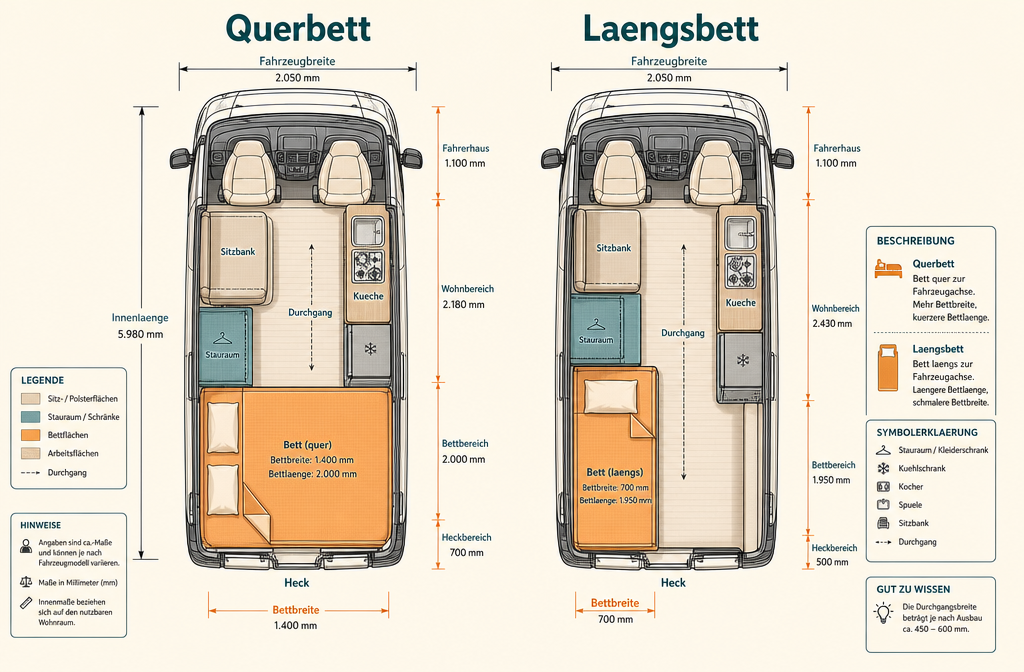
What is the difference between a transverse bed and a longitudinal bed?
The transverse bed is installed perpendicular to the direction of travel, while the longitudinal bed runs parallel to it. This simple design decision changes the entire layout of a motorhome: how much freedom of movement remains, where storage space is created, and how comfortable getting in and out is.
Transverse bed:
- Lies at a 90-degree angle to the driving axis.
- Typical width: 140–160 cm (double bed standard)
- Often positioned at the rear of the vehicle
- Accessible from both sides (with rear arrangement)
Longitudinal bed
- Runs parallel to the driving axis.
- Typical width: 70–90 cm per side (for single beds) or 120–140 cm (double bed)
- Often arranged laterally in the vehicle
- Access usually only from one side
Decision rule: Those who travel as a couple and prioritize comfort choose the transverse bed. Those who travel alone or need maximum storage space are often better off with the longitudinal bed.
How much space do you need for a transverse bed, and what height is ideal?
A transverse bed requires at least 190–200 cm of interior width in the vehicle so that people up to about 185 cm can lie comfortably. More compact campervans (under 6 m in length) sometimes only offer 175–185 cm of usable bed length in the transverse format, which becomes problematic for taller people.
Body height and cross bed: The rule of thumb
| Height | Suitable for transverse bed? | Note |
|---|---|---|
| Up to 175 cm | ✅ Very good | Full freedom of movement |
| 175–185 cm | ✅ Good | Pay attention to the actual bed length |
| 185–195 cm | ⚠️ Limited | Check vehicle width beforehand |
| Over 195 cm | ❌ Often too short | Longitudinal bed recommended |
Important: The bed size indicated in vehicle descriptions often refers to the maximum mattress dimension, not the actual usable sleeping area. Always inquire about the clear interior width of the vehicle.
Which type of bed is more comfortable for couples?
For couples, the transverse bed is usually the more comfortable choice because both people sleep on a continuous lying surface and do not disturb each other when getting in and out. The longitudinal bed in the double version often requires one person to climb over the other if only one side is accessible.
Transverse bed advantages for couples:
- Shared mattress without a gap in the middle
- Dual access with rear arrangement
- Similar feeling to a hotel room double bed
- No "climbing" over the partner
Longitudinal bed configuration for couples:
- Two separate single beds next to each other (with an aisle in between) allow for undisturbed sleep
- Good for people with different sleep patterns
- More personal space for everyone
For romantic trips for two, such as a Road trip through Tuscany with a campervan, the transverse bed is the more popular choice among traveling couples.
Disadvantages of the transverse bed in a motorhome
The transverse bed sounds tempting, but has concrete weaknesses that should be known before booking. The biggest disadvantage: it eats up vehicle length and restricts the remaining living space.
The main disadvantages at a glance:
- Limited bed length for tall people (over 185 cm)
- Less storage space under the bed compared to some longitudinal bed layouts
- Poorer accessibility when the bed is in a niche (getting up requires bending over)
- Higher space requirement in the vehicle, which reduces the living area
- Poor ventilation on the wall where your head lies (with rear arrangement)
Common mistake: Many campers book a vehicle with a transverse bed without having checked the actual bed length. The result: uncomfortable nights with bent legs. Always ask the provider for the exact dimensions!
Are longitudinal beds in motorhomes more practical?
Longitudinal beds are indeed more practical in certain scenarios, especially in narrower vehicles or for solo travelers. They take advantage of the vehicle's natural length and leave more room to move around on the sides.
Advantages of the longitudinal bed:
- Better use of vehicle length
- Often more storage space on the side or underneath
- No problem with height (bed as long as needed)
- With single bed configuration: Everyone has their own sleeping area.
- Easier entry and exit with side access
When the longitudinal bed clearly wins:
- Solo travelers who want maximum comfort
- People over 185 cm tall
- Traveling in narrower vehicles (less than 220 cm interior width)
- If storage space under the bed is a priority
Is a longitudinal bed better for your back?
A longitudinal bed is not necessarily better for your back than a transverse bed. The quality of the mattress is decisive, not the orientation of the bed. However, some people sleep more restlessly in a transverse bed because they unconsciously perceive the vehicle's movements more strongly when they are lying across the direction of travel.
What actually influences back health:
- Mattress quality and thickness (minimum 10 cm recommended)
- Even support without sagging
- Sufficient bed length (Sleeping with bent legs puts strain on the spine)
- Vehicle leveling (a vehicle parked on a slope makes every mattress uncomfortable)
Costs: Transverse Bed versus Longitudinal Bed in Comparison
The bed layout itself does not cause any direct additional costs, but it does influence the vehicle type and thus the rental price. Vehicles with a transverse bed rear layout are often larger and more comfortably equipped, which places them in a higher price category.
Rough price range (estimates, depending on region, season, and vendor):
| Vehicle type | Bed layout | Typical rental price range |
|---|---|---|
| Compact camper van | Longitudinal bed | Entry |
| Mid-range motorhome | Longitudinal bed or transverse bed | Midfield |
| Fully integrated motorhome | Transverse bed (rear) | Premium |
Anyone looking for the right vehicle will find it at Campcruisers a wide selection of RVs with various sleeping layouts, brokered by professional rental companies worldwide. This allows you to directly compare the desired bed concept with the budget.
Which sleeping position is best suited to which type of bed?
The preferred sleeping position influences which bed layout is a better fit. Side sleepers benefit from a wider bed (transverse bed), while back sleepers primarily need sufficient length.
- Side sleeper: Transverse bed preferred (more width for rolling over)
- Back sleeper: Longitudinal bed advantageous (full body length without restriction)
- Stomach sleeper: Both types work, mattress quality is crucial
- Restless sleepers: Transverse bed with access from both sides (no climbing over your partner)
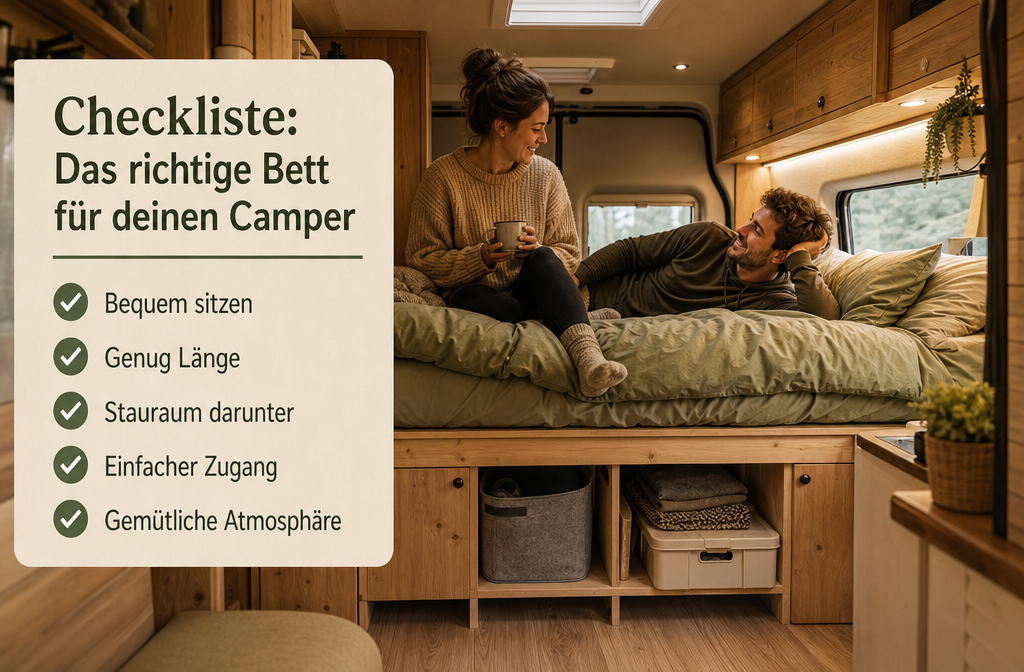
Tips for choosing the right bed in your camper
The right decision regarding bed layout saves frustration on your trip. This checklist helps before booking.
Checklist: Finding the Right Bed Layout
- Record the height of all sleepers.
- Ask the provider for the actual bed dimensions (not just the mattress dimensions).
- Consider travel companions (alone, as a couple, family)
- Match sleep habits (restless sleepers, early risers)
- Estimate storage needs (lots of luggage = storage under the bed is important)
- Check vehicle length and interior width
- Accessibility test: Can you sit upright? Do you have to climb?
- Inquire about mattress thickness and quality
Anyone planning a longer road trip, such as a Autumn Road Trip Through Saarland or a journey through South Holland with the RV, the sleep layout should be chosen as carefully as the route itself.
Common mistakes when choosing a bed for your RV.
Most mistakes don't happen out of ignorance, but from lack of time when booking. These points are most often overlooked.
Mistake 1: Relying on photos only
Photos often show the bed in the best possible perspective. The actual dimensions may differ significantly.
Error 2: Do not check height
Especially with transverse beds in compact vehicles, the usable bed length is often shorter than expected.
Error 3: Access forgotten
A bed in a niche sounds cozy until you have to get up at night and bump your head.
Mistake 4: Ignoring mattress quality
A bad bed can ruin even the most beautiful camping vacation. Always ask about mattress thickness.
Mistake 5: Not thinking about storage space
Those with a lot of luggage need storage space under the bed. Not all layouts offer this equally.
Which bed is better for small bedrooms (compact vehicles)?
In compact vehicles under 6 m in length, the longitudinal bed is often the better choice because it uses the vehicle length without taking up width. The transverse bed requires a certain minimum width and significantly reduces the remaining living space.
Recommendation by vehicle size:
- Under 5.5 m vehicle length: Prefer a longitudinal bed or a high bed
- 5.5–6.5 m: Both layouts possible, check transverse bed
- Over 6.5 m: Transverse bed easily realizable, more comfort
Conclusion: Transverse bed vs. longitudinal bed — What's right for you?
The decision between a transverse bed and a longitudinal bed is ultimately a personal one that depends on body size, travel partners, and travel style. Couples who want to sleep together and are under 185 cm tall will be happier with a transverse bed. Solo travelers or tall people benefit from the longitudinal bed.
In short:
- Choose a side bed if: Travel for two, height under 185 cm, comfort is a priority
- Choose a longitudinal bed if: Traveling alone, height over 185 cm, storage space important, compact vehicle
Before your next campervan trip, it's worth choosing the sleeping layout as carefully as you choose your destination. If you want to book a motorhome with the right bed layout now, you can find it at Campcruisers a wide selection of vehicles for every travel style — whether a cozy transverse bed camper for a vacation on the farm or a practical single bed vehicle for the solo tour.
Safe travels and even better nights! 🚐✨
FAQ: Transverse Bed vs. Longitudinal Bed in a Motorhome
What is the main difference between a transverse bed and a longitudinal bed?
The transverse bed lies across the direction of travel (90 degrees), the longitudinal bed parallel to it. This influences the bed width, accessibility, and available living space in the vehicle.
Which bed is better for two people?
For couples, the transverse bed is usually more comfortable, as it offers a continuous lying surface and both people can get in and out independently of each other.
At what height does the transverse bed become problematic?
If you're around 185 cm tall or more, you should check the actual bed length of the vehicle. In compact campervans, the usable length in the transverse direction may be less than 185 cm.
Is a longitudinal bed better for your back?
Not necessarily. The quality of the mattress and sufficient bed length are more crucial than the orientation of the bed.
Which layout saves more space in the vehicle?
The longitudinal bed makes more efficient use of the vehicle length and often allows more lateral space, especially in narrower campervans.
Does a vehicle with a transverse bed cost more?
The bed layout itself isn't a direct price factor, but vehicles with a comfortable transverse bed rear layout are often larger and better equipped, which increases the rental price.
Can the bed layout in the RV be changed?
In some vehicles, a longitudinal bed can be converted into a transverse bed (conversion function). However, this depends on the respective vehicle model and should be checked in advance.
Which bed is suitable for children?
For families with children, bunk beds or separate sleeping areas are often more practical. A transverse bed can work well for smaller children if there is separate space for parents.
How important is mattress quality compared to the layout?
Very important. A thin or worn-out mattress makes even the best layout uncomfortable. A mattress thickness of at least 10 cm is recommended for longer trips.
Where can I find RVs with different bed layouts?
On Campcruisers Motorhomes can be filtered by vehicle type. The vehicle descriptions of the rental companies usually contain information on the floor plan and bed layout.
Quellen
This article is based on general industry knowledge about RV floor plans and sleeping layouts. Specific dimensions are guidelines and may vary depending on the vehicle manufacturer and model. For binding dimensions, always contact the respective rental company.
Tags: Transverse bed, longitudinal bed, motorhome floor plan, camper bed layout, rent a motorhome, rent a camper, sleeping layout motorhome, camping comfort, RV tips, motorhome equipment, camping vacation, campervan bed


 English
  German
  Spanish
  Italian
  Polish
  Dutch
Dutch  French
  Danish