
Last updated: May 24, 2026
Quick Answer: When buying or renting a motorhome, allergy sufferers should pay particular attention to smooth, easy-to-clean surfaces, high-quality air filter systems and allergen-free upholstery materials. Vehicles with hard floors instead of carpets, without previous owner pets and with HEPA filters in the air conditioning system offer the best conditions for a trouble-free trip.
Key Takeaways
- Smooth surfaces (Plastic, vinyl, artificial leather) are clearly preferable to carpets and fabric upholstery because they offer little foothold for mites and pollen.
- HEPA filter Air conditioners and portable air purifiers significantly reduce indoor pollution from pollen, mold spores, and particulate matter.
- Used motorhomes are not automatically unsuitable, but require a thorough inspection for mold, animal hair residue, and moisture damage.
- Mold prevention begins with consistent ventilation and the use of a dehumidifier — especially in humid climates.
- Hypoallergenic equipment packages some manufacturers now offer, but are not standardized and should be critically examined.
- For pollen allergy sufferers are coastal or high-altitude camping destinations particularly suitable with less pollen dispersal.
- Eine thorough deep cleaning before starting the journey — ideally with a steam cleaner — significantly reduces the allergen load in the interior.
- Rental vehicles should be checked for pet-free status and cleaning standards before booking.
What are the best RV materials for allergy sufferers?
The best materials for allergy sufferers in RVs are those that neither attract nor trap allergens: smooth plastics, vinyl, faux leather, and coated wood surfaces. These are easy to wipe down and offer little surface area for dust mites and mold spores to attack.
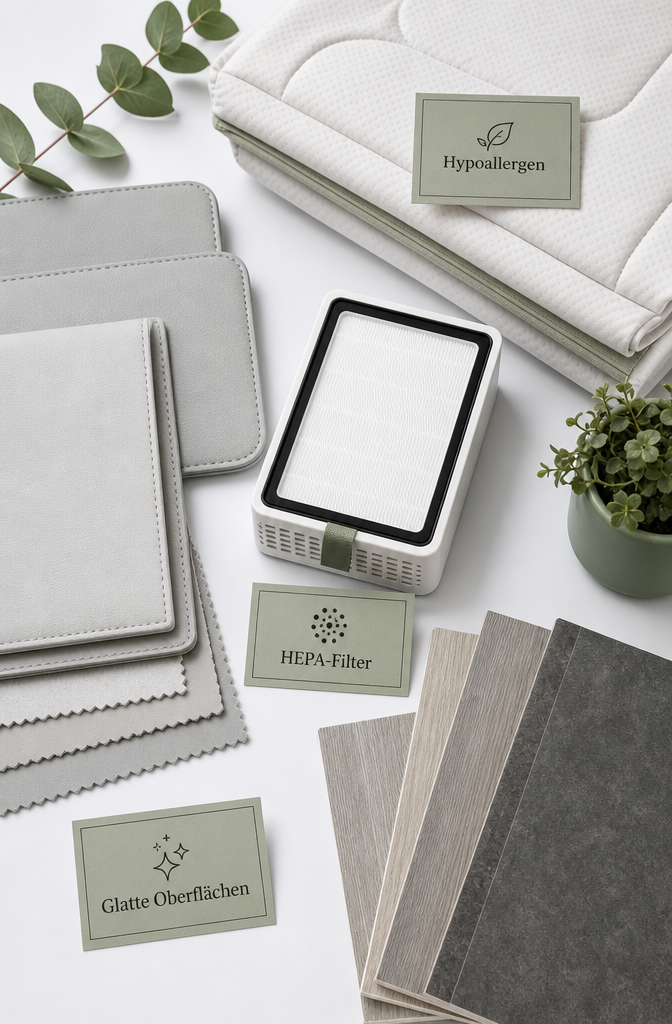
Recommended materials at a glance:
| Area | Allergy-friendly | Better to avoid |
|---|---|---|
| Floor | Vinyl, PVC, Laminate | Carpet, Cork |
| Upholstery | Faux leather, PU coating | Fabric, velvet |
| Walls | Plastic trim | Textile covering |
| Curtains | Washable synthetic roller blinds | Heavy fabric curtains |
| mattress | Allergy protection cover | Unzipped foam |
Specific recommendation: Those who have a choice should prefer vehicles with fully tiled or vinyl-coated floors. Even a small rug at the entrance can carry significant amounts of pollen and mold spores into the interior.
How can I make a camper van allergy-friendly?
Making a motorhome allergy-friendly can be achieved through a combination of material selection, air filtration, and a consistent cleaning routine. Even a standard vehicle can be made significantly more tolerable with a few targeted measures.
Practical measures:
- Remove carpets and textile curtains or replace with washable alternatives.
- Allergy Protection Covers To put on mattresses and pillows (available in outdoor and allergy specialist stores).
- Portable HEPA Air Purifier acquire - compact models for vehicles are available from approx. 50–100 euros.
- Microfiber cloths use instead of a duster to bind allergens and prevent them from being stirred up.
- Hygrometer install: Humidity below 50% keeps mites and mold at bay.
💡 Tip: A dehumidifier or silica gel bag in cabinets and under the bench costs little, but effectively prevents moisture accumulation, which promotes mold.
Which upholstery is best suited for allergy sufferers?
For allergy sufferers, upholstery made of synthetic leather or PU-coated fabric is clearly the best choice because they have no fibers in which mites can nest and can be completely wiped clean. Fabric upholstery—especially velour and terry cloth—are, on the other hand, veritable mite magnets.
What to consider when buying or renting:
- Seat surfaces and backrests made of smooth faux leather or coated material
- Removable, machine washable Covers as a compromise when faux leather is unavailable
- No foam cores without a protective cover. — open-cell foam absorbs moisture and promotes mite growth
Choose faux leather if you sleep in the vehicle daily. Choose washable covers if you only occasionally stay overnight and the vehicle is rented.
How much does a hypoallergenic RV cost?
A specially equipped, allergy-friendly motorhome costs between 40,000 and over 100,000 euros when new, depending on the features and manufacturer — but not solely because of the allergy-friendly equipment, but because high-quality interiors are generally more expensive. The allergy-friendly features (hard floors, synthetic leather, air filters) increase the price compared to a comparable standard model by an estimated 2,000–8,000 euros, depending on the manufacturer and the options chosen.
Cost Overview (Estimates):
- Retrofit HEPA air purifier: 50–200 Euro
- Allergy sufferer mattress protection set: 30–80 Euro
- Retrofitting vinyl flooring (specialist company): 300–800 euros
- Retrofitting faux leather upholstery: 500–2,000 euros
- Dehumidifier for vehicles: 20–60 Euro
For those who want to test whether camping with allergies works at all, a rental vehicle is a good option. On Campcruisers Motorhomes can be booked from professional rental companies worldwide — and ask directly about pet-free equipment and cleaning standards before booking.
Which cleaning methods help with allergens in a campervan?
The most effective methods against allergens in a camper van are steam cleaning, HEPA vacuum cleaners, and damp wiping all surfaces. Dry wiping or conventional vacuum cleaners without HEPA filters stir up allergens instead of trapping them.
Step-by-step cleaning before the trip:
- Wash all textiles (covers, curtains, bed linen) at at least 60 °C.
- Wipe hard surfaces damp — kitchen, cabinets, walls.
- Vacuum the floor with a HEPA vacuum cleaner, then damp wipe.
- Treat mattresses and upholstery with a steam cleaner (kills mites).
- Clean the air conditioning system and vents or change the filters.
- Turn on the air purifier and ventilate the vehicle for 30 minutes.
⚠️ Common mistake: Many allergy sufferers only clean visible surfaces and forget ventilation slots, hinges, and the underside of benches—precisely where mites and mold spores accumulate.
Are there special RVs for people with allergies?
Some manufacturers now offer equipment packages specifically for allergy sufferers — with hard flooring, synthetic leather upholstery, and improved air filtration. However, there is no uniform standard for "hypoallergenic motorhomes," so the terminology varies greatly between manufacturers.
Known approaches in the industry (without guarantee of completeness):
- Some manufacturers in the premium segment offer allergy-friendly interiors on request.
- Conversion specialists can retrofit existing vehicles accordingly.
- In the rental sector, there are occasional providers that designate pet-free fleets.
Booking tip: When renting a motorhome through a platform like Campcruisers It's worth asking the rental company directly whether the vehicle is smoke- and pet-free and what cleaning standards apply.
What do I, as an allergy sufferer, need to consider when buying a motorhome?
When buying a motorhome as an allergy sufferer, three factors are crucial: interior materials, ventilation and filter system, and the vehicle's history. Those who systematically check these three points avoid the most common mistakes.
Checklist for purchase:
- Hard floor instead of carpet available?
- Upholstery made of faux leather or coated material?
- Air conditioning with replaceable pollen filter?
- No visible signs of mold (especially in the bathroom, closets, under seats)?
- Vehicle smoke-free and pet-free (when buying used, ask previous owner)?
- Adequate ventilation options (roof vent, window)?
- Humidity measurement in the interior (is over 65% relative humidity a warning sign)?
For anyone who is still unsure whether campervan life is compatible with allergies: A rental trip is the smartest first step. Check out the selection at Campcruisers there — you'll find vehicles from professional rental companies worldwide and can filter specifically for your needs.
How do I avoid mold and dust mites in the RV?
Mold and dust mites develop in motorhomes primarily due to high humidity and inadequate ventilation. Consistently keeping the humidity below 50% and ventilating regularly effectively disrupts the habitat of both allergens.
The most important preventative measures:
- Ventilate daily., especially after cooking and showering.
- Hygrometer Operate permanently in the vehicle and actively dehumidify when values exceed 55%.
- Dehumidifier or silica gel Place in cabinets and under seats.
- Stand mattresses up regularly. and let air out.
- Repair leaks immediately. — even small points of water entry lead to mold formation within a few days.
- No damp towels or clothing Do not leave in a closed vehicle.
Anyone travelling in humid regions — for example, while Exploring South Holland by Motorhome — ventilation should be handled particularly consistently.
Which air filters are recommended for motorhomes?
For RVs, HEPA filters of class H13 or H14 are recommended because, according to European standard EN 1822, they filter out at least 99.95% of all particles from 0.3 micrometers. This includes pollen, mold spores, and a large portion of house dust mite allergens.
Combining two approaches:
- Vehicle's own air conditioning: Change the pollen filter (cabin air filter) regularly — manufacturer's recommendation is usually annually or every 15,000 km. Upgrade to an activated carbon combination filter possible.
- Portable Air Purifier: Compact devices with HEPA H13 for vehicle interiors are available from various manufacturers. Pay attention to the room size—for a camper, devices for 15–25 m² are usually sufficient.
Choose a portable HEPA air purifier if you are traveling in regions with high pollen levels. Choose the activated carbon combination filter in the air conditioner if you are also sensitive to odors and chemical compounds.
Are used RVs unsuitable for allergy sufferers?
Used motorhomes are not fundamentally unsuitable for allergy sufferers, but require a significantly more thorough preliminary check than new vehicles. Crucial factors are freedom from mold, no animal hair residue, and a flawless condition of the ventilation system.
What to pay special attention to when buying used:
- Check the interior for musty odors and visible signs of mold (cabinets, bathroom, under seats).
- Ask previous owners about pets and smoking — and verify the information with your own smell test.
- Moisture measurement on walls and floors using a moisture meter.
- Inspect air conditioning and vents for dirt and mold.
- In case of a positive test result: schedule professional vehicle cleaning and ozone treatment (costs: approx. 100–300 euros depending on the provider).
A used vehicle with a hard floor and synthetic leather that was smoke- and pet-free may be more suitable for allergy sufferers than a new vehicle with carpet and fabric upholstery.
Which camping destinations are particularly suitable for allergy sufferers?
Camping destinations on the coast, at high altitudes above 1,500 meters, and in regions with little grass and tree growth are particularly suitable for allergy sufferers. At these locations, the pollen concentration in the air is measurably lower than in the lowlands or near forests.
Recommended travel destinations for allergy sufferers:
- Coastal regions: Sea air contains significantly less pollen than inland air.
- High mountains: Above 1,500 m, the pollen count drops significantly.
- Northern Europe in early summer: Shorter pollen season than in Central Europe.
- Coastal pitches in Southern Europe: For example, on the Tuscan coast — those seeking inspiration will find it in the Adventure Tuscany with the RV.
Pollen calendars for the respective travel destination can be accessed via national weather services and allergy apps—this is highly recommended before planning your trip.
What are common mistakes when choosing a motorhome for allergy sufferers?
The most common mistake is relying solely on manufacturer statements without inspecting the vehicle itself. Other typical mistakes involve underestimating humidity and forgetting about cabin air filters.
The five most common mistakes:
- Accept carpet because it "looks cozy" - it is the biggest allergen collector in the vehicle.
- Do not check air conditioning. — a clogged or moldy ventilation filter makes the allergen exposure inside worse than outside.
- Used purchase without mold inspection — Moisture in the vehicle is often not immediately visible.
- Rental vehicle without prior consultation book — pet-free vehicles are not standard everywhere.
- Postpone cleaning until the end of the trip. - Allergens build up during travel and should be removed before starting your journey.
You can find more about the basics of worry-free RV travel — such as weight issues — in the Guide to motorhomes up to 3.5 tons.
FAQ: Motorhome for Allergy Sufferers
As an allergy sufferer, can I travel with a motorhome at all?
Yes, absolutely. With the right vehicle selection, consistent cleaning and good travel planning, camping is not only possible for allergy sufferers, but often more pleasant than hotel travel because you control the environment yourself.
Which flooring is the most allergy-friendly in a motorhome?
Vinyl and PVC flooring are the best choice: smooth, moisture-resistant, and easy to clean. Laminate is also suitable, but less moisture-resistant.
How often should I change the air filter in my RV?
Replace the cabin air filter of the air conditioning system at least once a year or according to the manufacturer's specifications. Change more frequently with intensive use in regions with high pollen counts.
Are pet allergy sufferers particularly at risk in rental vehicles?
Yes. Pet hair and dander can remain in upholstery and vents, even after normal cleaning. Ask specifically for pet-free vehicles before booking.
What is an ozone treatment and does it help with allergens?
An ozone treatment neutralizes odors and kills mold spores and mites. It is not a substitute for mechanical cleaning, but a useful addition for heavily used vehicles.
Which apps help allergy sufferers with travel planning?
Pollen forecast apps from national weather services (e.g., DWD in Germany) and specialized allergy apps provide daily pollen levels for travel destinations.
Is a portable air purifier worth it in a motorhome?
Yes, especially for pollen and mold allergy sufferers. Compact HEPA-H13 devices are affordable and make a noticeable difference in a closed vehicle.
Can mold in a campervan be permanently removed?
Superficial mold can be removed with suitable agents. However, deep-seated mold in insulation material or wood structure requires professional remediation — and can be a disqualifying factor when buying a used property.
Conclusion: Well prepared for allergy sufferers' travel
Camping with allergies is not a contradiction — it just requires a little more planning and the right decisions when choosing a vehicle. The most important steps: prefer hard floors and synthetic leather, ensure HEPA filtration, consistently control humidity, and thoroughly clean the vehicle before the trip begins.
Anyone who doesn't have their own RV yet and would like to test how well traveling with allergies works in a camper: Now a Rent a campervan Search for Campcruisers and specifically according to your own requirements. The platform connects travelers with professional rental companies worldwide — and the next allergy-friendly road trip can begin! 🌿
Enjoying the inspiration for the first route? Then take a look at the best campsites in Europe many of which are located on the coast or in high altitudes, exactly where allergy sufferers can breathe a sigh of relief.
Quellen
- European Standard EN 1822 for the classification of particulate air filters (HEPA), Beuth Verlag
- German Environment Agency: Indoor Air and Allergens www.umweltbundesamt.de
- German Weather Service (DWD): Pollen Forecast www.dwd.de
Tags: RV for allergy sufferers, allergy-friendly RV, RV tips, HEPA filter RV, dust mite RV, mold in RV, RV rental, camping for allergy sufferers, hypoallergenic RV, RV cleaning, pollen allergy camping, RV materials


 English
  German
  Spanish
  Italian
  Polish
  Dutch
Dutch  French
  Danish