
Last updated: May 24, 2026
Quick Answer
Semi-integrated motorhomes are the most popular class of motorhome in Germany and Europe because they combine driving comfort, living space and price in a balanced way. For couples, they offer enough space for two without being as large and heavy as an integrated motorhome. Those who want to travel together without sacrificing comfort will find the ideal entry point here.
Key Takeaways
- Partially integrated motorhomes retain the original driver's cabin of the base vehicle and are therefore cheaper than fully integrated models.
- For couples, lengths between 6.5 and 7.5 meters usually ideal, as they remain maneuverable and still offer sufficient living space.
- Prices start from approximately. €35,000 (used) and extend new to over 80.000 €, depending on the features and brand.
- Well-known brands with strong couples models include, among others: Hymer, Dethleffs, Knaus and Carado.
- The biggest disadvantage: The cabin is not fully integrated into the living area, which can mean noise and heat loss.
- With the right winter equipment, semi-integrated motorhomes are quite Usable year-round.
- Anyone who isn't sure whether this vehicle class is right for them can Rent a campervan and try out different types before buying.
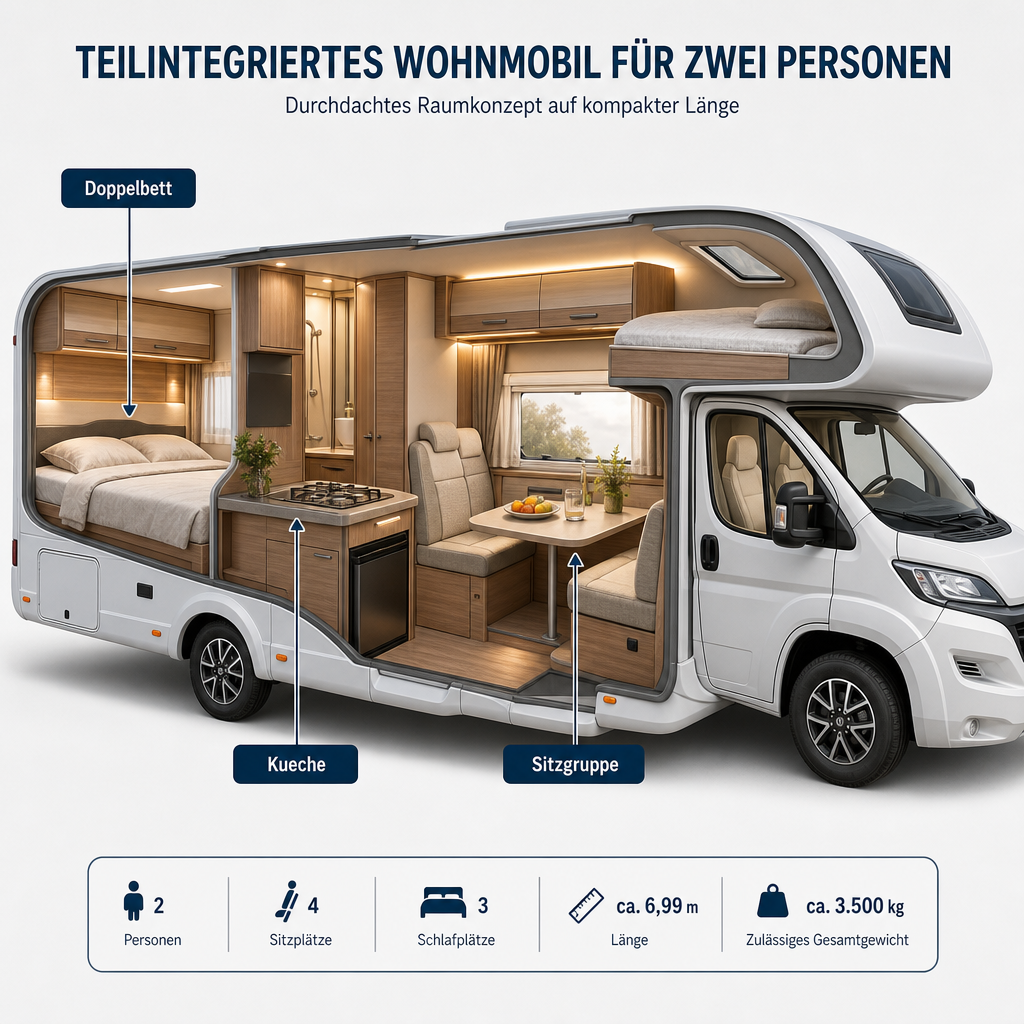
What exactly are semi-integrated motorhomes?
Semi-integrated motorhomes (also known as "semis") are recreational vehicles in which the living area is built on a panel van chassis, but the original driver's cab of the base vehicle is retained. This distinguishes them from fully integrated motorhomes, where the driver's cab and living area merge seamlessly.
Specifically, that means:
- The windshield and doors are from the standard vehicle (e.g., Fiat Ducato, Mercedes Sprinter, or Citroen Jumper).
- The living area behind it is individually designed with a kitchen, bathroom, sleeping area and seating area.
- There is a partition or at least a noticeable boundary between the driver's cab and the living area.
The result is a vehicle that feels almost like a normal van on the road, but offers a fully-fledged home on wheels inside. For couples entering the RV lifestyle for the first time, this is a huge advantage: no culture shock while driving, but still real living comfort in the evening.
Costs of semi-integrated motorhomes compared to other types
Semi-integrated motorhomes usually cost less than fully integrated models, but more than panel van campers. This makes them the classic mid-range segment.
| Vehicle type | Original price (approx.) | Used price (approx.) |
|---|---|---|
| Panel van camper | €45,000–€75,000 | €20,000–€40,000 |
| Semi-integrated motorhome | €55,000–€90,000 | €30,000–€55,000 |
| Fully integrated motorhome | €80,000–€150,000 | €45,000–€90,000 |
| Alcove motorhome | €50,000–€80,000 | €25,000–€50,000 |
💡 Decision rule: Those with a fixed new budget under €60,000 who still want a separate bedroom or a full bathroom are usually better off with a semi-integrated motorhome than with an integrated one.
The more affordable driver's cab (standard production instead of custom-made) is the main reason for the price difference. This also has a positive impact on repairs: spare parts for Fiat Ducato or Mercedes Sprinter are available throughout Europe.
Which brands have good semi-integrated models for couples?
Several established manufacturers offer layouts specifically tailored to couples. The best-known German and European brands in the semi-integrated segment are:
- Hymer (B-Class, Exsis-t): High-quality workmanship, many layouts with queen bed
- Dethleffs (Globebus, Esprit): Good value for money, solid equipment
- Knaus (Sun TI, Boxstar): Modern design, strong insulation
- Carado (T-Series): More affordable entry point, reliable basic equipment
- Bürstner (Lyseo, Ixeo): Particularly well thought-out use of space
- Eura Mobil (Profila RS): Strong in insulation and winter resistance
Tip for couples: Pay attention to a fixed queen bed (across or lengthwise) that doesn't need to be rebuilt every day. That's the biggest gain in convenience in everyday travel.
What should you consider when wild camping with a semi-integrated motorhome?
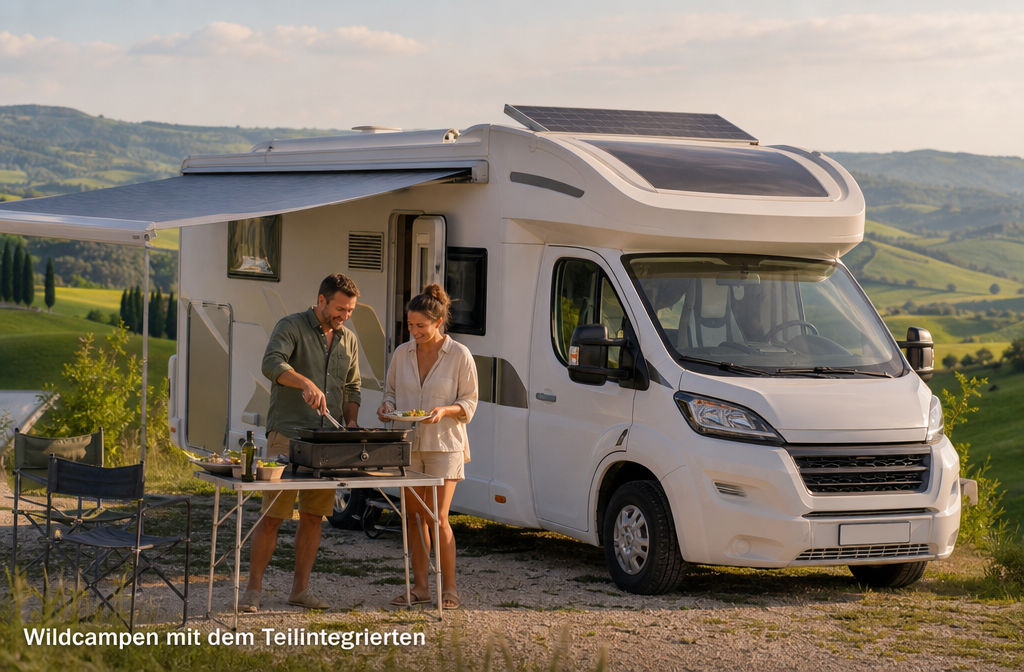
Wild camping with a semi-integrated motorhome is generally possible, but is subject to clear legal and practical frameworks. In most European countries, free overnight stays outside of designated areas are only permitted to a limited extent or not at all.
Legal principle: In Germany, wild camping is forbidden on private property without permission and in nature reserves. In countries like Sweden (Allemansrätten) or Scotland, there are significantly more liberal regulations.
Practical points for semi-integrated motorhomes when wild camping:
- Fresh water supply: Plan for at least a 100-liter tank, as no campsite supply is available.
- Self-sufficient power supply: A solar panel (at least 200 Wp) plus a lithium secondary battery is recommended.
- Wastewater: The gray water tank must be large enough to last 2–3 days without emptying.
- Pitch size: A 7-meter semi-integrated motorhome can fit on most gravel roads and bays accessible to passenger cars.
Those wanting to explore Tuscany by motorhome will find in our Adventure Guide to Tuscany many practical tips on pitches and routes.
What length is ideal for a couple in a semi-integrated motorhome?
For couples, vehicle lengths between 6.5 and 7.5 meters the best choice. Shorter models (under 6 m) often offer too little storage space and no full-fledged bathroom, while longer models (over 8 m) quickly become a problem on narrow campsites and city streets.
Why 6.5–7.5 meters?
- Still drivable with a normal B driving license (note total weight under 3.5 t!)
- Fits most campsite pitches in Europe
- Offers enough space for a fixed bed, shower room, and seating area.
- Easier to park in cities and on ferries
⚠️ Important: Total weight is often more crucial than length. Those driving with a B license must stay under 3.5 tons. More on this in the article about Motorhomes up to 3.5 tons and overloading.
How difficult is it to drive a semi-integrated motorhome?
Honest answer: less difficult than most beginners think. A semi-integrated motorhome drives very similarly to a large van because it is based on the same chassis. Anyone who has ever driven a moving truck or Sprinter will quickly feel comfortable.
What is unusual at first:
- Width and height: Most semi-integrated motorhomes are about 2.30–2.35 m wide and 3.0–3.2 m high. Parking garages and some underpasses are off-limits.
- Blind spot in the rear: A reversing camera is almost indispensable and often standard equipment in new vehicles.
- Wind sensitivity: You can clearly feel the vehicle on highways in crosswinds or when being overtaken by trucks.
After a weekend of getting used to it, most couples report that driving becomes routine. If you want to get a feel for it beforehand, you can simply Rent a campervan and take a short test trip before buying.
What are the disadvantages of semi-integrated motorhomes?
No type of vehicle is perfect, and the semi-integrated model certainly has a few weaknesses that you should be aware of.
The main disadvantages at a glance:
- No complete integration into living spaces: The driver's cab remains a separate zone, which can lead to heat loss in cold weather and poorer sound insulation in case of noise.
- Windshield as a weak point: A large windshield means heat in the summer and heat loss in the winter if thermal curtains or insulating mats are not used.
- Less panoramic view: Compared to a fully integrated motorhome, you sit lower and have less all-round visibility.
- Base vehicle dependency: When the Fiat Ducato or Sprinter undergo a model change, this can have an impact on the spare parts supply for older models.
Who is a semi-integrated motorhome not for? Anyone who wants to walk standing up through the entire vehicle every day (from the driver's seat to the bathroom) is better off with a fully integrated motorhome. And those who are only traveling as a couple on narrow city trips will find the panel van camper a more compact solution.
Can a semi-integrated motorhome also be used in winter?
Yes, but with limitations and the right equipment. Many semi-integrated motorhomes are designed ex works for temperatures down to -15 °C if they are equipped with a heater (diesel or gas heater, e.g. Truma or Webasto) and sufficient insulation.
What to watch out for when using in winter:
- Heating: Diesel-powered auxiliary heaters are more efficient than pure gas heaters at sub-zero temperatures.
- Water system: Fresh water tanks and pipes must be heatable or sufficiently insulated.
- Thermomatten: For windshields and skylights, they significantly reduce heat loss.
- Winter tires: Mandatory in many European countries under winter conditions.
Models with the designation Winter Package or 4-Season Expansion are specially designed for year-round use. More affordable entry-level models without these packages are better suited for spring through autumn.
Are semi-integrated motorhomes better for retirees or young couples?
Both groups benefit, but for different reasons. Semi-integrated motorhomes: The perfect compromise for couples applies to all age groups because this class of vehicle is so versatile.
For retired couples:
- A fixed bed without daily conversion protects your back
- A full-fledged bathroom with shower and toilet is more comfortable than in panel vans.
- Sufficient storage space for longer trips
- Lower driving stress compared to large fully integrated motorhomes.
For young couples:
- More affordable entry price than fully integrated motorhomes
- Compact enough for spontaneous trips and festival visits
- Easier to drive than alcoves or large fully integrated motorhomes
- Flexible for weekend trips and long journeys
💬 The semi-integrated motorhome is the Swiss Army knife of motorhomes: not the specialized tool for every single case, but the right thing for 90% of situations.
Anyone wanting to explore South Holland or other European regions will find it in South Holland Motorhome Guide Inspiration for the first route.
What additional equipment is worthwhile for semi-integrated motorhomes?
The basic equipment of a semi-integrated motorhome is sufficient for simple campsite vacations. Those who want more flexibility and comfort should retrofit specific features.
Features that are really worth it:
| Features | Benefit | Costs (approx.) |
|---|---|---|
| Solar panel (200–400 Wp) | Self-sufficient power supply | 500–1,500 € |
| Lithium auxiliary battery (100 Ah) | More capacity, less weight | 800–1.500 € |
| Reversing camera | Safety during shunting. | 150–400 € |
| Awning (electric) | Sun protection, outdoor living space | €800–€2,000 |
| Thermal Windshield Covers | Winter comfort, privacy | 100–300 € |
| Gas grill (outdoor) | Cooking outdoors | 80–300 € |
Anyone who enjoys cooking outdoors will find what they need in our Gas Grill Guide for RVs Practical tips for selection and use.
What mistakes do beginners make when buying a partially integrated motorhome?
The most common buying mistakes either cost money or nerves, and most are easily avoidable.
The 5 most common beginner mistakes:
- Buying too large a vehicle: An 8-meter model sounds tempting, but couples without children rarely need more than 7.5 meters.
- Do not test floor plan. Definitely sleep (or at least lie down) and cook in the vehicle before signing.
- Ignoring weight: Many semi-integrated motorhomes are already close to the 3.5-tonne limit when empty. With luggage, water and bicycles, this can quickly become problematic.
- Only look at the purchase price: Operating costs (insurance, TÜV, parking space, fuel) can amount to €3,000–6,000 per year.
- Used purchase without inspection: Moisture damage in the structure is the biggest risk when buying a used vehicle. Always bring a moisture meter or hire an expert.
Smarter start: Rent before you buy. Who owns a Rent a campervan ...and can test different floor plans, makes significantly better decisions when buying.
FAQ: Semi-Integrated Motorhomes for Couples
What is the difference between semi-integrated and fully integrated?
With semi-integrated motorhomes, the original driver's cab of the base vehicle is retained. With fully integrated motorhomes, the driver's cab is completely integrated into the living area, which offers more space and a panoramic view, but is also significantly more expensive.
Do I need a special driving license for a semi-integrated motorhome?
For vehicles up to 3.5 tons, a normal Class B driving license is sufficient. Heavier models require Class C1. Since 2026, there have been new EU regulations that may allow driving motorhomes up to 4.25 tons with Class B. More on this in our Article about the new EU driving license regulations.
How much fuel does a semi-integrated motorhome consume?
On average, consumption is 10–14 liters of diesel per 100 km, depending on driving style, load, and wind conditions. More likely towards the upper end on highways, and towards the lower end on country roads.
Can you park a semi-integrated motorhome on regular campsites?
Yes, semi-integrated models up to 7.5 m fit on almost all European campsites. For longer models, the maximum vehicle length of the site should be checked in advance.
How long does a semi-integrated motorhome last?
With good care and regular maintenance, easily 15–20 years or 200,000 km. The body is often more durable than the chassis.
Is a semi-integrated motorhome better than an alcove motorhome for couples?
For couples without children: mostly yes. Alcove motorhomes do offer an additional sleeping berth above the cabin, but they are more difficult to drive and have a higher center of gravity. Couples usually do not need the alcove bed.
How much does a good used semi-integrated motorhome cost?
For a well-maintained model that's 5–8 years old with 60,000–100,000 km mileage, you should expect to pay €35,000–€55,000. Be cautious with anything under €30,000.
Is it worth renting before buying?
Absolutely. Anyone using platforms such as Campcruisers Being able to test different vehicle types avoids expensive bad purchases and allows you to find the layout that really suits your travel style.
Conclusion: Semi-integrated motorhomes as the perfect compromise for couples
Semi-integrated motorhomes: The perfect compromise for couples is not an empty marketing phrase, but an honest assessment. This vehicle class offers genuine living comfort, remains easy to drive and affordable, and adapts to almost any travel style, whether short trip, seasonal travel or long-term adventure.
Your next steps:
- Check the floor plan: Visit a trade fair (e.g. Caravan Salon Düsseldorf) or a dealer and test different layouts.
- Calculate weight: Realistically calculate what you want to carry and check the permissible total weight.
- Rent first, then buy: Utilizes Campcruisersto rent a partially integrated motorhome for a weekend and experience everyday life on wheels.
- Plan route: Start small. A first tour through South Holland or Tuscany is perfect for beginners.
Adventure awaits, and a semi-integrated motorhome is the ideal companion for most couples. 🚐✨
Quellen
- Caravaning Industry Association (CIVD): Market Data Motorhomes Germany, 2023, https://www.civd.de
- ADAC Motorhome Guide: Motorhome Types in Comparison, 2022 https://www.adac.de
- Stiftung Warentest: Motorhome Test, 2021 https://www.test.de
Tags: Semi-integrated motorhome, motorhome for couples, rent a motorhome, rent a camper, motorhome types, camping tips, motorhome buying guide, wild camping, motorhome equipment, camping couples, Hymer, Dethleffs


 English
  German
  Spanish
  Italian
  Polish
  Dutch
Dutch  French
  Danish