
Last updated: May 24, 2026
Quick Answer: A campervan with a pop-up roof (also called a high-top or pop-top) is a campervan whose roof can be raised manually or electrically to create headroom inside and often an additional sleeping area. The pop-up roof makes compact vans suitable for everyday use without permanently increasing the vehicle height. It is one of the most popular ways for couples, families and solo travellers to get more space out of a small vehicle.
Key Takeaways
- A pop-up roof typically increases the standing height in a campervan to 1.80–2.10 m and often creates a second sleeping area.
- The retrofit costs for a professionally installed pop-up roof are roughly between 2,500 and 6,000 euros, depending on the vehicle and manufacturer.
- Popular base vehicles for pop-top roof conversions include VW T6/T7, Mercedes Vito, Ford Transit Custom, and Renault Trafic.
- The total weight increases by approximately 30-80 kg due to a pop-up roof, which slightly increases fuel consumption.
- In Germany, a pop-up roof retrofit must be entered in the vehicle documents and approved by the TÜV.
- Renowned German manufacturers and outfitters include Reimo, Westfalia, VW (Originalzubehör), and California Concepts.
- For families with children, the pop-up roof is particularly valuable; solo travelers benefit most from the headroom.
- Regular maintenance of the soft top and seals significantly extends their lifespan.
What exactly is a pop-up roof on a campervan?
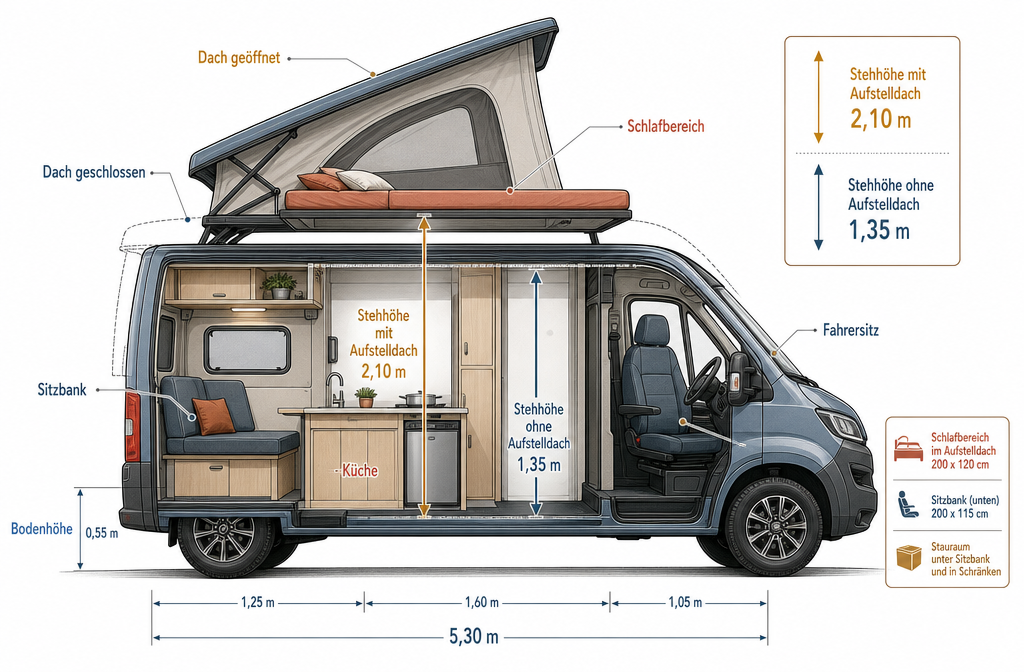
A pop-up roof is a hinged or liftable roof element that is integrated into the vehicle roof of a campervan. When closed, the van looks like a normal vehicle; when open, it creates an elevated living space with headroom and often an additional sleeping area.
There are two main variants:
- Folding sunroof (classic poptop): The roof is pushed upwards and folds open on one side. Typical for VW California and Reimo conversions.
- Elevating Roof The entire roof lifts evenly, often with rigid side walls made of GRP (glass fiber reinforced plastic) instead of fabric.
The term "Aufstelldach" (pop-up roof) is often used synonymously in German with "Hubdach" (lifting roof), "Poptop" or "Elevating Roof". The main difference to a high roof: A high roof is permanently raised, a pop-up roof can be lowered.
How much extra space does a pop-up roof really provide?
A pop-top roof transforms a compact campervan into a fully-fledged living space. When erected, most models achieve an interior height of 1.80 to 2.10 m, compared to approx. 1.30–1.45 m when the roof is closed.
This means specifically:
| Condition | Typical interior height | Headroom possible? | An extra bed? |
|---|---|---|---|
| Roof closed | 4. 3–4.7 ft | No | No |
| Pop-up roof open | 1. 80–2.10 m | Ja | Yes (on most models) |
The sleeping area in the attic usually offers space for one to two people (depending on the vehicle width), with a sleeping surface of approximately 1.90 × 1.10 m for the VW T6 format. It's not a luxury bed, but absolutely sufficient for a night under the stars.
💡 Practical tip: Anyone who travels regularly with children particularly appreciates the pop-up roof bed. Children love the elevated sleeping area, and adults have the lower bed to themselves.
Cost Comparison: Standard Campervan vs. Campervan with Pop-Up Roof
A pop-top roof is an investment that can be worthwhile, but needs to be well-planned. Anyone buying a vehicle with a pop-top roof or having one retrofitted must expect the following costs (all figures are estimates for 2026, without guarantee):
New vehicle with factory pop-up roof (e.g., VW California Ocean): from approx. 60,000–75,000 Euro
Retrofitting by a specialized converter.
- Simple folding sliding roof (fabric): approx. 2,500–4,000 euros
- High-quality GRP pop-up roof with sleeping area: approx. 4,000–6,500 euros
- Electric pop-up roof (Premium): from approx. 5,000 euros upwards
Ongoing additional costs:
- Slightly increased fuel consumption (approx. 0.2–0.5 l/100 km more due to additional weight)
- Occasional care and renewal of the roof covering (every 5–10 years, approx. 300–800 euros)
Anyone who wants to try out a camper van with a pop-up roof before buying or retrofitting one can find options on platforms like Campcruisers rent a suitable campervan and test the concept in everyday life.
The best manufacturers for pop-up roof campervans in Germany
There are several established places to go in Germany for campervans with pop-up roofs, both for new vehicles and for retrofitting.
Well-known providers and manufacturers (without rating):
- Reimo: One of the largest European specialists for camping conversions, offers folding sliding roofs and complete conversion kits for many vehicle models.
- Westfalia: A name steeped in tradition in the camping sector, known for high-quality VW conversion solutions.
- VW Commercial Vehicles: The VW California is the best-known production vehicle with a pop-up roof in Germany.
- California Concepts / Reimo Motorhomes: Specialized in individual conversions for various base vehicles.
- Terrain Tamer / Pendle Conversions: Better known in the British market, but also available in Germany.
Anyone wishing to retrofit a used vehicle should be sure to use certified body shops that provide TÜV-compliant documentation.
Common Problems with Pop-Up Roofs and How to Avoid Them
A pop-up roof is robust, but not maintenance-free. The most common problems concern:
- Leaky seals: Especially after several years, the rubber sealing strip can become porous. Regular rubbing with rubber care products (e.g. silicone-based) extends its lifespan.
- Stuck linkage: Hinges and gas springs can become stiff in the cold. Light grease or silicone spray helps.
- Damaged roofing material: UV radiation and mechanical stress take their toll on the fabric. Quality products made of acrylic or polyester last significantly longer than cheaper alternatives.
- Condensation in the interior: Without sufficient ventilation, condensation will form in the roof area. A small ventilation grille or a roof ventilator will remedy this.
⚠️ Common mistake: Erect the pop-up roof in strong wind or rain. Even high-quality pop-up roofs are not designed for extreme conditions. When in doubt, it is better to keep it closed.
Is a pop-up roof worth it for solo travelers or families?
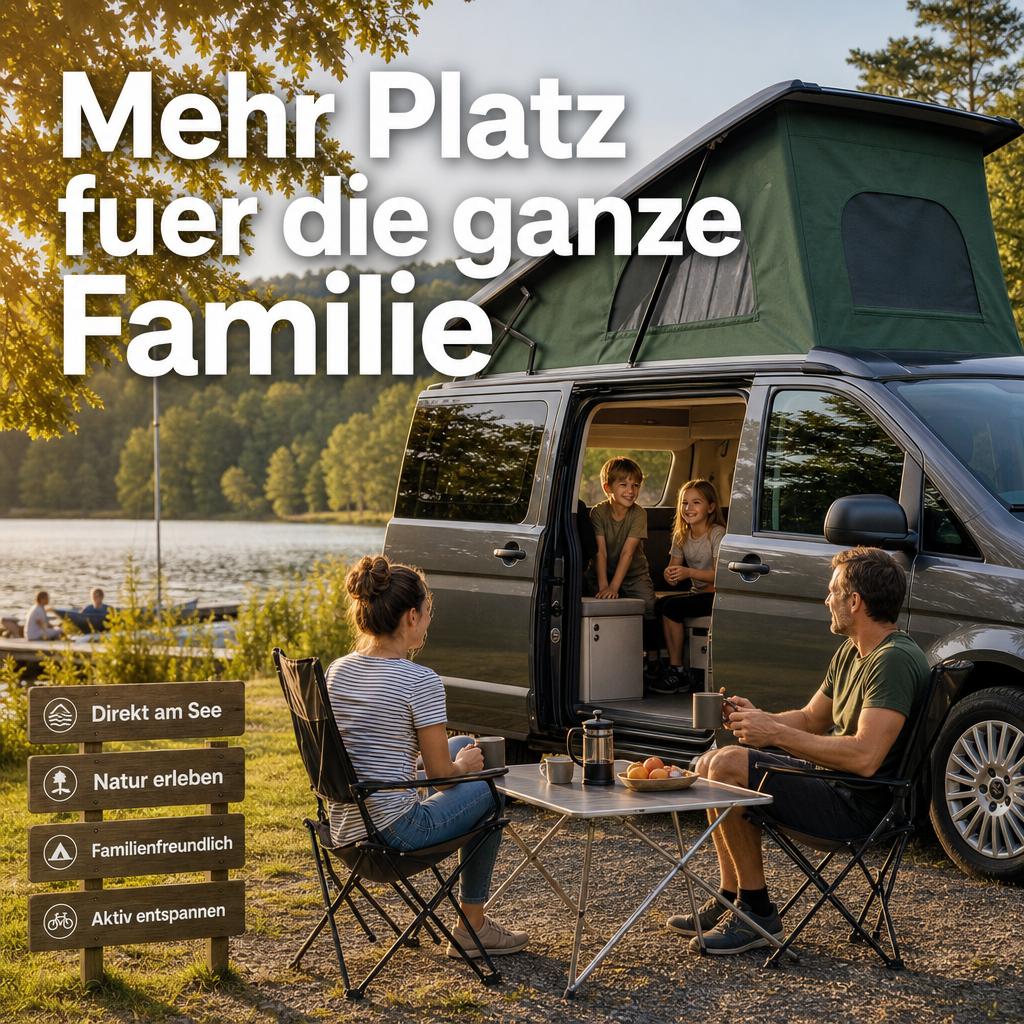
For families: Definitely yes. The pop-up roof creates a second sleeping space and headroom, which makes everyday life in the van much more comfortable. The difference is especially noticeable when traveling with children.
For solo travelers and couples: The added value lies mainly in the headroom and the better sense of space. An additional sleeping space is less relevant for one person, but being able to stand up without bending over is a real gain in comfort.
Choose a pop-top roof if:
- You are traveling with two or more people
- You value being able to stand up straight while getting dressed, cooking, or moving around in the van.
- If you also want to drive the vehicle in everyday life (low profile with the roof closed)
A pop-top roof is less important if:
- You are traveling exclusively solo and headroom is not an issue.
- You prefer a vehicle with a permanently high roof (e.g. a high-roof Transit)
- The budget is very limited.
You can find inspiration for campervan destinations in our article about the Adventure Tuscany with the RV or the Exploring South Holland.
How difficult is it to self-install a pop-up roof?
Retrofitting an elevating roof yourself is technically possible but challenging. Bodywork is necessary: the vehicle roof must be cut out, which can quickly go wrong without experience and tools.
Steps for self-assembly (simplified):
- Measure the vehicle roof and create a cutting template.
- Creating a roof cutout with a jigsaw and angle grinder
- Seal cut edges (rust protection!)
- Fit and screw the pop-top roof frame
- Run electrical wiring (if electric convertible top).
- TÜV approval and registration in the vehicle documents
Recommendation: Anyone without experience in bodywork should leave the installation to a certified specialist. The costs for professional installation are manageable compared to the risk of incorrect self-installation.
Which vehicles are best suited for a pop-top roof conversion?
The choice of base vehicle is crucial. Not every van is equally well suited for a pop-top roof.
Particularly suitable vehicles:
| Vehicle | Roof width | Available pop-up roofs | Besonderheit |
|---|---|---|---|
| VW T6 / T6.1 / T7 | 1. 42 m | A great many (Reimo, Westfalia, VW) | Largest selection on the market. |
| Mercedes Vito / V-Class | 1.50 m | Multiple providers | A little more width |
| Ford Transit Custom | 1.45 m | Growing supply | Good value for money |
| Renault Trafic / Opel Vivaro | 1. 42 m | Some providers | More affordable base vehicles |
| Fiat Ducato (Panel Van) | 1.70 m | Few specialized providers | More volume, but less choice. |
The VW T6/T7 has the largest selection of pop-up roofs because it is the best-selling base vehicle for campervans in Germany.
By the way: Electric campervans can also be combined with pop-up roofs. Read more in the article about the eVentje, the electric camper van.
Weight and Fuel Consumption: What changes with a pop-up roof?
A pop-up roof weighs between, depending on the design and material 30 and 80 kgThat sounds like a lot, but it's manageable in the context of a campervan.
Impact on fuel consumption:
- An extra weight of 30–80 kg increases fuel consumption by approx. 0.2–0.5 l/100 km (estimated value, depending on the vehicle and driving style).
- With the roof closed, the drag coefficient (cw value) is hardly worse than the production vehicle.
- When driving with the roof open (which is not recommended), the air resistance increases significantly.
Anyone driving a motorhome up to 3.5 tons should keep an eye on the extra weight. Our article on Motorhomes up to 3.5 tons and overloading provides helpful information on this.
Can you really sleep comfortably in the pop-up roof?
Yes, with the right expectations. The sleeping area in the pop-up roof is not a hotel bed, but absolutely sufficient for camping.
What works well:
- Sleeping area of approx. 1.90 × 1.10 m (VW T6 format) is sufficient for two people who know each other well 😄
- Temperatures: The roof fabric insulates less than the vehicle body, therefore colder in winter. A good sleeping bag or down comforter is essential.
- Ventilation: Many pop-up roofs have integrated windows or mesh inserts that provide fresh air.
What works less well:
- The noise level on the roof fabric can be disruptive in heavy rain.
- In high summer, it can get very warm under the fabric. Going to bed early or a ventilation system helps.
Legal Requirements for Pop-Top Roof Conversions in Germany
In Germany, any structural modification to a vehicle that affects its operating license must be registered. A pop-up roof is such a modification.
What vehicle owners need to know:
- The retrofit must be approved by a recognized expert (TÜV, DEKRA or GTÜ).
- After acceptance, the pop-up roof will be entered in the vehicle documents (Registration Certificate Part I).
- Reputable outfitters provide a component certificate or a general operating permit (ABE) for their product, which simplifies registration.
- Failure to register may invalidate the operating permit, which can have consequences under insurance law in the event of damage.
⚠️ Important: Always ask the conversion company in advance for an ABE (general operating permit) or parts certificate. This saves time and money during the TÜV inspection.
Alternatives to the classic pop-up roof
A pop-up roof isn't the only way to create more space in a campervan. There are interesting alternatives:
- Permanent high roof: Fixed, raised roof made of GRP or steel. Full standing height is always available, but a higher vehicle profile (parking garages, ferries).
- Folding roof / folding sunroof: Compromise between pop-up roof and high roof, often more affordable to retrofit.
- Roof tent on the vehicle roof: Separately mounted tent on the roof rack. Affordable, but less integrated.
- Extendable alcove bed: No roof conversions, instead a bed that is extended over the driver's cab. Typical of larger motorhomes.
Choose the high roof if you want permanent headroom and the vehicle profile doesn't matter. Choose the pop-up roof if you prefer flexibility and a normal vehicle profile when driving.
Maintenance tips for a long service life of the pop-up roof
A well-maintained pop-up roof will last for many years. These measures make the difference:
- Regularly clean the roof fabric. Mild soapy solution, no harsh cleaners. At least once per season.
- Rub in seals: Apply silicone spray or special rubber care product to all sealing strips (2× per year).
- Check hinges and gas springs. Check for smooth operation, grease if necessary.
- Let the roof dry after rain. Never roll up or close when damp, as this promotes mold.
- Winter storage: Store with the roof slightly open or allow to dry completely before storing the vehicle.
- Visual inspection for cracks: Especially at the corners of the roof covering and at the seams.
FAQ: Camper Van with Pop-Up Roof
How much does a pop-up roof for a VW T6 cost?
The retrofitting costs, including installation, range from approximately 2,500 to 6,000 euros depending on the model and provider. Inexpensive folding sliding roofs start below 3,000 euros, while high-quality GRP pop-up roofs with a sleeping area cost more.
Can I install a pop-up roof myself?
Technically yes, but body work is required. Without experience, professional installation is strongly recommended, as mistakes are costly and safety-relevant.
Does a pop-up roof need to be registered in Germany?
Yes. Every structural modification to the vehicle must be approved by TÜV, DEKRA or GTÜ and entered in the vehicle documents.
How much weight does a pop-top roof add?
Depending on the design and material, between 30 and 80 kg. This is roughly the weight of an adult person.
Can you drive into parking garages with a pop-up roof?
Yes, when closed, a van with a pop-up roof has the same height profile as the standard vehicle. Typical vehicle heights are 1.90–2.00 m.
How long does a pop-up roof last?
With regular maintenance, a high-quality pop-up roof will last 10–20 years. The roof fabric may need to be replaced after 8–12 years.
Which vehicle has the best factory-installed pop-up roof?
The VW California is the best-known production vehicle with a pop-up roof in Germany and is considered the benchmark in this segment. Other manufacturers offer similar solutions.
Is a pop-up roof waterproof?
High-quality pop-up roofs are water-repellent, but not 100% waterproof in heavy rain and wind. Regular maintenance of the seals is crucial.
Can a pop-up roof be used in winter?
Yes, but the insulation is less than the vehicle body. A good sleeping bag or down comforter is a must in winter.
Is a pop-up roof worth it when renting?
Absolutely. Anyone who wants to rent a camper van with a pop-up roof can try out the concept without the risk of buying. On Campcruisers Various campervans with pop-up roofs are available.
Conclusion: More space, more freedom
For many camping enthusiasts, a camper van with a pop-up roof is the ideal compromise: compact and suitable for everyday use when driving, spacious and comfortable when standing and sleeping. Whether for weekend trips to the Sauerland, a road trip through Tuscany, or a longer journey through Europe, the pop-up roof turns a simple van into a real home on wheels.
Concrete next steps:
- Try before you buy: Rent a campervan with a pop-up roof via Campcruisers and test whether the concept fits your travel style.
- Select vehicle: VW T6/T7 offers the largest selection of pop-up roofs. For larger groups, it's worth taking a look at the Mercedes Vito or Ford Transit Custom.
- Compare converters: Obtain at least three quotes and insist on a general operating permit (ABE) or a parts certificate.
- Don't forget the TÜV registration: Without registration, you risk losing your insurance coverage.
- Establish a skincare routine: Service the seals and clean the roof fabric twice a year, and the pop-up roof will last for many years.
Anyone looking for more camping inspiration can find it on the Campcruisers Blog More tips about renting and traveling with a motorhome.
Quellen
- Reimo Reisemobile GmbH: Product Information about Pop-Up Roofs and Vehicle Conversion (reimo.com)
- Federal Motor Transport Authority (KBA): Information on Vehicle Modifications and Operating Permit (kba.de)
- VW Commercial Vehicles: California Model Description and Technical Data (vw-nutzfahrzeuge.de)
- ADAC: Guide to Motorhomes and Campervans (adac.de)
Tags: Campervan with pop-up roof, pop-up roof campervan, poptop van, campervan conversion, camper rental, motorhome rental, VW California, camping vacation, campervan conversion, Reimo pop-up roof, camping Germany, campervan sleeping space


 English
  German
  Spanish
  Italian
  Polish
  Dutch
Dutch  French
  Danish