
Last updated: May 24, 2026
Quick Answer: A 4×4 camper is worthwhile whenever the planned route takes you off paved roads, winter conditions prevail, or remote natural destinations are to be reached that are simply not accessible with a standard motorhome. For classic camping trips on campsites, an all-wheel-drive motorhome is usually oversized and unnecessarily expensive. The decision therefore depends less on the vehicle than on the itinerary.
Key Takeaways
- 🏔️ All-wheel drive is worth it. on gravel roads, river crossings, snow, sand, and steep terrain.
- 💶 4×4 camper costs typically cost 30–80% more per day in rent than comparable standard models (estimated, depending on provider and vehicle class).
- ⛽ Increased consumption An additional consumption of approx. 2–4 liters per 100 km is realistic to factor in for all-wheel drive.
- 🌨️ Winter rental is possible and makes sense, especially in Scandinavia, Iceland, or the Alps.
- Family Families benefit from the increased security and larger interiors of many expedition campers.
- 🚗 Driver's license class and be sure to check the vehicle's weight beforehand, as some 4×4 campers exceed 3.5 tons.
- 🛡️ Insurance terms and conditions Off-road driving is often restricted; always read the rental terms and conditions.
- 🧰 Additional equipment like sand ladders, recovery straps and compressors can be crucial.
- 🌍 Popular Destinations For all-wheel drive campers: Iceland, Namibia, Australia, Patagonia, Norway, Scotland.
- ✅ For normal camping trips In Central Europe, a standard RV is usually the better choice on paved roads.
What are the advantages of all-wheel drive motorhomes off-road?
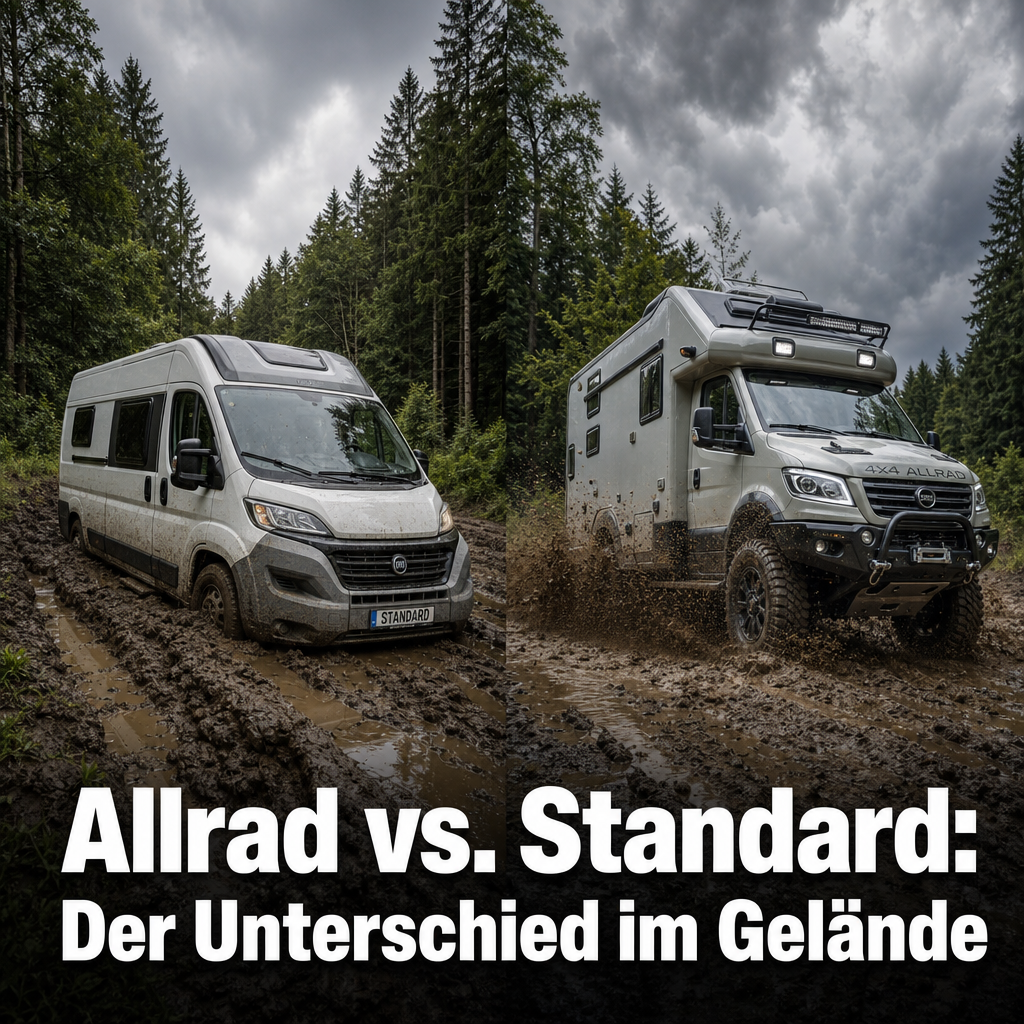
All-wheel drive motorhomes transfer engine power to all four wheels simultaneously, which significantly improves traction on loose, slippery, or uneven surfaces. This means that gravel roads in Iceland, sandy tracks in Namibia, or snowy forest roads in Scandinavia become realistic destinations that would simply remain closed off with a standard motorhome.
The most important terrain advantages at a glance:
- Higher ground clearance: Expedition campers often have 25–35 cm of ground clearance, while standard RVs usually have less than 20 cm.
- Limited slip differentials: Enable driving out of deep ruts or mud holes.
- Better wading depth: Many 4x4 campers are designed for river crossings up to 60–80 cm.
- More stable suspension: Reduces damage on bumpy terrain.
- Hill Descent Control Modern all-wheel drive systems support controlled driving on steep slopes.
Decision rule: Anyone planning to spend more than 20% of their planned route on unpaved roads should seriously consider renting all-wheel-drive camper vans.
Are 4x4 campers more expensive than regular RVs?
Yes, clearly. All-wheel drive campervans are more expensive to rent, and for several reasons: higher vehicle acquisition costs, specialized maintenance, and lower availability in the rental market.
Typical price differences (estimates, depending on region and season):
| Vehicle type | Daily rental (indicative price) | Additional costs compared to standard |
|---|---|---|
| Compact campervan (2WD) | 80–130 € | Base |
| Large alcove motorhome (2WD) | €120–€180 | +20–40% |
| 4×4 camper (pickup base) | 150–250 € | +50–80 % |
| Expedition Camper (All-Wheel Drive) | €200–€350 | +80–150 % |
Note: These values are guideline values based on standard market rental prices in Europe and Australia (2026). Actual prices vary considerably depending on the provider, season and destination.
In addition, there are higher fuel costs due to increased consumption. If you want to rent an all-wheel drive motorhome, you should realistically calculate the overall budget.
Common mistake: Travelers book an expensive 4×4 camper for a route that is 90% on asphalt. The money would be better invested in a more comfortable standard vehicle or more travel days.
What routes and types of terrain are best suited for all-wheel drive motorhomes?
All-wheel drive motorhomes unfold their added value on routes that deliberately run off the main roads. For asphalt trips through France or Tuscany, nobody needs all-wheel drive.
Ideal destinations and terrain types:
- 🇮🇸 Iceland: F-roads (highland roads) are legally only open to 4x4 vehicles.
- 🇳🇦 Namibia: Gravel roads like the D-roads, sand dunes in the Etosha area.
- 🇦🇺 Australia (Outback): Red Centre, Cape York Peninsula, Gibb River Road.
- 🇳🇴 Norway: Fjord roads in winter, Hardangervidda Plateau.
- 🏴 Scotland: Remote Highlands trails, unpaved coastal paths.
- Argentina Patagonia: Route 40, gravel roads near El Calafate and Torres del Paine.
Who, for example, from Buenos Aires to Ushuaia Anyone who travels to Ruta 40 and Patagonia will quickly realize why all-wheel drive is not a luxury, but a necessity.
Decision rule: If the route includes F-roads, D-roads or outback tracks, then all-wheel drive is mandatory, not optional.
Can I rent a 4×4 camper in the winter?
Yes, winter rentals are possible with many providers and even recommended for certain destinations. All-wheel drive campervans with winter tires are the safest choice in Scandinavia, Iceland, and the Alps in winter.
What to consider when renting in winter:
- Winter Tires or Studded Tires: Legally required in Norway, Sweden and Finland (periods vary depending on region).
- Heating system: Diesel heaters (e.g. Webasto or Truma) are indispensable in sub-zero temperatures.
- Battery capacity: Cold significantly reduces the performance of auxiliary batteries, pay attention to lithium batteries or sufficient capacity.
- Antifreeze in the water system: Many rental companies equip winter vehicles accordingly, but always ask.
- Visibility and Illumination: Short days in Scandinavia require good lighting and possibly auxiliary headlights.
Popular winter destinations for 4×4 campers: Lofoten (Norway), Lapland (Sweden/Finland), Icelandic Highlands (limited access), Swiss Alps.
Which brands offer good all-wheel-drive RVs for rent?
Not all brands are equally available in the rental market. The selection depends heavily on the destination.
Popular vehicle bases for rental all-wheel-drive campers:
- Toyota Land Cruiser / HZJ: Classics for Africa, Australia and Iceland, extremely reliable.
- Mercedes-Benz Sprinter 4×4: Popular base for European expedition campers, good workshop availability.
- Iveco Daily 4×4: Higher payload, popular for larger bodies.
- Volkswagen Crafter 4MOTION: Compact, good for gravel roads in Europe.
- Unimog (Mercedes-Benz): Extreme terrain, highly specialized, rarely available for rent.
- Ford Transit 4×4: Common in the rental market in Australia and New Zealand.
On Campcruisers.com Travelers can specifically filter for RV rentals with all-wheel drive and compare vehicles from professional rental providers worldwide. The platform works with specialized rental companies that focus on expedition vehicles.
What should I keep in mind when driving an all-wheel drive campervan?
All-wheel drive protects against many dangers, but not all. Anyone who has never driven a heavy 4×4 vehicle should familiarize themselves with the basics before the trip.
The most important driving tips:
- Engage all-wheel drive only when needed. Permanent all-wheel drive on asphalt increases wear and fuel consumption.
- Drive slowly off-road: Speed is the most common mistake in off-road driving. Under 20 km/h is often the right speed.
- Choose the driving line, don't correct it. In the field, determine the line before the obstacle, don't steer in the middle of it.
- Know the weight: Many 4×4 campers weigh over 3.5 tons. Who underestimated the weight limits, risks fines and insurance problems.
- Adjust tire pressure: Reduce pressure for sand and gravel (often to 1.5–2.0 bar), increase again on asphalt.
- Never alone in extreme terrain: Always drive with a second vehicle or after researching the route beforehand.
In addition, it's worth taking a look at the new EU driving licence regulations, as heavy all-wheel drive motorhomes may require a class C or CE driving license, depending on their weight.
Is a 4x4 camper worth it for normal camping trips?
For classic camping trips to developed campsites in Central Europe, an all-wheel drive RV is usually not worth it. The additional rental costs, higher fuel consumption, and often more limited maneuverability on narrow campsites argue against it.
When a standard RV is better:
- The route is more than 80% asphalt.
- Overnight stays exclusively at campsites with paved pitches.
- Budget is limited.
- No experience with off-road vehicles.
When 4x4 makes sense even for "normal" tours:
- Autumn/winter travels in low mountain ranges or Alpine regions with the risk of snow and ice.
- Travel to countries with poor road infrastructure (e.g., Albania, Morocco, Georgia).
- If wild camping on unpaved pitches is planned.
For a relaxed journey through Tuscany or South Holland, a comfortable standard vehicle is perfectly adequate and even makes traveling more pleasant.
How much more fuel does an all-wheel drive RV consume?
An all-wheel-drive campervan consumes an estimated 2–4 liters more per 100 km compared to a comparable 2WD model. This is due to the higher curb weight of the all-wheel-drive system, the larger tire cross-section, and the often more powerful engine.
Typical consumption values (estimated values):
| Vehicle type | Consumption (reference value) |
|---|---|
| Compact 2WD Camper Van | 9–12 l/100 km |
| Large 2WD Motorhome | 12–16 l/100 km |
| 4×4 camper (pickup base) | 13–18 l/100 km |
| Expedition 4x4 Camper | 16–22 l/100 km |
On a 2,000 km trip, an extra consumption of 3 l/100 km means around 60 liters of additional fuel, which at a diesel price of €1.60 results in approximately €96 in additional costs. Not a budget killer, but something to factor in.
Are there any insurance restrictions for 4x4 campers?
Yes, and that's one of the most common pitfalls when renting all-wheel drive RVs. Many rental agreements explicitly exclude damage from off-road driving, even if the vehicle is technically designed for it.
Typical insurance clauses for 4×4 rental vehicles:
- Off-road exclusion: Damages on non-public roads or off-road are often not covered.
- Tyre damage: Often generally excluded, even in all-wheel drive vehicles.
- Underbody clause: Damage to the underbody caused by stones or obstacles is often not insured.
- River crossings: Water damage caused by crossing rivers is almost always excluded.
What to do:
- Read the rental agreement completely before booking.
- Request additional insurance for off-road operation.
- Book with providers that offer transparent insurance conditions for off-road driving.
- Consider taking out private travel insurance with vehicle damage coverage.
What additional equipment do I need for an all-wheel drive camper van?

The vehicle alone is not enough. Anyone driving off-road in a 4×4 camper needs the right equipment to be able to help themselves in an emergency.
Recommended basic equipment for off-road tours:
- 🪣 Sand ladders (e.g. MAXTRAX): For driving out of sand or mud traps.
- 🔧 Recovery strap and shackle: For breakdown assistance by another vehicle.
- 💨 Compressor: For adjusting tire pressure off-road.
- 🔦 High-Lift Jack: For lifting the vehicle in case of punctures in the field.
- 🗺️ Offline Maps and GPS: Mobile service is often unavailable in the field. Who travels without internet, should be well prepared.
- 🧯 Fire extinguisher: Mandatory in many countries, and advisable for expedition trips anyway.
- 🪫 Power station or auxiliary battery: For self-sufficient camping without a power connection.
- 💧 Water reserve: At least 20 liters extra for remote areas.
Many rental companies offer this equipment as optional accessories, often at an extra charge. Always clarify in advance what is included in the rental package.
Are 4x4 RVs suitable for families?
Yes, all-wheel-drive RVs are generally suitable for families, provided the vehicle is appropriately sized and the route is planned to be child-friendly. Many expedition campers offer more space and features than compact standard vehicles.
Benefits for families:
- Larger interiors with separate sleeping areas in many expedition models.
- Increased safety on wintry or slippery roads.
- Access to quieter, more secluded pitches away from crowded campsites.
- Adventure character that inspires children.
What families should pay attention to:
- Child seats: Always ask the rental company in advance whether Isofix attachments are available.
- Vehicle height: High-built 4×4 campers have high entry heights, which may be impractical for small children.
- Off-road driving with children: Extreme potholed roads are unpleasant for children and can be tiring on long journeys.
- Emergency planning: Always have a plan B in remote areas.
What mistakes should you avoid when renting an all-wheel drive RV?
When renting an all-wheel drive camper, the same mistakes are made time and again, which can be expensive or ruin the vacation.
The most common errors:
- Didn't read the insurance terms: Off-road damage is often excluded, even with 4×4 vehicles.
- Driver's license class not checked: Heavy all-wheel-drive campers may require a C license.
- Wrong vehicle selected for the route. Book a 4×4 camper for an asphalt road trip, or conversely a 2WD for F-roads in Iceland.
- Not enough time planned for off-road courses. Off-road, you often only drive at 20–40 km/h, and routes take significantly longer than on asphalt.
- No offline maps included. Cell phone reception is unreliable in rural areas.
- Recovery strap and sand ladders not included: Anyone who is stuck and has no equipment is dependent on outside help.
- Overload: Many expedition campers have limited payloads despite their robust construction.
FAQ: Renting All-Wheel Drive Motorhomes
Do I need a special driver's license for a 4×4 camper?
That depends on the weight of the vehicle. Vehicles up to 3.5 tons can be driven with class B. Heavier expedition campers require class C. Always check with the rental company and check the current EU regulations.
Can I rent a 4×4 camper spontaneously?
During peak season, all-wheel drive campervans are quickly booked, especially for popular destinations like Iceland or Namibia. Early booking (3–6 months in advance) is recommended.
Are F-roads in Iceland really only for 4x4 vehicles?
Yes. The Icelandic F-roads are legally closed to vehicles without all-wheel drive. Anyone caught there with a 2WD vehicle risks high fines and loss of insurance.
What does a 4×4 camper cost compared to a regular RV?
Roughly 30–80% more per day, depending on vehicle class, destination and season. In addition, there are higher fuel costs.
Can I camp anywhere with an all-wheel drive RV?
Not necessarily. Wild camping is regulated or prohibited in many countries, regardless of the type of vehicle. Always check the local regulations.
Which destination is best suited for first-timers with a 4×4 camper?
Scotland or Norway are good starting destinations: well-developed infrastructure, but enough adventure on gravel roads and remote coastal paths.
Is all-wheel drive necessary in the summer?
Only if the route includes gravel roads, sandy paths, or steep terrain. On asphalt in summer, all-wheel drive offers no advantage.
How far in advance should I book a 4x4 RV?
For peak season (June–August in Europe, December–February in Australia) book at least 3–6 months in advance. For winter season in Iceland or Scandinavia, plan early as well.
Conclusion: When is a 4×4 camper really worth it?
Rent all-wheel drive motorhomes: When is a 4×4 camper worth it? The answer is clearer than many think. A 4×4 camper is an exceptional travel tool for anyone who truly wants to travel off the beaten track: on gravel roads in Patagonia, the F-roads of Iceland, or the sandy tracks of Namibia. For these travelers, all-wheel drive is not a luxury, but a requirement.
For everyone else heading to well-developed campsites in Central Europe or planning relaxed summer tours, a comfortable standard RV is the smarter and more affordable choice.
Actionable Next Steps:
- Analyze route: What percentage of the route is on unpaved roads? Over 20% = seriously consider 4×4.
- Calculate budget: Include rental costs, additional fuel consumption, and supplementary insurance.
- Check driver's license: Check the weight of your desired vehicle against your own driver's license class.
- Read insurance policy terms: Before booking, not after.
- Rent a camper now: On Campcruisers.com All-wheel drive campers and standard vehicles from professional rental companies worldwide can be compared and booked directly. Simply enter your destination, filter by vehicle type and start your adventure.
Quellen
- Icelandic Road and Coastal Administration (Vegagerðin): Regulations for F-roads in Iceland – www.road.is
- ADAC Travel Magazine: Motorhome Consumption Values and Vehicle Classes (2023)
- European Driving Licence Directive 2006/126/EC (last amended 2023)
Tags: Rent an all-wheel drive RV, 4x4 camper, RV rental, expedition camper, off-road camping, rent an off-road vehicle, Iceland camper, winter camping, camper rental, all-wheel drive RV, camping adventure, long-distance RV


 English
  German
  Spanish
  Italian
  Polish
  Dutch
Dutch  French
  Danish