
Last updated: May 24, 2026
Quick Answer: A motorhome with an automatic transmission relieves the driver of manual shifting and makes long stages, city trips and mountain passes much more comfortable. Once you've driven automatic, you rarely want to go back to manual transmission. For beginners, couples and anyone who really wants to enjoy their vacation, automatic is often the better choice.
Key Takeaways 🚐
- Automatic transmission significantly reduce driving stress, especially in city traffic and on mountain roads.
- Modern automatic transmissions (e.g. torque converters, DSG, AMT) are reliable and low-maintenance.
- The surcharge for a motorhome with automatic transmission is approximately €2,000–5,000 when purchasing, depending on the model.
- Brands such as Mercedes-Benz, Fiat, Ford and Volkswagen offer tried-and-tested automatic transmissions in motorhomes.
- The fuel consumption of modern automatic transmissions hardly differs from that of manual transmissions anymore.
- Automatic transmission is especially recommended for novice drivers and older travelers.
- Alcove, semi-integrated, and fully integrated motorhomes benefit the most from automatic transmissions.
- Rental motorhomes with automatic transmission are available through platforms such as Campcruisers bookable.
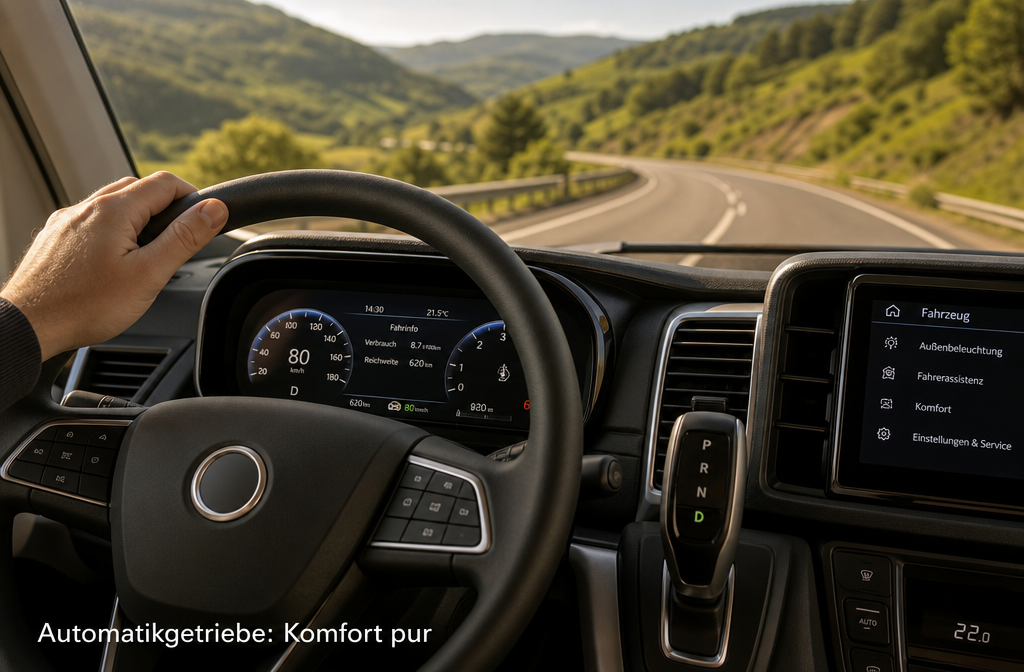
What are the advantages of an automatic transmission in a motorhome?
An automatic transmission in a motorhome makes driving noticeably more relaxed because the driver can fully concentrate on traffic, route and surroundings without constantly having to clutch and shift gears. This is not a luxury, but a real safety advantage.
The most important advantages at a glance:
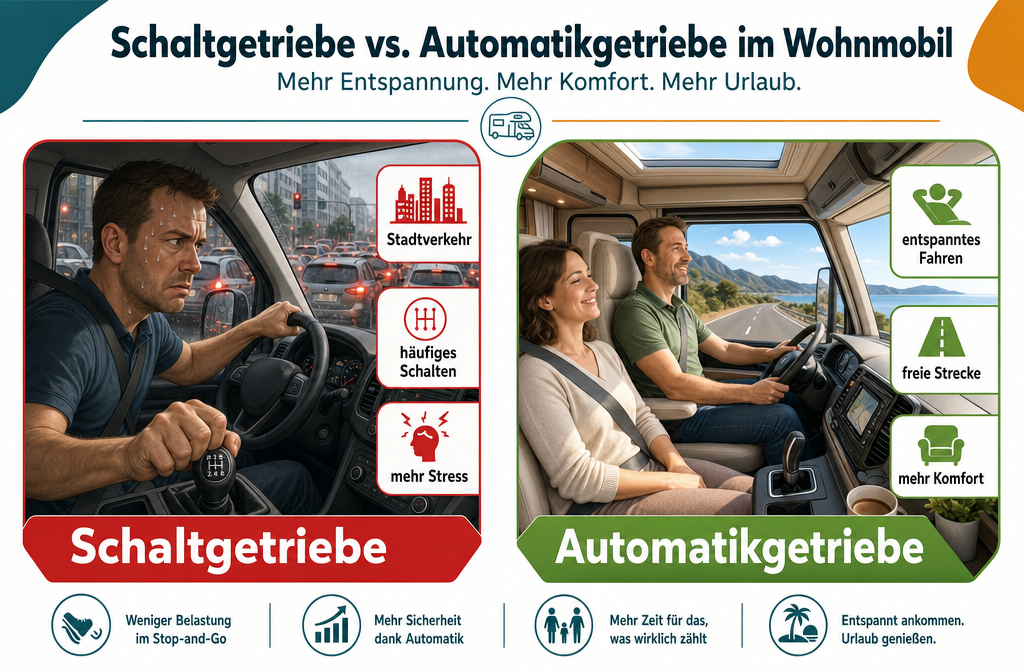
- Less driving stress: No manual clutch operation in traffic jams, at traffic lights or on serpentine roads.
- More safety: Both hands stay on the steering wheel, your eyes stay on the road.
- Smoother start: Especially with heavy vehicles (from 3.5 t), the automatic transmission prevents jerky starts.
- Comfort on long stages: Anyone who drives 400 km at a stretch gets tired much slower with an automatic transmission.
- Easier on the mountain: No rolling back when starting on hills, no stalling the engine.
- More relaxed passengers: Those who don't have to shift gears can navigate better, pour coffee, or enjoy the scenery.
Motto: A motorhome with an automatic transmission makes traveling so much more relaxed because it frees the driver from a mechanical task that is particularly strenuous with heavy vehicles.
What are the disadvantages of an automatic transmission in a motorhome?
Automatic transmissions are not the perfect solution for everyone. Those who enjoy active driving or travel in very remote regions should be aware of a few things.
Potential disadvantages:
- Higher purchase price: Automatic transmissions usually cost €2,000–5,000 more when purchased new.
- Limited repair options In remote areas (e.g. on a road trip from Buenos Aires to Ushuaia) automatic transmission damage can be more difficult to repair than a manual transmission problem.
- Less control when off-roading. Experienced drivers sometimes prefer manual control on extreme terrain.
- Habituation effect Anyone who has driven manual cars for years needs a few miles to get used to it.
Conclusion: For most camping vacations on European roads, the advantages clearly outweigh the disadvantages. The disadvantages mainly play a role on extreme tours or with a very limited budget.
How expensive are motorhomes with automatic transmission in comparison?
Motorhomes with automatic transmissions typically cost €2,000–5,000 more to purchase than comparable models with manual transmissions. When renting, the surcharge is often lower or non-existent, as many modern rental vehicles are already equipped with automatic transmissions as standard.
| Category | Manual transmission | Automatic transmission | Surcharge (approx.) |
|---|---|---|---|
| Panel van (new) | from €45,000 | from €48,000 | ~3.000 € |
| Semi-integrated (new) | from €65,000 | from €68,000 | ~€3,000–€5,000 |
| Fully integrated (new) | from €90,000 | from €93,000 | ~€3,000–€5,000 |
| Rent per day | 80–120 € | €90–€130 | ~€10–€20 |
Note: Prices are indicative values for 2026 and vary depending on the manufacturer, equipment, and market.
Those who want to rent a motorhome instead of buying one will find it at Campcruisers a wide selection of vehicles with automatic transmissions from professional rental partners worldwide.
Which brands offer good automatic transmissions in motorhomes?
The best-known and most reliable automatic transmissions in motorhomes come from Mercedes-Benz (9G-Tronic), Fiat (Comfort-Matic), Ford (EcoBlue Hybrid with 8-speed automatic) and Volkswagen (DSG). The base vehicle largely determines which transmission is installed.
Proven combinations:
- Mercedes Sprinter + 9G-Tronic: Very smooth shifting, popular with fully integrated and semi-integrated motorhomes (e.g. Hymer, Niesmann+Bischoff).
- Fiat Ducato + Comfort-Matic (ZF automatic): Frequently installed in Carado, Dethleffs, Knaus, Sunlight. Robust and widely used solution.
- Ford Transit + 8-speed automatic: Increasingly used by manufacturers such as Weinsberg and Bürstner.
- VW Crafter + DSG: Very direct shift characteristics, popular with van campers.
Tip: When buying or renting, always ask whether a true torque converter automatic transmission or an automated manual transmission (AMT) is installed. The difference in driving comfort is noticeable.
Are there differences between different types of automatic transmissions?
Yes, and the difference is clearly noticeable in everyday use. The three most common types in motorhomes are torque converter automatic transmissions, automated manual transmissions (AMT), and dual-clutch transmissions (DSG/DCT).
| Type | Ride comfort | Distribution in motorhomes | Besonderheit |
|---|---|---|---|
| Torque converter automatic | ⭐⭐⭐⭐⭐ very gentle | High (Mercedes, ZF) | Classic, very reliable |
| Automated manual transmission | ⭐⭐⭐ jerks slightly | Center (older Fiat models) | Cheaper, but noticeable shift jerks. |
| DSG/DCT | ⭐⭐⭐⭐ direct | Low (VW Crafter) | Sporty, very efficient |
Recommendation: Those who want maximum comfort should opt for the torque converter automatic transmission. AMT transmissions are automatic, but the shifting behavior is less smooth and can be annoying in heavy vehicles in city traffic.
How do I properly drive a motorhome with an automatic transmission?
A motorhome with an automatic transmission is generally easier to drive than one with a manual, but there are a few points to keep in mind in order to move the vehicle gently and safely.
Step-by-step for beginners:
- Selector lever to "D" (Drive) park and simply drive off. No clutch needed.
- Brake for stopping. use, do not put your foot on the clutch (there isn't one).
- Uphill driving: Foot on the brake, shift to "D", then release the brake and accelerate. No rolling back.
- Driving downhill: Use manual mode or "L/S" (Low/Sport) to activate engine braking and protect the service brake.
- Shunting: Shift into "R" (Reverse), work slowly and with a spotter.
- Parking: Always put it in "P" (Park) and also apply the handbrake, especially on hills.
Common mistake: Overheating the service brake on long downhill runs due to failure to use the engine brake. This is especially true for heavy motorhomes over 3.5 tons. More on weight issues can be found in the article about Motorhomes up to 3.5 tons and overloading.
Can I drive an RV with automatic transmission with little driving experience?
Yes, absolutely. A motorhome with an automatic transmission is much more accessible to novice drivers and people with little experience with large vehicles than a manual. The automatic eliminates the biggest hurdle when driving a motorhome: the coordinated clutch and gear changes in a heavy, long vehicle.
What beginners should still pay attention to:
- Vehicle width and length: A motorhome is wider and longer than a car. That takes practice, regardless of the transmission.
- Check driver's license: Since 2026, there will be new regulations in the EU for motorhomes over 3.5 t. More on this in our article on new driving licence regulations in the EU.
- Parking Practice: Practice beforehand in an empty parking lot, especially reversing.
- Using cruise control: Engage cruise control on highway stretches to reduce fatigue.
Choose automatic if: If you rarely drive large vehicles, plan on doing a lot of city traffic or mountain roads, or simply want to arrive more relaxed.
Are automatic transmissions in motorhomes less reliable?
Modern automatic transmissions in motorhomes are very reliable and have caught up enormously in recent years. The idea that automatic transmissions are more prone to failure than manual transmissions comes from a time when that was actually the case.
What practice shows:
- Torque converter automatics like the Mercedes 9G-Tronic or the ZF automatic in the Fiat Ducato are considered very durable with regular maintenance.
- Automatic transmissions don't have a clutch that wears out (a common cost item with manual transmissions).
- The greatest risks arise from too infrequent oil changes or Overheating when driving downhill without engine braking.
Conclusion: With proper maintenance, an automatic transmission in a motorhome is at least as reliable as a manual transmission.
How much do maintenance and repairs cost for automatic transmissions?
Maintenance and repairs for automatic transmissions are somewhat more expensive than for manual transmissions, but the difference is smaller than many expect. The decisive cost factor is regular transmission fluid changes, which are more important for automatic transmissions than for manuals.
Typical maintenance costs (guideline values 2026):
- Gear oil change: €150–400 depending on the vehicle and workshop (recommended every 60,000–100,000 km or every 4–5 years).
- Automatic transmission repair: €1,500–4,000 in case of damage (rare with correct maintenance).
- Clutch on manual transmission: €800–€2,000 (not applicable with automatic transmission).
Important: Anyone renting a motorhome via a platform like Campcruisers books, doesn't have to worry about maintenance and repairs. The professional rental partners take care of that.
What is the fuel consumption of a motorhome with an automatic transmission?
Modern automatic transmissions consume hardly any more fuel compared to manual transmissions, in some cases even less. Older automatic transmissions did indeed have higher consumption of 0.5–1.5 liters per 100 km, but current 8- and 9-speed automatics have largely eliminated this disadvantage.
Realistic consumption values for motorhomes (reference values):
| Vehicle class | Manual transmission | Automatic transmission | Difference |
|---|---|---|---|
| Panel van (3.5 t) | 9–11 L/100 km | 9–12 L/100 km | ±0–1 L |
| Partially integrated (3.5–5 t) | 11–14 L/100 km | 11–14 L/100 km | ±0–0.5 L |
| Fully integrated (>5 t) | 13–17 L/100 km | 13–17 L/100 km | ±0–0.5 L |
Values vary greatly depending on load, driving style, terrain and weather conditions.
Which RV classes are particularly suitable for automatic transmissions?
Basically, all motorhome classes benefit from an automatic transmission, but especially heavy and larger vehicles make the difference most noticeable.
Classes with the biggest comfort gain:
- Fully integrated motorhomes (from 6 t): Heavy, long, often maneuvered on tight campsites. Automatic transmission is almost indispensable here.
- Partially integrated motorhomes (3.5–5 t): The most common type of RV. Automatic transmission makes driving in the mountains and city traffic much more pleasant.
- Alcove motorhomes: Often heavier and more unwieldy. Automatic transmission significantly reduces driving stress.
- Panel van camper: Automatic mode is worthwhile here too, especially for city trips like a Tour of South Holland or the Tuscany.
Less critical: Small campervans under 3 tons, where driving is already similar to passenger cars.
What should I consider when buying a motorhome with automatic transmission?
When buying a motorhome with an automatic transmission, you should pay attention to the transmission type, the maintenance history, and the compatibility with your planned travel style. Not every automatic is the same.
Checklist for purchase:
- ✅ Clarify gearbox type: Torque converter automatic, AMT or DSG? (Torque converter = usually the most comfortable choice)
- ✅ Check maintenance history: Was the transmission fluid changed regularly?
- ✅ Take a test drive. Is the transmission jerking when starting or shifting gears? This is a warning sign.
- ✅ Check driver's license: Is class B sufficient, or is BE/C1 required? (Relevant from 3.5 t)
- ✅ Pay attention to weight: Overloading is a common problem, more on that in the article about Motorhomes up to 3.5 tons.
- ✅ Warranty and Guarantee: Is there a transmission warranty at the dealer?
- ✅ Rent before you buy: Those who are unsure can initially rent a motorhome with automatic transmission to get to know the driving style.
FAQ: Motorhome with Automatic Transmission
Can I drive an automatic motorhome with a regular driver's license (Class B)?
Yes, Class B is sufficient for up to 3.5 t permissible total weight. Since 2026, there are new regulations in the EU that allow heavier vehicles with Class B in certain cases. You can find details in the article on new EU driving licence regulations.
Is an automatic transmission in a motorhome better for older drivers?
Yes. The automatic system significantly reduces physical strain and mental fatigue, which is a real advantage, especially for older travelers.
Which automatic transmission is the most reliable in a motorhome?
The Mercedes 9G-Tronic and the ZF automatic transmission in the Fiat Ducato are considered particularly durable and proven in the motorhome industry.
Can I drive a motorhome with automatic transmission off-road?
Yes, but experienced off-road drivers sometimes prefer manual transmissions for more control. For normal camping terrain and paved roads, the automatic transmission is perfectly adequate.
How often does the transmission fluid need to be changed in an automatic transmission?
Usually every 60,000–100,000 km or every 4–5 years, depending on the manufacturer and usage. Always consult the vehicle manual.
Is a rental RV with automatic transmission more expensive?
Often only slightly. Many modern rental vehicles already come standard with automatic transmission, without a large surcharge.
What is the difference between AMT and true automatic?
AMT (automated manual transmission) shifts automatically, but with noticeable shift jerks. A true torque converter automatic shifts more smoothly and is more comfortable in a motorhome.
Can an RV with automatic transmission tow?
Yes, but there are restrictions depending on the type of transmission. Always observe the manufacturer's specifications, as some automatic transmissions can be damaged when towed.
Is automatic transmission worth it even for short weekend trips?
Absolutely. Especially on short trips with a lot of city traffic, searching for campsites and maneuvering, the automatic transmission makes driving much more relaxed.
Are there electric RVs with automatic transmission?
Electric camper vans don't have a classic gearbox, but are just as comfortable to drive. Read more in the article about the eVentje electric campervan.
Conclusion: More relaxed on the road with the right transmission 🏕️
A motorhome with an automatic transmission makes traveling so much more relaxed because it simply eliminates one of the biggest sources of stress when driving large vehicles. No clutching in traffic jams, no stalling on hills, no tired arms after 400 km of highway. Instead: a view of the landscape, coffee for the passenger, and arriving with energy for the adventure.
For beginners, the automatic transmission is almost indispensable. For experienced drivers, it's a real gain in comfort. And for anyone who really wants to enjoy their vacation, it's simply the better choice.
Next steps:
- Try out: Rent a motorhome with automatic transmission on Campcruisers and experience the difference on your next tour.
- Plan route: Let yourself be inspired by travel ideas like the Tuscany with a motorhome or South Holland inspire.
- Check driver's license: Clarify which vehicle class you need for the desired vehicle before booking.
- Just drive off: The best thing about a motorhome with automatic transmission is that you can focus on the essentials: traveling.
Quellen
- ADAC: Guide to Motorhomes and Campervans (2024) – https://www.adac.de
- ZF Friedrichshafen AG: Product Information Automatic Transmissions (2023) – https://www.zf.com
- Caravanning Industry Association (CIVD): Market Data Motorhomes Germany (2024) – https://www.civd.de
Tags: Motorhome with automatic transmission, automatic transmission motorhome, motorhome rental, camper rental, motorhome tips, camping driving tips, automatic motorhome, motorhome buying advice, camping beginners, motorhome comparison, automatic transmission types, relaxed travel


 English
  German
  Spanish
  Italian
  Polish
  Dutch
Dutch  French
  Danish