
Last updated: May 24, 2026
Quick Answer
Fully integrated motorhomes are the largest and most luxurious RVs on the market: the driver's cabin and living area form a single, continuous unit without a dividing wall. They offer maximum living comfort, but are also the most expensive and demanding vehicle class. Anyone who wants to travel long-term and in comfort will find the best combination of vehicle and mobile home here.
Key Takeaways
- Fully Integrated Motorhomes differ from alcove and semi-integrated motorhomes due to the seamless connection of the driver's cab and living area.
- New prices start at around €80,000 and range to well over €300,000 for premium models.
- Leading brands in Germany include Hymer, Dethleffs, Knaus Tabbert, Bürstner and Carthago.
- The maintenance costs (insurance, parking space, maintenance, fuel) can amount to €5,000–12,000 per year.
- Fully integrated models are particularly suitable for couples and long-term travelers, less so for occasional users.
- Typical buying mistakes: incorrect weight management, underestimated maintenance costs, and no test drive.
- With proper care, high-quality models last 15–25 years.
- Winter camping is possible, but requires special preparation and equipment.
- Those who want to try out a fully integrated motorhome first can do so via platforms such as Campcruisers rent.
What are fully integrated motorhomes and how do they differ from other types of campers?
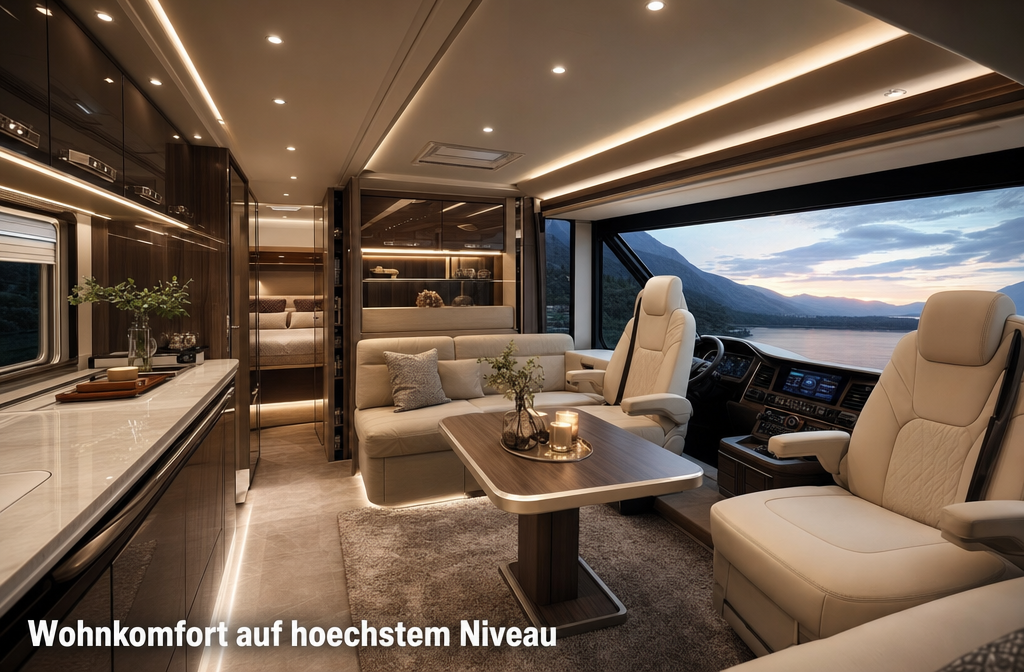
Fully integrated motorhomes, the premier class on four wheels, are characterized by the complete fusion of the driver's cab and the living area. There is no partition, no step, no visible transition. The result is a unified, spacious interior that extends from the steering wheel to the rear garage.
The most important differences at a glance:
| Type | Cabin | Construction | Sense of space | Price |
|---|---|---|---|---|
| Fully integrated | Seamlessly integrated | Custom build on chassis | Very generous | High (from ~€80,000) |
| Semi-integrated | Separate driver's cabin | Based on a standard vehicle. | Good | Mid-range (from ~€50,000) |
| Alcove | Separate cabin + bunk above driver's cabin | Based on a standard vehicle. | Compact, lots of storage space | Affordable (from ~€40,000) |
| Panel van | Production vehicle | Interior design | Compact | Affordable (from ~€35,000) |
What makes fully integrated motorhomes special?
- Wide panoramic windshield for a delightful driving experience
- Driver's seats that can be turned into lounge chairs
- No need to climb through: You can move freely through the entire vehicle
- Visually more elegant, aerodynamic design
The cockpit of a fully integrated motorhome feels like a living room with a view that also happens to be moving.
How much does a high-quality fully integrated RV cost?
The entry-level price for new fully integrated motorhomes is around 80,000 to 100,000 euros. Mid-range models range from 120,000 to 200,000 euros, while premium models from manufacturers such as Carthago or Hymer can exceed the 300,000 euro mark.
Cost overview:
- New Vehicle Entry: approx. €80,000–110,000
- New mid-range vehicle: approx. €120,000–€200,000
- New vehicle premium: €200,000–€350,000 and more
- Used vehicle (5–10 years old): approx. €40,000–120,000 depending on condition and equipment
Estimated annual maintenance costs:
- Car insurance: €800–2,500
- Pitch/Winter storage: 500–2,000 €
- Maintenance and repairs: €1,000–3,000
- Fuel (diesel, approx. 25–35 l/100 km depending on model and load): variable
- TÜV, fees: 200–500 €
Tip: If you're unsure whether the investment is worthwhile, you should first rent a fully integrated motorhome. About Campcruisers Various models and sizes can be booked to get a real feel for the vehicle class before investing six- or seven-figure sums.
Also, consider the weight classes: Many fully integrated motorhomes exceed 3.5 tons, which is relevant in terms of driving license requirements. Our article explains what this means specifically regarding new driving licence regulations in the EU.
Which brands build the best fully integrated motorhomes in Germany?
Several German and European manufacturers have established themselves as reliable providers in the fully integrated class. Quality leadership cannot be claimed across the board, but the following brands enjoy a particularly good reputation in the camping community:
- Hymer (Bad Waldsee): One of the best-known German motorhome companies, known for quality workmanship and innovation. Also, check out the new Hymer Redwood an.
- Carthago (Aulendorf): Considered a premium manufacturer with particularly high-quality workmanship and durability.
- Bürstner (Kehl): Wide range of models, good value for money in the mid-range.
- Dethleffs (Isny): Traditional manufacturer with solid quality and a good dealer network.
- Knaus Tabbert (Jandelsbrunn): Innovative construction methods, also strongly represented in the fully integrated segment.
- Niesmann+Bischoff: Boutique manufacturer of absolute luxury models, handcrafted top quality.
What to consider when choosing a brand?
- Dealer network and service availability in your region
- Spare parts supply (also for older models)
- Warranty conditions and goodwill according to user forums
- Resale value after 5–10 years
What are typical mistakes when buying a fully integrated motorhome?
The most common mistake is underestimating the permissible total weight. Many buyers load up their new vehicle and find that they quickly exceed the permitted limit with bicycles, water, food, and equipment. More on how to Holding a motorhome under 3.5 tons.
Die häufigsten Kauffehler:
- No test drive. on the freeway and narrow country roads
- Wrong length chosen. Vehicles over 7.5m are not allowed on some campsites
- Equipment Overrated: Not every optional equipment package is useful in everyday life
- Buying used without an expert opinion: Moisture damage is the most common hidden problem
- Maintenance costs underestimated: Many buyers only consider the purchase price.
- No trial night: You only realize whether the bed, bathroom, and kitchen are truly right for you after spending a night in the vehicle.
Purchasing rule: Have every used purchase checked by an independent expert or at ADAC. Moisture measurements cost little and can prevent expensive surprises.
Who should consider a fully integrated motorhome, and who shouldn't?
A fully integrated motorhome is worthwhile for anyone who travels at least 60–80 days per year and doesn't want to compromise on living comfort. Retired couples, long-term travelers and anyone who uses their vehicle as a real second home benefit the most.
Fully integrated is the right choice if…
- you regularly plan long tours (Southern Europe, Scandinavia, Eastern Europe)
- you value a real double bed, a full kitchen and a spacious shower
- you are prepared to bear the higher purchase and maintenance costs
- you have a permanent parking space or a garage
Fully integrated is probably not for you if...
- you only camp 2-3 times a year
- you are traveling alone and prefer a smaller vehicle
- you're heading for narrow mountain roads or city centers
- your budget is under €60,000
Those who first want to find out whether the premier class on four wheels really suits their travel style can rent a fully integrated motorhome via Rent camp cruisers and try out different destinations, such as a Tuscany tour or a North Frisia Tour.
What optional equipment is useful for fully integrated motorhomes?
The most important optional extras are a solar system, lithium battery system, satellite system, and a powerful auxiliary heater. These four elements make the difference between a vehicle that only works at the campsite and a truly self-sufficient motorhome.
Useful extras, prioritized:
| Features | Benefit | Costs (Retrofitting approx.) |
|---|---|---|
| Solar system (200–400 Wp) | Self-sufficient charging without shore power | €1,500–€4,000 |
| Lithium battery (100–200 Ah) | More capacity, longer lifespan | €1,500–€3,500 |
| Parking heater (diesel) | Heating without shore power | €1,000–€2,500 |
| Reversing camera + maneuvering assistant | Safety when parking | 300–800 € |
| Satellite system (automatic) | TV and internet everywhere | 1.500–3.000 € |
| Bicycle carrier (rear garage) | Transport of E-Bikes | €300–1,500 |
| Awning (electric) | Comfort on the pitch. | €800–€2,000 |
Not always necessary: Air conditioning on the roof sounds tempting, but consumes an enormous amount of electricity and is hardly usable without shore power. Those who travel a lot in Southern Europe should rather rely on good insulation and blackout systems.
How do I properly care for and maintain a fully integrated motorhome?
Regular maintenance significantly extends the lifespan and protects against costly consequential damage. The most important measures are annual leak tests, chassis maintenance and correct winterization.
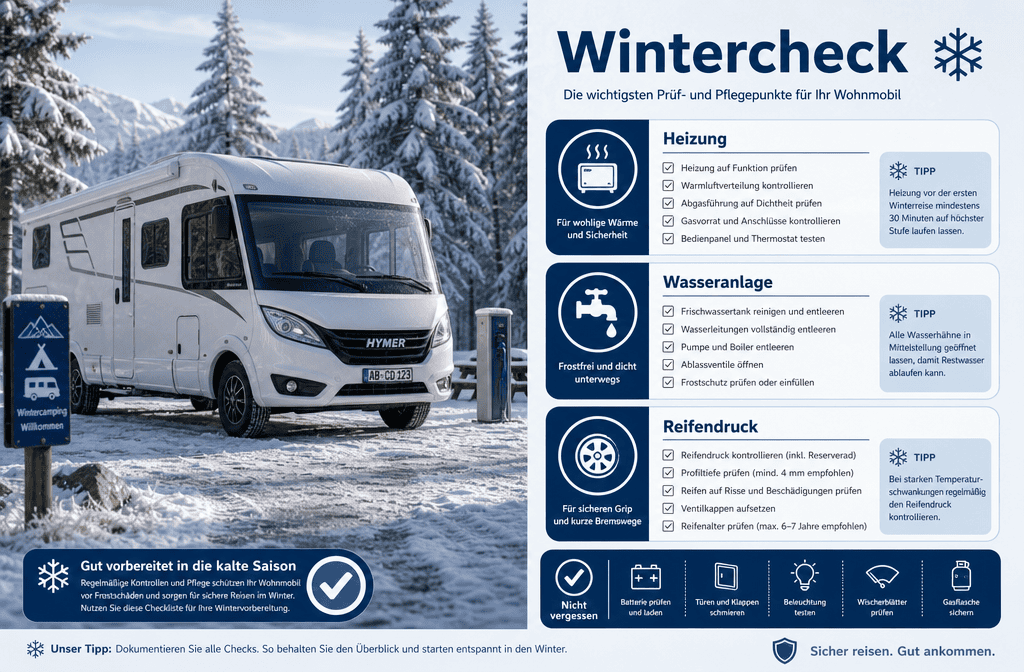
Annual maintenance checklist:
- ✅ Check all seals (windows, roof hatches, external flaps) for cracks
- ✅ Humidity measurement indoors and on walls
- ✅ Have the gas system checked by a specialist (mandatory every 2 years in Germany)
- ✅ Flush and disinfect the water system
- ✅ Check chassis and underbody for rust, preserve cavities
- ✅ Maintain refrigerator, heating, and air conditioning
- ✅ Check tire age (Recommendation: replace after 6–8 years, regardless of tread)
- ✅ Have the brake system and chassis checked by a specialist workshop
Common mistake: Many homeowners neglect roof maintenance. UV radiation and moisture attack the roof, and small cracks can turn into major water damage that can cost thousands of euros.
What do I need to consider when winter camping with a fully integrated motorhome?
Fully integrated motorhomes are generally suitable for winter camping, provided they are equipped with a powerful diesel auxiliary heater, a winter-proof water system, and sufficient insulation. Not every model is „Winterfest“ in the technical sense from the factory.
Winter Camping Checklist:
- Heating: Diesel parking heater (e.g. Truma Combi or Webasto) with sufficient capacity for sub-zero temperatures
- Water system: Frost protection for pipes and pump, fresh water tank insulated or heatable
- Tires: Winter tires or all-season tires with M+S marking
- Battery: Lithium batteries tolerate cold better than AGM/Gel, but they also lose capacity at -10 °C.
- Condensation: Good ventilation prevents mold, regular ventilation is important even in cold weather.
- Wastewater: Insulate gray water tank or empty daily
Important: Not every campsite is open in winter. Research pitches in advance and check whether shore power and disposal facilities are available.
How much fuel consumption and maintenance costs will I have with a fully integrated motorhome?
Fully integrated motorhomes consume an average of 25–35 liters of diesel per 100 km, depending on weight, load, driving speed and topography. This is significantly more than a car, but an acceptable value for the living space and comfort offered.
Consumption and costs overview (2026 estimate):
- Fuel consumption: 25–35 l/100 km (Diesel)
- At 10,000 km/year and €1.70/l: approx. €4,250–5,950 fuel costs
- Pitch fees: €15–40/night at campsites
- Insurance (fully comprehensive): €1,200–2,500/year depending on vehicle value
- General inspection (TÜV) + emissions test: every 2 years, approx. €150–250
- Winter storage: 500–1,500 €/year
Total costs per year (estimate for active user): €8,000–15,000 including fuel, parking, insurance, and maintenance. That sounds like a lot, but is put into perspective when you consider that hotel costs for comparable trips would be significantly higher.
What alternatives are there to fully integrated motorhomes?
Those who find top-of-the-line vehicles on four wheels too big, too expensive, or too unwieldy have several good alternatives. Semi-integrated motorhomes offer similar comfort in somewhat more compact dimensions and at a more affordable price. Camper vans are ideal for solo travelers and couples who want to be more flexible on the road.
Alternatives in comparison:
- Partially integrated motorhome: Good compromise between comfort and handling, from approx. €50,000 new
- Panel van/Camper van: Compact, city-friendly, inexpensive to maintain, less living space
- Alcove motorhome: Plenty of storage space, affordable, but high weight and poorer aerodynamics
- Caravan (RV): No driver's license issues, affordable, but less flexible when driving
- Rent instead of buy: Often the most economical solution for occasional travelers
For those who want to try out different types before buying: On Campcruisers Both panel vans and larger motorhomes can be booked to find your own favorite.
What are the most common technical problems with fully integrated motorhomes?
The most common technical problems are moisture damage from leaky seals, issues with the gas system, and defects in the 12-volt electrical system. Especially with used vehicles, a thorough inspection before purchase is worthwhile.
Common problems and solutions:
- Moisture in the structure: Cause is usually leaky roof hatches or window seals. Solution: Annual inspection, replace seals in good time.
- Gas system: Pressure regulators and hoses age. Mandatory: Inspection by a qualified specialist company in Germany every 2 years.
- 12V electrics: Cable breaks, corrosion on plug connections, weak alternator. Solution: Regular visual inspection, clean connections.
- Refrigerator (Absorption): Sensitive to uneven parking spaces and high temperatures. Solution: Park the vehicle as level as possible.
- Gearbox/Engine: Fully integrated models often use Fiat, Mercedes or MAN chassis; strictly adhere to maintenance intervals.
- Awning: Mechanical parts break in the wind if the awning is not retracted in time.
How long does a high-quality fully integrated motorhome last?
A well-maintained, fully integrated motorhome realistically lasts 15 to 25 years. Crucial factors are the quality of the construction, protection against moisture, and regular maintenance of the chassis and drive system.
Factors determining lifespan:
- Construction material: GRP (glass fiber reinforced plastic) structures are more durable than wooden frame constructions
- Moisture protection: The most important single factor for the service life of the living area
- Mileage: Motorhomes with less than 150,000 km are considered to be in good condition; over 200,000 km it becomes more critical.
- Brand quality: Premium manufacturers like Carthago or Niesmann+Bischoff build for a particularly long service life.
- Care and Winter Storage: Vehicles that are stored dry and covered age significantly slower.
FAQ: Fully Integrated Motorhomes
What is the difference between fully integrated and partially integrated?
In a fully integrated motorhome, the driver's cab and living area form a single unit without a partition. In a semi-integrated model, the standard driver's cab is retained and the living area is attached to it.
Do I need a special driving license for a fully integrated motorhome?
That depends on the permissible total weight. Vehicles up to 3.5 tons can be driven with class B. Heavier models require class C1 or C. Since 2024, there have been EU-wide changes, which are covered in our article on Driving licence regulations to be explained.
Can I drive an A-class motorhome in the city?
Yes, but it's challenging. Vehicles over 7m in length and 3m in width won't fit in every parking garage and are difficult to maneuver in narrow old towns.
How long does it take to get used to a fully integrated motorhome?
Most drivers report feeling confident operating the vehicle after 2-3 rides. A test drive in an empty parking lot is highly recommended.
Is a fully integrated motorhome suitable for solo travelers?
Generally yes, but the vehicle size and costs are often disproportionate for one person. Panel vans or semi-integrated motorhomes are usually the better choice for solo drivers.
Can I take a fully integrated motorhome on ferries?
Yes, but length and height determine the fare. Vehicles over 6 m are charged as "Overlength vehicle" on most ferries, which is more expensive.
What is the resale value?
Well-maintained fully integrated motorhomes retain a solid resale value. Premium brands like Carthago typically lose 30–40% of their new price in the first 5 years, after which the value stabilizes.
Can I rent an A-class motorhome before I buy?
Yes, and that's highly recommended. About Campcruisers Various types of motorhomes can be booked to find the right vehicle type for your own travel style.
How much floor space do I need?
Plan at least 8 x 3.5 m of space. For a vehicle with a slide-out or awning, the width should be extended to 5–6 m.
Conclusion: Is the king class on four wheels worth it?
Fully integrated motorhomes are not for everyone, but for passionate long-term travelers, they are simply unbeatable. The combination of spacious living space, driving experience and freedom of travel is unparalleled. Anyone who travels regularly, can afford the maintenance costs, and is willing to deal with technology and maintenance, will find their mobile dream home in a fully integrated motorhome.
Your next steps:
- Try out: First, book a fully integrated motorhome via Campcruisers, before you buy.
- Compare: Visit trade fairs such as the Caravan Salon Düsseldorf and test different layouts.
- Calculate: Calculate all running costs, not just the purchase price.
- Check: Have every used purchase inspected by a professional.
- Let's go: Ob TuscanyWhether it's the North Sea or South Holland, adventure awaits. 🚐
Quellen
- Caravanning Industry Association (CIVD): Market Data Motorhomes Germany, 2023
- ADAC: Motorhome Guide, Buying Advice and Technology, 2022
- Stiftung Warentest: Motorhome Tests and Consumer Reports, 2021–2023
- Federal Ministry for Digital and Transport: Driving Licence Regulations and Vehicle Classes, 2024
Tags: Fully integrated motorhome, luxury motorhome, buy a motorhome, RV, rent a camper, rent a motorhome, camping equipment, winter camping motorhome, motorhome costs, Hymer, Carthago, long-term travel, motorhome care


 English
  German
  Spanish
  Italian
  Polish
  Dutch
Dutch  French
  Danish