
Last updated: May 24, 2026
Quick answer: The permissible payload for rental vehicles is the difference between the permissible total weight (zGG) and the vehicle's empty weight. For a typical campervan, this value is often between 300 and 700 kg, while for vans and moving vehicles it can be significantly higher. Exceeding the payload limit can result in fines, loss of insurance coverage, and in the worst case, liability in the event of an accident.
Key Takeaways
- Payload = GVW minus Curb Weight of the rental vehicle, readable in the vehicle registration document (fields F.1 and G).
- Campervans and motorhomes often have a surprisingly low payload of 300–600 kg because the conversion and furnishings increase the unladen weight.
- Vans can offer 800–1,500 kg of payload depending on the model, removal vans sometimes even more.
- Exceeding limits may jeopardize the rental agreement's insurance coverage and lead to fines according to the German Road Traffic Act (StVO).
- Luggage, passengers, water, gas and groceries all count towards the payload.
- Heavy objects belong deep and in the center of the vehicle, not in the rear compartment or on the roof.
- Many tenants underestimate the weight of water supplies: 1 liter of water = 1 kg.
- Since the EU driving licence reform, campervans up to 4.25 t can be driven with class B under certain conditions.
- When renting through a booking platform such as Campcruisers The technical data of the vehicles are usually found in the vehicle description.
- Packing smart saves weight and stress on your trip.
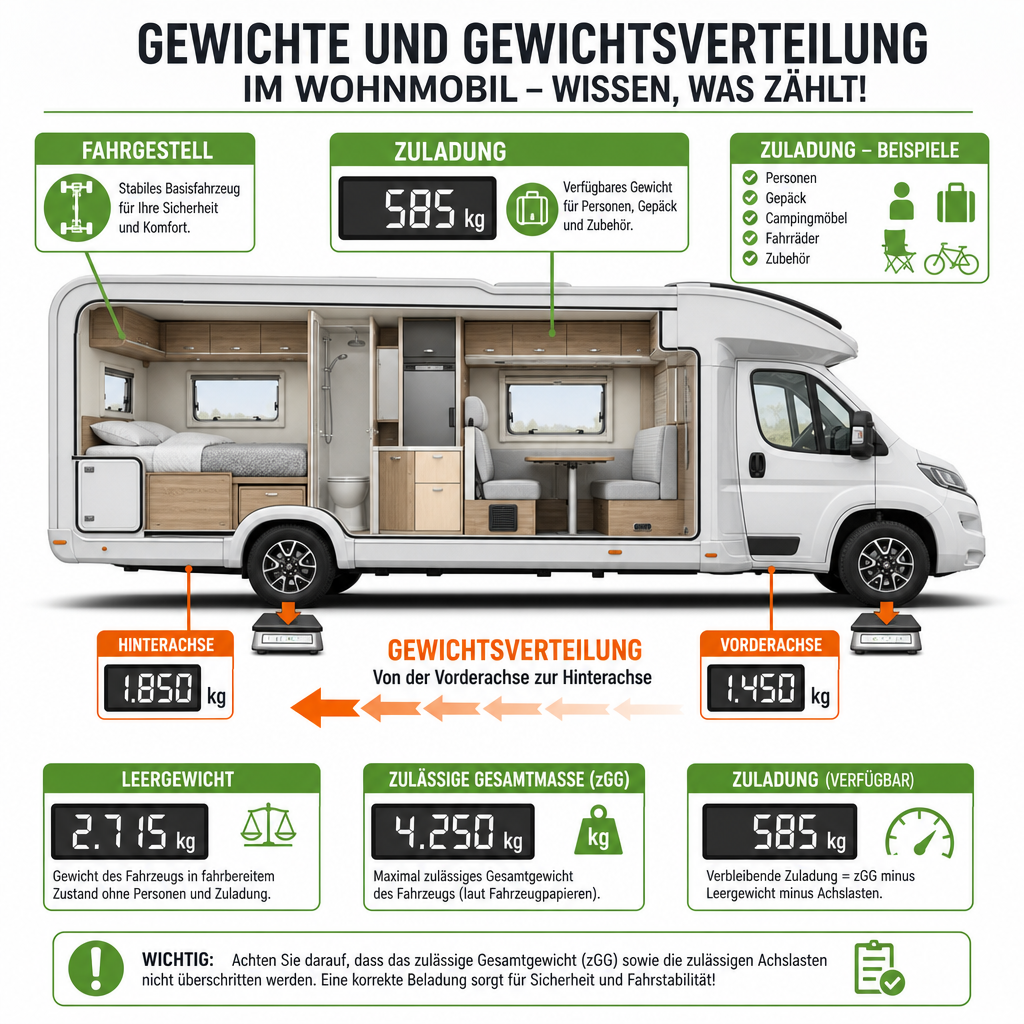
What does payload mean exactly for rental vehicles?
The payload is the maximum weight a vehicle can transport in addition to its own weight. In rental vehicles, this includes everythingPeople, luggage, groceries, water, gas cylinders, bicycles and other equipment.
The formula is simple:
Payload = permissible total weight (PTW) − empty weight
You can find the following in the vehicle registration document (Zulassungsbescheinigung Teil I):
- Field F.1: permissible total weight
- Field G: Curb weight (vehicle's own weight)
Important: The unladen weight stated in the registration certificate for motorhomes often only includes basic equipment. Optional extras such as bicycle racks, awnings or solar panels further increase the actual unladen weight, thus reducing the available payload.
How do I calculate the allowed payload for my rental vehicle?
The calculation is direct and only requires two values from the vehicle registration document. Anyone taking over a rental vehicle should check these values before starting their journey.
Step-by-step:
- Open vehicle registration certificate (Registration Certificate Part I is usually located in the glove compartment).
- Read field F.1 = permissible total weight in kg.
- Read field G = Empty weight in kg.
- Calculate difference = available payload.
- Weigh your own luggage, before it goes into the vehicle. Luggage scales or bathroom scales can help.
- Factor in passengersEvery person counts with their actual body weight.
Example calculation for a campervan:
| Value | Example |
|---|---|
| Permissible maximum weight (F.1) | 3,500 kg |
| Empty weight (G) | 3,050 kg |
| Available payload | 450 kg |
| 2 people (80 kg each) | - 160 kg |
| Remaining for luggage & equipment | 290 kg |
It sounds like a lot, but it's quickly used up: 40 liters of fresh water (40 kg), gas bottles (15–20 kg), bicycles (2 × 15 kg), food for a week (20–30 kg), and camping equipment add up incredibly quickly.
Differences between cars and vans in payload
Campervans and regular cars have fundamentally different payload capacities. A standard car typically offers 400–600 kg of payload, but a fully equipped campervan on the same chassis can have less than 400 kg due to the conversion.
| Vehicle type | Typical payload |
|---|---|
| Small transporter (e.g. VW Transporter) | 800–1,200 kg |
| Large van (e.g. Mercedes Sprinter) | 900–1,500 kg |
| Compact Campervan (up to 3.5 t) | 300–600 kg |
| Large campervan (up to 3.5 t) | 200–500 kg |
| Moving vehicle (7.5 t class) | 2,000–3,500 kg |
Decision rule: Anyone who wants to transport a lot of heavy camping equipment (motorcycles, e-bikes, heavy cooking equipment) should specifically look for vehicles with a higher payload or choose a larger model. On Campcruisers Vehicles can be filtered by type and features to find the right model.
Common mistake: Many campers assume that a motorhome with a permissible total weight of 3.5 t automatically offers plenty of leeway. In fact, the opposite is often the case, because the conversion adds 500–800 kg of unladen weight.
Which vehicle types have the highest payload?
Moving vans and heavy-duty transporters offer the highest payload, followed by small vans. For camping purposes, camper vans based on small vans are a good compromise between living comfort and load capacity.
Anyone needing maximum payload when camping should consider the following vehicle classes:
- Panel van camper based on Sprinter/Ducato: Often 500–700 kg payload, as the conversion is more compact.
- Partially integrated motorhomes over 3.5 t: Higher payload, but class B may no longer be sufficient. Here, it's worth taking a look at the new EU driving licence regulation for motorhomes up to 4.25 t.
- Pickup-based campers: High payload of the base vehicle, but the body reduces it.
What are the penalties for exceeding the maximum payload?
In Germany, exceeding the permissible total weight is an administrative offense according to the StVO (German Road Traffic Regulations), which results in graduated fines depending on the extent of the excess. From an excess of more than 5%, warnings and fines may be imposed; exceeding the limit by more than 20% may result in points in Flensburg.
Fine framework (Germany, as of 2026, Source: Fine Catalog StVO):
| Overload | Fine (Driver) | Fine (Owner/Lessor) |
|---|---|---|
| Up to 5% | Warning | Warning |
| 5–10% | from €95 | from €190 |
| 10–15% | from €140 | from €285 |
| Over 20% | From €235 + 1 point | from €470 |
Even more critical: In the event of an accident due to overloading, the motor vehicle liability insurance can reduce or refuse benefits if the overloading was the cause of the accident. This can lead to significant personal liability.
What are the legal consequences if I ignore the payload capacity of a rental vehicle?
Legally, the driver bears full responsibility for compliance with the permissible total weight. This also applies to rental vehicles: The rental agreement usually contains a clause that restricts the lessor's insurance coverage in the event of overloading and makes the renter liable.
Specific legal consequences:
- Liability under the Rental Agreement Damage to the vehicle caused by overloading (e.g. tire blowouts, brake failure) can be fully charged to the renter.
- Criminal Law Relevance: In accidents involving personal injury, overloading can be considered negligent behavior.
- Comprehensive (Car) Insurance Many rental vehicle insurance policies contain explicit exclusion clauses for damage caused by overloading.
Recommendation: Check the rental agreement for clauses regarding loading before the start of the journey and, if in doubt, ask the landlord.
Additional costs if I exceed the payload limit
Direct additional fees for overloading are not usually included as a flat rate in most rental agreements, but the indirect costs can be significant. These include fines from police checks, repair costs for vehicle-related damage, and the loss of liability waivers.
Some landlords reserve the right to retain the deposit or make additional claims for damages in the event of proven overloading. Those who use a booking platform like Campcruisers booked, you should carefully read the insurance conditions of the respective provider before booking.
Payload in moving vehicles vs. minibuses: What is the difference?
Removal vehicles are specially designed for high payloads and offer significantly more payload than minibuses or camper vans. A 7.5-tonne removal vehicle can have a payload of up to 3,500 kg, while a 9-seater minibus, despite its similar vehicle size, often only offers a payload of 500–800 kg because the weight of the seats and passengers dominates the unladen weight.
Important for camping trips with a group: Anyone traveling with multiple people and a lot of equipment should calculate the payload especially carefully. With a fully occupied 9-seater (8 people × 80 kg = 640 kg), the payload is already exhausted or exceeded by the passengers alone.
Tips for packing effectively without exceeding the weight limit
Packing smart doesn't mean sacrificing comfort, but choosing consciously. With the right strategy, weight can be significantly reduced without having to forgo essential camping equipment.
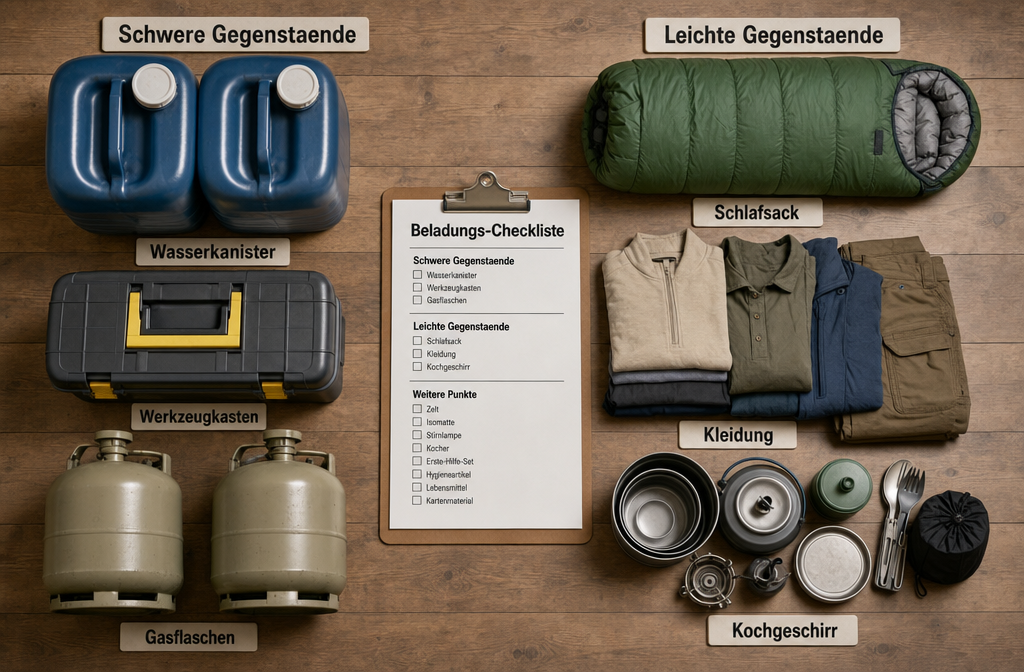
Practical packing tips for campers:
- Fill up with water on site. Starting with an empty fresh water tank and only filling it at the campsite can save up to 100 kg.
- Choose lightweight equipment: Titanium cutlery, ultralight sleeping bags, and compact camping chairs add up.
- Maintain a digital checklist: Record the weight of each item before it is placed in the vehicle.
- Minimize clothing: Multiple wearable, quick-drying clothes instead of full suitcases.
- Buy local food. Instead of carrying heavy supplies, it's better to shop along the way.
- Gas cylinders: Only take as much as you need; a full 11 kg bottle weighs about 18 kg with its container.
- Bicycles: E-bikes can weigh 20–25 kg each, while classic touring bikes weigh 8–12 kg.
Checklist for correct weight distribution in the rental vehicle:
- Place heavy objects (water canisters, tools) low and over the axles.
- No loads on the roof that exceed the unladen weight in the vehicle registration document
- Distribute weight evenly on the left and right sides
- Avoid rear-heaviness: Keep the center of gravity centered.
- Secure all loose objects (load securing obligation according to StVO §22)
- Estimate or weigh the total weight before departure (truck scales can be used at truck stops)
Common Mistakes When Loading Rental Vehicles
The most common mistake is forgetting to include passengers and liquids in the payload calculation. Many campers only calculate the luggage, but not the body weight of all occupants.
The biggest loading errors at a glance:
- Passengers not included: Each person counts towards the payload with their actual weight.
- Forgot to empty the fresh water tank: 100 liters = 100 kg, which many people don't realize.
- Curb weight from the internet instead of from the vehicle registration: Manufacturer's specifications are base values without optional equipment.
- Roof rack overloaded. The roof load is separately limited (stated in the vehicle registration document or manual).
- Load securing neglected. Loose objects in the vehicle are life-threatening in the event of emergency braking.
- Gas cylinders transported incorrectly: Gas cylinders must be transported upright and secured.
Anyone interested in the topic of independence and self-sufficiency when camping will find what they're looking for in the article about the Glamping boom and the camper's independence further interesting perspectives.
FAQ: Payload for rental vehicles
Where can I find the permitted payload of my rental vehicle?
In the vehicle registration certificate (Part I): Field F.1 = permissible maximum mass, Field G = empty weight. Payload = F.1 minus G. The document is always included with the rental vehicle.
Do passengers count towards the payload?
Yes, every person in the vehicle counts towards the payload with their actual body weight. This also applies to children.
Am I allowed to load a rental vehicle up to its maximum payload?
Yes, that is allowed. But: The permissible total weight must not be exceeded. The payload is the theoretical upper limit, which is exhausted jointly by people, luggage and liquids.
What happens if I am too heavy during a police check?
Fines are threatened according to the StVO fine catalog, and from 20% overloading also a point in Flensburg. The vehicle can be detained until the excess weight is unloaded.
Do I lose insurance coverage if I overload my vehicle?
Possibly yes. In the event of an accident, the insurance company may check whether the overloading was the cause of the accident. In the worst case, the benefits will be reduced or denied.
How much payload does a typical campervan have?
A compact campervan up to 3.5 t gross vehicle weight often has only 300–600 kg of payload after deducting the empty weight. This is quickly exhausted when two people, water, gas and equipment are included.
Can I have a rental vehicle weighed?
Yes. Many truck stops and rest areas have publicly accessible truck scales. This costs a few euros and provides security before departure.
Does the payload limit also apply to roof luggage?
Yes, roof boxes count towards the total payload. Additionally, there is a separate roof load limit (stated in the vehicle manual) that must not be exceeded.
Am I allowed to drive a motorhome over 3.5 t with class B?
Since the EU driver's license reform, this has been possible up to 4.25 t under certain conditions. Details are explained in the article on new EU driving license regulation for motorhomes.
Where can I find campervans with a high payload for rent?
On Campcruisers Vehicles from different providers can be compared according to type and equipment. The technical data can be found in the respective vehicle description.
Conclusion: Well planned is well traveled.
The payload of rental vehicles is not a bureaucratic side issue, but a real safety concern. Anyone who invests five minutes before departure to read the empty weight and GVWR from the vehicle registration and roughly calculate their own luggage will avoid fines, insurance trouble and dangerous driving situations.
Concrete next steps:
- Check the vehicle registration certificate (fields F.1 and G) immediately at the start of the rental.
- Include passengers, water, gas, and equipment in the calculation.
- Load heavy items low and in the center, secure everything.
- When in doubt, use a truck scale at the truck stop.
- Check the rental agreement for clauses regarding liability for overloading.
Anyone who feels like finally going on tour now: On Campcruisers you will find a large selection of campervans and motorhomes from professional rental partners worldwide. Easy Rent a campervan, check the payload and drive off! 🚐
Quellen
- Federal Ministry for Digital and Transport: Road Traffic Regulations (StVO) §22 Load, §34 Axle Load and Total Weight. www.gesetze-im-internet.de
- Federal Motor Transport Authority (KBA): Registration Certificate Part I – Explanation of the fields. www.kba.de
- ADAC: Fine Catalog Overload, Status 2024. www.adac.de
- EU Directive 2006/126/EC on driving licences (driving licence categories and weight limits).
Tags: Payload rental vehicle, rent campervan, motorhome payload, luggage rental car, permissible total weight, overloading penalty, camping packing tips, transporter payload, empty weight vehicle registration document, camping equipment, rent motorhome, calculate vehicle weight


 English
  German
  Spanish
  Italian
  Polish
  Dutch
Dutch  French
  Danish