
Last updated: May 24, 2026
Quick Answer: Not every rental RV is suitable for a skiing holiday. A winter-proof RV needs at least a parking heater, insulated water tanks, winter tires, and double-glazed windows. Those who pay attention to these details when renting and pack the right additional equipment will experience a skiing holiday that easily outshines hotels.
Key Takeaways
- Winter hardiness is not a standard: Only specially equipped RVs are permanently suitable for temperatures below 0 °C.
- Parking heater is mandatory: Without a diesel or gas heater, it gets dangerously cold at night.
- Winter tires and snow chains are legally required in many Alpine countries.
- Rental prices For winter-proof motorhomes, the cost is approximately €80–200 per day, depending on the vehicle class (estimate; varies greatly depending on the provider, region and season).
- Insulated fresh water tanks Prevent the water supply from freezing in freezing weather.
- Families and singles both can benefit from winter camping if the vehicle is the right size.
- Insurances must explicitly cover winter conditions and mountain roads.
- Typical errors: No snow chains, wrong sleeping bags, not enough gas.
- On Campcruisers.com Winter-suitable vehicles can be found at professional rental partners worldwide.
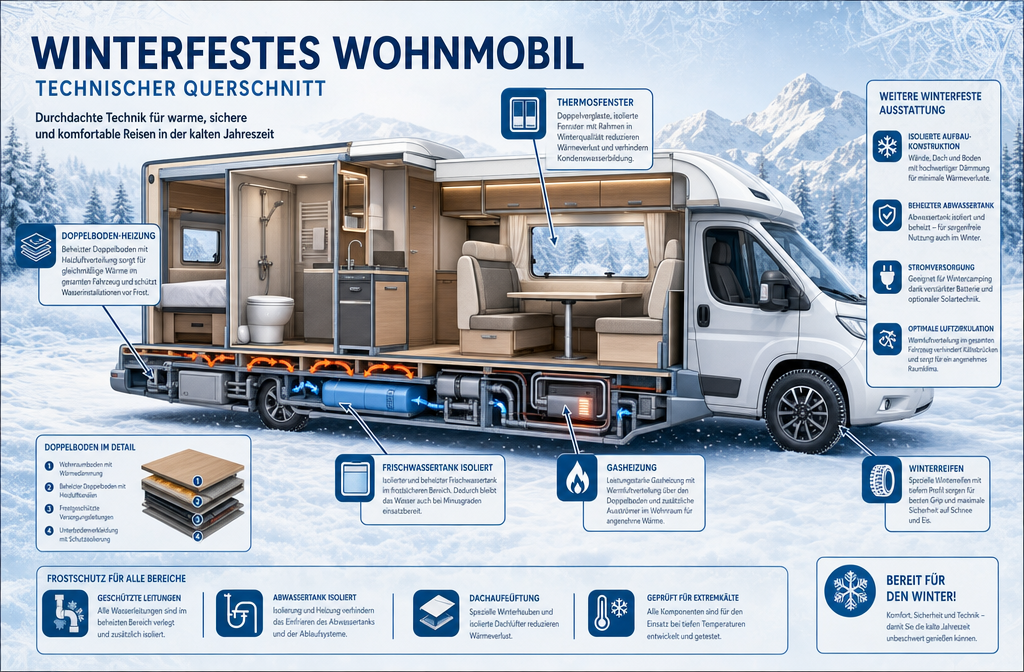
What makes a motorhome winterproof?
A winterproof motorhome is specially designed for continuous operation in sub-zero temperatures. This means: insulated walls and floors, a powerful heating system, frost-proof water tanks, and winter tires. Without these features, a standard motorhome is simply not safely habitable in snow and frost.
Key features at a glance:
| Characteristic | Why it matters |
|---|---|
| Parking heater (Diesel/Gas) | Keeps the interior warm even at -15 °C without the engine running. |
| Raised floor heating | Protects fresh water and waste water tanks from freezing. |
| Thermo/Double-glazed windows | Reduces heat loss and prevents condensation |
| Insulated fresh water tank | Prevents freezing at night temperatures below 0 °C |
| Winter tires (M+S or Alpine symbol) | Legally required in many Alpine regions |
| Reinforced insulation (walls/roof) | Keeps the heat in, the cold out. |
Important when renting: Explicitly ask the landlord whether the vehicle is approved for winter camping. Not every RV with heating is automatically winter-proof in a technical sense.
Are all RVs suitable for winter camping?
No, definitely not. Standard rental RVs are usually designed for use between April and October. Their water tanks are often unprotected in the underbody, the insulation is minimal, and the heating is hardly sufficient for nighttime temperatures below -5 °C.
Motorhomes suitable for skiing holidays:
- Vehicles with explicit "winter approval" from the manufacturer
- Models with Truma Combi heater or Webasto auxiliary heater
- Motorhomes with double floor and heated underfloor area
- Alcove and semi-integrated motorhomes with thick wall insulation
Less suitable:
- Simple panel vans without additional insulation
- Older vehicles without thermostat control
- Motorhomes without winter tire package
A motorhome without winter approval in a ski resort is like sandals on the slopes: technically possible, but you'll regret it.
Which RVs are best suited for ski holidays?
Fully integrated motorhomes and large semi-integrated models with double-floor heating systems are best suited for ski vacations. They offer enough space for wet ski clothing, helmets, and equipment and usually have the strongest heating systems.
Sorted by type of travel:
- For couples: Panel van with winter package (e.g., Fiat Ducato base with Truma heating) — compact, maneuverable on mountain roads
- For families: Semi-integrated motorhomes from 6 meters with bunk beds and double floor heating
- For comfort campers: Fully integrated with separate bedroom and 230V connection
Decision rule: Choose a panel van if you plan on driving on narrow mountain roads or smaller pitches. Choose a larger semi-integrated or fully integrated motorhome if comfort and space for equipment are a priority.
In addition, it's worth taking a look at the new EU driving licence regulationsbecause since 2026, vehicles up to 4.25 tons can be driven with a normal Class B driver's license — this significantly expands the selection of available rental vehicles.
How much does it cost to rent a winter-proof camper per day?
Winter-proof rental motorhomes cost an estimated €80 to €200 per day in the high season (December to March), depending on the vehicle class and region. In addition, there are often costs for the winter package (snow chains, winter tires, possibly parking heater rental), which may be charged separately.
Cost factors at a glance:
- Vehicle class: Panel vans cheaper than fully integrated motorhomes
- Season: Christmas and New Year's Eve are more expensive than January/February
- Winter package: Can cost an extra €10–30 per day (estimate)
- Deposit: Often higher in winter due to increased risk of damage
- Minimum rental period: Many providers require a minimum of 7 days in winter.
Tip: Booking early saves real money. Winter-ready vehicles are in short supply — those who book in October have a better selection and often cheaper prices.
On Campcruisers.com You can compare campervans from professional renters and book directly.
How does the heating work in a winterized RV?
Most winter-proof camper vans use either a gas heater (e.g. Truma Combi) or a diesel heater (e.g. Webasto or Eberspächer). Both systems can bring the interior to comfortable temperatures regardless of the engine running.
The two most common systems:
Gas heating (Truma Combi): Heats air and water simultaneously, runs on the on-board gas system. Inexpensive to operate, widely used. Disadvantage: Gas supply must be monitored.
Diesel heater (Webasto/Eberspächer): Uses the vehicle's fuel tank, no separate gas supply needed. Very reliable in extreme cold, often quiet operation.
Raised floor heating system: Many winter-proof motorhomes also direct heating warmth into the underbody to keep fresh and waste water tanks frost-free. Without this system, tanks and pipes can freeze at -10 °C or colder.
When renting, ask: What heating system is installed? Is the gas supply included in the rent or extra? Is there a raised floor heating system?
What do I need to consider when winter camping?
Winter camping in a motorhome is safe and comfortable if you know a few basic rules. The biggest risks are freezing water pipes, slipping hazards on access roads, and radiator overload.
The most important rules for winter camping:
- Never turn the heating off completely., even at night — maintain a minimum temperature of approximately 10 °C indoors
- Check the fresh water tank daily, use a canister instead for prolonged frost
- Empty the wastewater tank regularly.so that it doesn't freeze
- Ventilate briefly daily.to avoid condensation
- Remove snow load from the roof, especially in flat roof RVs
- Pitch with electricity hook-up Select to conserve the auxiliary battery
- Emergency equipment Always with you: snow shovel, jumper cables, ice scraper
Those interested in weatherproof pitches will find on the Campcruisers Blog - an overview of weatherproof campsites in Baden-Württemberg — ideal as a starting point for ski tours.
How do I protect a rented RV from frost and cold?
Protecting a rental motorhome from frost mainly means keeping an eye on the water system, using the heating correctly, and parking the vehicle properly. As a renter, you are responsible for damage caused by improper handling of frost.
Specific protective measures:
- Fresh water tank: In extreme frost (below -10 °C) drain the water and use a canister.
- Waste water tank: Leave the valve slightly open to prevent water from collecting.
- Door locks: Treat with lock de-icer, not with water.
- Exterior flaps and storage compartments: Check for ice formation before attempting to force open.
- Awning: Let it dry after driving in snow and ice
- Gas system: Pressure regulators can freeze in extreme cold — inquire about special regulators for winter operation
Important: Frost damage caused by negligence (e.g., leaving the heating turned off) is often not covered by standard insurance. Read the rental agreement carefully.
What are typical mistakes when renting a winter RV?
The most common mistakes happen even before departure: choosing the wrong vehicle, forgetting equipment, or overlooking insurance gaps. Knowing these pitfalls will save you trouble on the slopes.
The 7 most common mistakes:
- No winter package booked — and then no snow chains with them
- Gas cylinders too small — lasts only 2–3 days with the heater running continuously
- Fake sleeping bag — Summer sleeping bags are not sufficient in the event of a heating failure
- Pitch without electricity hook-up — On-board battery discharges overnight
- No winter tires checked — simply assuming that the landlord installed them
- Not enough de-icer — Windows and locks are freezing up
- No emergency number for the landlord — critical in the mountains at night if the heating fails
Tip: When checking the vehicle upon pickup, explicitly take photos of the tires, the heating system, and the gas meter. This protects you upon return.
What additional equipment do I need for a winter camping trip?
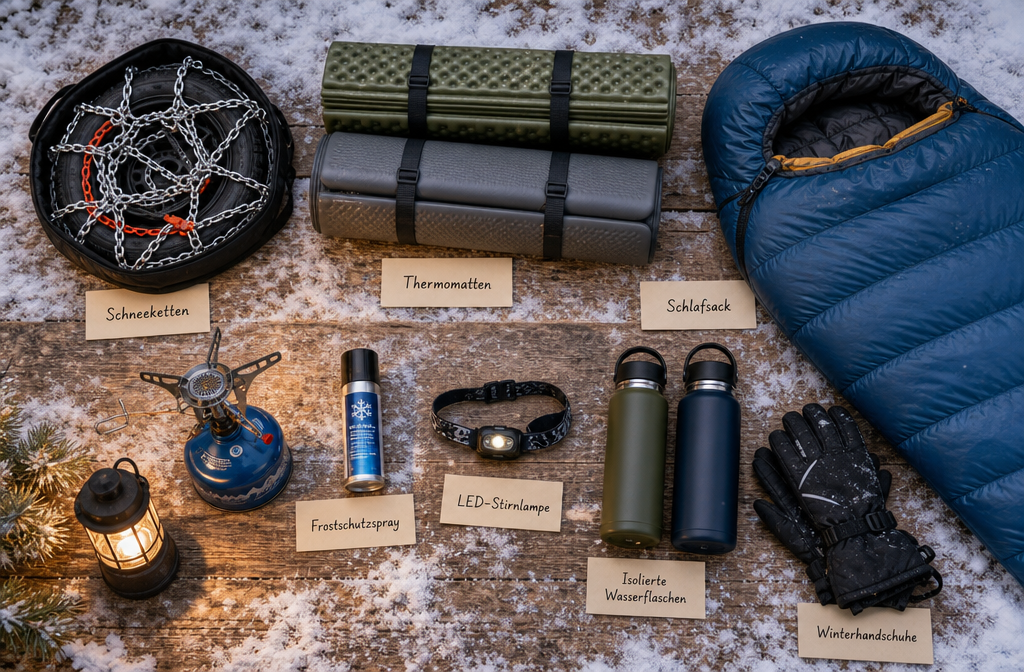
Besides the winter-ready vehicle itself, there are a number of pieces of equipment that can make the difference between a comfortable adventure and a crisis vacation.
Mandatory equipment:
- Snow chains (suitable for the tire size of the rental vehicle)
- Snow shovel (compact, for storage)
- Ice scraper and windshield de-icer
- Jump leads or power bank for vehicle batteries
- Antifreeze for windshield washer fluid (-30 °C quality)
Comfort equipment:
- Thermal curtains or thermal mats for windows (significantly reduce heat loss)
- Sleeping bags for -10 °C as backup
- Insulated water bottles and thermoses
- Compact power station for extra energy (e.g. for laptops, cell phones)
Especially for skiers:
- Ski boot dryer (12V operation)
- Ski holder for external mounting or roof rack
- Change of clothes in waterproof packing sacks
If you want to know more about mobile power supply, you can find one on the Campcruisers blog. Detailed article about the Jackery Explorer 500 V2 — a compact solution for your power needs on the go.
How much does winterizing an RV cost?
Those who buy or rent winter equipment themselves must expect additional costs of roughly €100–400, depending on what is already included in the vehicle. Many rental companies offer winter packages that bundle snow chains, thermal mats, and ice scrapers.
Cost estimate (Purchase):
| Equipment | Estimated costs |
|---|---|
| Snow chains | £50–£150 |
| Thermal mats/Thermal curtains | 30–80 € |
| Snow shovel (compact) | 15–30 € |
| Sleeping bag (-10 °C) | 60–150 € |
| Power station (medium-sized) | 200–500 € |
Landlord Winter Package: Often cheaper than buying individually if you only go winter camping once a year. Ask explicitly about it when booking.
What insurance do I need for a winter camping vacation?
For winter camping in a motorhome, you need at least fully comprehensive insurance with a winter clause, breakdown assistance with recovery service in the mountains, and ideally international travel health insurance. Standard insurance policies often do not cover damage caused by snow, ice, or recovery costs.
Insurance Checklist:
- ✅ Comprehensive insurance with deductible: Mandatory, especially on wintry mountain roads
- ✅ Breakdown assistance/breakdown cover with recovery service: Standard roadside assistance often only applies to paved roads.
- ✅ Travel health insurance Especially recommended for skiing (risk of accidents)
- ✅ Travel cancellation insurance: In case snowfall or closures block the route
- ⚠️ Check winter clause. Some rental agreements exclude damages caused by frost or snow if negligence is proven.
Ask the landlord: Is winter operation explicitly allowed in the rental agreement? Which roads and countries are covered? Is there a 24-hour emergency number?
Also the Vehicle weight limits should be kept in mind — winter gear and ski equipment add up quickly.
Are RVs more suitable for families or singles?
Motorhomes for ski vacations are suitable for both groups—the vehicle size is crucial. Singles and couples can manage well with a compact van, while families with children need a semi-integrated or fully integrated model with bunk beds and more storage space.
For families:
- At least 6–7 meters in length for 4 people
- Bunk beds or sufficient sleeping spaces
- Plenty of storage space for ski equipment, wet clothes, and kids' stuff.
- Choose family-friendly pitches with sanitary facilities
For singles/couples:
- A panel van or small semi-integrated motorhome is sufficient.
- Agile on narrow mountain roads and parking lots
- Lower rental prices, lower fuel consumption
Decision rule: Choose a vehicle with at least 2 square meters of living space per person. For families with children under 10 years old: bunk beds and a separate seating area are not a luxury, but a necessity for a relaxed trip.
FAQ: Winterproof Motorhomes for Ski Holidays
Can I drive into the Alps with any rental campervan?
No. Many rental agreements exclude mountain roads or winter operation. Always check the contract and explicitly ask for winter approval.
Do I need a special driver's license for large winter RVs?
Vehicles up to 4.25 tons can be driven in the EU with a class B driving license from 2026. Heavier vehicles require class BE or C.
How cold can it get in a winterized RV at night?
With the auxiliary heater running, the interior temperature remains easily at 18–22 °C even when it's -20 °C outside. Without the heater, it quickly drops to the outside temperature.
Are snow chains included with the rental RV?
Not automatic. Some landlords offer it as part of a winter package, others charge extra. Always clarify in advance.
What happens when the heater fails in the RV?
Contact the landlord immediately (24-hour emergency number!), take the vehicle to a heated hall, and drain the water pipes to prevent frost damage.
Am I allowed to drive a rented RV on snow?
Yes, if the vehicle has winter tires and the rental agreement allows winter operation. Snow chains are mandatory for certain road signs.
How much gas does a campervan heater consume per night?
A Truma Combi heater consumes approximately 200–400 g of gas per hour in continuous operation (estimate depending on setting and outside temperature). An 11 kg bottle will therefore last roughly 2–4 nights at full load.
Can I stay overnight at normal campsites in winter?
Many campsites are closed in winter. Specifically search for special winter pitches in ski areas or year-round open sites and book in advance.
Is winter camping with children safe?
Yes, with the right vehicle and equipment. Important: never leave children alone in the vehicle, operate the heater correctly, and have an emergency plan.
How do I find winter-proof rental campervans?
On Campcruisers.com you can specifically search for vehicles with winter equipment from professional rental partners and book directly.
Conclusion: How to make your ski vacation in a winter-proof motorhome a success
Winter-proof campervans: What to look for when renting for a ski holiday — this can be broken down into three key points: choosing the right vehicle, bringing the right equipment, and reading the rental agreement carefully.
Whoever does this homework gets a ski vacation that stands out from any hotel stay: fresh snowy mountains right outside the door in the morning, cozy cooking in your own kitchen in the evening, and all without booking deadlines for the ski course or overcrowded hotel restaurants.
Your next steps:
- Book your vehicle early. — winter-proof models are rare, especially during the Christmas and Carnival season
- Request winter package — Confirm snow chains, thermal mats and winter tires
- Checking insurances — Ensure comprehensive insurance with winter coverage and breakdown assistance with recovery service
- Pre-book pitches — good winter pitches in ski areas are booked up quickly
- Check off the equipment list — Snow shovel, ice scraper, backup sleeping bags, power station
Ready for the slopes? On Campcruisers.com find winter-suitable RVs from professional rental companies — simply enter travel dates, compare, and Rent a campervanThe snow isn't waiting. ❄️🚐
Quellen
- Federal Motor Transport Authority (KBA): Registration Statistics Motorhomes, 2024, https://www.kba.de
- ADAC: Winter Camping Tips and Vehicle Technology, 2023 https://www.adac.de
- Truma Gerätetechnik GmbH: Product Information Combi Heater, 2024, https://www.truma.com
- Webasto Group: Auxiliary Heaters for Motorhomes, 2024, https://www.webasto.com
- European Commission: Driving Licence Directive 2026, https://transport.ec.europa.eu
Tags: Winter camping, winter-proof motorhome, rent a motorhome, ski vacation camper, motorhome ski vacation, motorhome heater, winter camping equipment, rent a camper in winter, motorhome snow chains, winter travel motorhome, camper ski area, motorhome Alps


 English
  German
  Spanish
  Italian
  Polish
  Dutch
Dutch  French
  Danish