
Last updated: May 24, 2026
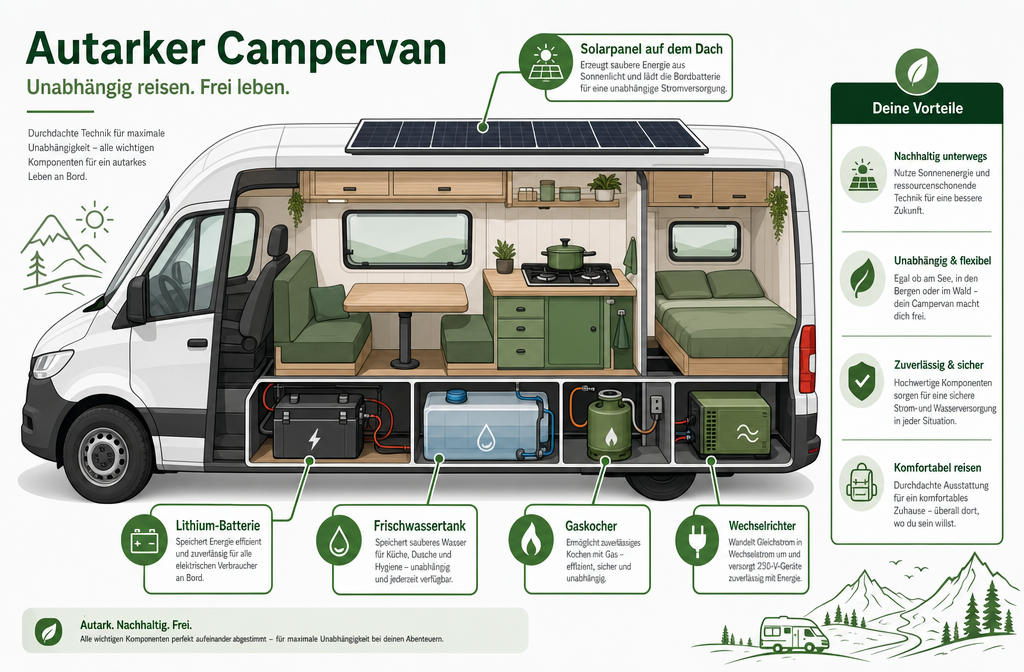
Quick Answer: Being self-sufficient means that you can travel with your camper completely independently of campsite infrastructure — no electricity connection, no fresh water tap, no sewage drain. For this, your rental camper needs at least a sufficiently dimensioned secondary battery (preferably lithium), a solar panel, a sufficiently large fresh water tank, and a gas supply for cooking and heating. If you pay attention to these features when renting, you can spontaneously stay in nature — without booking, without neighbors, without compromises.
Key Takeaways
- Off-grid Camping means complete independence from external infrastructure (electricity, water, disposal).
- Eine Lithium battery (100–200 Ah) is the most important single factor for comfortable off-grid living.
- Solar panels (100–200 watts) is sufficient for most summer trips; in winter, a shore power backup is advisable.
- A Fresh water tank From 80 liters, it allows 2–3 days of independence for two people.
- At the Rental Camper It's worth taking a close look at the equipment list — not every camper is designed for off-grid camping.
- Legal Applies: Wild camping is generally prohibited in Germany and many EU countries, with exceptions in Scandinavia and on private property with permission.
- Beginners often underestimate the Power consumption From refrigerators to heating systems - these are the biggest energy consumers.
- A Rental camper with self-sufficient equipment typically costs 10–30% more per day than a basic model, but is worth the price.
What does it actually mean to be self-sufficient when camping?
Being self-sufficient when camping means that you can manage completely without external supply connections with your motorhome or campervan. No electrical hook-up (EHU), no fresh water tap from the campsite, no on-site waste water disposal – you are your own little power plant.
The concept can be divided into three levels:
- Energy autarky: Power from solar panels, battery or generator
- Water autarky: Own fresh water tank + grey water tank
- Disposal Autonomy: Chemical toilet or cassette toilet, grey water disposal at service stations
"Being self-sufficient" isn't an all-or-nothing concept. Many campers are 80% self-sufficient and only use service stations to refill water or dispose of waste—that's enough for real freedom on the road.
Who is off-grid camping suitable for? For anyone who wants to stay spontaneous, avoid crowds, or head to remote natural destinations. For families with small children or first-time campers, a campsite with infrastructure can be more comfortable at first.
How much electricity do you really need for a self-sufficient camper?
The average daily consumption of a well-equipped campervan is between 50 and 150 Wh, depending on the season and use. The refrigerator is often the biggest consumer.
Here is a realistic overview of consumption:
| Device | Consumption (approx.) | Hours/Day | Daily consumption |
|---|---|---|---|
| Compressor refrigerator | 30–50 W | 24 h (cyclic operation) | 30–60 Wh |
| LED lighting | 5–15 W | 4 h | 20–60 Wh |
| Diesel heater (blower) | 10–30 W | 8 h | 80–240 Wh |
| Charge smartphone | 5–10 W | 2 h | 10–20 Wh |
| Laptop | 30–65 W | 2 h | 60–130 Wh |
| Coffee maker (12V) | 120–180 W | 0.25 h | 30–45 Wh |
Realistic daily budget for two people: 150–350 Wh — without air conditioning or a kettle (these are hardly practical for self-sufficient setups).
Typical beginner mistake: Running the diesel heater at night, without knowing that the blower alone significantly drains the battery overnight. Those who factor this in will choose a camper with at least 100 Ah lithium capacity when renting.
Which battery is best for mobile power supply in a motorhome?
For self-sufficient camping, a Lithium iron phosphate battery (LiFePO4) The best choice. It offers more usable capacity, a longer lifespan, and lower weight than traditional AGM or Gel batteries.
Comparison of common battery types:
| Battery type | Usable capacity | Lifespan (cycles) | Weight (100 Ah) | Price |
|---|---|---|---|---|
| AGM | ~50 % | 300–500 | ~28 kg | inexpensive |
| Gel | ~50–60% | 500–700 | ~28 kg | medium |
| LiFePO4 | ~80–90% | 2,000–5,000 | ~12 kg | high |
Rule of thumb for renting: Pay attention to at least 100 Ah LiFePO4 for a couple 200 Ah if you want to be completely self-sufficient for longer than 3 days, or if you use a diesel heater intensively.
At the eVentje, the electric camper van, the battery capacity issue is solved completely differently — there, the traction battery also powers the on-board electrics, which redefines the self-sufficient concept.
How much does a complete off-grid camping setup cost?
Anyone booking a rental camper with self-sufficient equipment generally pays a Surcharge of 10–30% per day compared to a base model without a solar panel and lithium battery. For orientation:
Equipment costs at the time of purchase (guidelines for retrofitting):
- Solar panel 200 W incl. charge controller: 200–400 €
- LiFePO4 battery 100 Ah: €300–600
- Inverter 1,000 W: 100–250 €
- Fresh water tank 100 L (installation): €150–400
- Cassette toilet: €80–200
Total costs for a complete off-grid retrofit: Estimated €800–1,800 for a basic setup, excluding installation costs.
When renting, you don't pay for this investment yourself—you simply benefit from the vehicle's features. That's why it's worth it when Rent a campervan to specifically filter for vehicles with solar panels and lithium batteries.
Can you retrofit a rental camper to be self-sufficient?
Short answer: No, you shouldn't do that. Rental vehicles may not be modified without the express permission of the lessor. This applies to permanently installed solar panels, batteries, or water tanks.
What you as a tenant can easily bring with you:
- Portable solar panel (foldable, lays on the roof or on the floor)
- Power station / Power bank (e.g. 500–1,000 Wh capacity)
- Portable Water Canisters (in addition to the built-in tank)
- Camping toilet (if not available)
A portable solar panel with 100–200 W and a power station with 500 Wh is a legitimate and flexible solution for rental campers without a permanently installed solar system. While it won't make you completely self-sufficient, you'll be well-equipped for 1–2 days without a power connection.
Important: Always read the rental conditions before departure and, if in doubt, ask the landlord what is permitted.
What additional equipment do I need for a self-sufficient RV?
Besides batteries and solar power, there are a number of devices that make off-grid living truly comfortable. Here are the most important:
Mandatory equipment:
- Diesel heater (e.g. Webasto or Eberspächer): Independent of gas cylinders, very efficient
- Compressor refrigerator: Significantly more efficient than absorption refrigerators, ideal for self-sufficient operation.
- 12V pump for fresh water: Standard in most campervans
- Greywater tank: At least 30–50 liters so you don't have to go to the disposal station right away
Nice-to-have:
- Inverter (230V output): For laptops, camera batteries, or small household appliances
- External shower: Practical after hikes, saves fresh water indoors
- Solar-powered roof vent: Ventilation without electricity consumption
Anyone who enjoys cooking outdoors will find something in the article about Outdoor kitchen in focus Further practical tips for cooking away from the campsite kitchen.
What legal considerations do I need to keep in mind when living off-grid?
Being self-sufficient and wild camping are two different things - that's the most important legal note. Standing autonomously means technical independence, not the legal freedom to park anywhere.
Legal Situation in Selected Countries (as of 2026):
| Land | Wild camping | Parking freely (in parking lots/on the street) |
|---|---|---|
| Germany | Prohibited (German Federal Nature Conservation Act) | Overnight stays in vehicles permitted, 1–2 nights tolerated |
| Austria | Forbidden | Similar to Germany, regionally different |
| France | Forbidden in nature reserves | Often tolerated in public parking lots |
| Spain | Forbidden in many regions | Regionally very different |
| Sweden/Norway | Allowed (Freedom to roam) | Allowed, with distance regulations to buildings. |
Important rules for Germany:
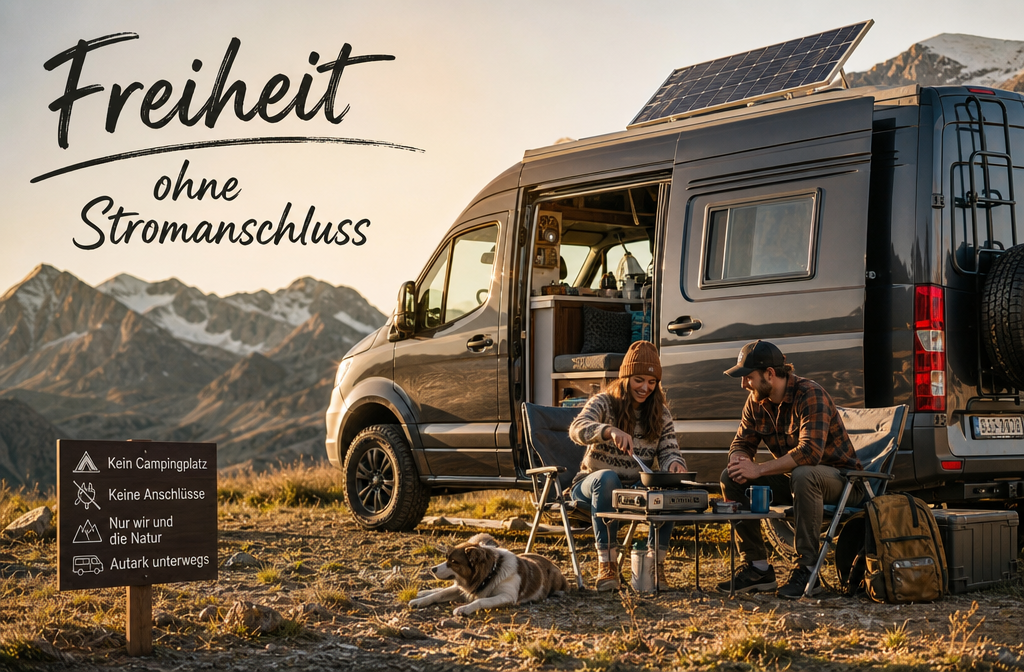
- Setting up camping chairs, tables, or awnings on public property without permission is prohibited.
- Simply sleeping in your vehicle in a legal parking space is not considered wild camping.
- Nature reserves and national parks are generally off-limits.
Anyone wanting to find out about weight regulations and other legal aspects of renting can find information in our article on Motorhomes up to 3.5 tons and fines for overloading further important notes.
How long can you camp self-sufficiently with one battery charge?
With a 100 Ah LiFePO4 Battery and a daily consumption of approx. 150 Wh you get to 4–5 days — assuming you have a solar panel that recharges during the day. Without solar and without recharging via the alternator, that drops to 1-2 days.
Practical example for 2 people, summer:
- Battery: 200 Ah LiFePO4 (usable: ~180 Ah = ~2,160 Wh)
- Daily consumption: ~200 Wh (refrigerator + lights + charging)
- Solar panel: 200 W, delivers approx. 600–900 Wh on a sunny summer day
- Result: Theoretically unlimitedly self-sufficient on sunny days; with cloud cover, 5–7 days buffer
In Winter solar output is at least halved, while heating requirements increase. Anyone traveling self-sufficiently in winter should consider a 200 Ah+ Battery and ideally set a shore power option as a backup.
What mistakes do beginners make when boondocking?
The most common mistakes on your first self-sufficient camping trip are avoidable — if you know them.
Top 5 beginner mistakes:
Underestimating the refrigerator: An absorption refrigerator running on gas is often less efficient in the summer than a 12V compressor refrigerator. If you're traveling self-sufficiently, you should know which type your rental camper has.
Battery deeply discharged. AGM batteries should not be discharged below 50%. Anyone who doesn't know this will destroy the battery after only a few seasons — this is of course not a problem with rental vehicles, but it explains why some rental cars have weaker batteries.
Misallocating fresh water: 80 liters sounds like a lot, but for two people showering, cooking, and washing dishes, it's only enough for 2-3 days. Short showers (Navy Shower) save a lot of water.
Choose a location without sun exposure. The prettiest spot under the trees hardly charges the solar battery. Always pay attention to an unobstructed southerly direction.
No disposal strategy: Gray water and cassette toilets need to be emptied at some point. Anyone who doesn't know where the next disposal station is will quickly have a problem.
Who is self-sufficient camping even worth it for?
Off-grid camping is especially worthwhile for travelers who Flexibility over comfort places and enjoy going off the beaten path. However, it's not for everyone.
Self-sufficient camping is worthwhile if you...
- want to stay spontaneous and not book pitches in advance
- Want to enjoy natural landscapes without campsite neighbors?
- are traveling for longer than 2 weeks and want to save on campsite fees
- travels in Scandinavia or other countries with right to roam
Camping is better when you…
- traveling with a campervan for the first time
- travels with small children and needs showers, a playground, and electricity
- you are traveling in countries where wild camping is heavily regulated
- Values safety and social interaction with other campers
The Glamping boom and the growing popularity of independent camping shows: More and more travelers want both — comfort and freedom. Self-sufficient equipment is the key to this.
What are typical problems when living off-grid, and how do you solve them?
Even with good equipment, there are situations that can become a problem when boondocking. Here are the most common and their solutions:
Problem: Battery dead, no sunshine
→ Solution: Driving for 30–60 minutes recharges the battery via the alternator. Alternatively: Take a power station as backup.
Problem: Fresh water empty, no disposal station nearby
→ Solution: Carry a water canister as a reserve (5–10 L is sufficient for an emergency day). Apps like Park4Night or Campercontact show service stations nearby.
Problem: Heating not working
→ Solution: Contact the rental company immediately if you have a problem with your rental camper. Therefore, always have the rental company's emergency number readily available.
Problem: Neighbors or Ordnungsamt (public order office)
→ Solution: Be polite, don't set up any camping furniture, move on after one night. In most cases, there are no problems if you remain discreet.
FAQ: Being self-sufficient with a rental camper
What does "autark" mean exactly when it comes to motorhomes?
A motorhome is self-sufficient if it can function without external power, water, and waste disposal connections — that is, completely independent of campsite infrastructure.
What equipment must a rental camper have for self-sufficient camping?
At a minimum: solar panel, second battery (ideally lithium), fresh water tank from 80 L, gray water tank and gas supply. A diesel heater is a big plus for cooler nights.
Is wild camping legal in Germany?
No. Wild camping is generally prohibited in Germany according to the Federal Nature Conservation Act. However, sleeping in a vehicle in legal parking spaces is permitted and often tolerated for 1-2 nights.
How much more does a rental camper with self-sufficient equipment cost?
Typically 10–30% more per day than a base model. The exact surcharge depends on the vehicle type and provider.
Can I use a portable solar panel in a rental camper?
Yes, as a rule it is — a foldable solar panel that you simply lay down without permanently mounting it is not a problem with most landlords. If in doubt, ask beforehand.
How long does a lithium battery last in a camper?
LiFePO4 batteries last for 2,000–5,000 charge cycles under normal use, which in practice corresponds to 10–15 years.
What is the difference between free-standing and being self-sufficient?
"Wild camping" describes the location (outside of a campsite), while "self-sufficient camping" describes technical independence. You can be self-sufficient at a campsite (without a power connection) or wild camp without being self-sufficient.
Which apps help with finding parking spaces?
Park4Night, Campercontact and iOverlander are the best-known apps for free parking spaces and service stations in Europe.
Do I need a special driver's license to rent a campervan?
That depends on the vehicle weight. Class B is sufficient for vehicles up to 3.5 tons. More about this in our article on new EU driving license regulations for motorhomes.
Is self-sufficient camping possible in winter?
Yes, but more demanding. A powerful diesel heater, a large lithium battery (200 Ah+) and a shore power backup are recommended in winter.
Conclusion: How to find the right self-sufficient rental camper
Being self-sufficient: What equipment your rental camper needs for this – the answer is clearer than many think. Solar panels, lithium batteries, sufficient fresh water, and reliable heating are the four pillars of true independence on the road. If you specifically look for these features when renting, you gain a freedom that no campsite can offer: staying spontaneous, having the most beautiful spots all to yourself, and waking up in the morning where others only dream of being.
Your next steps:
- Check equipment list: When renting, explicitly ask about solar panel output, battery type, and tank size.
- Consider destination and time of year: Scandinavia in summer? Self-sufficiently a piece of cake. Alps in November? Plan for a larger battery and heating.
- Research the legal situation in the destination country. Park4Night and local camping forums are good sources.
- Take portable backup with you: A small power station gives you security in case the built-in system falters.
Ready for your self-sufficient adventure? Let's go Campcruisers.com find rental campers from professional renters worldwide — simply filter by features and you're ready to go! 🚐☀️
Quellen
- Federal Ministry for the Environment, Nature Conservation and Nuclear Safety: Federal Nature Conservation Act (BNatSchG), current version
- ADAC: Campervan & Camping Guide, Power Supply in the Campervan, 2023
- Stiftung Warentest: Leisure Batteries for Motorhomes in Comparison, 2022
Tags: stand alone, rent a motorhome, rent a camper, self-sufficient camping, solar panel motorhome, lithium battery camper, off-grid motorhome, wild camping Germany, self-sufficient equipment, rental camper equipment, fresh water tank motorhome, camping power supply


 English
  German
  Spanish
  Italian
  Polish
  Dutch
Dutch  French
  Danish